music theory iv midterm
 Call Kai
 Learn
Learn Practice Test
 Spaced Repetition
 Match
Match Flashcards
 Knowt Play
1/18

There's no tags or description
Looks like no tags are added yet.
Name | Mastery | Learn | Test | Matching | Spaced | Call with Kai |
|---|
No analytics yet
Send a link to your students to track their progress
19 Terms
pitch collection
group of pitch classes without any specific ordering
scale / mode
specific ordering of a collection that emphasizes a tonal center
quartal chord
chords created through intervals fourths apart
eg. Eb. Ab, Db is notated as 3 × 4 on Eb
n x 4 on y
tall tertian
chords with thirds beyond 7ths, including a 9th, 11th, 13th
split chord
two pitch classes that are a semitone apart
eg. C E G Eb is notated by C(3!)
C E G Gb is notated by C(5!)
polychords
combines two triads that don’t belong to the same key
eg. William Grant Still, Poeme
tall tertian chord is a kind of polychord
t/f
false
Harmonic profiles of whole tone vs octatonic
Whole tone = major thirds, major seconds, two aug triads a WT apart, incomplete V7s
Octatonic = Lots of triads! Two 07s a semitone apart
Pentatonic major vs minor
major = do re mi so la
any five pitches circled on the circle of fourths create major pentatonic
minor = do me fa so te
quartal chords associated with pentatonic
hexatonic blues
minor: do me fa fi so te
major: do re ri/me mi so la
how to identify mode
find the key signature, use the mnemonic “i dont play lydian music after lunch” to find the starting pitch name
c ionian = c major, first note
3 flats, starting G = E flat major, third note = G Phrygian
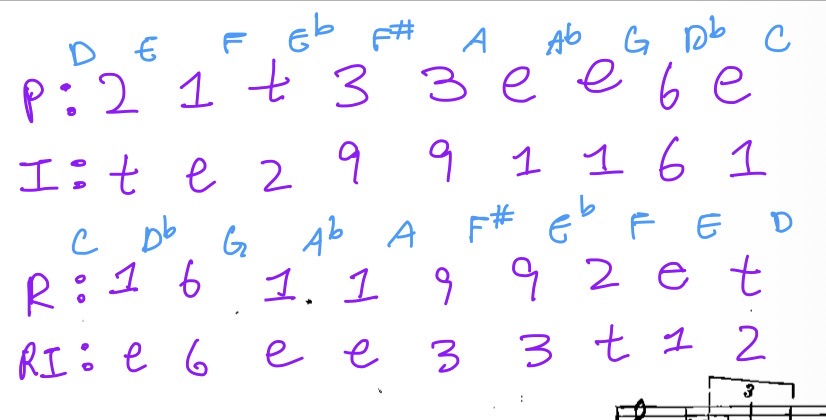
how to fill matrix for serialism
identify all the pitch class intervals (clockwise) for the PRIME form, then the INVERSION, then RETROGRADE and RETROGRADE inversion
prime, inversion, retrograde and retrograde inversion
prime is the pitch class intervals of the original row
inversion is the same intervals but in the opposite direction (complimentary = 12 for pitch class intervals)
retrograde is always read BACKWARDS (make sure u notated with the prime / inverted in brackets)
characteristics of minimalist music
repetition
gradual changes
simple pitch classes
diatonic, better on the ears
claude debussy, voiles
layering
whole-tone-0, Gb pentatonic for B section, whole-tone for the end
ABA’
william grant still, poème
begins with D tonality, modulates to B minor, returns to D
moves into Oct (0,1) in the middle of
features polychord
steve reich, violin phase
phase shifting, instruments playing same pitches and rhythms at different speeds
pattern is diatonic or interpreted as quartal
pattern is 12 eights long, the pattern shifts by one eighth
meta music is music resulting from layering
julius eastman, gay guerrila
Organic music is a compositional technique where the subsequent bars are built out of material that has come right before it
arvo pärt, cantus in memory of benjamin britten
every part moves twice as slow (augmented rhythm)
tintinnabulation = melody moves by step, T voice plays pitches of a diatonic triad
eg. M = A aelioan, T = A minor