psych mindtap personality, social psychology, psychological disorders
 Call Kai
 Learn
Learn Practice Test
 Spaced Repetition
 Match
Match Flashcards
 Knowt Play
1/104

There's no tags or description
Looks like no tags are added yet.
Name | Mastery | Learn | Test | Matching | Spaced | Call with Kai |
|---|
No analytics yet
Send a link to your students to track their progress
105 Terms
Idiographic approaches
A qualitative approach to studying personality that emphasizes the uniqueness of each individual.
Nomothetic approaches
A quantitative approach to studying personality that focuses on common traits or dimensions that apply to all people.
Projective measures
having someone tell an ambiguous story about an image or story → e.g. Rorschach inkblot, TAT
- idea is that person is going to PROJECT their own personality, desires, goals onto story/image
Delay of gratification
declining a pleasant activity now in order to get greater pleasure later
- marshmallow test
social psych: Conformity
matching behaviour and appearance to perceived social norms
Door-in-the-face
people are more likely to agree to a small request after they have refused a large request
- A persuasive technique in which compliance with a target request is preceded by a large, unreasonable request.
Situational attributions
A judgment assigning the cause of a person's behaviour to the environment.
Fundamental attribution error
tendency to attribute behaviour to INTERNAL causes without regard to situational influences
attitude
positive or negative perception of people, objects, or issues
Objective measures
fill out the survey → e.g. self-reports, informant ratings (getting someone who knows you well to fill out the survey about you as well)
- FLAWS: people might lie, be ignorant or have a different idealized version of themselves
- They have systems to try and ensure more accuracy (e.g information ratings)
Psychodynamic theory
A theory put forward by Sigmund Freud in which psychic energy moves among the compartments of the personality: id, ego, and superego.
Ego
The component of Sigmund Freud's personality theory that is the self that others see.
Id
The component of Sigmund Freud's personality theory containing primitive drives present at birth.
Superego
The component of Sigmund Freud's personality theory that internalizes society's rules for right and wrong, or the conscience.
Defence mechanisms
In Sigmund Freud's personality theory, a protective behaviour that reduces anxiety.
Humanistic approaches
PERSONAL EXPERIENCE and belief systems
- ppl seek personal growth to fulfill their potential
- SELF- ACTUALIZATION (Maslow)
- more OPTIMISTIC APPROACH
- when things go right instead of wrong
Self-actualization
A state of having fulfilled your potential.
Person-centered (therapy)
A humanistic therapy approach developed by Carl Rogers to help clients achieve congruence, or an alignment of the real and ideal selves.
Unconditional positive regard
according to Rogers, an attitude of total acceptance toward another person
Self-concept
People's description of their own characteristics.
Self-esteem
A judgment of the value of the self.
Interdependent self-construal
focuses on your connection with others (less likely to be unique to you)
Independent self-construal
Your uniqueness ← not linked to a particular situation
Reciprocal determinism
A social-cognitive learning theory of personality that features the mutual influence of the person and that of the situation on each other.
Self-efficacy
belief in being able to perform in a particular area
ex. belief someone can do rlly well in a hard math class/low self-efficacy in auditioning for school play
Self-handicapping
the strategy whereby people create obstacles and excuses for themselves so that if they do poorly on a task, they can avoid blaming themselves
Self-regulation
the process by which people alter or change their behaviour to attain personal goals
Self-control
a process of self-regulation in contexts involving a clear trade-off between long-term goals and short-term temptations
Locus of control
A cognitive expectancy featured in social-cognitive learning theories of personality about the source of individual outcomes; an external locus of control sees outcomes as resulting from luck or chance, while an internal locus of control sees outcomes as the result of individual effort.
Personality trait
A characteristic; a dispositional tendency to act in a certain way over time and across circumstances
Personality type
A classification based on particular configurations of personality traits or other characteristics.
The Big Five
A trait theory that identifies five main characteristics that account for most individual differences in personality.
openness,
conscientiousness,
extraversion,
agreeableness,
neuroticism
Social norms
rules that define acceptable and expected behaviours for members of a group
Descriptive social norms
What people ACTUALLY think, feel, or do
Prescriptive social norms
What people SHOULD think, feel, or do
Informational influence
A group has informational influence if we adopt the group consensus because it SEEMS CORRECT
- cover your sneeze with ur arm so u dont spread germs
Normative influence
A group has normative influence if we adopt the group consensus to show identification with the group
- dont wanna be excluded from grp, show ur a good member by covering ur sneeze with ur arm
Compliance
Agreement with a request from a person with NO perceived authority.
Foot-in-the-door
the tendency for people who have first agreed to a small request to comply later with a larger request
- A persuasive technique in which compliance with a small request is followed by compliance with a larger request that might otherwise have been rejected.
Low-balling
Making further requests of a person who has already committed to a course of action.
Obedience to authority
compliance with a request from an authority figure
Halo effect
occurs when our positive impressions of people, brands, and products in one area lead us to have positive feelings in another area.
Thin slices of behaviour
brief, 1-5 minute samples of audio or video used in psychology to make quick, often accurate judgments about a person's traits, states, or social interactions.
Attributions
act of assigning cause to behaviour issues
Dispositional attributions
A judgment assigning the cause of a person's behaviour to personal qualities or characteristics.
Correspondence bias
The tendency to view behaviour as the result of disposition, even when the behaviour can be explained by the situation in which it occurs.
Actor-observer bias
Emphasizing dispositional attributions to explain the behaviour of others while emphasizing situational attributions to explain our own behaviour.
Self-serving bias
Attributing success to dispositional factors while attributing failure to situational factors.
Stereotypes
false assumption about what characteristics all members of some group share
Prejudice
positive or negative attitude toward an entire group of people
Discrimination
unfair actions based on stereotyping and prejudice
Bystander effect
The study of situational variables related to helping a stranger, most notably the decreased likelihood of helping as the number of bystanders increases.
- more bystanders less likely to help
Diffusion of responsibility
reduction in sense of responsibility often felt by individuals in a group; may be responsible for the bystander effect
- feel less responsible for smth bc there are others to help them
Audience inhibition/evaluation apprehension
ppl are going to judge me for helping
they will think im overreacting
Groupthink
flawed decision-making in which a collection of individuals favours conformity over critical analysis
Social facilitation
tendency to perform better in the presence of others
social loafing
exerting less effort when performing a specific task with a group than when alone
Deindividuation
Immersion of an individual within a group, leading to anonymity.
aggression
physical or verbal behaviour intended to hurt someone
cognitive dissonance
psychological state of having related ideas or perceptions that are inconsistent
social psychology
study of how individuals think and behave in social situations
Psychological disorders
clinically significant disorder in an individual's cognition, emotion regulation, or behaviour dysfunction in the psychological, biological, or developmental processes underlying mental functioning
- was known as ABNORMAL PSYCH
Biopsychosocial model
A model that sees health as the result of biological, psychological, and social factors.
Evidence-based practice
combines the personal experience of the clinician, the best scientific evidence, and a consideration of patient values and expectations to tailor scientifically valid treatments of the individual
Comorbidity
Two or more disorders in the same individual.
Abnormal behaviour
actions, thoughts, or emotions that are atypical, maladaptive, distressing, or socially unacceptable, often indicating a potential mental health condition
Diathesis-stress model
A model that suggests that the experience of stress interacts with an individual's pre-existing vulnerability to produce a psychological disorder.
Psychoanalytic/psychodynamic therapy
Sigmund Freud's treatment approach based on his psychodynamic theory.
Focus on bringing unconscious struggles into consciousness (free association, dream analysis)
Insight: Increase patient's understanding of their own psychological processes
Person/Client-centered therapy
A humanistic therapy approach developed by Carl Rogers to help clients achieve congruence, or an alignment of the real and ideal selves.
Cognitive behavioural therapy
A combination of cognitive restructuring with behavioural treatments that has been shown to be effective in reducing symptoms of many psychological disorders.
Psychotropic medication/pharmacotherapy
Psychotropic medication: Drugs that affect mental processes
Any drug with the capability of altering a person's state of consciousness.
Neurodevelopmental disorders
conditions arising from impaired central nervous system development, impacting brain function, learning, behavior, and emotion
Autism spectrum disorder (ASD)
A disorder characterized by deficits in social relatedness and communication skills that are often accompanied by repetitive, ritualistic behaviour.
Attention deficit hyperactivity disorder (ADHD)
A disorder characterized by either unusual inattentiveness, hyperactivity with impulsivity, or both.
Schizophrenia (spectrum and other psychotic disorders)
severe disorder characterized by disturbance in thought, perceptions, emotions and behaviour
Positive symptoms
EXCESSES IN BEHAVIOUR
- delusions
- hallucinations
- disorganized speech
- disorganized behaviour
Negative symptoms
Deficits in functioning including:
Isolation, withdrawal
Apathy
Blunted emotion
Slowed, monotonous speech
- Generally more difficult to treat than positive symptoms; different underlying causes
- must have at least ONE POSITIVE SYMPTOM
Mood disorders
a PROLONGED, pervasive emotional disturbance
depressive disorders
emotional disorders primarily involving sadness, despondency, and depression
Major depressive disorder
affective disorder in which a person feels sad and hopeless for weeks or months
Depressive attributional style
attribute failures to internal, global, stable causes
learned helplessness
the belief that one cannot control the outcome of events
Cognitive triad
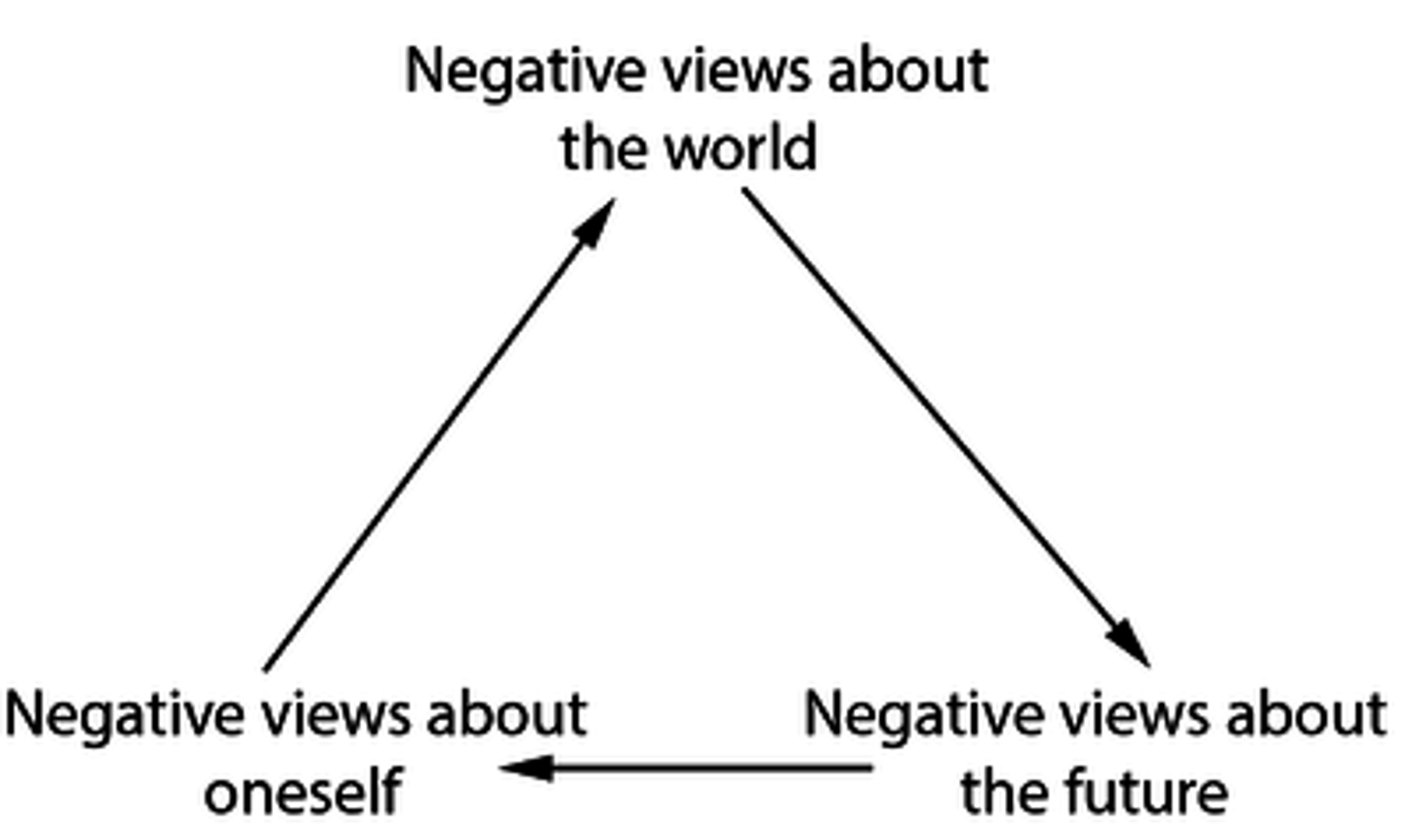
The three forms of negative thinking that Aaron Beck theorizes lead people to feel depressed. The triad consists of a negative view of one's experiences, oneself, and the future.
Bipolar disorder
A mood disorder characterized by alternating periods of mania and depression.
Mania/manic episode
period of abnormally excessive energy and elation
electroconvulsive therapy (ECT)
A biological treatment in which seizures are induced in an anaesthetized patient; it is used primarily in the treatment of mood disorders that have not responded to medication or other treatments.
Deep brain stimulation
Electrical stimulation applied through surgically implanted electrodes that is used to treat some anxiety and mood disorders.
Anxiety disorders
A class of disorders marked by feelings of excessive apprehension and worry.
Generalized anxiety disorder
psychological disorder characterized by nearly constant, exaggerated worries
Specific phobias
persistent fear of a specific object or situation
Panic disorder
recurrent unexpected panic attacks
Agoraphobia
excessive, irrational fear of being in public places
Social anxiety disorder
an intense, persistent fear of being watched, judged, or embarrassed by others in social situations
Obsessive compulsive disorder
An anxiety disorder involving repetitive thoughts and urges to perform certain rituals.
Obsessions
recurrent, intrusive, and unwanted thoughts or ideas or mental images; often include fear of contamination, of accidents, or of one's own aggression
THOUGHTS
Compulsions
particular acts that one feels driven to perform over and over again; often include cleaning, checking, and counting
ACTIONS
antisocial personality disorder
unusual remorselessness, lack of empathy, or disregard for social conventions
delusion
strongly held thought or belief that is at odds with reality
dissociative disorders
a class of psychological disorders involving changes in consciousness, memory, or self-identity
dissociative identity disorder
Presence of two or more distinct identities (multiple personality)