Cell Bio Lab Exam II
 Call Kai
 Learn
Learn Practice Test
 Spaced Repetition
 Match
Match Flashcards
 Knowt Play
1/64

There's no tags or description
Looks like no tags are added yet.
Name | Mastery | Learn | Test | Matching | Spaced | Call with Kai |
|---|
No analytics yet
Send a link to your students to track their progress
65 Terms
Electrophoresis
Is a method whereby charged molecules in solution, chiefly proteins and nucleic acids, migrate in response to an electric field
1- Strength of the field
2- Net charge, and size of the molecules
3- Shape of the molecules, and ionic strength
4- Viscosity, and temperature of the medium in which the molecules are moving
What does the electrophoresis migration rate through the electrical field depend on?
HINT: there are four things
In most electrophoresis units, the gel is mounted between two buffer chambers containing separate electrodes so that the only electrical connection between the two chambers is through the gel.
What is electrophoresis?
What are the types of electrophoresis?
Paper – small molecules and amino acids
Polyacrylamide gel – proteins and nucleic acids
Agarose gel – very large proteins and nucleic acids • Starch gel – proteins and nucleic acids
Gel electrophoresis can be divided into two categories:
HINT: there are two dimensions; one contains three and the other contains one
One dimension
• SDS-PAGE
• Native-PAGE
• Isoelectric Focusing (IEF)
2. Two dimensions
• 2D-PAGE
Native gel electrophoresis
separation is based on size, charge, and shape
Isoelectric focusing electrophoresis
separation is based on isoelectric point
SDS-PAGE electrophoresis
separation is based on size
2 dimensional gel
based on two separations
first separation is based on isoelectric point and second separation is based on size through SDS page
What is the gel matrix composed of?
agarose or polyacrylamide
Is a cross-linked polymer of acrylamide
polyacrylamide
Acrylamide
is a potent neurotoxin and should be handled with care!
Lab procedure for lab 5
1. Set the precast gel based on the video. https://www.youtube.com/watch?v=XnEdmk1Sqvg
2. Mix 5uL protein sample with 5uL loading buffer.
3. Heat the sample at 95oC-100oC for 5min, then load into the well.
4. Run the gel at 150V until the front dye reach the bottom.
5. Stain the gel with 100mL Coomassie stain solution.
6. Destain the gel with 100mL destain solution.
Electrophoresis
A separation technique that exploits the differential migration of molecules in an electrical field depending upon their size and charge
Variables that are exploited in the electrophoresis are:
polarity
voltage
length of application
current
What is the cross-linking agent we used in lab 5 ?
N,N methylene bis acrylamide
The pore size determines what in lab 5?
rate of migration
The pore size decreases with increased what ?
Increased T
The gelling process requires what two things ?
what two things do we use for lab 5?
initiator and catalyst
initiator is ammonium persulfate
catalyst is TEMED
The top of the electrode is positive or negative ?
Negative cathode
The bottom of the electrode is positive or negative?
Positive cathode (anode)
What stays constant in lab 5?
what is our main concerns when running gels?
current
voltage
power constant
heat build-up and its effects on the proteins
Polyacrylamide gels
Have smaller pores than agarose, therefore high degree of resolving power.
Can separate DNA fragments which range in size from 10- 500 bp.
DNA fragments that differ in size by one nucleotide can be separated from each other.
Polyacrylamide gel electrophoresis is also used to separate protein molecules.
Protein electrophoresis
Separate proteins based on
Size (Molecular Weight - MW)
Allows us to • characterize • quantify • determine the purity of the sample • compare proteins from different sources •And it is a step in Western blot
SDS page
The purpose of this method is to separate proteins according to their size, and no other physical feature
The end result of an SDS has two important features: what are they?
All proteins contain only primary structure
All proteins have a large negative charge which means they will all migrate towards the positive pole when placed in an electric field
______________ is the most frequently used cross-linking agent for polyacrylamide gels
Bisacrylamide
Smaller proteins will move through the gel _________ while larger proteins move at a ____________ pace
Faster; Slower
________ are ionic substances that become partially _________ in water dissociated
Buffers; dissociated
What pH level are the following tanks and buffers?
tank buffer
stacking gel
separation gel
8.30
6.90
8.48
SDS PAGE: separates proteins primarily based on their molecular weight
In lab 5 which protein electrophoresis did we complete ?
The further down a gel protein has gone the smaller the __________ __________ is
molecular weight
How to calculate %T
%T = total percentage of acrylamide (monomer) and bisacrylamide (cross-linker) per 100 ml of solution.
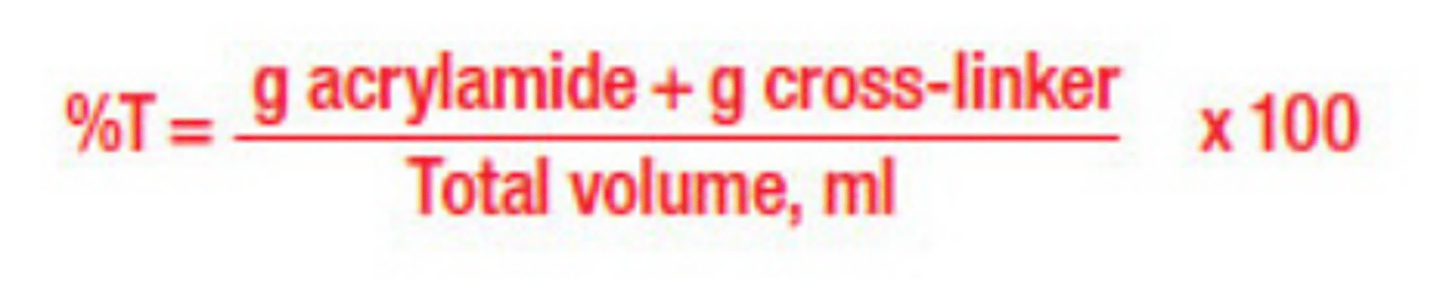
Found at the top of the gel and contains the wells. - Has lower %T (larger pore size), lower pH. - All of the protein samples line up and enter the separating gel at exactly the same time.
stacking gel
Separating gel
Has higher %T (smaller pore size), higher pH. - Proteins will separate based on size.
loading buffers
Tris-HCl,
SDS,
glycerol,
beta-mercaptoethanol,
bromophenol blue.
running buffers
Tris
glycine
SDS pH 8.3
DNA extraction id divided into six steps:
tissue homogenization
plant cell lysis in DNA extraction buffer
separation of DNA from other cellular components
DNA precipitation
DNA washing
DNA resuspension of downstream
Plant cell lysis includes what four things
Tris
EDTA
NaCl
SDS
B mercaptoethanol
what is the neutralization buffer in lab 6?
Bio 101 solution III
Nucleic acids and proteins have an absorbance maxima at ____nm and ____nm, respectively.
Pure DNA will have an A260/A280 ratio of ________-__________.
260-280
1.8-2.0
Lower 260/280 ratios usually indicate that a sample is contaminated by residual phenol, sugar, or the reagents used in the extraction protocol.
True or false
TRUE
Tris contains a mixture of ______ acid and its _______ ________ acid, acts as a buffer and increases permeability of cell wall
weak
conjugate weak acid
EDTA cations such as Mg 2+ and Ca2+ which reduces the _________ ___________- of DNase
enzyme activity
NaCl helps to remove proteins that are bound to the _______
DNA
SDS ___________ proteins which helps ______ ________ ________
linearizes
plant cell lysis
To get quality DNA what should be removed?
phenolics compounds
B mercaptoethanol is a strong _____ agent
reducing
Sodium acetate with isopropanol are used for _______ _________________
DNA precipitation
introns
non coding sequences and od not code for proteins
removed by RNA splicing as mRNA matures
Exons
are coding sequences and code for proteins
Principle of PCR is what three steps?
denaturation
annealing
extension
Agarose gel electrophoresis
is a method used to separate DNA fragments by size in a solid agarose gel which is a common way to check the PCR products
The rate of migration in lab 7 and 8 is proportional to what ?
size
DNA loading dye serves a few purposes:
coloring and to easily track your sample
loading dye is dense and keeps the DNA in your sample from diffusing away in the buffer
After gel electrophoresis, the DNA can be visualized under ______ due to the intercalating dye ethidium bromide or SYBR gold
UV
The PCR nucleotide mix in lab 7 and 8 is what?
dNTPs
The agarose gel electrophoresis has _________ resolving power than SDS page
Lower
The higher the concentration of agarose, the __________ the pore size
Smaller
Factors that affect DNA migration in lab 8 is what ?
agarose concentration
size of DNA molecule
DNA conformation
Applied voltage
In lab 8 what loading dye will we use?
bromophenol blue and sucrose
cDNA no introns is what bp
gDNA with introns is what bp
694
805
RT PCR is _______
PCR product is _________
cDNA
gDNA
Why is the size of the RT-PCR product different from that of the genomic PCR product?
intron exon structure
primer design
polyadenylation
PCR conditions
In PCR, what does annealing temperature depend on? what determines the extension time that should be used during PCR
Primer length and composition
Target DNA
polymerase being use in reaction