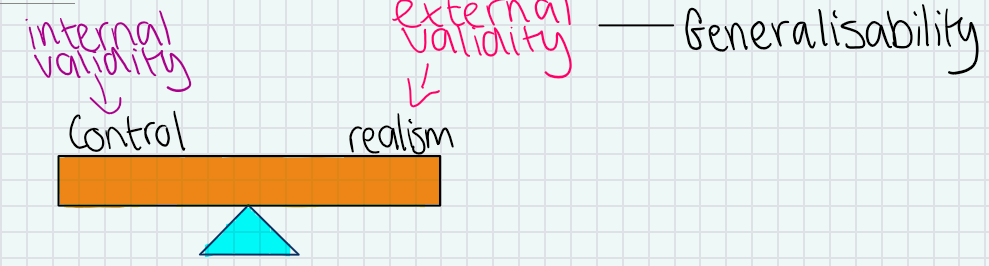
control and realism
 Call Kai
 Learn
Learn Practice Test
 Spaced Repetition
 Match
Match Flashcards
 Knowt Play
1/13

There's no tags or description
Looks like no tags are added yet.
Name | Mastery | Learn | Test | Matching | Spaced | Call with Kai |
|---|
No analytics yet
Send a link to your students to track their progress
14 Terms
control and realism seesaw
standardisation
means all p’s experience identical procedures + materials
all p’s have same experience of being in the study
controls for extraneous variables- can be sure measuring effects of IV on DV
extraneous variables
any variable other than IV which might affect the DV
participant variables= characteristics of individual p’s eg age, gender
situational variables= features of the situation of environment eg time of day, weather
standardised instructions
all p’s given same instructions delivered in the same way
instructions are scripted and either read aloud by same researcher or are read by p’s
control for investigating effects and researcher bias
investigator effects
anything an investigator does (consciously or unconsciously) which has an effect on p’s behaviour within a study
direct=interacting with p
indirect= as a consequence of how study is designed
researcher bias
a type of investigator effect which results in a skew or bias
eg putting all your friends in 1 group
randomisation
refers to the use of chance wherever possible in the deign of a study
eg random generation of word for a word list
randomise the order of words in a words list
random allocation
use of chance to allocate p’s to each pf the conditions
use either lottery method/ random number generator
positives of random allocation
controls for researcher bias/ investigator effects
AND for participant variables
( does not eliminate p variables- just minimises them
control groups
2 (or more) levels/ conditions of the IV
experimental group- change in IV
control group- no change in IV (placebo)— everything the same so have standardised experience except for manipulation (change of IV)
provides baseline for comparison/ analysis- essential in order to draw causal conclusions
demand characteristics
any cue or clue from the researcher or from research situation that may be interpreted by p’s as revealing the purpose of an investigation
this may lead to a P changing their behaviour within the research situation
single blind trial
only p’s are blind to aim
controls demand characteristics
double blind trial
researcher and p’s do not know aim
controls demand characteristics AND investigator effects
pilot studies
a small scale trial run of a study to test analysis of the design
with a view to making improvements, before proper study conducted