Capturing sound
 Call Kai
 Learn
Learn Practice Test
 Spaced Repetition
 Match
Match Flashcards
 Knowt Play
1/96

There's no tags or description
Looks like no tags are added yet.
Name | Mastery | Learn | Test | Matching | Spaced | Call with Kai |
|---|
No analytics yet
Send a link to your students to track their progress
97 Terms
What is a transducer, and give an example
A transducer is a device that converts between different types of energy.
Eg a microphone
What types of energy does a microphone convert?
Sound, and therefore variations in air pressure into electrical energy.
What is the transducer element of a microphone?
It’s capsule.
This is sensitive.
What are the three types of microphones you need to know about in A level music tech?
Dynamic, condenser and ribbon microphones
What are dynamic microphones sometimes also known as?
Moving coil microphones
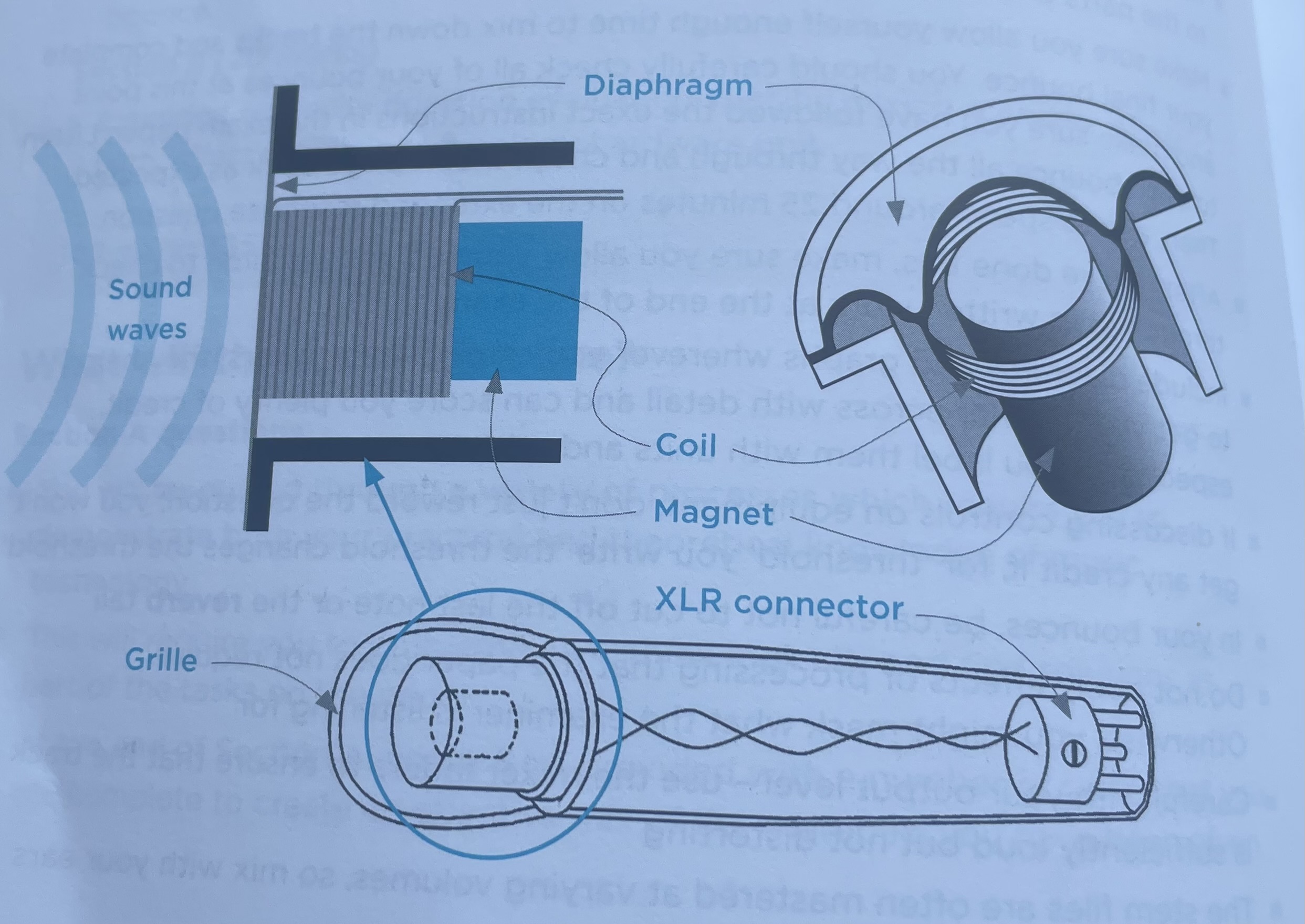
How do dynamic microphones work?
They go through a process called electromagnetic induction -
A movable coil is positioned in a magnetic field, attached to a diaphragm.
When sound enters the microphone, the diaphragm vibrates.
The coil moves in the magnetic field and a varying electrical current is induced that is proportional to the changes in air pressure.
What is a diaphragm?
A thin piece of metal that moves in response to the changes in air pressure
Diagram to show how dynamic mics work
What are the features of dynamic microphones?
Inexpensive
Robust
Good for live use
Doesn’t require phantom power
Can withstand high SPL/volume
Limited HF response, so suitable for bass instruments
What is phantom power?
Voltage (48V) sent down the microphone cable to power the device.
This is used in preamplifiers and condensers, as well as audio interfaces.
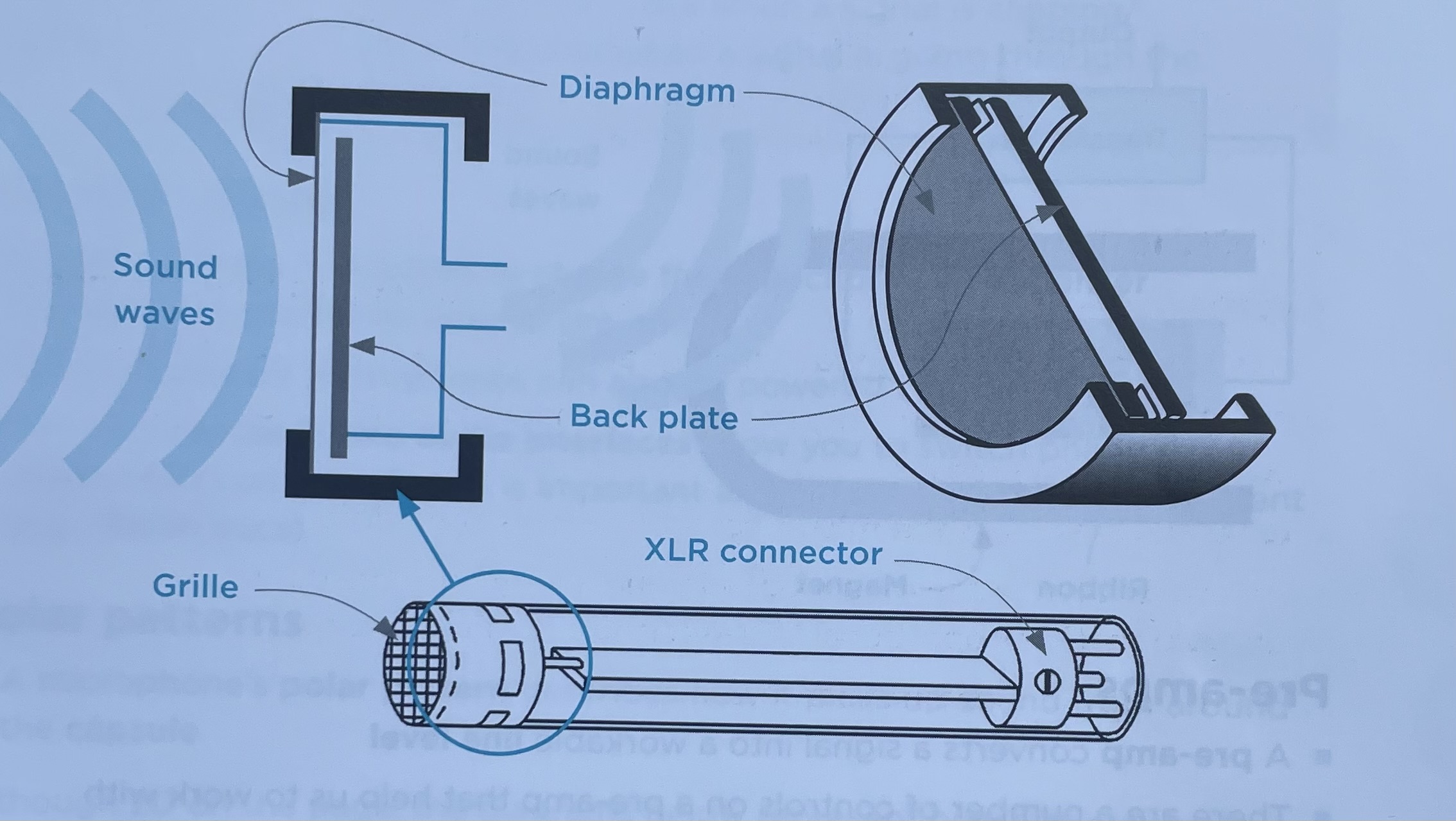
How do condenser microphones work?
They contain a capacitor, which consists of two plates.
Sound causes one of the plates to vibrate, which functions as a diaphragm.
This vibration changes the gap between the two plates.
The capacitor plates are powered. This means that moving the diaphragm causes a change in capacitance and thus a current flows.
Diagram to show how condenser mics work
What are the features of condensers?
They require phantom power
Sensitive, giving an effective capture of quiet sounds
Able to capture a wide frequency range and wide dynamic range
Suitable for most studio work
Able to catch a brighter signal than dynamic mics
Good signal-to-noise ratio, high output volume and thus low noise
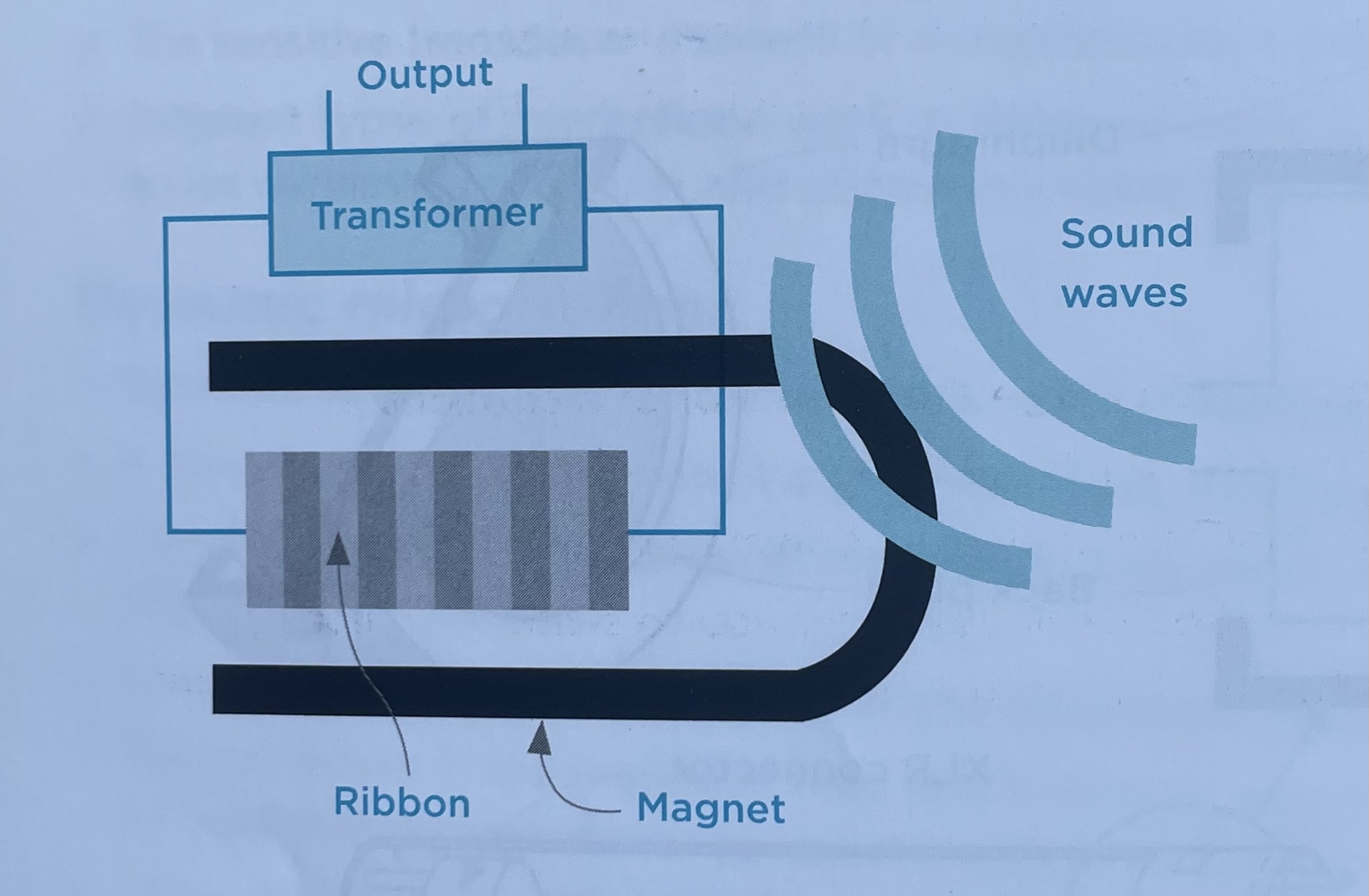
How do ribbon microphones work?
Sound vibrations disturb a metallic ribbon suspended in a magnetic field.
This generates a voltage that is proportional to the movement of the ribbon.
What are the features of ribbon mics?
They are fragile and often very expensive.
They are damaged or broken by phantom power.
They have a ‘warm’ sound when used as a close mic with emphasised lower frequencies.
Diagram of how a ribbon mic works
What is a pre-amp?
It converts a signal into a workable line level.
There are a number of controls on a pre-amp that help us work with mics and recording equipment.
What are the controls you’d often find on a pre-amp? (6)
Phantom power
Gain
Pad
High pass filter
Polarity
Clip/Activity LEDs
Explain Gain on pre-amps
Gain - the amount of audio signal increased by an amplifier. Turning up the gain increases volume.
This is used either to boost signals to an operable level or to boost beyond that point to drive the signal into distortion for musical purposes.
Explain the Pad on pre-amps
This is a switch that attentuates (reduces) the gain by a set amount to prevent clipping.
Clipping - form of waveform distortion that occurs when an amplifier is overdriven and attempts to deliver a current/output voltage beyond its maximum capability.
Explain high pass filter on pre amps
A type of filter that removes only lower frequencies below a set cutoff frequency and allows high frequencies through unaffected.
This is sometimes known as a “rumble filter”
Explain Polarity on pre-amps
Pre amps invert the polarity of the signal.
Explain Clip/Activity LEDs on pre-amps
These illuminate when a signal is clipping/distorting, and when a signal is going through the channel.
What is required to charge the capacitor of a condenser mic, and for its internal pre-amp?
Phantom power
What can some condenser mics also be powered by?
A battery
TECHNOLOGICAL DEVELOPMENT AND IMPACT ON MUSIC OF MICROPHONES: Para 1 - ribbon mics.
One of the earliest high-quality microphone types was the ribbon microphone, developed in the early 20th century.
Ribbon microphones use a thin metal ribbon suspended in a magnetic field to generate a signal.
They are highly sensitive and produce a warm, natural sound with a smooth high-frequency response. This made them particularly suitable for early studio recordings, especially for orchestral and jazz music.
As a result, ribbon microphones contributed to the characteristic warm and balanced tonal quality of mid-20th-century recordings.
However, they were fragile and less practical for loud sound sources, which limited their use in more energetic or amplified musical styles.
Para 2 - dynamic mics
The introduction of the dynamic microphone in the 1930s provided a more robust and versatile solution.
Dynamic microphones operate using electromagnetic induction, making them durable and capable of handling high sound pressure levels.
This allowed them to be used effectively for live performances and loud instruments such as drums and electric guitar amplifiers.
The durability and reliability of dynamic microphones contributed to the rise of live amplified music, particularly in rock and pop genres from the 1960s onwards.
Their ability to withstand high volumes without distortion enabled more aggressive performance styles and louder concerts, which became a defining feature of modern popular music.
Para 3 - condenser mics
The condenser microphone was developed in the 1910s, but became widely used in studios from the 1950s onwards as recording technology improved.
It works by using a capacitor and requires phantom power, making it more sensitive than other microphones.
Because of this high sensitivity, condenser microphones can capture very detailed and clear sounds, especially in the high frequencies. This makes them ideal for recording vocals and acoustic instruments in a studio.
This had a big impact on music because it allowed singers to sound more clear, expressive, and intimate. As a result, it helped shape genres such as:
Pop
Ballads
R&B
where vocals are the main focus.
Final para - general
The availability of different microphone types also enabled more advanced production techniques.
For example, engineers could choose specific microphones based on the desired timbre, allowing for greater creative control over recordings.
The use of condenser microphones for close-miking vocals helped create a more intimate and present sound, while dynamic microphones could be used to isolate louder sources and reduce unwanted bleed. Ribbon microphones, with their smooth response, continued to be valued for capturing natural tones in controlled environments.
Why do mixing desks and audio interfaces allow you to switch phantom power on and off?
This is important as it can damage equipment when being put in or taken out (eg ribbon mics)
What is a microphone’s polar pattern?
This describes how a mic picks up sound from around the capsule.
What are the four types of polar patterns?
Omnidirectional, cardioid, hypercardioid, figure of 8
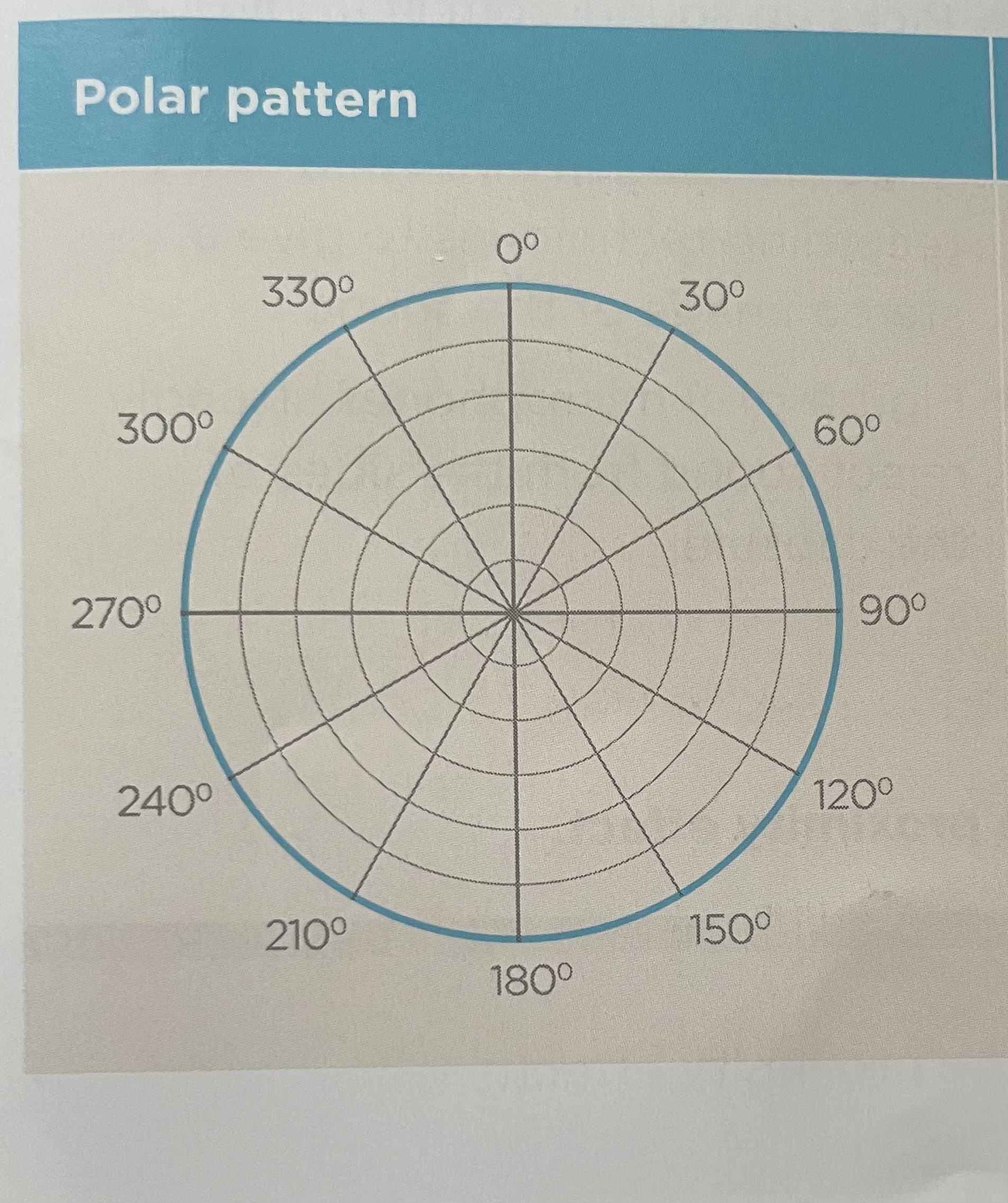
What are the characteristics of an omnidirectional polar pattern?
Picks up sound from all around the capsule
Captures room ambience
Provides little isolation so can lead to spill being captured
Useful if the space sounds nice or if the performers are all around the microphone
Diagram of an omnidirectional polar pattern
What are the characteristics of a cardioid polar pattern?
Rejects sound from behind the microphone
Minimises amount of reverb and noise captured from behind the microphone
Used for close-mic work
Diagram of cardioid polar pattern

What are the characteristics of a hypercardioid polar pattern?
Picks up sound from in front of the capsule and gives some capture from behind.
Provides partial isolation from other instruments but captures some of the ambience from the room.
Diagram of a hypercardioid polar pattern

What are the characteristics of a figure of 8 polar pattern?
Picks up sound from in front of and behind the capsule (like a figure of 8 🤯)
Used in mid-side (?) recording techniques to give a stereo image of the sound
Figure of 8 mics strongly reject sound from the sides of the capsule
Diagram of figure of 8 polar pattern

What do all directional polar patterns exhibit?
The proximity effect (covered later)
How can engineers avoid capturing unwanted background noise and spill?
By ensuring that performers wear closed-back headphones
By keeping the monitor mix relatively quiet in headphones
By using acoustic screens/isolation booths
By making use of overdubbing and directional microphones
What is a microphone’s frequency response?
This tells us the frequencies the mic picks up
This can be seen in a graph
The flatter the graph, the more ‘true’ the sound is
If the graph has any peaks, it means that the frequencies are captured louder than they are in real life.
Example frequency response graph

What is transient response?
How quickly the diaphragm can move when disturbed by a vibration.
What sort of transient response do small diaphragm condenser mics tend to have?
A very fast transient response (the fastest) as they have the lightest and easiest to move diaphragm.
This means that their high frequency response is often better.
What is the transient response of a dynamic microphone?
Not very quickly, slower than condenser mics.
This is particularly true of large diaphragm mics used to record instruments such as kick drums.
The transient response is slow because the diaphragm in a dynamic mic is connected to a heavy coil, making movement slow.
What can dynamic mics therefore introduce?
A form of acoustic compression
What is the best way to consider your gain structure when recording?
Using the dynamic range of audio equipment to its best advantage in order to minimise noise and unwanted distortion.
How can this be done?
By setting appropriate gain levels on each piece of equipment.
Example of inappropriate gain levels on equipment
If the volume on an electric piano is set at a low level and the audio interface gain is turned up to the maximum, you will capture lots of hiss.
If the volume of the electric piano is at its highest level, you risk capturing a distorted signal
Why is it important to record at a good gain level? (2 reasons)
In order to maximise the signal-to-noise ratio, but not sufficiently loud that the signal’s peaks are clipped.
What is the order of gain stages normally?
First gain stage - adjust the instrument itself
Next gain stage - adjust gain on the pre-amp/interface
What does the gain at each stage of recording need to be?
Well above the noise floor (?) but with enough headroom to be comfortably below the point of distortion/clipping
What is signal-to-noise ratio?
How differences in volume between the signal you want to capture and the noise are described in a recording.
A poor signal-to-noise ratio means that noise is more prevalent in a recording
Signal-to-noise ratio graph

How can distortion of quieter parts of the signal be prevented?
By the use of dithering - adds noise at a lower volume than the least significant bit
What does 1 bit correspond to in digital audio?
Roughly 6dB of signal-to noise-ratio.
Eg for CD - 16 bit system - has a maximum of 96dB.
With dithering the useable dynamic range is around 90dB.
What is headroom?
The gap between the loudest peaks of your mix or audio and the point at which digital clipping begins
What does digital clipping sound like?
Harsh and unmusical
What can analogue soft clipping be used to do?
To add warmth to a recording
What is impedance?
The amount of opposition a circuit presents to current or voltage change (‘Z’).
What are the differences in impedance in signals?
Impedance is labelled as ‘Z’ - can be ‘Hi-Z’ and ‘Low-Z’.
Lo-Z inputs - normally used for microphones
Hi-Z inputs - normally used for instruments such as electric guitar
How can a signal at instrument level be converted to microphone level (Hi-Z to Lo-Z)?
Through DI boxes
How does microphone and instrument levels compare to line level?
They’re both much lower than line level.
How are these able to become a workable line level?
By boosting from a pre-amp.
What cables do microphone level signals and instrument level signals travel through?
Microphone level signals - XLR connectors
Instruments level signals - TS jacks
What is the proximity effect?
An increase in low frequencies that can happen when a sound source is close to a microphone.
When closer, there will be an increase in the captured signals lower frequencies.
Where is the proximity effect particularly apparent?
When recording male voices or acoustic guitars
How do directional microphones respond to the proximity effect?
They exhibit it.
How can the proximity effect be used positively?
When recording kick drums and bass guitars - they have mostly low frequencies
How can this effect be reduced?
EQ or a HPF/rumble filter in post production, or altering the mic position - moving it further away when capturing the sound.
How are microphones often designed to avoid the proximity effect?
They are often mounted in an elastic suspension mount/cradle to isolate against stand vibrations and avoid capture of low frequency rumble.
How can unwanted high and low frequency noise (hiss and hum) be removed?
Filters.
Low pass filters can remove hiss
High pass filters can remove hum
A parametric EQ with a narrow Q can be used to remove a specific frequency that is causing a problem.
PHASE: What is meant by waves being in phase?
Their peaks and troughs line up.

What is meant by waves being out of phase?
Their peaks and troughs don’t line up.
This causes destructive interference - which in some cases can cancel out the sound of the wave.

Diagram of waves being completely out of phase (causes noise cancellation)?

What situation is where phase must be considered?
Any situation where multiple mics are recording the same sound source - eg drum recording.
Specific example
Recording the snare drum by using two mics on opposite sides of the drum.
What’s the difference between polarity and phase?
Phase - shift in time relative to an initial wave
Polarity - the reversal of two connections on a cable, eg tip and ring on a jack cable
What are the three types of microphone switch?
Polar pattern, High pass filter, Pad
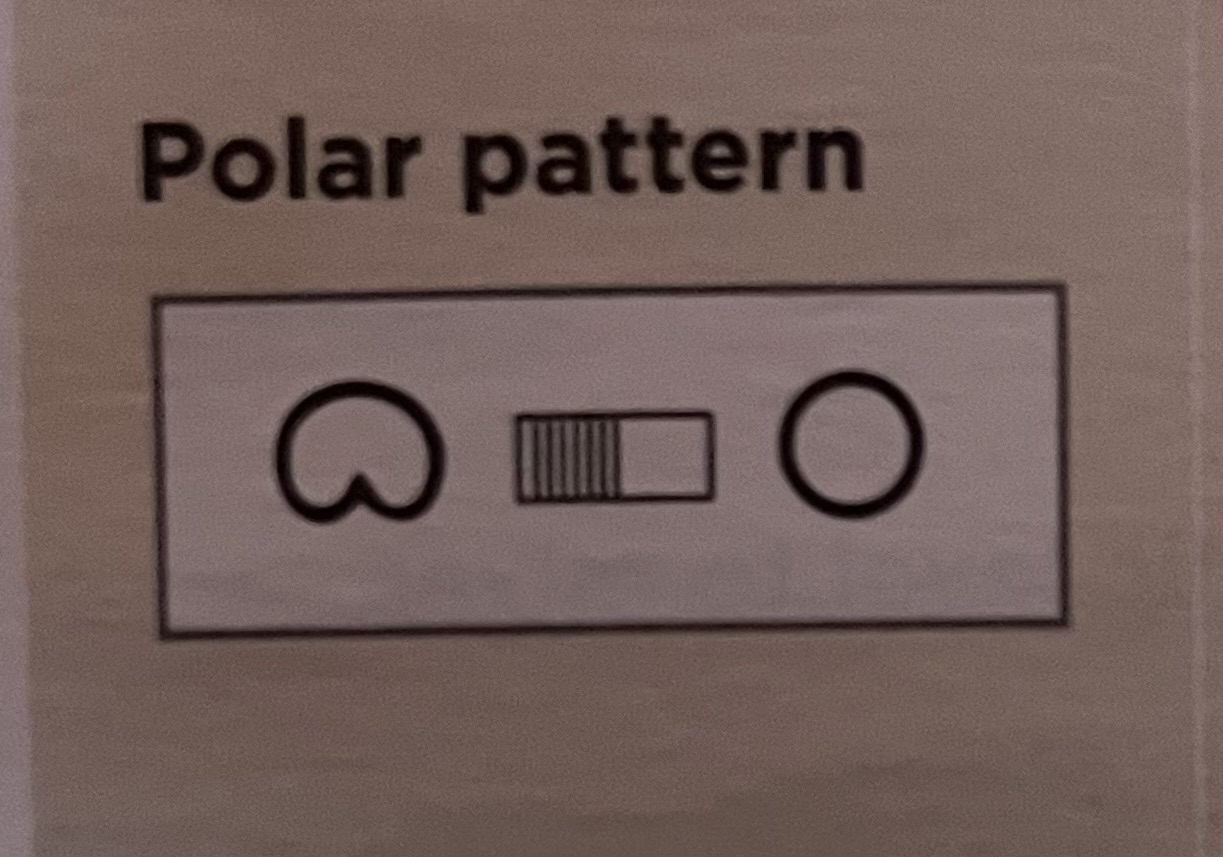
What does the polar pattern switch do?
The switch changes how sound is picked up around the capsule
Diagram of polar pattern switch
What does the high pass filter switch do?
Removes all frequencies below the cutoff (tends to be 80-150Hz).
Sometimes know as a rumble filter.
Diagram of high pass filter switch

What does a pad switch do?
Changes the sensitivity of the microphone
Diagram of pad switch

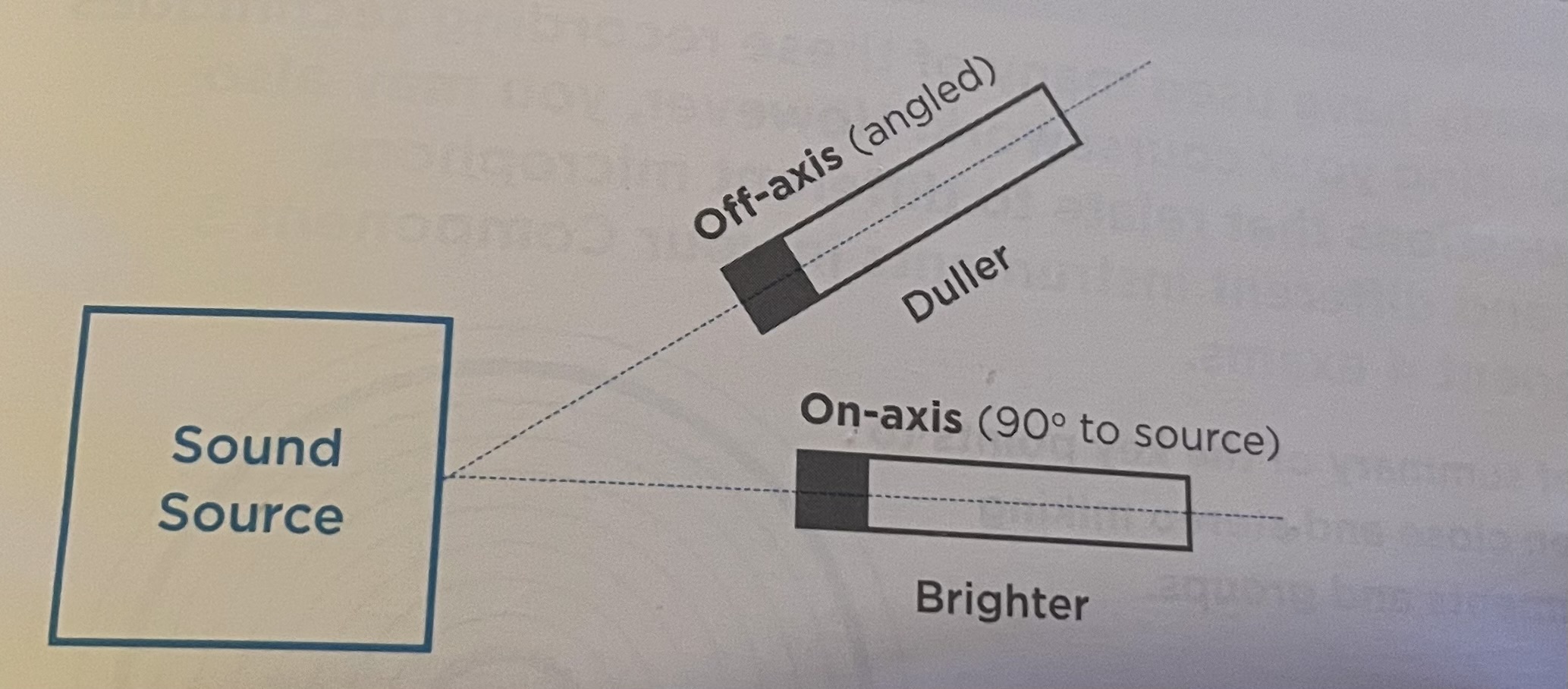
What is the difference between on-axis and off-axis microphone placement?
On-axis - directly facing sound source
Off-axis - angled towards the sound source
What is the difference in sound capture between on-axis and off-axis mic placement?
On-axis placement will capture a brighter sound
Off-axis placement will capture a duller sound
Diagram of on-axis vs off-axis placement
What does DI stand for?
Direct injection
What does a DI box do?
Converts a signal at instrument/line level to microphone level, and unbalanced signals to balanced signals.
DI boxes are used to eliminate the need to mic up electronic instruments, giving a direct connection to an audio interface or mixer.
What is the difference between active and passive DI boxes?
Active DI boxes require phantom power or a 9V battery
Passive DI boxes don’t require external power.
Diagram of DI box

What are plosive sounds?
Sounds with a strong initial transient (‘p’, ‘d’) which can create a large disturbance in air pressure on the diaphragm and a ‘pop’ sound.
How can plosive sounds be avoided?
By using a pop filter - disperses air more evenly to avoid such a quick and large diaphragm movement.
How can the impact of plosive sounds be reduced?
By using EQ and compression in post production.
But the best solution is to re-record.