Tannins
 Call Kai
 Learn
Learn Practice Test
 Spaced Repetition
 Match
Match Flashcards
 Knowt Play
1/37

There's no tags or description
Looks like no tags are added yet.
Name | Mastery | Learn | Test | Matching | Spaced | Call with Kai |
|---|
No analytics yet
Send a link to your students to track their progress
38 Terms
c. Complex polyphenols
Tannins are chemically classified as
a. Simple phenols
b. Terpenoids
c. Complex polyphenols
d. Glycosides
c. Tannins and flavonoids
The two types of antioxidants that are complex polyphenols classified under tannins
a. Alkaloids and glycosides
b. Resins and volatile oils
c. Tannins and flavonoids
d. Steroids and terpenoids
b. They do not crystallize
The reason tannins are difficult to separate from other compounds
a. They are too large to filter
b. They do not crystallize
c. They are water insoluble
d. They evaporate easily
b. Antioxidant
Complex polyphenols use
a. Analgesic
b. Antioxidant
c. Antiseptic
d. Ink production
1. Astringent
Leather protection
Treatment for bleeding gums
Uses of tannins (3)
c. Goldbeater skin test
The test used to differentiate true tannins from pseudo tannins
a. Fehling's test
b. Gelatin test
c. Goldbeater skin test
d. Biuret test
d. Positive (+)
The result of the Goldbeater skin test that indicates a true tannin
a. No reaction
b. Negative (−)
c. Color change to blue
d. Positive (+)
c. Negative (−)
The result of the Goldbeater skin test that indicates a pseudo tannin
a. Positive (+)
b. Color change to blue
c. Negative (−)
d. Precipitation
c. They are small molecules that cannot produce leather
The characteristic of pseudo tannins that prevents them from producing leather
a. They are large molecules that cannot produce leather
b. They cause protein precipitation
c. They are small molecules that cannot produce leather
d. They are complex polyphenols
c. Hydrolyzable and non-hydrolyzable condensed
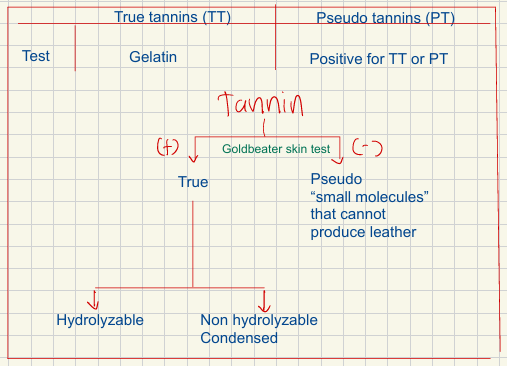
The two subtypes of true tannins based on hydrolysis
a. Astringent and non-astringent
b. Condensed and crystallizable
c. Hydrolyzable and non-hydrolyzable condensed
d. True and pseudo
d. Gelatin test
The test that is positive for both true tannins and pseudo tannins
a. Goldbeater skin test
b. Fehling's test
c. Biuret test
d. Gelatin test
b. When the insect Cynips tinctoria deposits its ova
The source of nutgall described as an excrescence from twigs or oak of the plant Quercus infectoria
a. When bacteria infect the bark
b. When the insect Cynips tinctoria deposits its ova
c. When the plant undergoes photosynthesis
d. When the plant is exposed to sunlight
c. Quercus infectoria
plant (Quercus infectoria)
insect (Cynips tinctoria)
The scientific name of the oak plant that is the source of nutgall
a. Hamamelis virginiana
b. Cynips tinctoria
c. Quercus infectoria
d. Cascara sagrada
d. Cynips tinctoria
plant (Quercus infectoria)
insect (Cynips tinctoria)
The scientific name of the insect responsible for the formation of nutgall
a. Quercus infectoria
b. Hamamelis virginiana
c. Cascara sagrada
d. Cynips tinctoria
a. Gallic acid and ellagic acid
The two constituent acids found in tannic acid
a. Gallic acid and ellagic acid
b. Citric acid and tartaric acid
c. Lactic acid and acetic acid
d. Malic acid and oxalic acid
b. Leather production &
c. Ink production
The uses of tannic acid in industry
a. Antiseptic
b. Leather production
c. Ink production
d. Universal antidote
a. Tannic acid, activated charcoal, and MgO
The components of the Minimum Antidote Therapy (MAT) universal antidote
a. Tannic acid, activated charcoal, and MgO
b. Gallic acid, ellagic acid, and MgO
c. Tannic acid, charcoal, and NaHCO₃
d. MgO, CaCO₃, and activated charcoal
1. Astringent
2. Tanning or dyeing agent
Uses of tannic acid
d. Hamamelis virginiana
The scientific name of witch hazel
a. Quercus infectoria
b. Cynips tinctoria
c. Cascara sagrada
d. Hamamelis virginiana
c. Hamamelitannin
The active tannin constituent of witch hazel (Hamamelis virginiana) known for its astringent property
a. Gallic acid
b. Ellagic acid
c. Hamamelitannin
d. Tannic acid
d. Astringent
The pharmacological action of hamamelitannin from witch hazel
a. Antitussive
b. Antimalarial
c. Anticholinergic
d. Astringent
a. Witch Hazel
Used for a type of perineal massage for labor and for soothing spray during post partum
a. Witch Hazel
b. Nut gall
c. Pines
d. Methylsalicylate
a. Hydrolysable
aka Pyrogallol tannins
a. Hydrolysable
b. Non-Hydrolysable
b. Non-Hydrolysable
“Non-Hydrolysable: may condense sa xmas at nag titinda ng puto bumbong na violet”
aka Condensed tannins
a. Hydrolysable
b. Non-Hydrolysable
b. Non-Hydrolysable
aka pyrocatechol tannins
a. Hydrolysable
b. Non-Hydrolysable
a. Hydrolysable
Chemical structure has sugar attached to phenolic acids
a. Hydrolysable
b. Non-Hydrolysable
b. Non-Hydrolysable
Chemical structure has flavonoid polymer
a. Hydrolysable
b. Non-Hydrolysable
a. Hydrolysable
Sugar attached to phenolic acids such as gallic and ellagic
Property of gallic and ellagic
a. Hydrolysable
b. Non-Hydrolysable
a. Hydrolysable
The product formed after dry distillation is Pyrogallol
a. Hydrolysable
b. Non-Hydrolysable
b. Non-Hydrolysable
The product formed after dry distillation is pyrocatechol
a. Hydrolysable
b. Non-Hydrolysable
a. Hydrolysable
Leather effect: bloom
a. Hydrolysable
b. Non-Hydrolysable
b. Non-Hydrolysable
Leather effect: tanner's red due to presence of phlobaphenes (red insoluble compound)
a. Hydrolysable
b. Non-Hydrolysable
a. Hydrolysable
Bromine test: Negative (−)
a. Hydrolysable
b. Non-Hydrolysable
b. Non-Hydrolysable
Bromine test: Positive (+)
a. Hydrolysable
b. Non-Hydrolysable
a. Hydrolysable
KMnO₄ test: Colorless
a. Hydrolysable
b. Non-Hydrolysable
b. Non-Hydrolysable
“Non-Hydrolysable: may condense sa xmas at nag titinda ng puto bumbong na violet”
KMnO₄ test: Violet
a. Hydrolysable
b. Non-Hydrolysable
a. Hydrolysable
Ferric chloride test: Blue-black
a. Hydrolysable
b. Non-Hydrolysable
b. Non-Hydrolysable
“Non-Hydrolysable: may condense sa xmas at nag titinda ng puto bumbong na violet”
Ferric chloride test: Green-black
a. Hydrolysable
b. Non-Hydrolysable