Nursing Care of the Child with an Alteration in Metabolism/Endocrine Disorder
 Call Kai
 Learn
Learn Practice Test
 Spaced Repetition
 Match
Match Flashcards
 Knowt Play
1/11

There's no tags or description
Looks like no tags are added yet.
Name | Mastery | Learn | Test | Matching | Spaced | Call with Kai |
|---|
No analytics yet
Send a link to your students to track their progress
12 Terms
What to know about the endocrine system?
Influences all physiologic processes
Growth and development
Metabolic processes related to fluid and electrolyte balance and energy production
Sexual maturation and reproduction
The body’s response to stress
Maintenance of internal homeostasis
What are the organs or tissues of the endocrine system?
Pituitary gland and hypothalamus (“control centers”)
Thyroid gland
Parathyroid glands
Adrenal glands
Gonads (ovaries and testes)
Islets of Langerhans located in the pancreas
What are the laboratory and genetic testing for endocrine disorders?
Newborn metabolic screening
Serum chemistry
Random and timed serum hormone testing
Growth hormone stimulation testing
Blood glucose (fasting, random and OGTT), HgA1C
Urine testing (ketone, glucose, 24‐hour collections)
Hemoglobin A1c
Genetic testing
Water deprivation study
Bone age radiographs
Imaging studies—CT, MRI, nuclear medicine, ultrasonography
What are the common medications for endocrine disorders?
Hypoglycemics (oral, injectable)
Hormone therapy (supplemental) (growth hormone; levothyroxine)
Hormone suppression therapy (Octreotide; Methimazole)
Corticosteroids and mineralocorticosteroids
Desmopressin acetate (DDAVP)
What are the complications of growth hormone deficiency and therapy?
Altered carbohydrate, protein, and fat metabolism
Hypoglycemia
Glucose intolerance/diabetes
Slipped capital femoral epiphysis (SCFE)
Pseudotumor cerebri
Leukemia
Recurrence of CNS tumors
Infection at the injection site
Edema and sodium retention
What are the common medical treatments for endocrine disorders?
Dietary interventions
Glucose monitoring and insulin delivery via programmable pumps
Irradiation/administration of radioactive iodine
Surgery
What are the pituitary disorders?
Growth hormone deficiency
Precocious puberty
Delayed puberty
Diabetes insipidus
Syndrome of inappropriate antidiuretic hormone secretion
What are the goals of nursing management of precocious or delayed puberty?
Educating the child and family about the physical changes the child is experiencing
Teaching how to correctly use the prescribed medications
Helping the child to deal with self-esteem issues related to the differences in the rate of growth and development of secondary sexual characteristics compared to peers
Promoting age-appropriate physical development and pubertal progression
What are the thyroid disorders in children?
Hyperthyroidism: rare in children
Mostly seen as Graves’ disease
Excessive T3, T4, T3 resin uptake
TSH usually low
Treated by destruction of thyroid gland
Hypothyroidism: can be congenital or acquired
Certain populations at risk (Downs, maternal hypothyroidism)
Decreased thyroid hormones
Decreased T3, T4, T3 resin uptake
TSH usually elevated
Lifelong thyroid supplementation
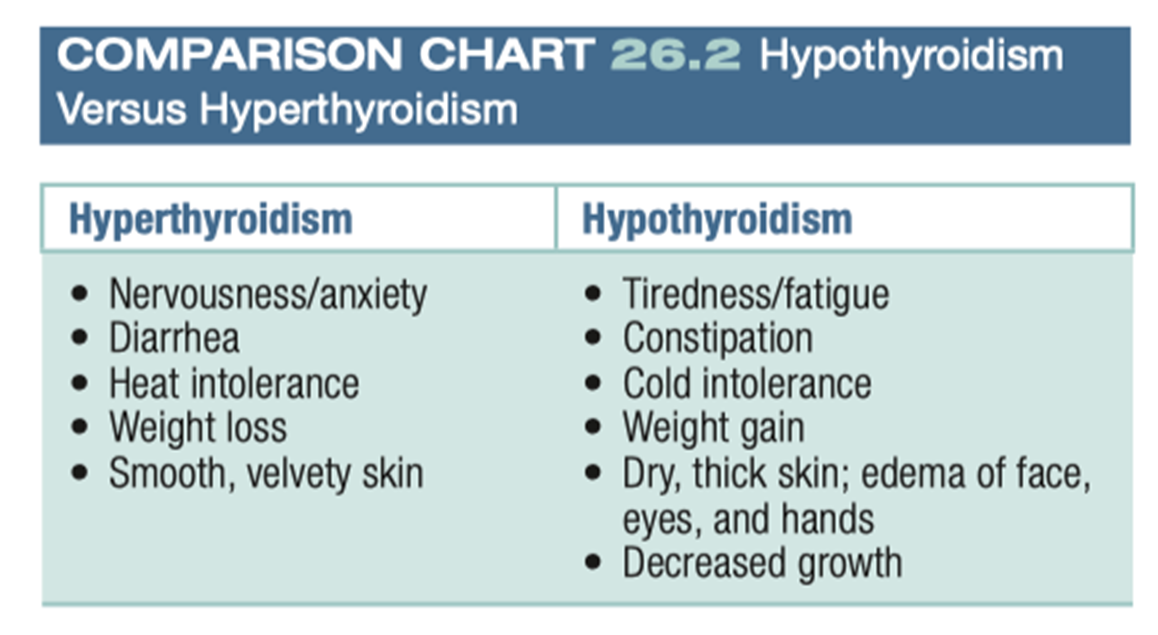
What is included in promoting growth for a child with congenital hypothyroidism?
Measure and record growth at regular intervals.
Measure thyroid levels at recommended intervals (every 2 to 4 weeks until the target range is reached on a stabilized dose of medication, then every 1 to 3 months and decreasing in frequency as the child gets older).
Monitor for signs of hypo- or hyperfunction, including changes in vital signs, thermoregulation, and activity level.
Provide adequate rest periods and meet thermoregulation needs.
What are the signs of thyroid signs?
Sudden onset of severe restlessness and irritability
Fever
Diaphoresis
Severe tachycardia
What are some other endocrine disorders?
Adrenal gland disorders
Congenital adrenal hyperplasia
Cushing syndrome
Addison disease
Polycystic ovary syndrome