Phytoplankton Succession
 Call Kai
 Learn
Learn Practice Test
 Spaced Repetition
 Match
Match Flashcards
 Knowt Play
1/28

There's no tags or description
Looks like no tags are added yet.
Name | Mastery | Learn | Test | Matching | Spaced | Call with Kai |
|---|
No analytics yet
Send a link to your students to track their progress
29 Terms
Differences between aquatic and terrestrial ecosystems
There are more autotrophs, detrital production, detritus, and decomposers in terrestrial ecosystems but more herbivores in marine ecosystems
What does light availability depend on in marine ecosystems
Season and mixing
What do nutrient concentrations depend on in marine ecosystems
Mixing and also on recycling (terrestrial sources)
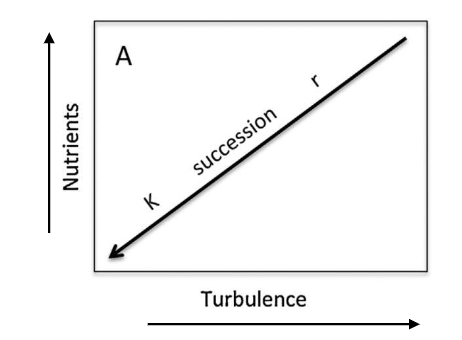
What is the Margalef Mandala
It is a model that illustrates how succession and r and k selection functions in ecosystems with varying levels of nutrients and turbulence. The diagonal shows main succession from nutrient rich, turbulent waters to calm, nutrient poor waters
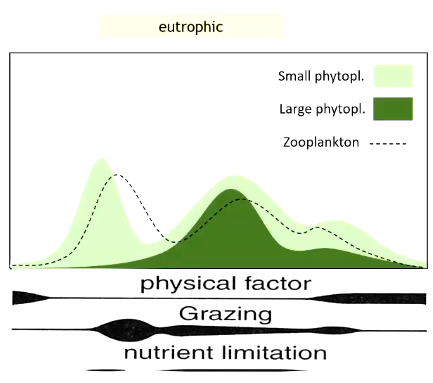
Phytoplankton dynamics in eutrophic vs oligotrophic lakes
Physical factor — same between the two
Grazing — More grazing in eutrophic lakes especially in spring
Nutrient limitation — Much more nutrient limitation in oligotrophic lakes and almost none in eutrophic lakes
Zooplankton dynamics in eutrophic vs oligotrophic lakes
Physical factor — Same between the two
Feeding by fish — very similar but more in eutrophic lakes
food limitation — eutrophic lakes have food limitation in spring and summer and none the rest of the time while oligotrophic lakes have food limitation the entire year except spring into summer
What does carbon export largely depend on
Depends on phytoplankton species composition. Large, heavy species sink faster, toxic species get eaten less, sticky or spiny species form larger heavy aggregates (sink faster)
Characteristics of cyanobacteria bloom
Increase — PH, chlorophyll-a, phytoplankton richness, phytoplankton RUE
Decrease — Water transparency, Zooplankton richness, Zooplankton RUE
Characteristics of Dinophyta blooms
Increasing — Water transparency, phytoplankton RUE, Zooplankton richness
Decreasing — Zooplankton RUE, Phytoplankton richness
Characteristics of chlorophyta blooms
Increasing — Water transparency, Phytoplankton RUE
Decreasing — PH, chlorophyll-a, phosphorus, zooplankton richness, zooplankton RUE
Characteristics of Mixed blooms
Increasing — PH, chlorophyll-a, phosphorus, phytoplankton RUE
Decreasing — Water transparency, zooplankton richness, zooplankton RUE
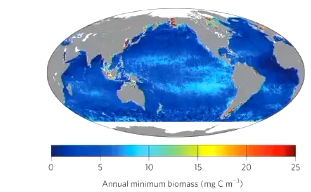
Describe annual biomass of phytoplankton globally
Looks very low across the entire globe with some activity at the northern polar regions
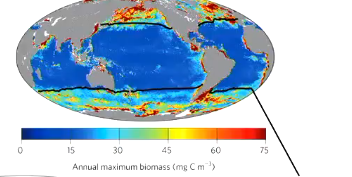
Describe annual maximum biomass globally
Most activity is at higher latitudes and not in temperate or tropical regions due to mixing conditions
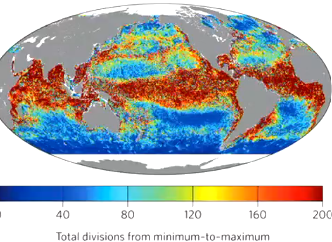
Describe total divisions from minimum-to-maximum for phytoplankton globally
Much more activity visible near and along the equator
Describe light availability seasonally
Light availability increases in spring supporting the spring bloom. Light levels remain high during summer, but biomass is low (grazing by zooplankton) meaning that light is not a limiting factor. Light availability drops off in autumn
What factor influences light availability
Mixing (surface mixing allows more light and deeper mixing reduces light because plankton are transported deeper)
Describe how nutrients change throughout the seasons and impact phytoplankton biomass
There are new (mainly inorganic), nutrients brought up through mixing in spring which supports spring bloom. During summer there are more organic nutrients because they are recycled. In fall there is more upwelling of inorganic nutrients due to seasonal storms and mixing which supports the second fall bloom
In calm nutrient poor areas what phytoplankton are present
more k selective
In turbulent nutrient rich areas what phytoplankton are present
More r selective
What is an example of an early successional phytoplankton species
Diatoms
What is an example of a late successional phytoplankton species
Dinoflagellates
Describe dynamics between large and small phytoplankton in eutrophic lakes
The first bloom in spring is almost entirely made up of small phytoplankton and gets grazed down by zooplankton. In summer the large phytoplankton dominate (represents a later large scale successional state), zooplankton populations also rise in summer. There is another small bloom in autumn that is dominated by small phytoplankton again
Describe dynamics between large and small zooplankton in eutrophic lakes
In spring large zooplankton dominate and graze away the first phytoplankton bloom. Summer is dominated by small zooplankton (this is because large zooplankton don’t have enough time to react after the spring bloom crashes).
What is the big takeaway from the comparison of eutrophic and oligotrophic lakes
That adding nutrients to a system doesn’t just increase biomass but completely changes the successional cycle and the way that phytoplankton and zooplankton function
How do marine heatwaves impact phytoplankton communities
Increased temperature alters phytoplankton communities. Increases in Syndiniales sp. (parasitic dinoflagellates) They can kill phytoplankton efficiently.
Life cycle of Syndiniales
Dinospore infects host, grows (multiplies) until host bursts, releases the vermiform (many dinospores clustered together), spores break apart and infect new hosts
Alkalinity enhancement method
Where you add material that are proton acceptors (alkalinity enhancers) that bind carbonic acid (thus binding CO2) in the stable form of bicarbonate. Kills two birds with one stone because it diffuses carbon from atmosphere and also increases PH thus reducing ocean acidification
Describe the method of PH enhancement
Mimics the natural process of mineral weathering but speeds it up. Grind minerals such as olivine or quicklime into a very fine powder to maximize surface area and increase the speed of the reaction
Different places where ocean alkalinity enhancement can be used
Directly dropped into ocean by boat, put into ocean through water treatment plants, added to land so it is washed into ocean