biology unit 3: sac2
 Call Kai
 Learn
Learn Practice Test
 Spaced Repetition
 Match
Match Flashcards
 Knowt Play
1/146

There's no tags or description
Looks like no tags are added yet.
Name | Mastery | Learn | Test | Matching | Spaced | Call with Kai |
|---|
No analytics yet
Send a link to your students to track their progress
147 Terms
the process of photosynthesis
The process of converting light energy into chemical energy stored in glucose.
what does photosynthesis involve?
the conversion of simple inorganic molecules (CO2 and H2O) into complex organic molecules (glucose - C6H12O6).
where is the location of photosynthesis?
the chloroplast
chloroplast diagram
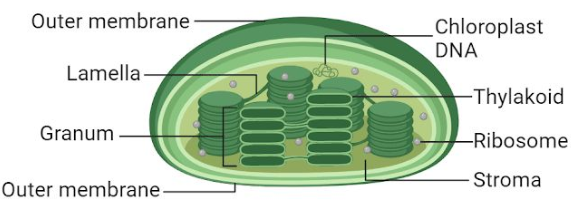
what are grana
stacks of thylakoid discs (membrane bound compartments) - containing green pigment chlorophyll
what is stroma
the gel like fluid between the grana in the chloroplast
equation of photosynthesis simplified
carbon dioxide + water (light) (chlorophyll) → glucose + oxygen
equation of photosynthesis using chemicals
6CO2 + 6H20 (light) (chlorophyll) → C6 H12 06 + 6O2
what to consider about photosynthesis equation
This chemical equation on its own won’t create glucose. It only tells us the inputs and outputs. Photosynthesis occurs in a series of biochemical pathways that involve many other compounds including enzymes and coenzymes.
COenzyme: ATP full name
Adenosine triphosphate
COenzyme: ATP loaded form
ATP
COenzyme: ATP unloaded form
ADP
COenzyme: ATP function
Transfers energy
Coenzyme: full name of NADH
Nicotine adenine dinucleotide
Coenzyme: loaded form of NADH
NADPH
Coenzyme: unloaded form of NADH
NAD+
Coenzyme: function of NADH
Transfer of electrons and hydrogen ions (protons)
Coenzyme: full name of NADPH
Nicotine adenine dinucleotide phosphate
Coenzyme: loaded form of NADPH
NADPH
Coenzyme: unloaded form of NADPH
NADP+
Coenzyme: function of NADPH
Transfer of electrons and hydrogen ions (protons)
Coenzyme: full name of FADH2
Flavine adenine dinucleotide
Coenzyme: loaded form FADH2
FADH2
Coenzyme: unloaded form FADH2
FAD
Coenzyme: function of FADH2
Transfer of electrons and hydrogen ions (protons)
light dependent stage location
Grana of the chloroplast
light dependent stage inputs
H2O (and ADP and Pi, and NADP+)
light dependent stage outputs
O2 ATP and NADPH
light dependent stage description
Light energy hitting the chlorophyll molecules imbedded in the grana causes water molecules to split into oxygen, electrons and hydrogen ions.
Oxygen forms in O2 and leaves the chloroplast.
The hydrogen ions and electrons are collected by NADP+ forming NADPH which moves on to the second stage in the stroma of the chloroplast.
Energy released in the reactions is used to form ATP (from ADP and Pi) which moves on to the second stage in the stroma of the chloroplast.
Light independent stage of photosynthesis (Calvin cycle) location
stroma of the choloplast
Light independent stage of photosynthesis (Calvin cycle) inputs
CO2 ATP, NADPH
Light independent stage of photosynthesis (Calvin cycle) outputs
C6H12O6, H2O (and ADP and Pi, and NADP+
Light independent stage of photosynthesis (Calvin cycle) description
CO2, from the atmosphere, and NADPH (supplying hydrogen ions and electrons), from the first stage, react together to form glucose (C6H12O6).
Energy for this reaction to occur is supplied by ATP from the first stage.
Water (and unloaded coenzymes) is also a product of this reaction.
A number of other molecules in the cycle (including the key enzyme RuBisCO) assist in the reaction.
what is chlorophyll
A green pigment located in the grana which absorbs and traps light energy.
absorption of chlorophyll
Chlorophyll absorbs/reflects different wavelengths of light. It is therefore more or less efficient depending on the colour of light.
worst = green
best = blue and red
what is Rubisco
an enzyme involved in the light independent stage (calvin cycle) of photosynthesis
role of rubisco
The role of rubisco is to bind CO2 and ‘fix’ the carbon into organic molecules in order to ultimately produce glucose.
what does rubisco bind CO2 with
with another compound called RuBP in order to make 3-PGA (a 3 carbon molecule).
what is 3- PGA converted too?
With ATP and NADPH from the light dependent stage, 3-PGA is converted into another molecule G3P.
what are G3P molecules further converted too
into glucose
what is photorespiration
when Rubisco sometimes binds O2 rather than CO2
why is photorespiration bad
The binding of O2 by rubisco wastes energy and reduces the rate of photosynthesis, therefore decreasing the efficiency of the plant.
what impacts the rate of photorespiration vs photosynthesis
impacted by the temperature and CO2:O2 ratio.
what happens when temp increases for photorespiration
As temperature of the plant increases, rubisco binds O2 more readily, increasing photorespiration rate.
what happens when CO2:O2increases for photorespiration
As O2 concentration in the leaf increases, relative to CO2, rubisco binds O2 more readily, increasing photorespiration rate.
how do plants reduce the rates of photorespiration in normal conditions
Plants open their stomata to take up CO2 from the atmosphere and release O2, reducing photorespiration rate.
what happens to reduce photorespiration in hot dry climates
plants may lose too much water through open stomata.
Closing stomata reduces water loss, but also increases O2 concentration in the leaf.
Along with the direct effect of the high temperature, this increases photorespiration rate
what adaptions do C3 plants have to reduce photorespiration
normal’ plants – have no features to reduce photorespiration. ‘Typical’ Calvin cycle (as per previous slides).
what adaptions do C4 plants have to reduce photorespiration
separate Calvin cycle into 2 stages occurring in 2 different cell types.
what adaptions do CAM plants have to reduce photorespiration
separate Calvin cycle into 2 stages occurring at different times of the day.
What defines a C3 plant?
Most common type of plant (~85%)
First product of carbon fixation = 3-PGA (3-carbon molecule)
Carbon fixed by Rubisco during the Calvin cycle
where does C3 photosynthesis occur
Occurs in mesophyll cells of leaves
Calvin cycle happens here
limitations of C3 plants
Photorespiration can occur
More common in hot / dry conditions
Reduces photosynthesis efficiency
e.g of c3 plants
Rice
Wheat
Fruits & vegetables
Trees
c3 quick summary
Use Rubisco to fix CO₂ → forms 3-PGA
Happens in mesophyll cells
Common, but affected by photorespiration
What defines a C4 plant?
First product = malate (4-carbon compound)
Carbon initially fixed by PEP carboxylase
Called C4 because first product has 4 carbons
Where does C4 photosynthesis happen?
Two different cells involved:
Mesophyll cells → initial carbon fixation
Bundle-sheath cells → Calvin cycle continues
How is CO₂ fixed in C4 plants?
CO₂ fixed in mesophyll cells
Enzyme = PEP carboxylase
Forms malate (4C)
PEP carboxylase does NOT bind O₂
What happens to malate?
Malate moves to bundle-sheath cells
Releases CO₂
Rubisco uses CO₂ in the Calvin cycle
why are C4 plants better in hot conditions?
PEP carboxylase doesn’t bind O₂
Little/no photorespiration
More efficient in hot, dry climates
How do C4 plants minimise photorespiration?
Maintain high CO₂ concentration in bundle-sheath cells
Gives Rubisco more CO₂ to bind
Less chance of Rubisco binding O₂
Minimises photorespiration
What is a disadvantage of C4 photosynthesis?
Uses ATP to move/fix carbon
More energy expensive than C3 plants
What environment suits C4 plants?
Best in hot, humid environments
Efficient photosynthesis under high temperatures
examples of C4 plants?
corn
sugarcane
What does CAM stand for?
Crassulacean Acid Metabolism
Special photosynthetic adaptation for dry environments
How is CAM photosynthesis separated?
Both stages occur in mesophyll cells
Happens at different times of day
Separation is by time, not by cell
(Memory trick: C4 = different cells, CAM = different times)
what do CAM plants do at night?
Stomata open
CO₂ enters leaf
PEP carboxylase fixes CO₂
Forms malate
What happens in CAM plants during daylight?
Stomata close → conserves water
Malate releases CO₂
Rubisco uses CO₂ in Calvin cycle
How is photorespiration reduced in CAM plants?
High CO₂ concentration around Rubisco during day
Even with stomata closed
Less chance of Rubisco binding O₂
Reduces photorespiration
What is a disadvantage of CAM plants?
Uses ATP
More energy expensive than C3
What environment suits CAM plants?
Hot, dry environments
Conserves water efficiently
Examples of CAM plants?
cacti
pineapples
factors effecting rate of photosynthesis
CO2 concentration
light intensity
light colour
water availability
temp
pH
enzyme inhibators
How does CO₂ concentration affect photosynthesis?
CO₂ is an input of the light-independent stage (Calvin cycle)
More CO₂ = faster photosynthesis rate
Rate increases until saturation point is reached
Why does photosynthesis level off at high CO₂?
Another limiting factor becomes the problem, such as:
Light intensity
Enzyme concentration
Water availability
Which plants cope better in low CO₂ conditions?
C4 and CAM plants are better adapted
Maintain high CO₂ around Rubisco
Reduce photorespiration
More efficient than C3 plants in low CO₂ conditions
CO₂ concentration — summary
More CO₂ → higher photosynthesis rate
Increases until saturation point
Then another factor limits rate
C4 + CAM cope better than C3 in low CO₂ conditions
How does light intensity affect photosynthesis?
Light is needed for the light-dependent stage
Used to split water (photolysis)
More light intensity = faster photosynthesis rate
Increases until saturation point is reached
Why does photosynthesis stop increasing at high light intensity?
Another limiting factor takes over, such as:
CO₂ concentration
Enzyme concentration
Water availability
Light intensity — summary
Light powers light-dependent reactions
More light → higher photosynthesis rate
Rate rises until another factor limits it
How does light colour affect photosynthesis?
Chlorophyll absorbs some wavelengths better than others
Different light colours provide different amounts of usable energy
This changes the rate of photosynthesis
Which light colours are most effective for photosynthesis?
Blue light → highly absorbed → high photosynthesis
Red light → highly absorbed → high photosynthesis
Green light → mostly reflected → low photosynthesis
How does water availability affect photosynthesis?
Low water / high temperature → stomata close
Helps reduce water loss
Less CO₂ enters leaf
Photosynthesis rate decreases
Why does low water lower photosynthesis?
Closed stomata stop CO₂ uptake
O₂ builds up inside plant
Rubisco binds O₂ instead of CO₂
Causes photorespiration → lowers photosynthesis
Which plants are better adapted to low water conditions?
C4 and CAM plants
Better at maintaining high CO₂ around Rubisco
Reduce photorespiration
More efficient than C3 plants in dry conditions
Why do enzyme-related factors affect photosynthesis?
Photosynthesis is enzyme controlled
Enzymes such as Rubisco help reactions occur
Anything affecting enzyme activity affects photosynthesis rate
How does temperature affect photosynthesis?
Temperature increases → photosynthesis rate increases
Reaches an optimal temperature (best rate)
Above optimum → rate declines
Enzymes denature at high temperatures
How does pH affect photosynthesis?
Photosynthesis enzymes have an optimal pH
At optimal pH → highest photosynthesis rate
Too acidic / too alkaline → enzyme activity decreases
Photosynthesis rate drops
How do enzyme inhibitors affect photosynthesis?
competitive and non-competitive inhibitors reduce enzyme activity
Prevent enzymes from binding to their substrate properly
This slows photosynthesis
How do herbicides affect photosynthesis?
Many herbicides act as enzyme inhibitors
They block enzymes involved in photosynthesis
This reduces photosynthesis rate
CRISPR-Cas9
A genome editing tool which cuts DNA at precise locations in order to:
delete genes from a cell (knock-out)
insert new genes/alleles into an organism’s genome (knock-in)
Why is improving photosynthesis important?
World population is growing → increased food demand
Climate change makes growing conditions harder
Need to increase crop efficiency and yield
What is crop yield?
Crop yield = amount of product harvested from crops
How can crops be modified to improve photosynthesis?
Use CRISPR-Cas9 gene editing
Alters plant DNA
Creates genetically modified crops
Can improve photosynthesis efficiency and crop yield
Why do crops need improved photosynthetic efficiency?
Most crops are C3 plants
Susceptible to photorespiration
Worse in hot / dry conditions
This lowers photosynthesis efficiency
How can CRISPR-Cas9 improve photosynthesis?
Can modify Rubisco efficiency
Helps reduce photorespiration
Makes C3 plants act more like C4/CAM plants
Improves photosynthesis rate
How can CRISPR-Cas9 improve crop yield?
Alters plant DNA to improve traits
Creates higher-yielding crops
Increases amount of harvestable product
Examples of CRISPR methods to improve crop yield?
Increase disease resistance
Improve shelf life of fruits/vegetables
Create compact plants
Increase grain size (e.g. wheat)
Increase flowering / fruiting timespan
What is Adenosine triphosphate?
Cell’s portable energy package
Stores energy for intracellular use
Provides energy for cellular processes quickly
How does ATP release energy?
Breaks off one phosphate group
Energy is released quickly
ATP becomes ADP