exam 4 (zoology)
 Call Kai
 Learn
Learn Practice Test
 Spaced Repetition
 Match
Match Flashcards
 Knowt Play
1/70

There's no tags or description
Looks like no tags are added yet.
Name | Mastery | Learn | Test | Matching | Spaced | Call with Kai |
|---|
No analytics yet
Send a link to your students to track their progress
71 Terms
Cognition
The process of acquiring knowledge and understanding through thought, experience, or senses
only animals are capable of cognition
Humans have the highest capacity for cognition
List the aspects of cognition
teaching
Short term memory
Casual reasoning
Planning
Deception
Transitive inference
Theory of mind
Language
Teaching
Steps :
Observation
the teacher observes the students capabilities
Judgement
the teacher judges the students’ actions or products
Modification
the teacher modifies the students behaviors
*animals don’t actively teach (young learn by observing adults and adult animals do not recognize that new learners need help
Short term memory
The number of items held in the mind at the same time
chimps and humans can hold 5-7 items at once
Other animals can hold fewer
Add another item, one of the existing ones is forgotten
Example: short term memory capacity
ability to remember a “to do list” of 5 simple tasks
Causal Reasoning
Causality = relationship between cause and effect
Causal Reasoning
the organism understands
What actions (causes) lead to certain effects
What effects results from specific causes
Example :
rats can be taught to press a lever to receive food
Babies learn that if they cry when they are hungry they will be fed
Error in Casual Reasoning
causal illusion
post hoc ergo propter hoc
After the fact therefore because of the fact
Mistaken interpretation of events
event A happened followed by even B
“Therefore” A causes B
Sometimes true, sometimes false
Example :
You failed a test after eating a hamburger
causal illusion : “eating hamburgers make you fail tests”
Animals must be capable of causal reasoning to suffer from casual illusions
mammals, birds, and some reptiles
Planning
Planning = thinking about activities required to achieve a goal
*Very hard to demonstrate in animals
most “planning” is probably instinctive
Instincts cannot be altered if variables change
Example:
birds gathering and storing seeds before winter
Is the birth “planning” for winter or just following an instinct
What are the different types of planning
Simple : one individual plans for one thing
you plan to study for tomorrow’s test
Complex : multiple individuals form a group plan
the football team gathers to discuss tactics for tomorrows game
Deception
The act of providing false information
Types of deception
False positives
Indicates food or danger when there is none
“The boy who cried wolf” - pretending there is a predator
False negatives
indicates no food or danger when there is some
A camouflaged predator hides to ambush- pretending there is no danger
false negatives are far more common in the animal world
Transitive inference
Use logic to determine the relationship between objects
example:
Aaron is taller than Bob
Bob is taller than carl
Who is taller Aaron or Carl
Animals capable of transitive inference
Theory of Mind
Ability to understand the reasoning and motivation of others
key element of human social interaction (ability to look at thinks from another person’s point of view)
Gives us the ability to empathize (understand and share the feelings of others)
Infants have TOM
Language
only humans have language
Chimpanzees and Gorilla
can be taught human created language (maybe)
But do not have their own language
Cannot teach each other sign language
Learning
A long term or permanent change in the potential for behavior that results from experience
Imperfect
relies on memory
Potential
not everything we learn is used
Reinforcement
Anything that alters the probability of a behavior
Positive
used to increase probability of future behavior
Example : bonus points for attendance
Negative
used to decrease probability of future behavior Example : penalty points for late submission
Fatigue adaptation
Loss of efficiency in a motor act when the act is repeated in rapid succession
Example: take notes in several classes in a row (your hand gets tired; you take fewer note
Sensory adaptation
Reduction of nerve impulses due to repetition of stimulus
Example: smell sensors adapting to odor
(Why you don’t smell yourself)
List the forms of learning
Habituation
Sensitization
Classical Conditioning
Operant Conditioning
Habituation
Responses wanes due to repetition without reinforcement
individuals react to the stimulus first
But there is no reward or danger following the stimulus
The individual tunes it out as irrelevant
Example: background noise
Benefit: avoid wasting energy by reacting to irrelevant stimuli
Sensitization
Enhanced responsiveness to a noxious or intense stimulus
reaction becomes more intense as the stimulus is repeated
Perception is that stimulus is “getting worse”
Stimulus remains the same, but sensitivity to it increases
Example: sharp pain your shoulder
each time you move and feel pain, you are more reluctant to move that way
Pain may feel worse each time
Opposite of habituation
Classical Conditioning
Animals learn to respond to a new stimulus using an existing behavior
behavior in response to a natural stimulus
Dog salivates in response to food
No natural responses to the new stimulus
Repeatedly associate the two stimuli
Animal associates the two stimuli
It now responds to the new stimulus with the original behavior
Operant Conditioning
Animals learns to associate a behavior with a consequence
Positive reinforcement :
animal is rewarded for a certain behavior
Example: give the dog a treat when it shakes paws with you
Negative reinforcement :
animal is punished for a certain behavior
Example: spray the cat with water when it jumps on the counter
Observational Learning
An indirect form of operant conditioning
animal watches another animal
The other animal gets a reward/punishment for a behavior
The observer animal learns what to do
Example:
two groups of ducks
Group 1 fed from dishes - one with a shock grid, one without
Group 2 observed
When released, group 2 avoided the dish with the shock grid
Constraints on Learning
Constraints that limit learning
preparedness
Genetic predisposition to learning
Methods
constraints imposed by the investigator
Preparedness Constraints
Genetic/hereditary predisposition affects learning
Prepared
the animals nervous system is suited to the task
Leads to rapid learning
Example: cats chasing the red dot
Unprepared
the nervous system is not suited to the task
Takes a long time to
Example: chimps learning sign language
Contraprepared
the nervous system would naturally act opposite to the task
Animal may not be able to learn the task at all
Methods Constraints
Experimental factors may affect results
learning apparatus
Environment
Investigator bias (Clever Hans)
Tasks should be part of an animal’s potential repertoire
Dominance
Animal #1 controls behavior of animal #2
Requirements
learning
Memory
Individual recognition
Intensity of encounters drops as the dominance hierarchy develops
Agonistic interactions
Aggressive or defensive social encounters among animals
Hierarchy
System of things ranked above and below each other
Despotic Hierarchy
A controls group
B , C , D are all subordinates, all equal
Example:
mice : dominant mouse is despot
Class: teacher is despot, all students are equal
Line Hierarchy
A controls B, B controls C, C controls D
common in chicken, primates
Also called “pecking order”
Military ranks work this way (General > Major > Captain > Corporal
Triangular Hierarchy
A control B, B controls C, but C controls A
very rare
Not stable : doesn’t really usually last long
Alliance Hierarchy
A is strong and would be a despot
B and C team up - stronger than A alone
B + C then dominate A
Examples : humans often do this (“neighborhood watch” > crook)
monkeys and dolphins
Dominance intensity
“Peck Right”
complete
All agonistic interactions won by the dominant individual
One way transmission of aggression
“Peck dominance”
incomplete
Dominant wins most, but not all, agonistic interactions
Transmission is not all one way, but mostly one way
Conditions for Dominance
Dominance hierarchies form when animals:
are social
Live close together
Are mobile
Compete for the same limited resources
Stability
Stable dominance hierarchies
everyone knows his place
Fewer fights
If there is a fight, it involves the dominant (his chance of injury is therefore higher)
Subordinates who keep their place never fight
their chance of injury is therefore lower
Overall, in stable hierarchies members experience:
less stress
Less aggression
Instability
Unstable hierarchies - opposite of stable
lots of fights among all members
High stress for all
High chance of injury for all
Reconciliation
After agonistic display/ fight
need to “make up” or society will break down
Winner usually makes up with loser
Happens quickly
Animals rarely “hold a grudge”
Prevent aggression costs from persisting long term
Methods of de-escalation
Need to defuse situation - avoid injury, societal breakdown
Methods
separation (physically stay away from aggression)
Calming behavior (start grooming)
Use submissive displays
Behave predictably (erratic behavior provokes aggression)
Direct attention to someone else (He did it!)
Define signal
The physical form in which a message is coded for transmission through the environment
Define discrete signal
All or nothing (on or off) aka digital
Define graded signal
Signal with degrees or levels to it (aka analog)
Define composite signal
A combination of two or more signals
Define syntax
Signal meaning depends on sequence or order (a means one thing before B, something else after B) x
Define context
Signal meaning depends on surrounding conditions
Define metacommunication
Communication about communication
Functions of communication : coordination
Use signals to organize groups to maintain proper spacing
Example: monkey contact calls 3 types
distance increasing calls - used to maintain territory spacing
Distance maintaining calls - prevents getting lost
Distance reducing calls - upon getting lost, call for help
Functions of communication : recognition
Convey information about who’s who
recognize species, caste, kin, neighbors
Functions of communication : recognition
Signal fitness
displays are expensive
Only healthy individuals and pull them off
Allows potential mates to determine readiness
Physiological - body is in ready condition
Psychological - animal is in the right mood
Functions of communication: social status
communicate aggression
Convey dominance information
Avoid costly fights by posturing/submitting
Functions of communication : alarm calls
Alert other animals to danger
Can be very specific
Functions of communication : food finding signals
information center (passive - learn from watching)
Active calling when food is found
Functions of communication : soliciting play
play can teach skills like hunting needed in the future
Play helps form social bonds
Functions of communication : hatch synchronization
chicks are vulnerable to predators
Parents can protect more easily if they all hatch at once
Calls within the egg help synchronize hatching
Summary: list the functions of communication
Coordination
Recognition
Reproduction
Social status
Alarm
Food finding
Care giving
Soliciting play
Hatch synchronization
Define the waggle dance of the honeybee
Conveys precise information about food
direction to the food source
Angle of the dance relative to the sun = angle to food
Distance to the food source
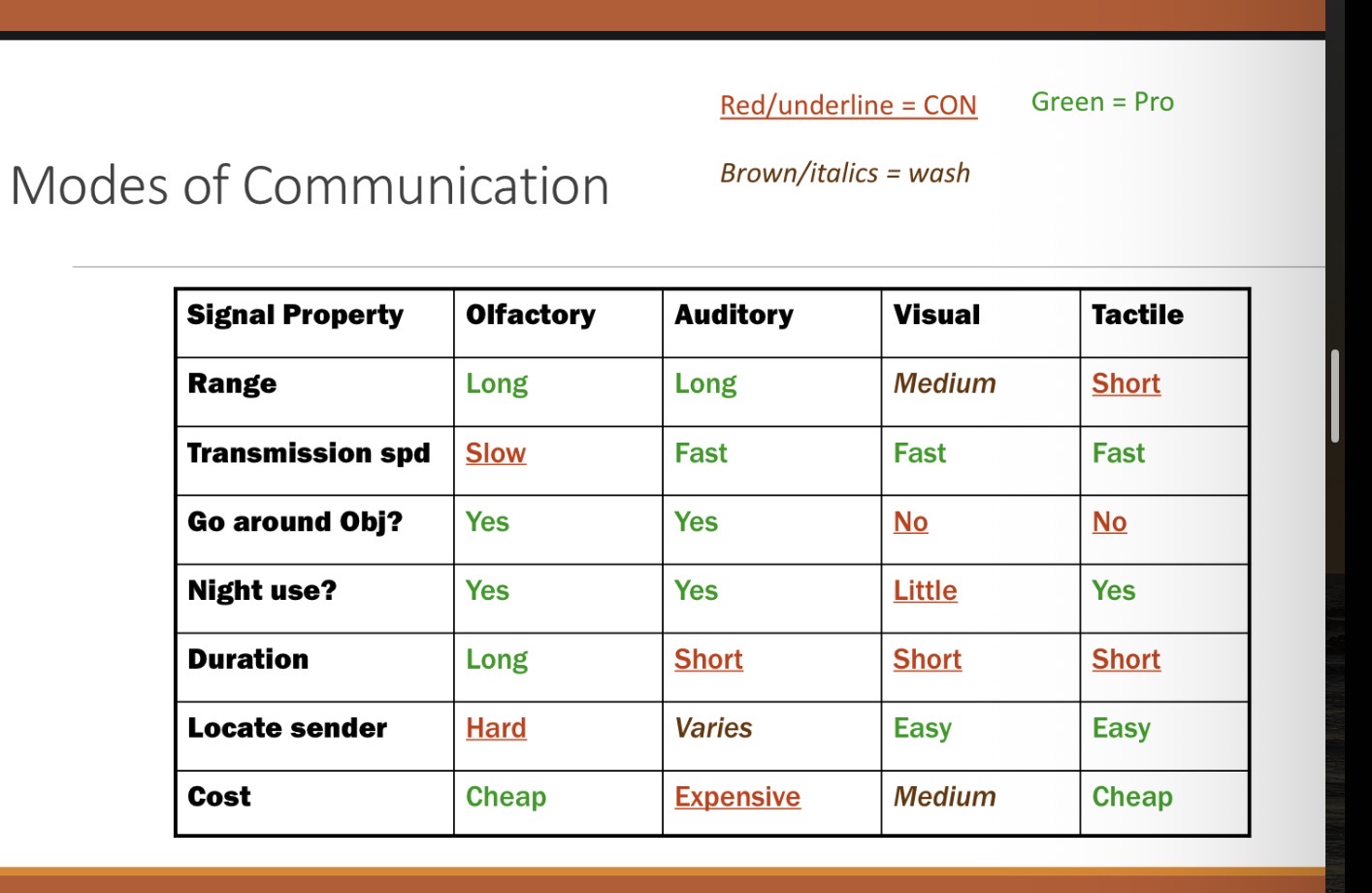
Modes of communication
Define isogamy
Male and female gametes are the same size
occurs in bacteria, fungi, algae
Define Anisogamy
Male and female gametes are unequal sizes
eggs is large, stationary
Sperm is small mobile
Occurs in animals and higher plants
Leads to unequal investment because it costs females more to produce eggs and females stand to lose more from unsuccessful mating
Mating systems and the environment
Mating systems depend on the environment and relative costs
Open plains :
food spread out
Predation present
Mammal grazers live in herds
Mating with multiple partners is common
Dense forest
long distance communication impossible
Food is clumped
Groups are usually small family units
Mate with one partner for a year, for life
Define monogamy
Neither sex can monopolize more than one member of the opposite sex
one male , one female, exclusive
Occurs when nesting sites are scarce
Occurs when both parents are required to raise young
Define polygamy
Any form of multiple mating systems
Polygyny
one male , two or more females (very common)
Polyandry
one female, two more more males (rare doesn’t happen in many species)
Forms of polygyny : resource defense
male controls feeding or nesting area
Female must enter males territory to breed
Males with best territories get several female
Males do not usually care for the young
Forms of polygyny : female defense
females live in groups for some environmental reason (lack of space)
Male controls entire feeding
One males group of females: harem
Forms of polygyny
Male dominance Lekking
occurs when male has no way to control resources
Males concentrate in one place
Males all advertise at once try to out display each other
Examples :
sage grouse
Prairie chicken
Fallow deer
Forms of polygyny : scramble
Males rush about attempting to mate with any ready female
occurs when females are not choosy about mates
Example: horseshoe crabs
Define polyandry
Female controls access to more than one male
very rare because females invest so much in the egg
Define satellite males
Male lurks on edge of dominant male’s territory
darts in to get some action when the dominant male’s is not looking
Marine isopods
live in sponges
Reproductive effort.
Combination of energy and risk undertaken for breeding
Energy:
female puts lots of protein into egg, yolk
Male spends energy defending territory
Risk:
Male may be more vulnerable to predators during showy days
Female may risk malnourishment while sitting on nest, carrying young in womb
Any energy or risk now, reduces chance of successful breeding later
Define semelparous
Reproduce once in a lifetime
adults usually die after breeding
Define iteroparous
Reproduce multiple times in a lifetime
adults live after breeding, can breed again