Accounting Terms
 Call Kai
 Learn
Learn Practice Test
 Spaced Repetition
 Match
Match Flashcards
 Knowt Play
1/95

There's no tags or description
Looks like no tags are added yet.
Name | Mastery | Learn | Test | Matching | Spaced | Call with Kai |
|---|
No analytics yet
Send a link to your students to track their progress
96 Terms
Accounts Payable
money a business owes to others for goods or services
Accounts Receivable
Money owed to a business for providing a good or service
Accounting Equation
Shows assets, liabilities, and equity all come together on the balance sheet
Assets
Anything a business owns of value or a resource of of value that has the potential to be transformed into cash
Liabilities
What the business owner owes to others, i.e.: loans, unpaid bills, etc
Equity
How much the business is worth if all assets were liquidated and all liabilities paid off; aka the stake the owner has in the business
Balance Sheet
Where everything comes together
The document where the accounting equation is found displaying assets, liabilities, and the business equity.
The balance sheet shows the relationship between what the business owns, what it owes, and how much the owners have invested
What is the cardinal rule of accounting?
debits and credits ALWAYS need to be equal
what side is debit always on
left
what side is credit always on
right
Revenue
the income your client earns through their business operations
The gross proceeds from sales, whether that’s products, services, rentals, or anything else that brings money into the business
Expenses
The cost of doing business such as labor costs like salaries, employee benefits, operating costs, such as utilities, rent and insurance and other essential expenses such as taxes and advertising or anything else that keeps the business moving
Income Statement
A document that summarizes a clients financial performance through the calculation of revenue minus expenses
Debits
These represent an increase in assets or expenses or a decrease in liabilities, owner’s equity or revenue
Credits
These represent a decrease in assets, expenses, or an increase in liabilities, owners equity, or revenue
Accounting Principle #1: Economic Entity Assumption
The assumption that the business is it’s own separate entity, distinct from it’s owners. Aka keep the business’s finances separate from personal finances
Accounting Principle #2: Reliability Assumption
Assuming the information you record in your client’s financial documents is verifiable and backed by proper documentation. If your client can’t provide an invoice, receipt, or bank statement to support a transaction, it is not a reliable transaction and cannot be recorded.
Accounting Principle #3: Full Disclosure Principal
Any information lenders or investors might need to make informed decisions should be disclosed in the financial statements or in the accompanying notes.
Accounting Principle #4: Conservatism Principal
If you’re not sure how to record an item, err on the side of caution. In other words, choose options that show less income or asset benefit. Potential losses can be recorded, potential gains cannot.
Accounting Principle #5: Materiality Principle
This principle allows you to focus on what matters: if an accounting standard has such a small impact on the financial statements that it wouldn’t mislead anyone, you can ignore it.
i.e. when providing documented information, you can round numbers to the next whole number (charts, reports, etc)
Accounting Principle #6: Consistency Principle
Once a business adopts a specific accounting method for recording certain items, it commits to entering all similar items in the same way in the future. This applies to line items on all financial statements and reports. Only change an accounting method if the new version improves the accuracy of the reporting.
Accounting Principle #7: Monetary Unit Assumption
Designed to bring simplicity and uniformity to your accounting practices. It states that you use one currency throughout all of your accounting activities. No need to adjust old entries for inflation.
Accounting Principle #8: Going Concern Assumption
This principle assures that the business is stable enough to operate and meet it’s obligations for the foreseeable future. The business makes decisions with the goal of keeping the business going rather than liquidating it. If a business is or is about to go under, it’s important to be transparent about it.
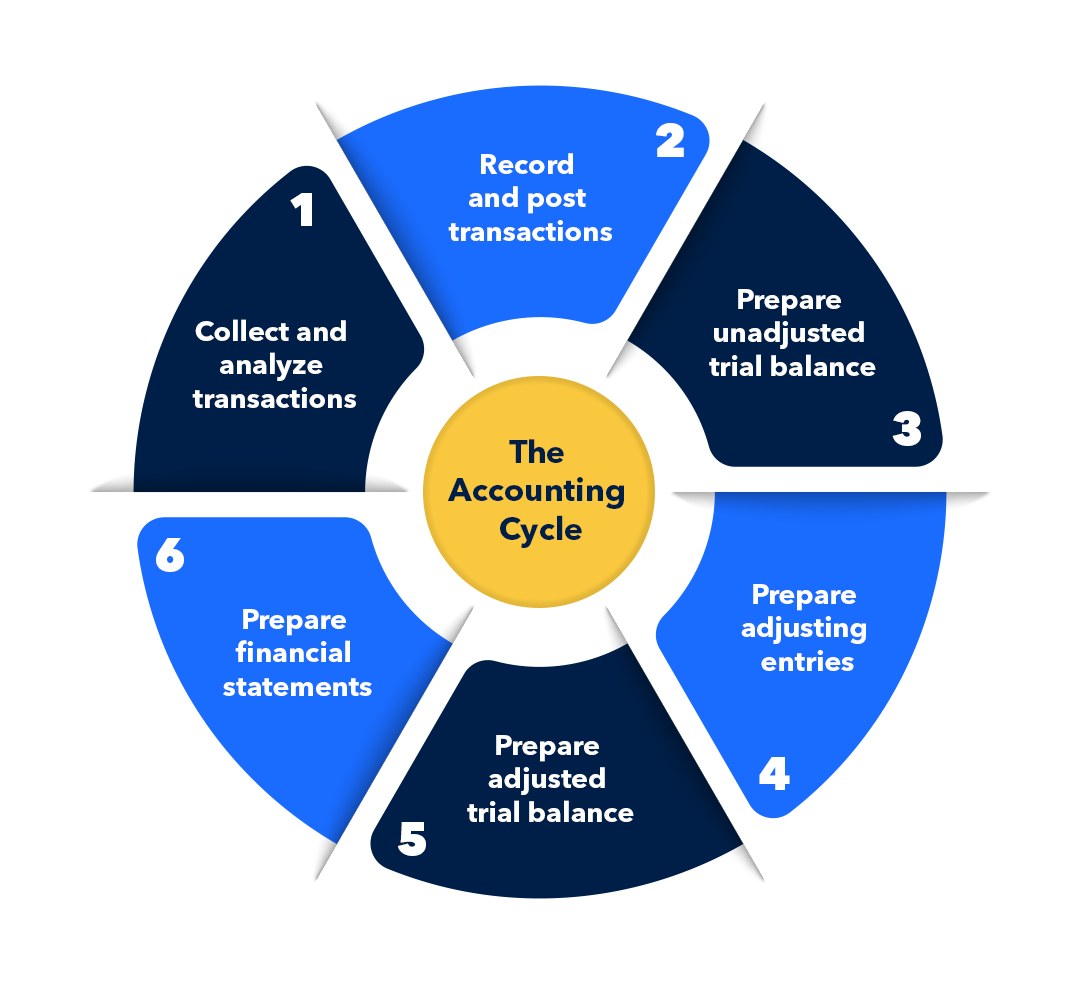
The Accounting Cycle - Step #1: Collect and analyze transactions
Collect and analyze transactions and gather supporting documents as well as Chart of Accounts
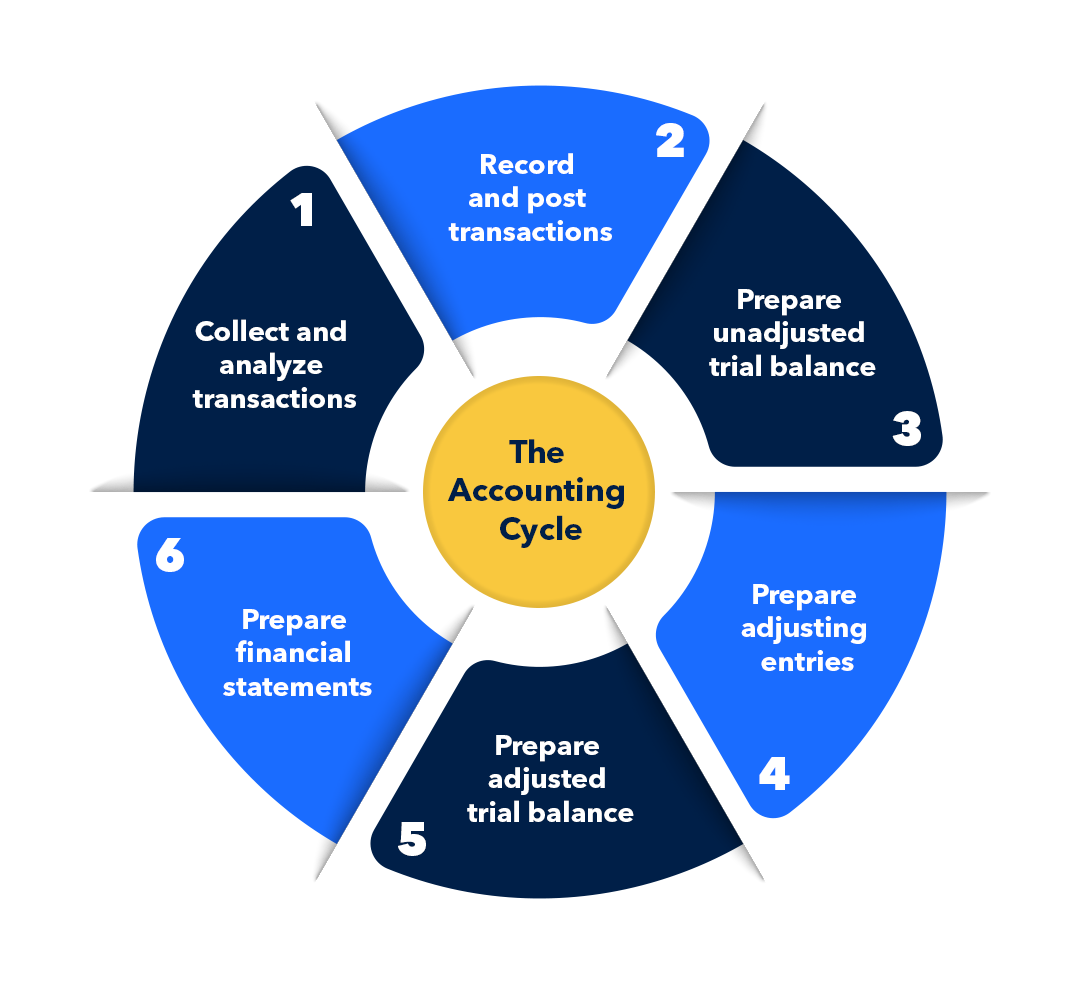
The Accounting Cycle - Step #2: Record and Post Transaction
Recording transactions making sure they are correctly categorized and assigned to the right accounts, posting the summary entries to the general ledger, then finally reconciling all transactions.
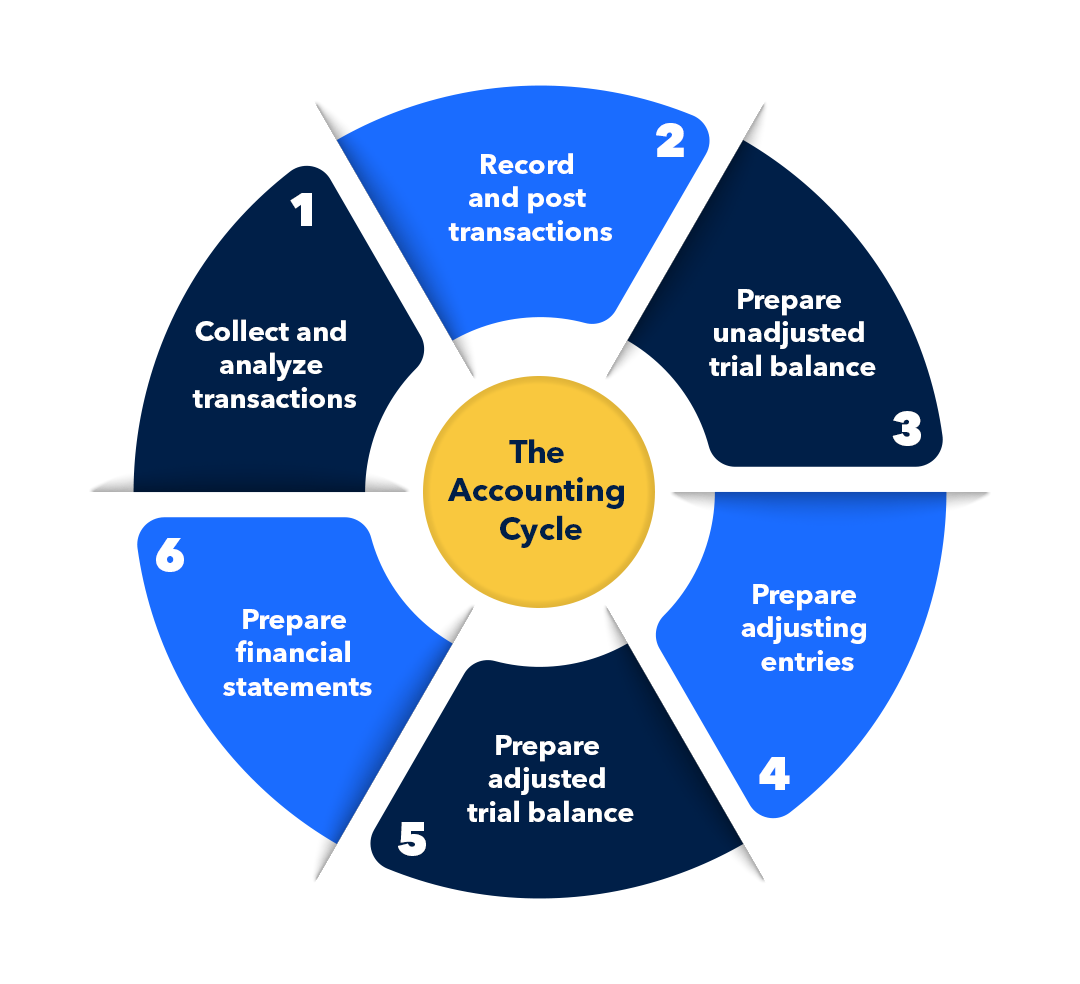
The Accounting Cycle - Step #3: Prepare Unadjusted Trial Balance
Using the unadjusted trial balance to verify that credits and debits are balanced, allowing you to check for any errors or omissions in the previous accounting cycle steps.
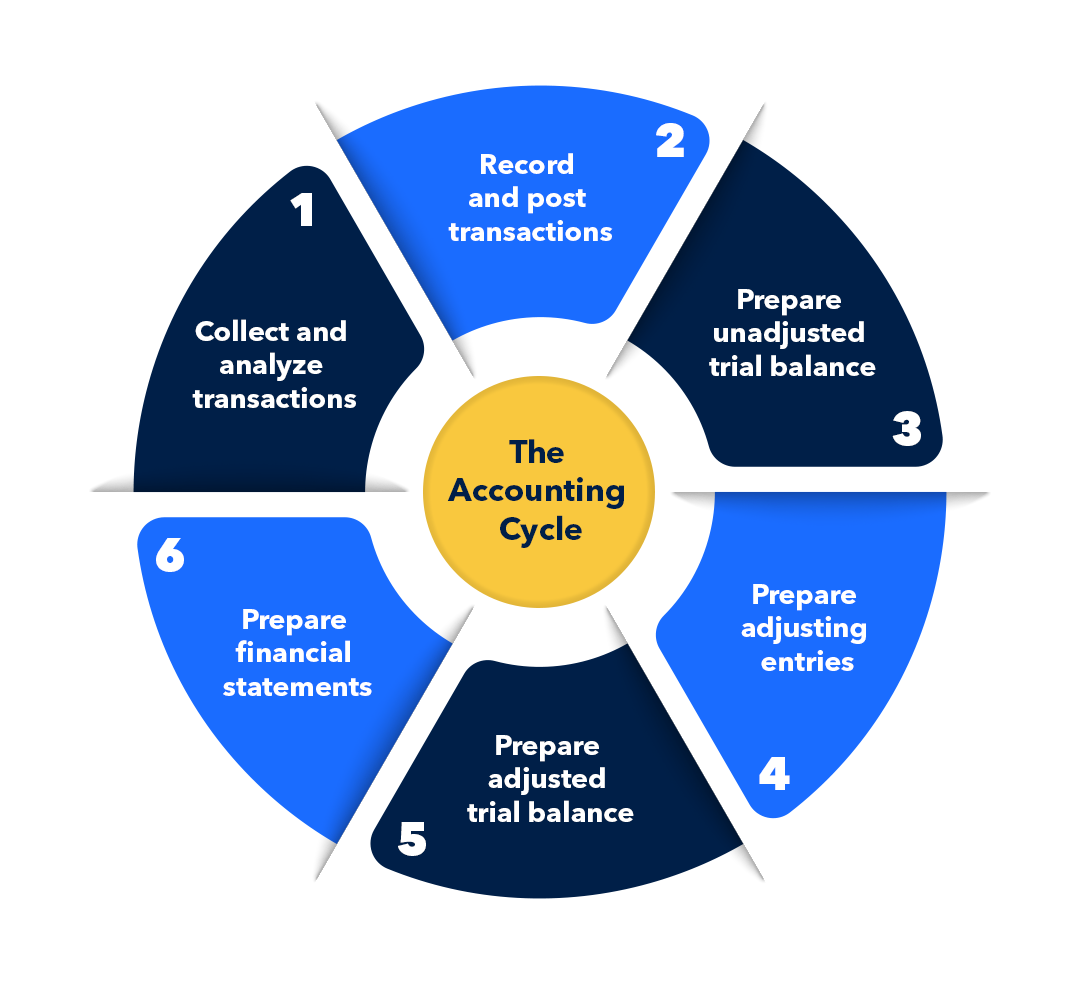
The Accounting Cycle - Step #4: Prepare adjusting entries
Adjusting entries is creating new entries to record depreciation and accrual adjustments.
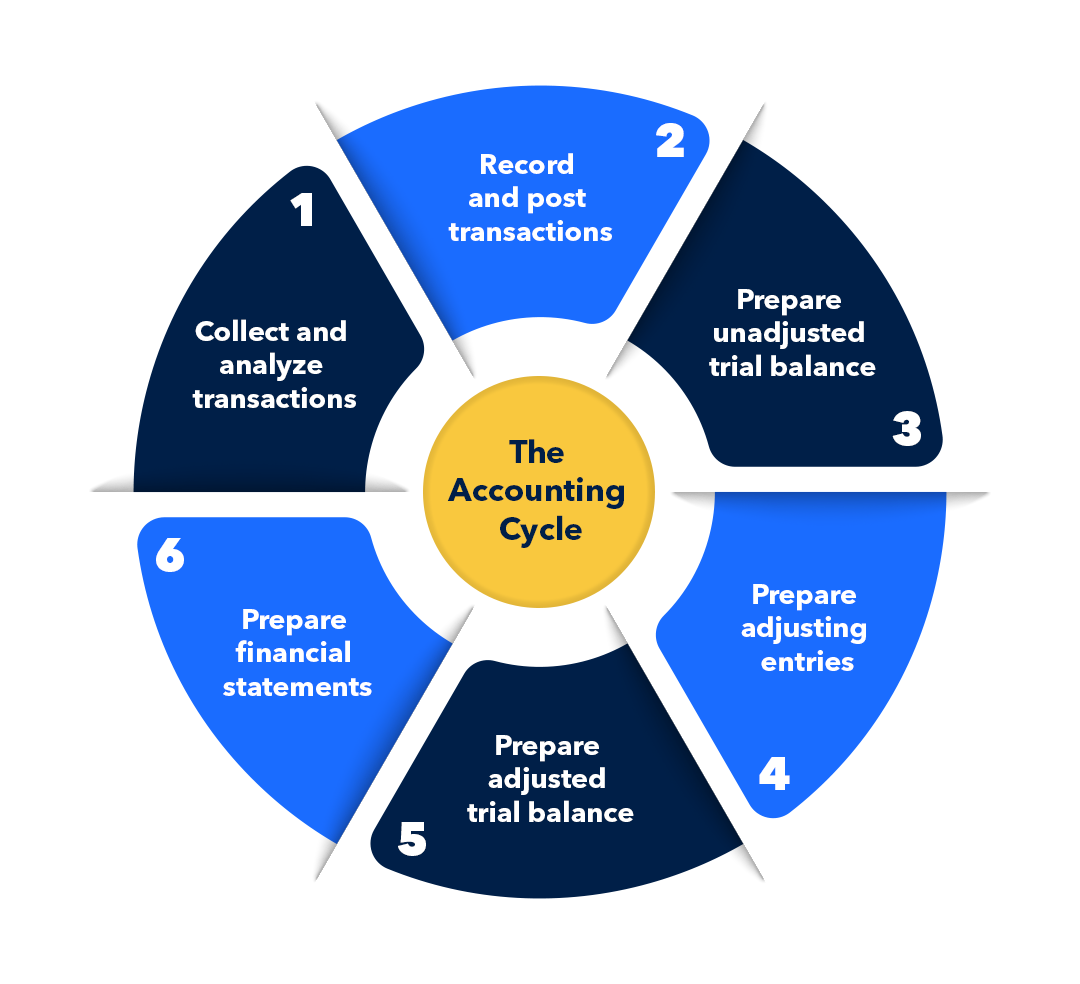
The Accounting Cycle - Step #5: Prepare adjusted trial balances
ATB is a listing of the ending balances in all accounts after adjusting entries have been prepared
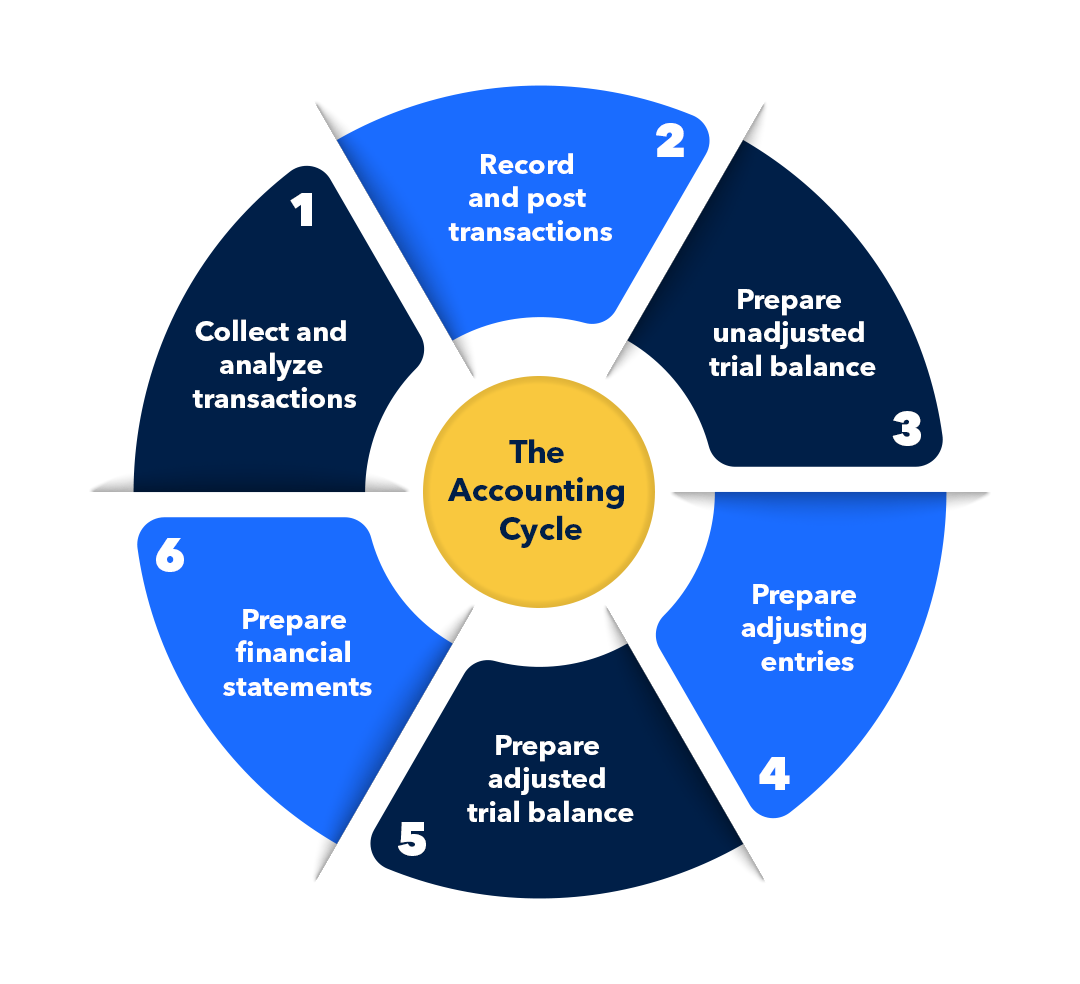
The Accounting Cycle - Step #6: Prepare financial statements (4)
1) Income statement: showing the business revenues and expenses for a specific period (aka a P&L)
2) Balance sheet: presenting a snapshot of the business assets, liabilities, and equity at a particular moment
3) Statement of Equity: tracing the changes in the business equity, starting from the opening balance to the ending balance for the period
4) Statement of Cash Flow: providing information about the sources and uses of cash by the business, offering insights into cash in flows and out flows
Chart of Accounts
A list of all of the accounts and sub-accounts used to categorize transactions
General Ledger:
A record of each financial transaction that takes place during the life of an operating business. It contains all accounts needed to prepare financial statements
Unadjusted trial balance:
A form or statement that lists the titles and balances of all ledger accounts at a given date before adjusting entries are made
Adjusting entries:
Creating new entries to record depreciation and accrual adjustments; these are provided to bookkeepers by a CPA or accountant
Adjusted trail balances:
A listing of the ending balances in all accounts after adjusting entries have been prepared
Financial Statements:
A set of reports that show how a business is performing financially and all business activities related to running the business
Foundational Principle #1: Periodicity Assumption
A business can report its financial results within specific time periods. This usually involves reporting results and cash flows regularly, such as monthly, quarterly, or annually.
Foundational Principle #2: Revenue Recognition Principle
Revenue is recognized when the work is finished and delivered, not when the payment arrives.
Foundational Principle #3: Matching Principle
revenues and their associated expenses should be recognized in the same reporting period.
Transaction Journal
Used to list the details of an individual event, like an expense or revenue transaction.
Transaction Journal Examples (4)
A) Sales Transactions: revenue for a business from the sale of goods and services
B) Cash Receipts: cash, check, and credit card sales and customer payments
C) Credit Purchases: items bought for the business items on credit
D) Cash Disbursments: payments made via chash and checks by the business
Vendor:
An entity that the business purchases products or services from
Chart of Accounts:
A list of all accounts and subaccounts used to categorize transactions
General Ledger:
A record of all financial transactions in a business, organized by account
Groups transactions by account type and includes balances for each account.
You will NOT find balances here
Double-entry Bookkeeping:
A method of recording financial transactions that ensures accuracy and balance in accounting records. Follows the principle that every transaction has two aspects: a debit and a credit.
What is a debit?
An increase in assets or expenses, or a decrease in liabilities, owner’s equity, or revenue
What is a credit?
A credit is a decrease in assets or expenses, or an increase in liabilities, owner’s equity, or revenue
Which Accounts INCREASE with a Debit? D.E.A.D.
Debit
Expenses
Assets
Dividends
Which Accounts INCREASE with a Credit? C.L.R.E.
Credit
Liabilities
Revenues
Equity
Cash-Basis Accounting
Revenues and expenses are recognized based on actual receipt or payment, rather than the completion of work or delivery of goods.
Accrual Principle:
Recognizing revenues when they are earned or incurred
Unadjusted Trail Balance:
Provides a list of account balances from the general ledger at a specific date, before any adjustments.
Accrual Accounting:
Revenues and expenses are reported or recognized on financial reports when they are earned or incurred, rather than when the payment is made or received
Matching Principle:
Revenues and their associated expenses should be recognized in the same reporting period.
In the mindset of accounting principles, when should you record revenue?
When they are earned regardless of when the business receives the money
In the mindset of accounting principles, when should you record expenses?
When they are incurred, regardless of when the business pays them.
Income Statement
AKA P&L; Shows the business’s revenues and expenses during a particular period
Total Income
The amount of revenue from the sale of goods and services
Cost of Goods Sold
The total cost to create goods
Gross Profit
Total revenues minus cost of goods sold
Net Profit/Income(loss)
The total of subtracting all expenses (including taxes) from the total revenue
Retained Earnings
Accumulated net incomes from previous years minus any dividends paid to shareholders
Operating Expenses
Day-to-day expenses incurred as the business generates revenue
Operating Profit
The profitability of a company’s core operations before interest, taxes, and non-operating expenses are deducted
Property, Plant, and Equipment (PPE)
A business’s long-term assets that are expected to generate economic benefits and contribute to revenue for many years. Aka Capital Investment
Depreciation
Spreading out the cost of an item over the expected life of the item
Current Asset
aka short-term assets that include cash and items that will be converted into cash quickly, typically within a year
Current Assets Examples (6)
Cash and Cash Equivalents: Accessible money, funds in bank accounts, and short-term, high-quality investments that can be accessed within 90 days (i.e. certificates of deposit)
Accounts Receivable: the amount of money that clients owe to a business in exchange for the goods and services that the business has provided on credit to the client
Inventory: The raw material a business uses in the production of finished goods as well as the finished goods and purchased merchandise held by a business for sale
Prepaid expenses: payments made in advance like paying 6 months of insurance premiums. They are considered assets since the cost has already been incurred.
Investment (aka Marketable Securities): Money market account balances, stocks, and bonds
Notes Receivable: Amounts owed to businesses that will be paid within 12 months
Fixed Assets (aka long-term assets)
Assets that a business acquires for productive use in its operations and are not intended for sale. These assets are expected to be used by the business for an extended period, typically beyond a year.
2 Types of Fixed Assets
Property, Plant, and Equipment: vehicles and equipment used to produce revenue
Intangible: a non-physical asset that provides future economic benefit such as a business's domain name, patents, and trademarks.
4 Steps of Tracking Assets
1) Identify the asset type
2) check if there is an existing account in the COA for the asset type
3) If needed, add the account if no account exists
4) Record the asset using the proper account in the journal
Lease
an agreement to pay rent for a specific period of time for the right to use an asset.
Lessor
the party who owns the asset and is renting it out.
Lessee
the party paying the rent to use the asset.
2 Kinds of Equipment Leases:
1) Operating Lease: There is no intention for ownership of the asset to transfer hands at the end of the lease.
2) Capital (Financing) Lease: The business intends to take ownership of the asset from the lessor to the lessee at the end of the lease.
Normal (Natural) Account Balance:
The expectation that a particular type of account will have either a debit or a credit balance based on it’s classification within the chart of accounts.
Cash Sales
Transactions where the customer pays for goods or services immediately with cash, check, or a credit or debit card.
What 3 Statements do cash sales affect?
1) Balance sheet
2) Income Statement
3) Statement of Cash Flows
POS Systems
Systems commonly used in retail stores, restaurants, and other businesses where goods or services are sold directly to customers
What does invoicing (credit sales) allow the customers to do?
It allows them to defer the payment of goods or services
Promissory Note:
A legal document that shows a promise to repay a specific amount of money by a certain date. Promissory notes are commonly used in various financial transactions, such as personal loans, business loans, and real estate deals.
Can indicate money owed by or owed to
2 Reasons for Promissory Notes:
1) Inter-company loans: When one business ( in a group of related companies loans money to another business (in the same group of companies)
2) Converting Overdue Payments: When a customer or vendor is overdue on a payment and agrees to a payment plan with interest. A promissory note serves as the legal, binding document of the agreement.
T or F: Promissory notes need to be accounted for on the balance sheet?
TRUE
Notes Receivable
Money owed to a business
Considered an asset
Notes Payable
Money a business owes
Considered a liability
Simple Interest Formula:
Principle x Interest Rate x Time = Interest
Bad Debt:
Any loans or outstanding balances that a business deems uncollectible
The Collection Process (4 Steps)
1) Accounts Receivable: Amount is posted here when a client pays on credit. Amount posted under accounts receivable.
2) Account Receivable aging report:Bookkeeper runs accounts receivable aging report every 30 days.
3) Doubtful Account: If even more time passes with no payment, the money moves to a doubtful account.
4) Accounts Uncollectible: Finally, the money moves to accounts uncollectible.
Methods for Writing Off Bad Debt (2)
1) Direct Write-Off:
Pros:
Simple
Takes care of uncollectable accounts in a single journal entry
Easier for business owners with no accounting background
Cons:
Does not follow the matching principle
Could make a business seem more profitable than it actually is
2) Allowance:
Rarely used by small businesses.
Pros:
Businesses analyze invoices and estimate the amount for bad debt expense
Adheres to the matching principle
More accurate books
Cons:
More complex
Inventory
The physical goods a business holds for sale or uses in the production process including:
stock of raw materials, work-in-progress, finished goods, and merchandise that a business holds
NOT considered inventory:
Computers used by salespeople for business operations
Packaging materials like boxes and shipping labels
4 Categories of Business Inventory
Raw Materials: The materials a business uses to create its products. For example, in a clothing manufacturing business raw materials could include fabrics, buttons, and zippers.
Work in Progress: Raw materials in the process of being transformed into finished products.
Finished Goods: Completed products that are ready for sale to the business's customers.
Merchandise: Finished goods that a business purchases from a supplier for the purpose of future resale.
Cost of Goods Sold
Total expense incurred in manufacturing the goods a business sells such as items for resale, raw materials, parts, labor costs, supplies, overhead costs, and shipping or freight expenses.
Inventory Valuation Methods (3):
FIFO: First things purchased are the first things sold.
Last In, First Out (LIFO): Most recently purchased items are the first ones sold
Average Cost Method (AVCO): Calculating the average cost by adding up the prices of all the things they bought and dividing it by the total number of items.