RX: Reactions
 Call Kai
 Learn
Learn Practice Test
 Spaced Repetition
 Match
Match Flashcards
 Knowt Play
1/11

There's no tags or description
Looks like no tags are added yet.
Name | Mastery | Learn | Test | Matching | Spaced | Call with Kai |
|---|
No analytics yet
Send a link to your students to track their progress
12 Terms
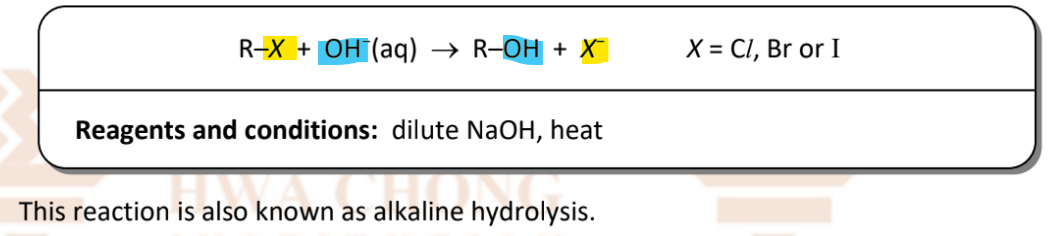
Nucleophilic substitution with OH- to form alcohol
RnC: dilute NaOH, heat
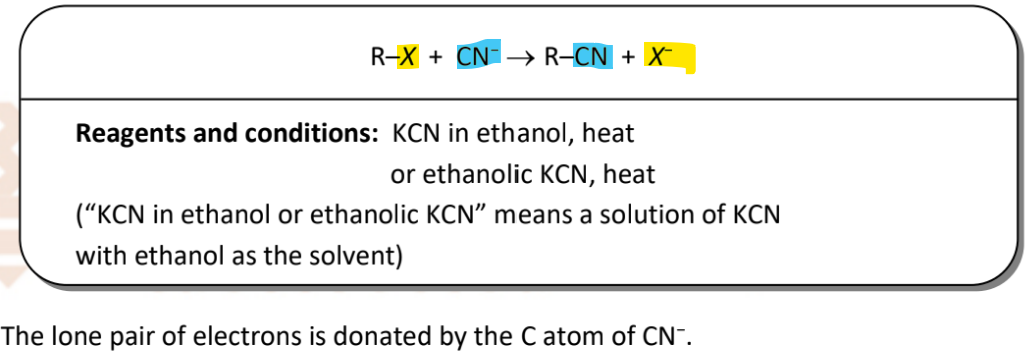
Nucleophilic substitution with CN- to form nitriles
RnCs: KCN in ethanol, heat OR ethanolic KCN, heat
AKA step-up reaction as carbon chain increases by 1 C atom
acidic hydrolysis of nitriles
RnCs: dilute H2SO4, heat

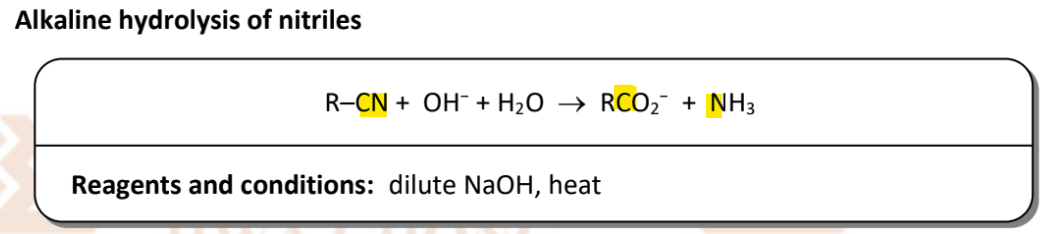
alkaline hydrolysis of nitriles
RnCs: dilute NaOH, heat
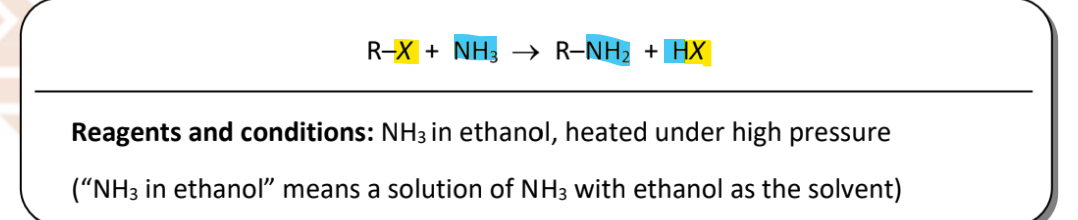
nucleophilic substitution with ammonia to form amines
RnCs: NH3 in ethanol, heated under high pressure
ethanol is solvent for ammonia
as amines can readily react with halogenoalkane, further reactions can occur to form more subsituted amines (pri, sec, ter, qua)
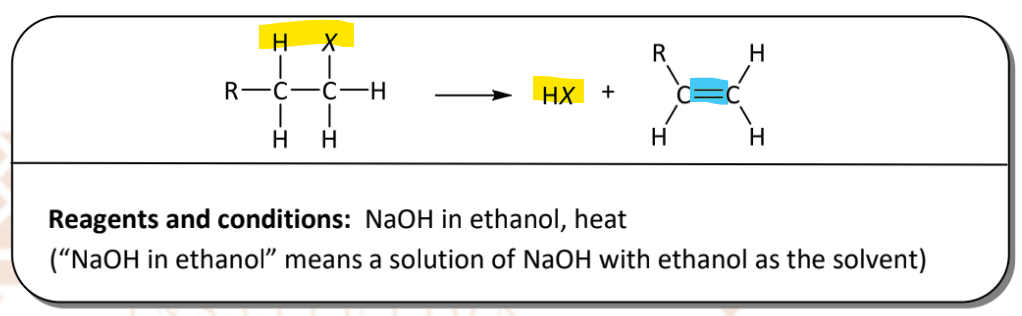
Elimination
RnCs: NaOH in ethanol, heat
Why are halogenoarenes less susceptible to nucleophilic substitution than halogenoalkanes?
bond strength of C-X bond
lone pair of e- on halogen atom delocalises into the benzene ring, resulting in partial double bond character in C-X bond
making bond length shorter and bond strength stronger
C-X bond becomes more difficult to break
Steric hinderance
rear side of C-X bond is blocked by bulky benzene ring, giving steric hinderance to nucleophilic attack
repellence
the pi-electron cloudof benzene ring repels lone pair of e- of incoming nucleophile
describe reactivity of halogenoarenes in electrophilic subsitution
reactive but less susceptible due deactivation by halogen substituent (T >50 for nitration)
halogen substituent is 2,4-directing
describe steps for distinguishing test for halogenoalkanes
add excess NaOH(aq) and heat (release X- ions)
add excess dilute HNO3 (remove unreacted OH- so brown AgO ppt won’t be formed)
Add AgNo3(aq) and observe ppt formed
decant and wash ppt in DI water, then add NH3(aq) to check for solubility (colours of AgCl and AgBr are difficult to differentiate)
Observations for chloroalkane, RCl
white ppt (formed in a longer time than RBr)
dissolves in dilute NH3(aq)
Observations for bromoalkane, RBr
cream ppt (formed in longer time than RI)
dissolves in concentrated NH3
Observations for iodoalkane, RI
yellow ppt (formed almost immediately)
insoluble in even concentrated NH3