surface treatments
 Call Kai
 Learn
Learn Practice Test
 Spaced Repetition
 Match
Match Flashcards
 Knowt Play
1/42

There's no tags or description
Looks like no tags are added yet.
Name | Mastery | Learn | Test | Matching | Spaced | Call with Kai |
|---|
No analytics yet
Send a link to your students to track their progress
43 Terms
Chemical cleaning methods
use chemicals to remove unwanted oils and soils from workpiece surface
mechanical cleaning
removal of substances from surface by mechanical operations
removing burrs, improving smoothness, adding lustre, enhancing surface properties
why clean the surface?
prepare surface for subsequent industrial processing
improve hygiene conditions for workers and customers
remove contaminants that might chemically react with surface
enhance appearance and performance
factors in selecting cleaning method (7)
contaminant
degree of cleanliness required
substrate material to be cleaned
purpose of cleaning
environmental and safety factors
size and geometry
production and cost requirements
types of chemical cleaning (5)
alkaline cleaning
emulsion cleaning
solvent cleaning
acid cleaning
ultrasonic cleaning
mechanical cleaning
physical removal of soils, scales, or films from work surface
by abrasives
deburring and improving surface finish
Blast finishing
high-velocity impact of particulate media
cleans and finishes surface
most well known is sand blasting
propelled by centrifugal force
wet slurry is sometimes fired
shot peening
high velocity of small cast steel pellets (shot) directed at metallic surface
improves fatigue strength of metal parts due to cold working
purpose is different from blast finishing
tumbling and other mass finishing
mixing action inside container in the presence of an abrasive media. causes parts to rub against media and each other to achieve the desired finishing action
mass finishing uses
deburring
descaling
deflashing
polishing
radiusing
burnishing
cleaning
Tumbling
use of horizontally oriented barrel of hexagonal or octagonal cross-section in which parts are mixed by rotating barrel
finishing by landslide action
cycle of rising and tumbling occurs continuously
barrel finishing is slower - several hours
noisy
electroplating
metal ions in electrolyte solution are deposited onto a cathode workpart
aqueous solution of acids, bases or salts
movement of plate metal ions in solution
MUST make structure electrically conductive by applying conductive paint
electroforming
electrolytic deposition of metal onto a pattern until the required thickness is achieved
pattern removed to leave formed part
electroformed parts are thicker so cycle is longer
patterns used in electroforming
solid or expandable
solid patterns have a taper or other geometry that permits removal of the electroplated part
Expendable patterns are fusible or soluble
Fusible is made of low-melting alloys, plastic, wax or other material that can be removed by melting
applications of electroforming
fine molds for lenses, CD, DVD, embossing and printing plates
electroless plating
process driven entirely by chemical reactions
deposition of metal onto part surface occurs in aqueous solution
greater cost
advantages of electroless plating
uniform plate thickness on complex part geometries
process can be used on both metallic and non-metallic substrates
no need for a DC power supply
anodizing
for decorative purposes
corrosion protection
electroplating vs anodizing
workpart to be coated is cathode in electroplating, anode in anodizing
in EP, coating is grown by adhesion of ions of a second metal to base metal
in anodizing, surface coating is formed through chemical reaction of substrate metal into oxide layer
hard anodizing
thick coatings up to 0.25 mm can be formed on aluminium
for high wear and corrosion resistance
organic coatings
polymers and resins
produced naturally or synthetically
applied as liquids that dry or harden as thin surface films on substrates
advantage of organic coatings
variety of colours and textures
protects substrate surface
cheap
easy to apply
what do organic coatings contain
binders
dyes or pigments
solvents
additives
binders
polymers and resins that determine the strength, physical properties and adhesion to surface
holds pigments and other ingredients in coating during and after application
most common binders are natural oils and resins
Dyes
soluble chemicals that colour the coating liquid but do not conceal surface beneath
Pigments
solid particles of uniform size that are dispersed in the coating liquid but insoluble
they colour the coating and hide surface below
they strengthen the coating as they are particulate
solvents
dissolve the binder and other ingredients
common are alcohols, esters, ketones
additives
biocides, fungicides, defoamers, catalysts to promote cross-links
transfer efficiency
proportion of paint supplied to the process that is actually deposited onto the work surface
car finishes
1) phosphate coat applied by dipping
2) primer coat applied by dipping
3) colour paint coat by spray coating
4) clear coat by spraying
methods of application
brushing and rolling, spray coating, immersion, flow coating
brushing and rolling
high transfer efficiency
not suited to mass production
brushing is versatile, rolling is only for flat surfaces
spray coating
forces liquid to atomize into fine mist
form a uniform coating when spread
manually in spray painting booths
or automated process
transfer efficiency is low
electrostatic spraying
improves transfer efficiency of spray coating
workpart is grounded electrically and atomized droplets are electrostatically charged
droplets are drawn to the part surfaces so that transfer efficiencies reach 90%
immersion
applies large amounts of liquid coating to the workpart, allowing excess to drain off and be recycled.
dip coating is the simplest, immersed in an open tank of liquid coating material
electrocoating
variation of dip coating where the part is electrically charged and dipped into paint bath of the opposite charge
improves adhesion and permits use of water-based paints
flow coating
workparts are moved through a paint booth where a series of nozzles shower the coating liquid onto the part surfaces.
excess drains into sump for recycling
organic coating converts from liquid to solid
curing
chemical change in organic resin where polymerisation/cross-linking occurs to harden coating
type of coating determines type of chemical reaction
ambient temperature curing
evaporation of solvent and oxidation of resin
elevated temperature curing
elevated temperatures are used to accelerate solvent evaporation as well as polymerisation of resin
catalytic curing
starting resins require reactive agents ‘
for polymerisation and cross-linking
radiation curing
various forms of radiation such as microwaves, UV light, and electron beams are required to cure
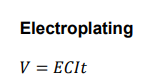
eletroplating formula
V= volume of metal deposited
E= Mass deposited per unit charge
C= current efficiency
t= time