RP2: Measuring an enthalpy change
 Call Kai
 Learn
Learn Practice Test
 Spaced Repetition
 Match
Match Flashcards
 Knowt Play
1/9

There's no tags or description
Looks like no tags are added yet.
Name | Mastery | Learn | Test | Matching | Spaced | Call with Kai |
|---|
No analytics yet
Send a link to your students to track their progress
10 Terms
Draw and label a diagram of the apparatus used in this experiment (3)
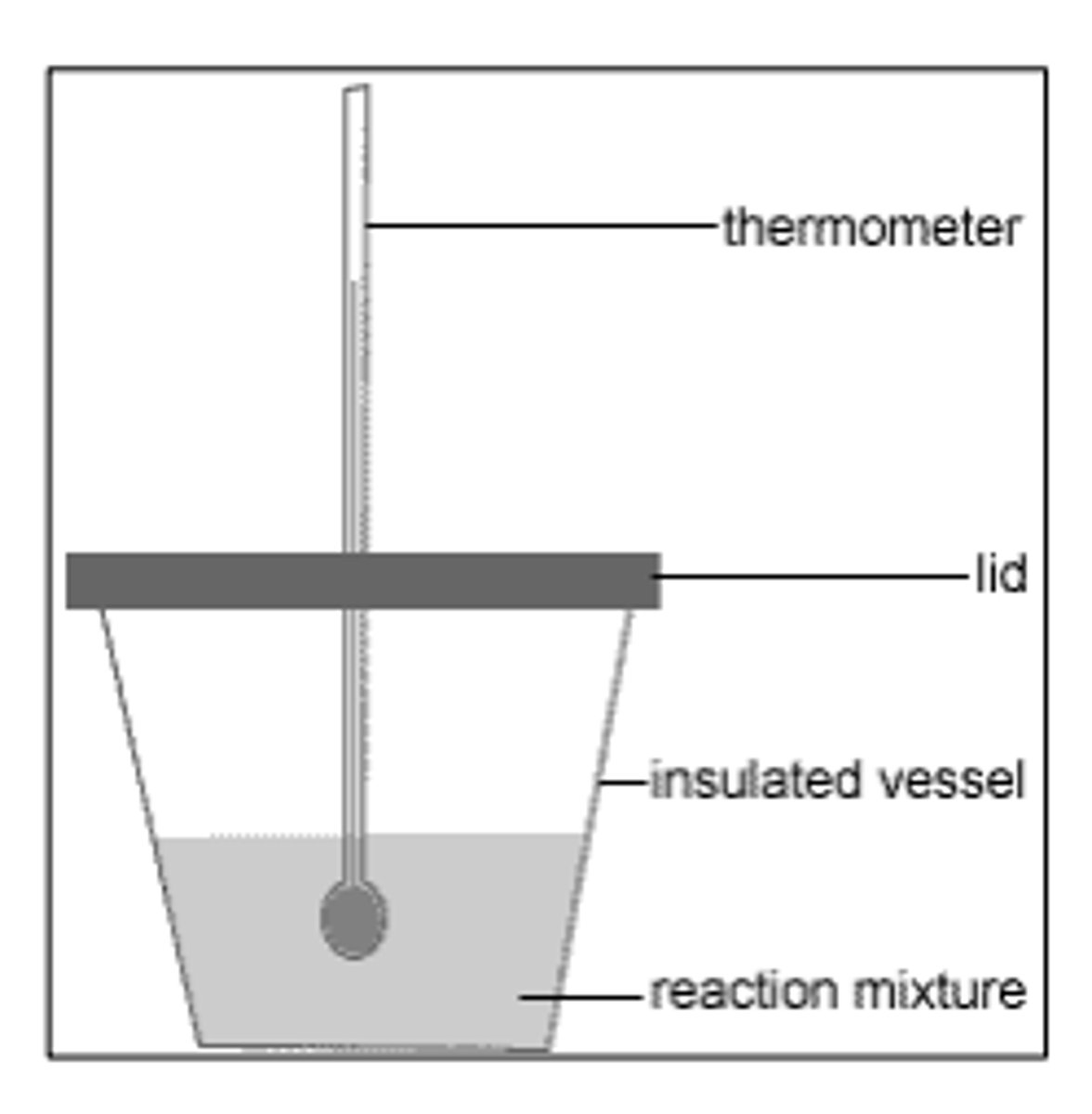
What is used to insulate and support the reaction mixture in an enthalpy change experiment? (1)
A polystyrene cup in a beaker
How should the thermometer be positioned in the experiment? (1)
Clamped in place with the bulb immersed in liquid
What temperature measurements should be taken before starting the reaction? (1)
The initial temperature(s) of the solution (or both solutions if two are used)
What is the correct order of adding reagents if a solid reagent is used? (2)
1. Add the solution to the cup first
2. Then add the weighed-out solid
What should be done to ensure even mixing of the reactants? (1)
Stir the mixture
What is recorded at the end of the reaction? (1)
The highest/lowest temperature reached
Why is the exact temperature rise difficult to obtain if the reaction is slow? (1)
Cooling occurs at the same time as the reaction
How can inaccuracies due to cooling be minimised in temperature measurements? (3)
1. Take readings at regular intervals
2. Plot the data
3. Extrapolate the temperature curve back
What are common sources of error in an enthalpy change experiment? (5)
- Heat loss/gain
- Approximation of specific heat capacity of solution
- Neglecting specific heat capacity of the calorimeter
- Incomplete reaction
- Assuming the density of the solution is the same as water