BIOC 4331 Lecture 37-39 (Glycogenesis and Glycogenolysis)
 Call Kai
 Learn
Learn Practice Test
 Spaced Repetition
 Match
Match Flashcards
 Knowt Play
1/49

There's no tags or description
Looks like no tags are added yet.
Name | Mastery | Learn | Test | Matching | Spaced | Call with Kai | Chat |
|---|
No analytics yet
Send a link to your students to track their progress
50 Terms
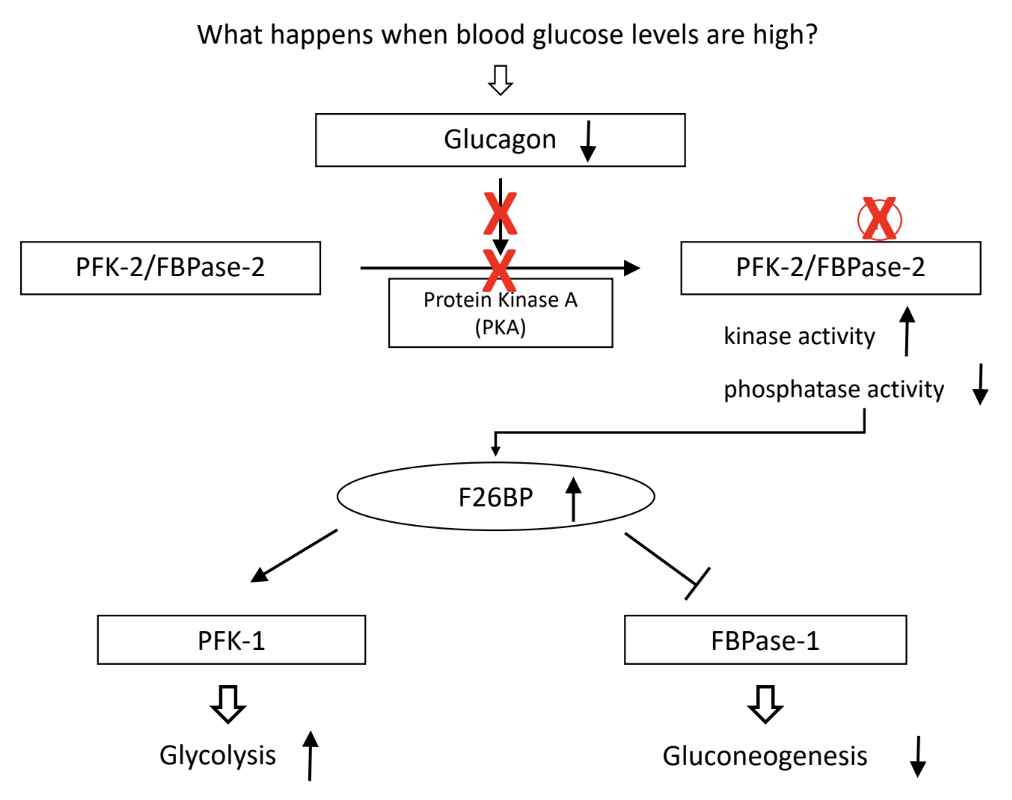
What happens to glucagon signaling when blood glucose is high?
Glucagon decreases.
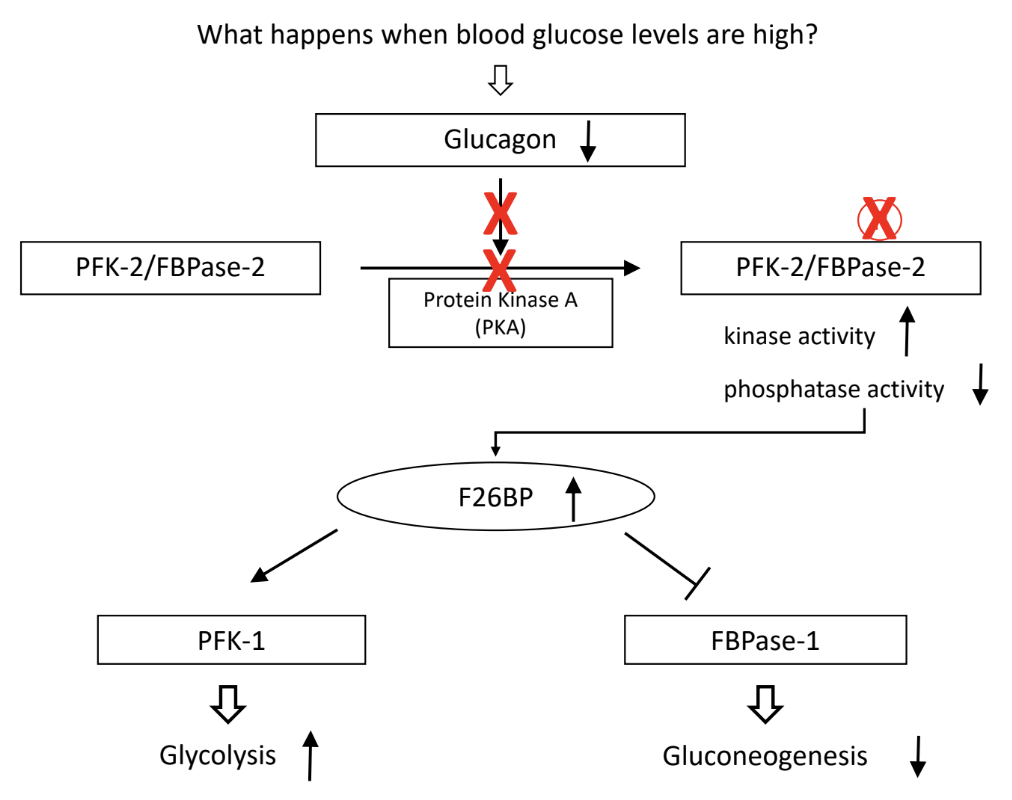
What happens to PKA activity when blood glucose is high?
PKA activity decreases.
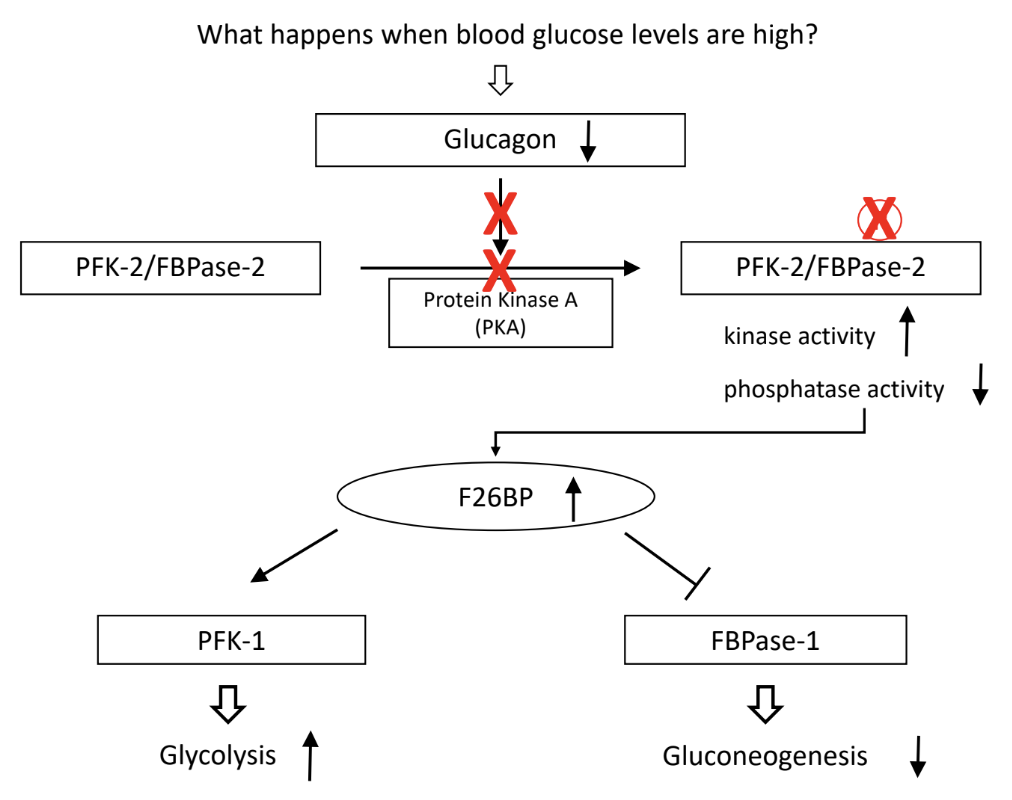
What happens to PFK-2/FBPase-2 when blood glucose is high?
Kinase activity increases and phosphatase activity decreases, so F26BP increases.
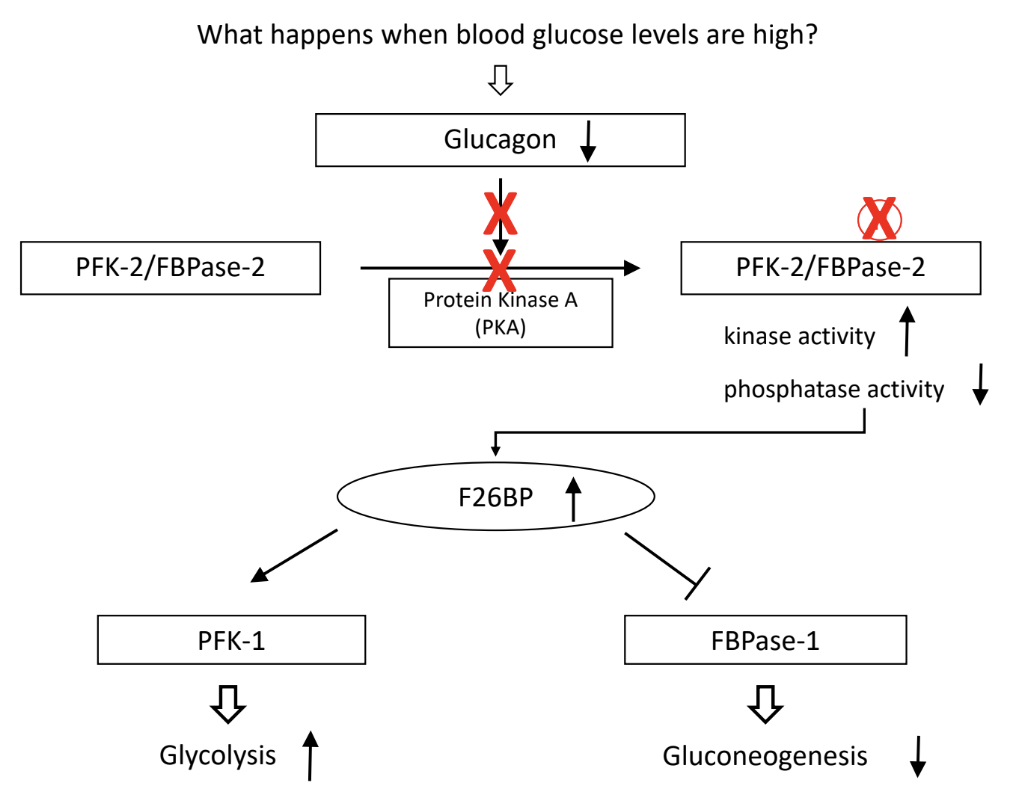
What is the effect of increased F26BP when blood glucose is high?
It activates PFK-1 and inhibits FBPase-1, increasing glycolysis and decreasing gluconeogenesis.
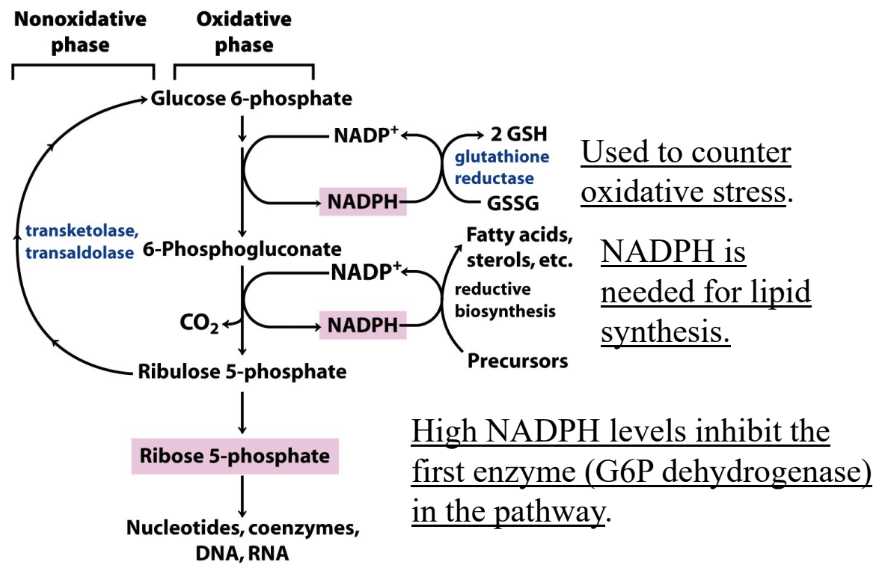
What is the main purpose of the pentose phosphate pathway?
To produce NADPH and ribose-5-phosphate from glucose-6-phosphate.
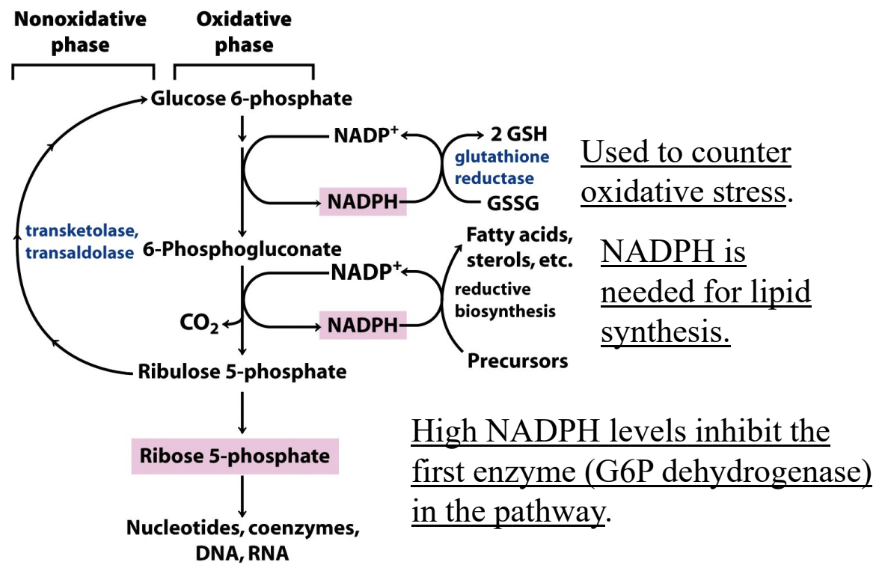
What important sugar does the pentose phosphate pathway produce for nucleotide synthesis?
Ribose-5-phosphate.
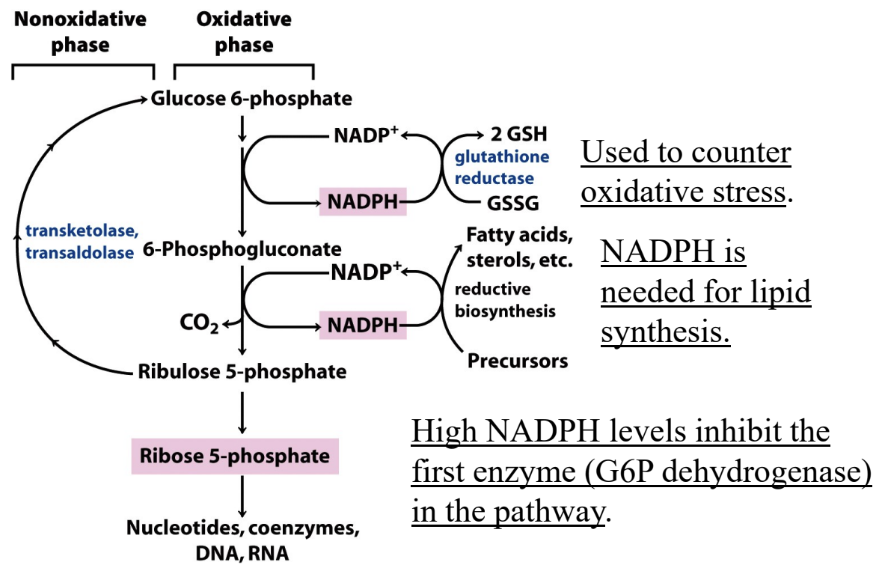
What important reducing equivalent does the pentose phosphate pathway produce?
NADPH.
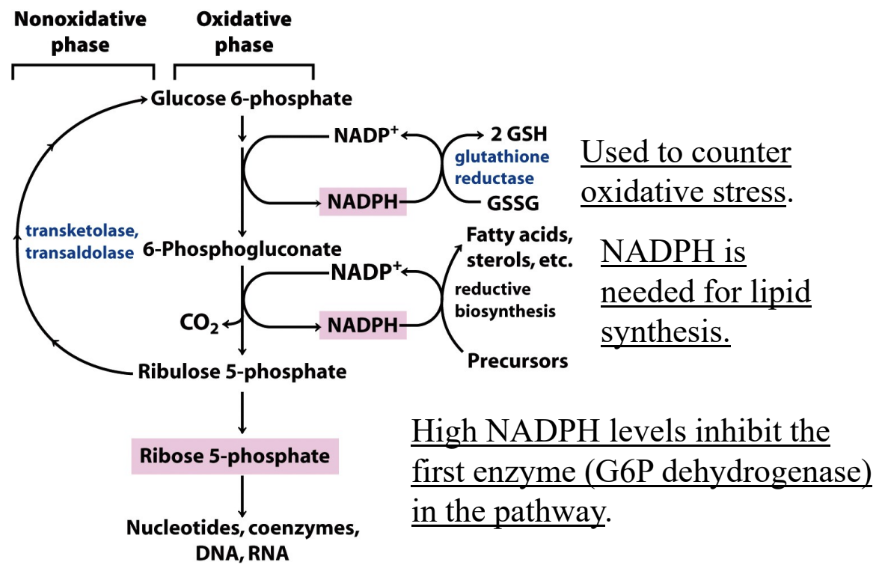
What is NADPH used for?
Reductive biosynthesis such as fatty acid synthesis and maintenance of reduced glutathione for protection against oxidative stress.
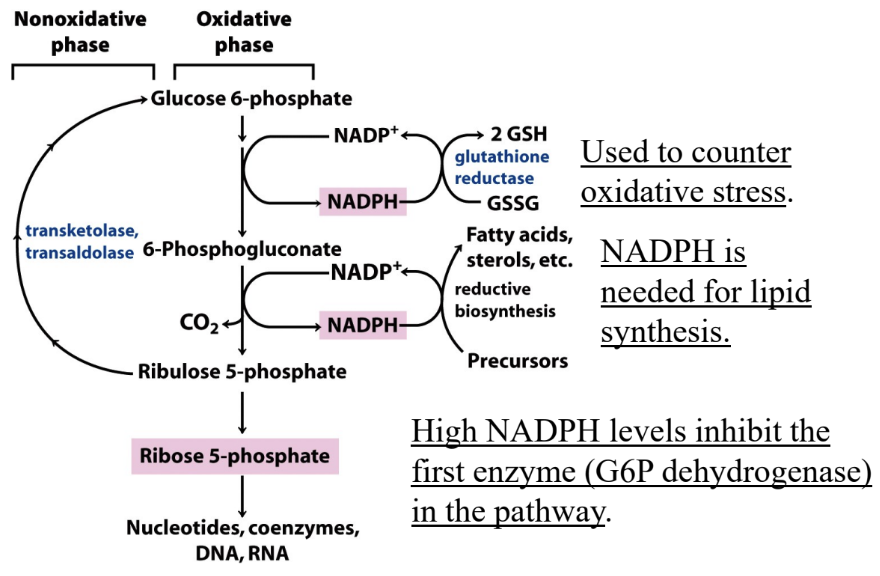
How does NADPH help protect cells from oxidative stress?
It reduces glutathione, which helps protect the cell from oxidative stress.
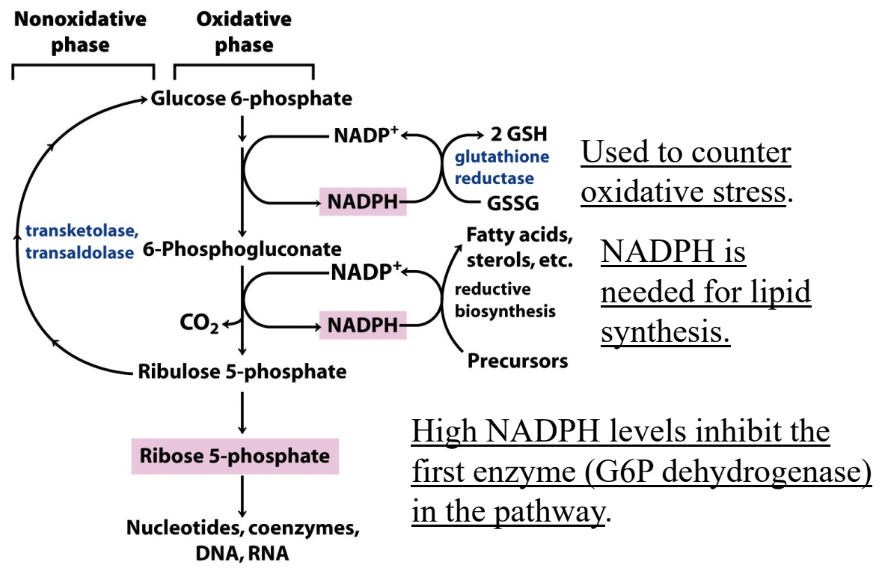
What happens to glucose-6-phosphate in the oxidative phase of the pentose phosphate pathway?
It is oxidized, and electrons are transferred to NADP+ to form NADPH.
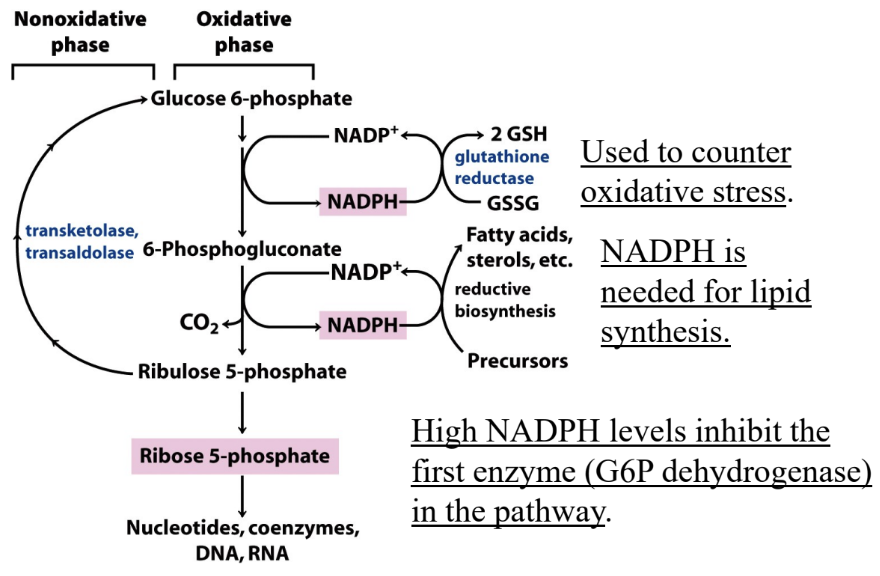
What is the carbon-number change in the pentose phosphate pathway?
A 6-carbon sugar is converted into a 5-carbon sugar.
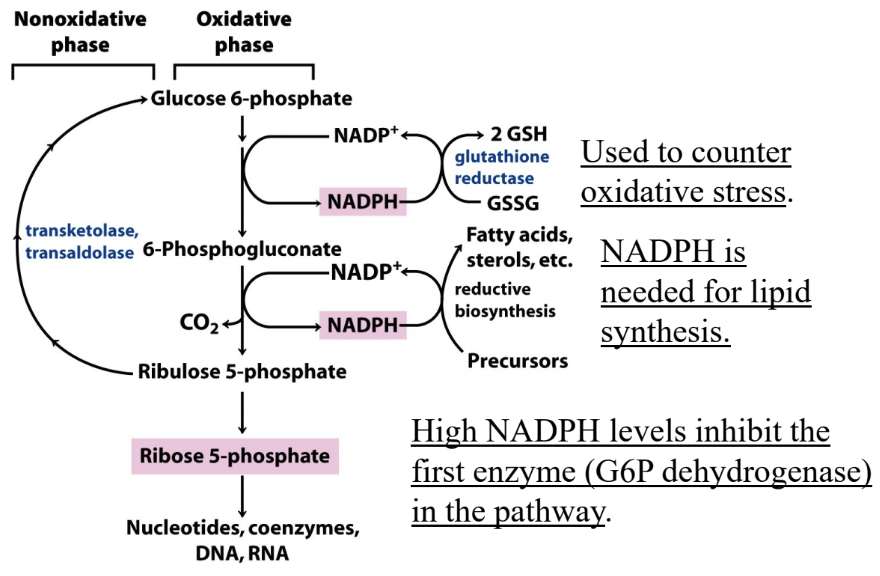
What inhibits the first enzyme of the pentose phosphate pathway?
High NADPH levels inhibit glucose-6-phosphate dehydrogenase.
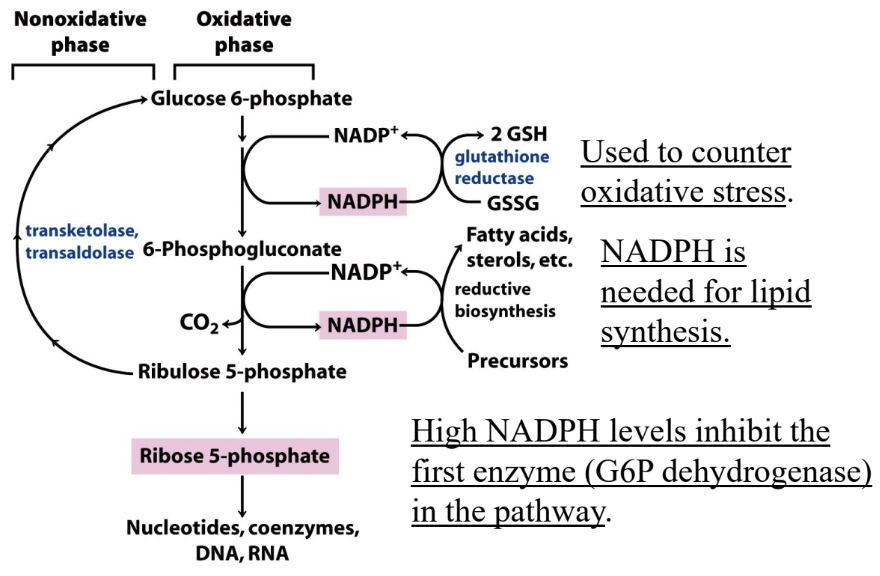
What are the two major phases of the pentose phosphate pathway?
Oxidative phase and nonoxidative phase.
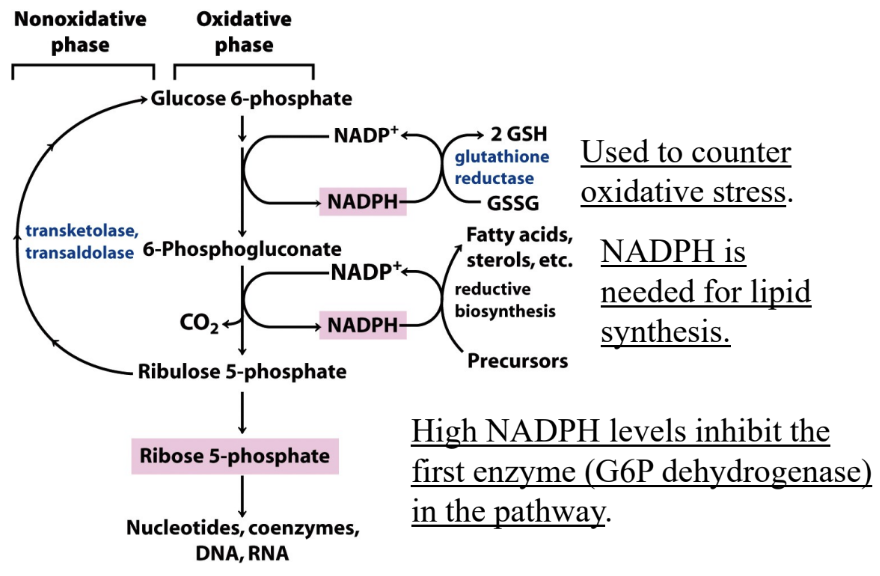
What does the nonoxidative phase of the pentose phosphate pathway do?
It rearranges sugars and can recycle pentose phosphates back into hexose phosphates.
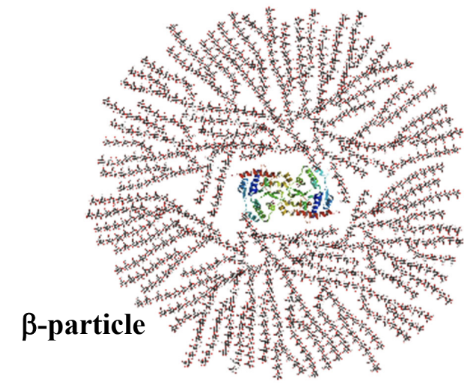
What is glycogen?
A branched polymer of glucose used for glucose storage.
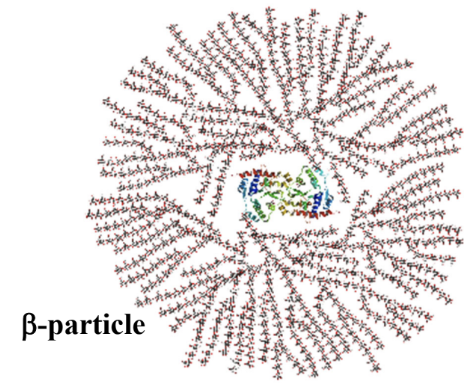
What glycosidic linkages are found in glycogen?
Alpha-1,4 linkages in the linear chains and alpha-1,6 linkages at branch points.
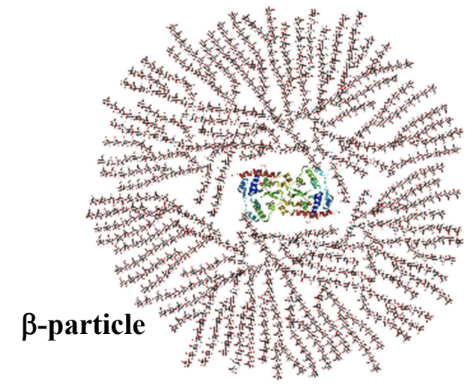
How often does glycogen branch?
About every 8 to 12 residues.
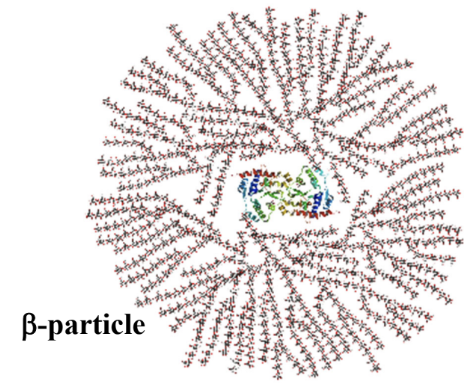
Where is glycogen especially abundant?
Liver and skeletal muscle.
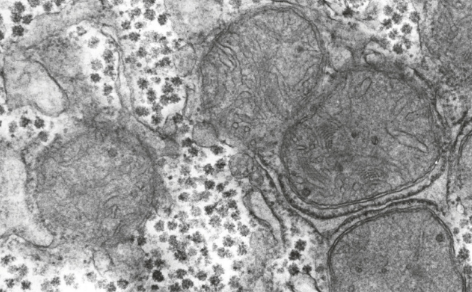
What is the main role of liver glycogen?
Regulation of blood glucose levels.
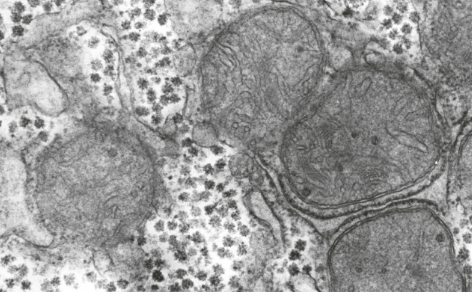
What is the main role of muscle glycogen?
A rapidly available energy source for muscle.
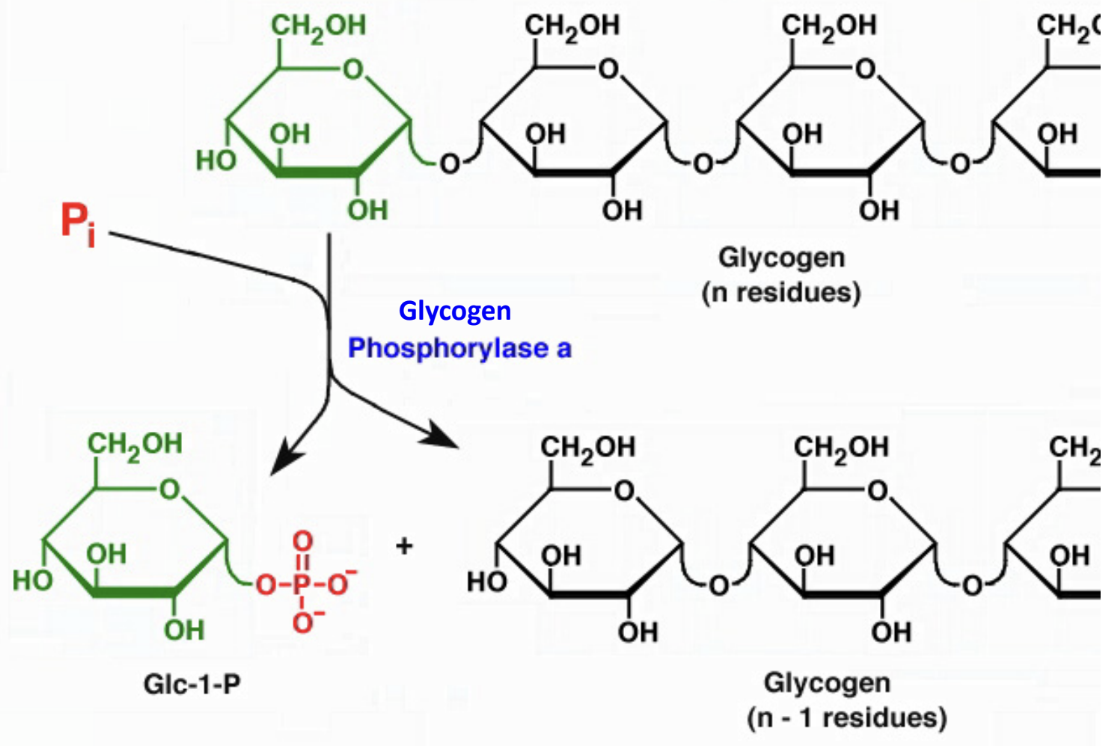
What enzyme catalyzes the phosphorolytic breakdown of glycogen?
Glycogen phosphorylase.
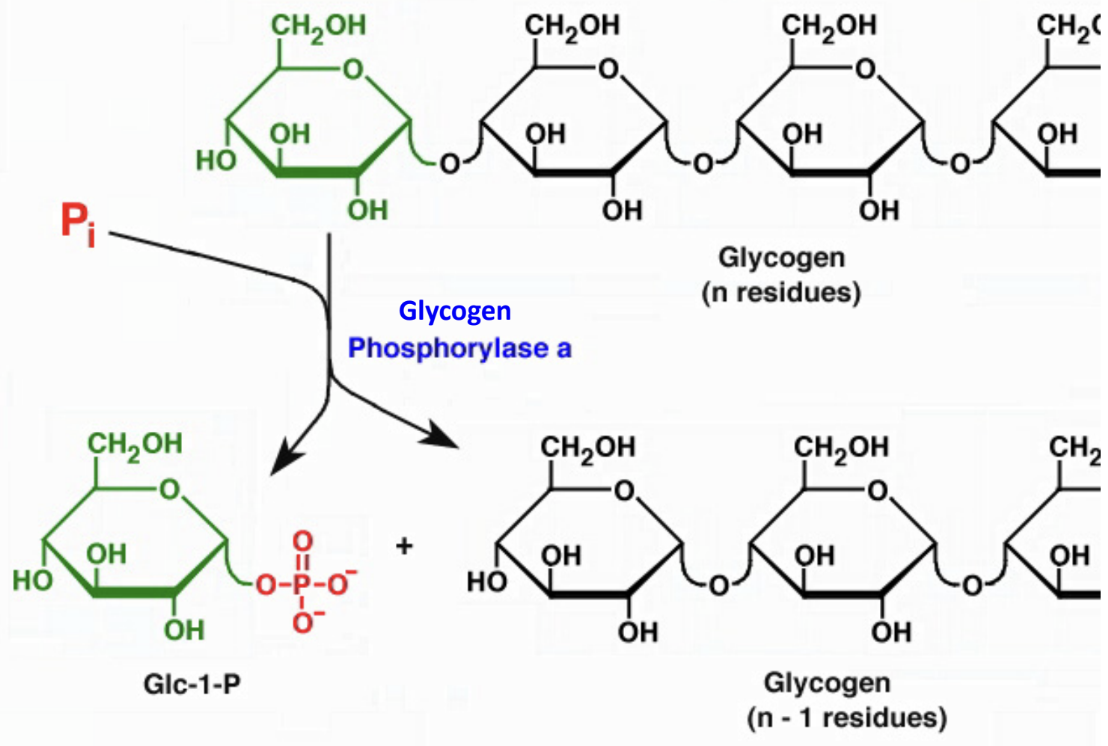
What product is released by glycogen phosphorylase?
Glucose-1-phosphate.
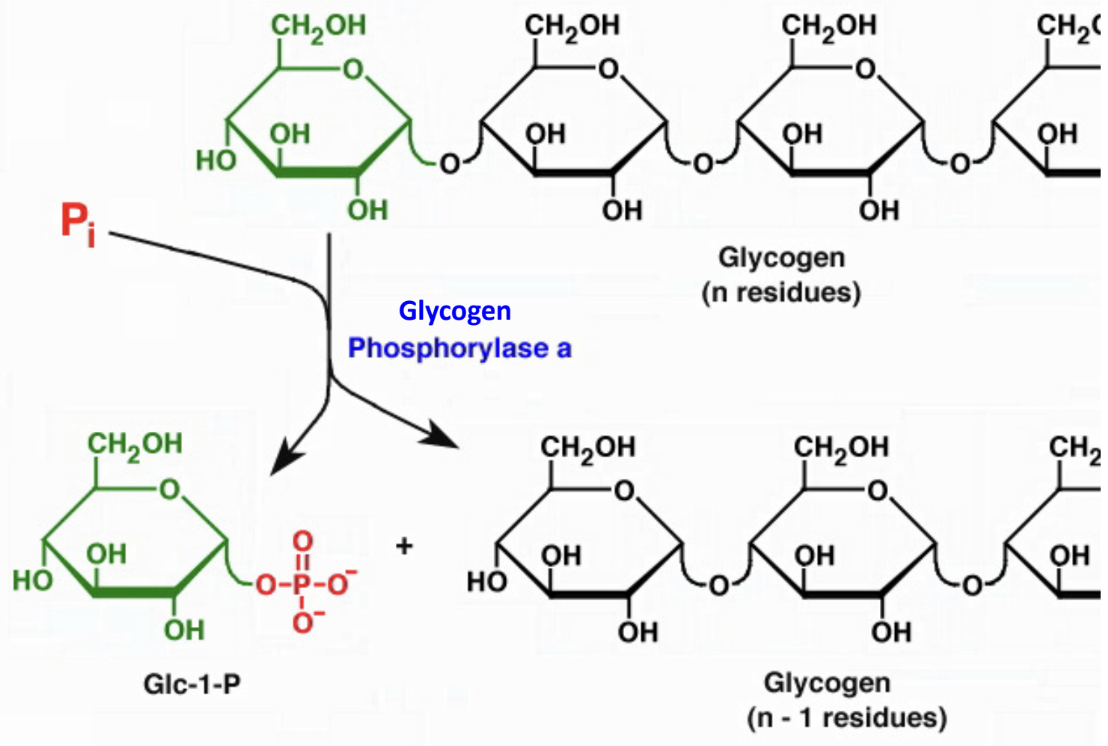
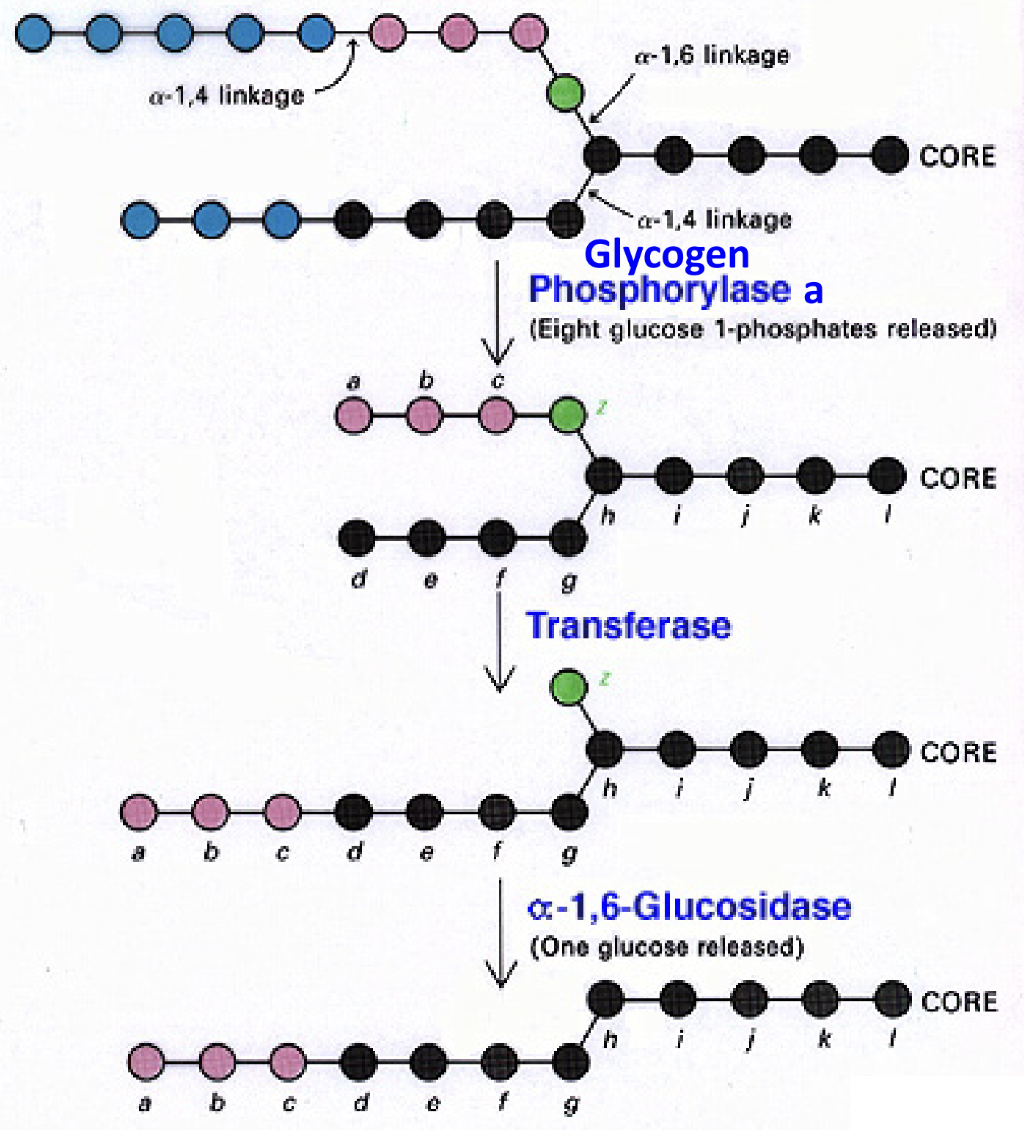
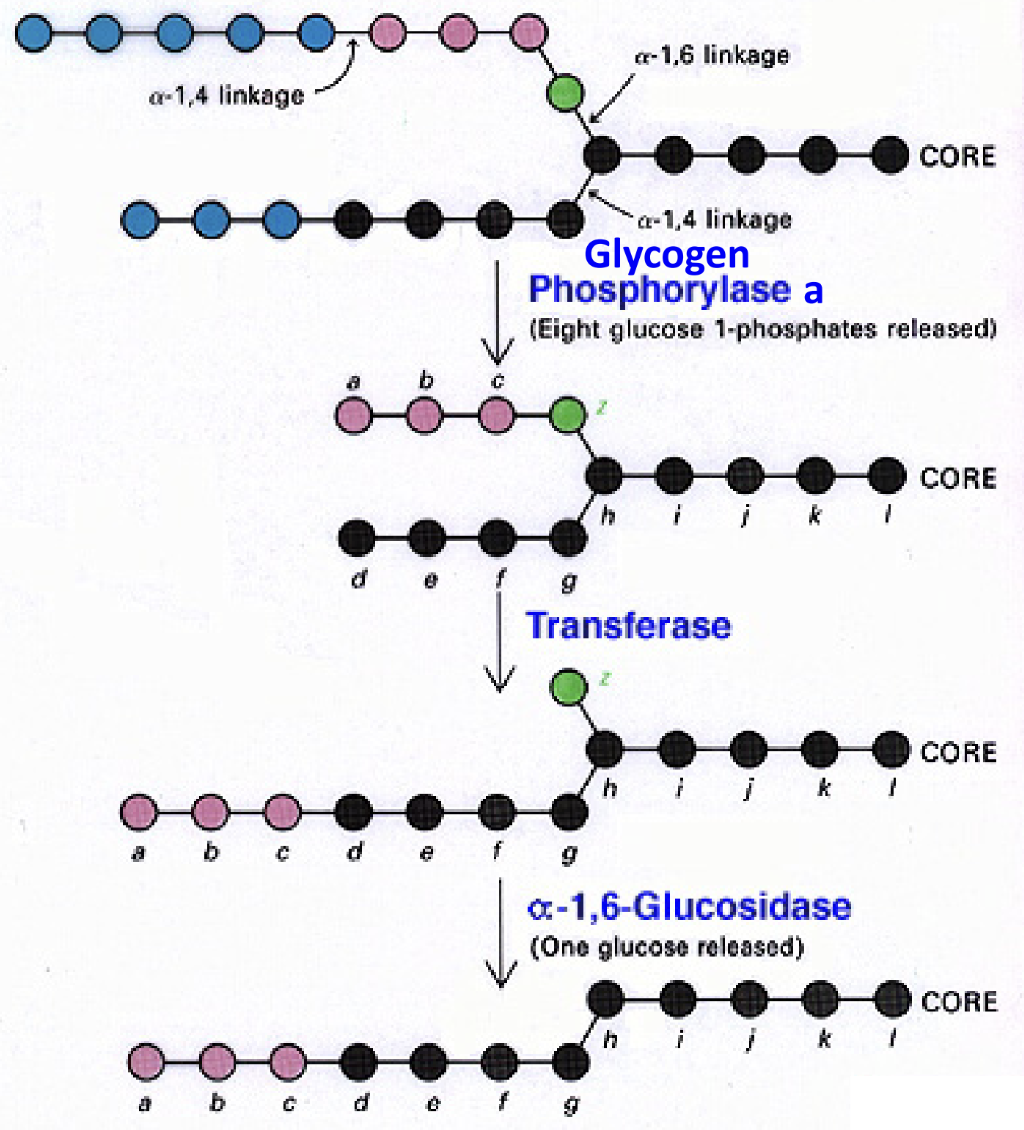
How close to a branch point can glycogen phosphorylase degrade glycogen?
It stops when it is about 4 residues away from a branch point.
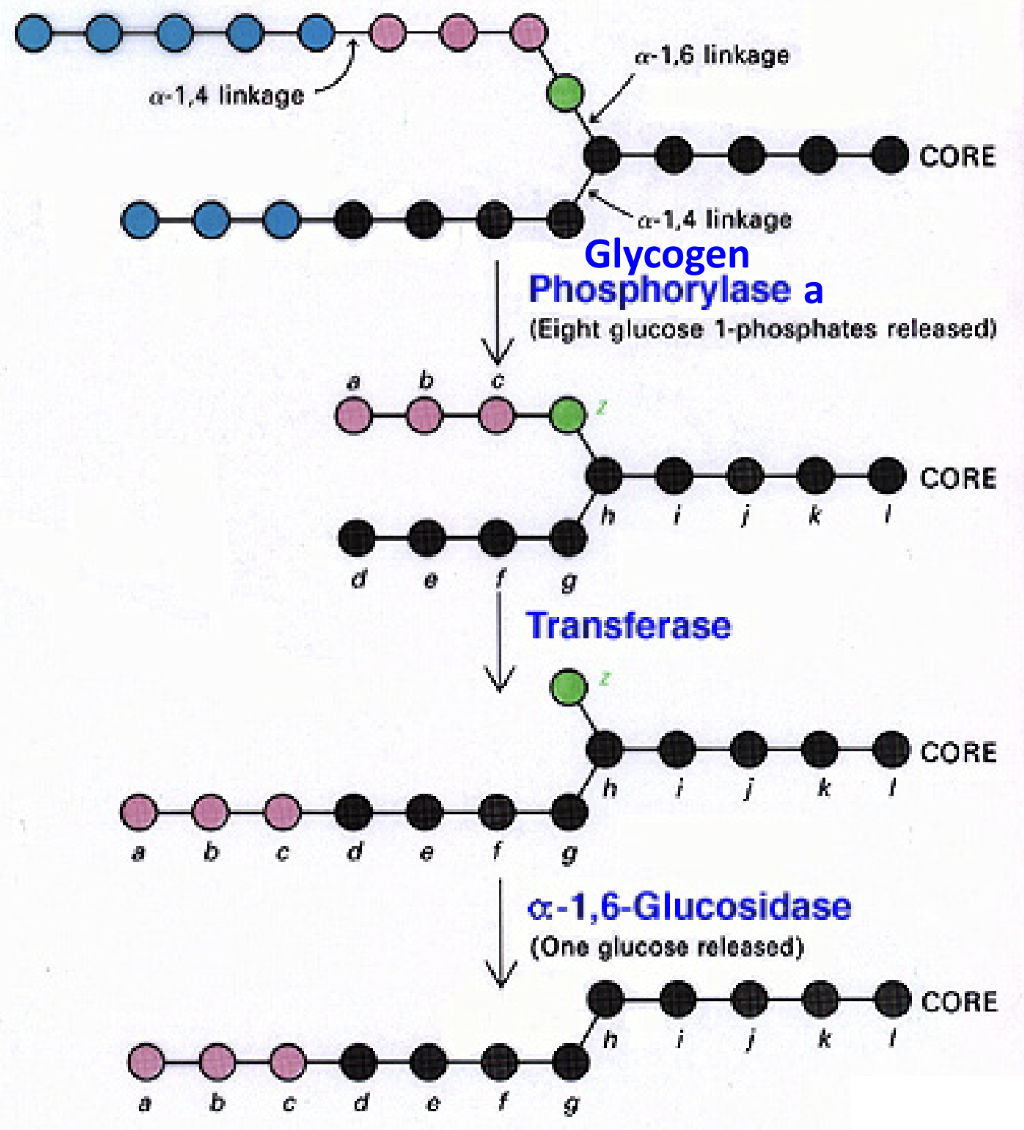
What are the two activities of the glycogen debranching enzyme?
Transferase activity and alpha-1,6-glucosidase activity.
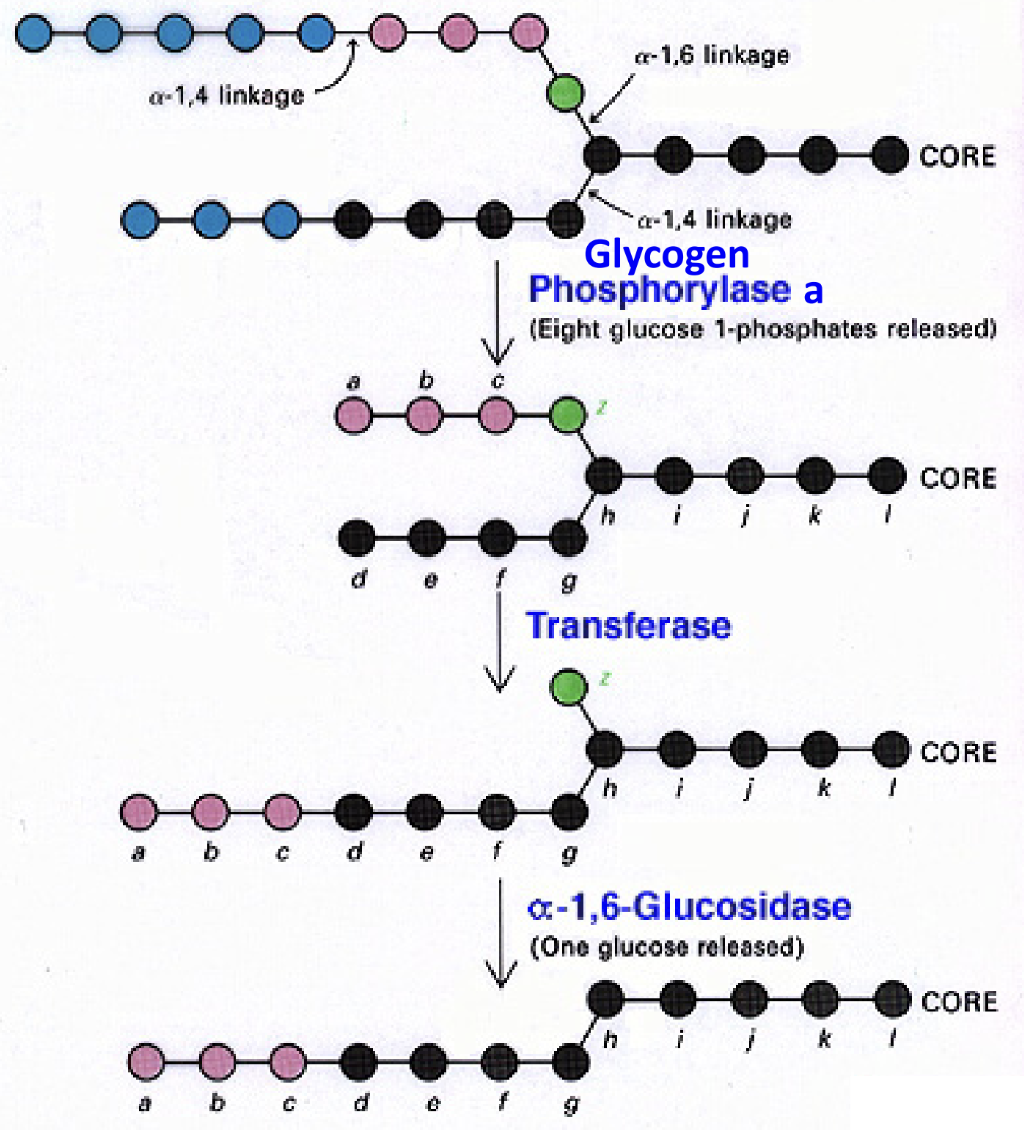
What does the transferase activity of the debranching enzyme do?
It transfers a short oligosaccharide from a branch to a nearby chain.
What does the alpha-1,6-glucosidase activity of the debranching enzyme do?
It hydrolyzes the alpha-1,6-linked glucose at the branch point, releasing free glucose.
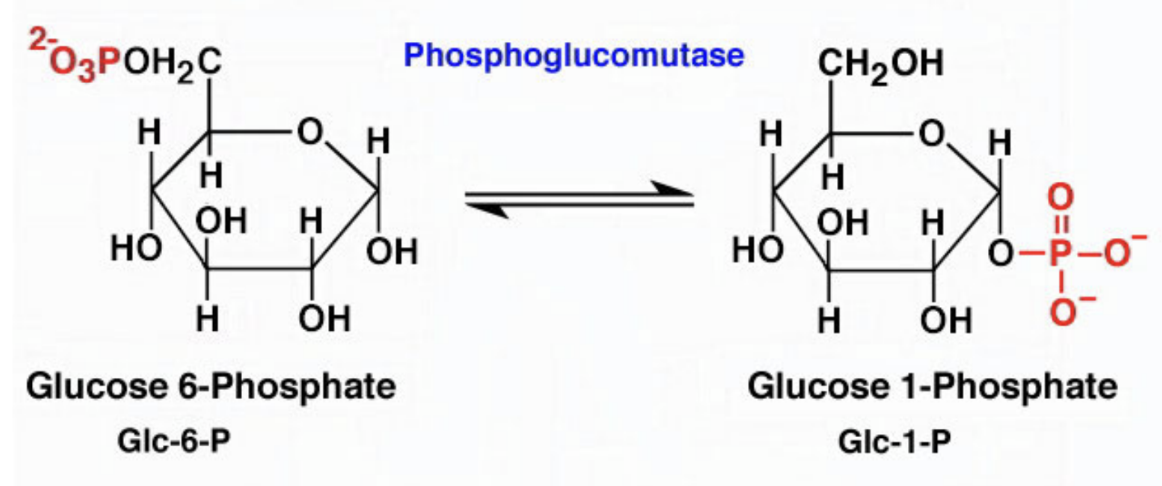
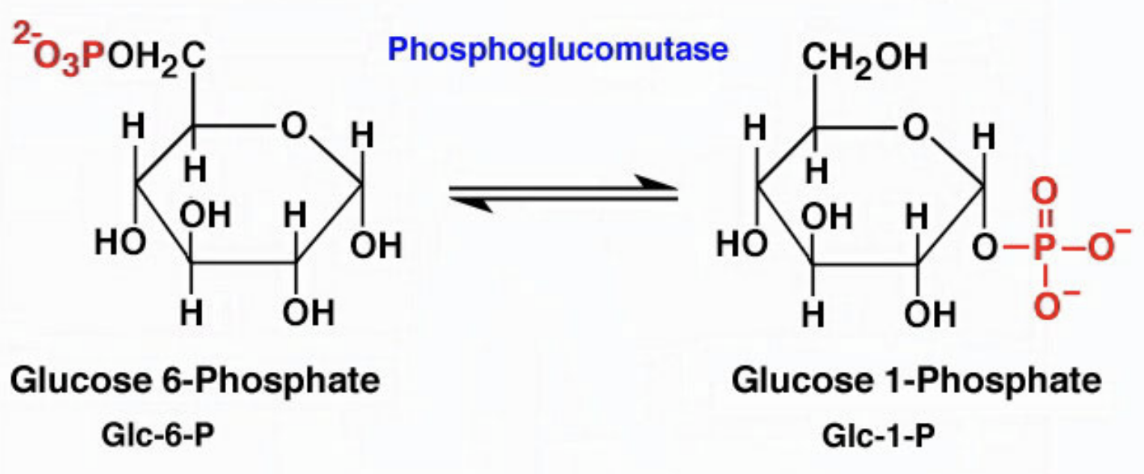
What enzyme converts glucose-1-phosphate to glucose-6-phosphate?
Phosphoglucomutase.
How does phosphoglucomutase work mechanistically?
It uses a phosphorylated Ser residue and the intermediate glucose-1,6-bisphosphate to convert glucose-1-phosphate to glucose-6-phosphate.
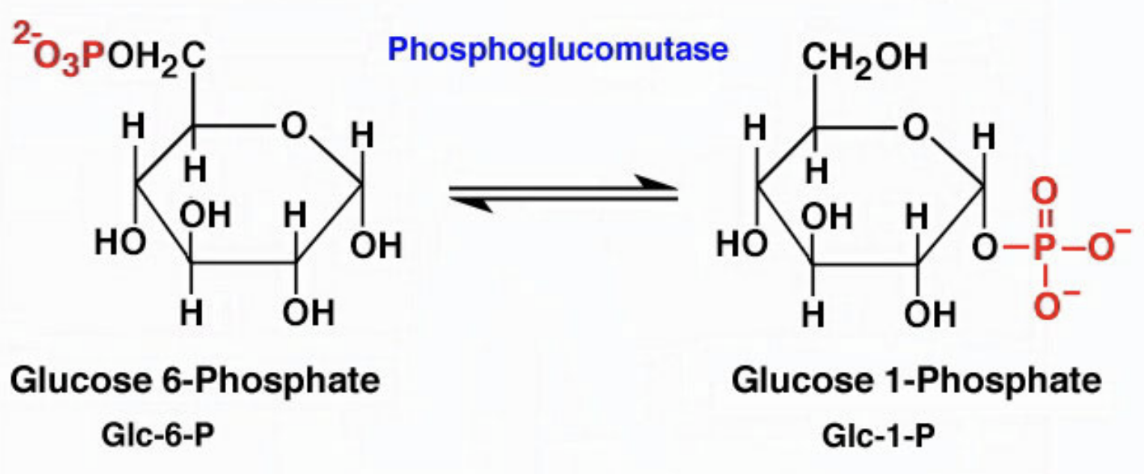
What can glucose-6-phosphate derived from glycogen be used for in muscle?
It can enter glycolysis.
What can glucose-6-phosphate derived from glycogen be used for in liver?
It can be converted to free glucose by glucose-6-phosphatase for release into the blood.
What is glycogenesis?
Glycogen synthesis.
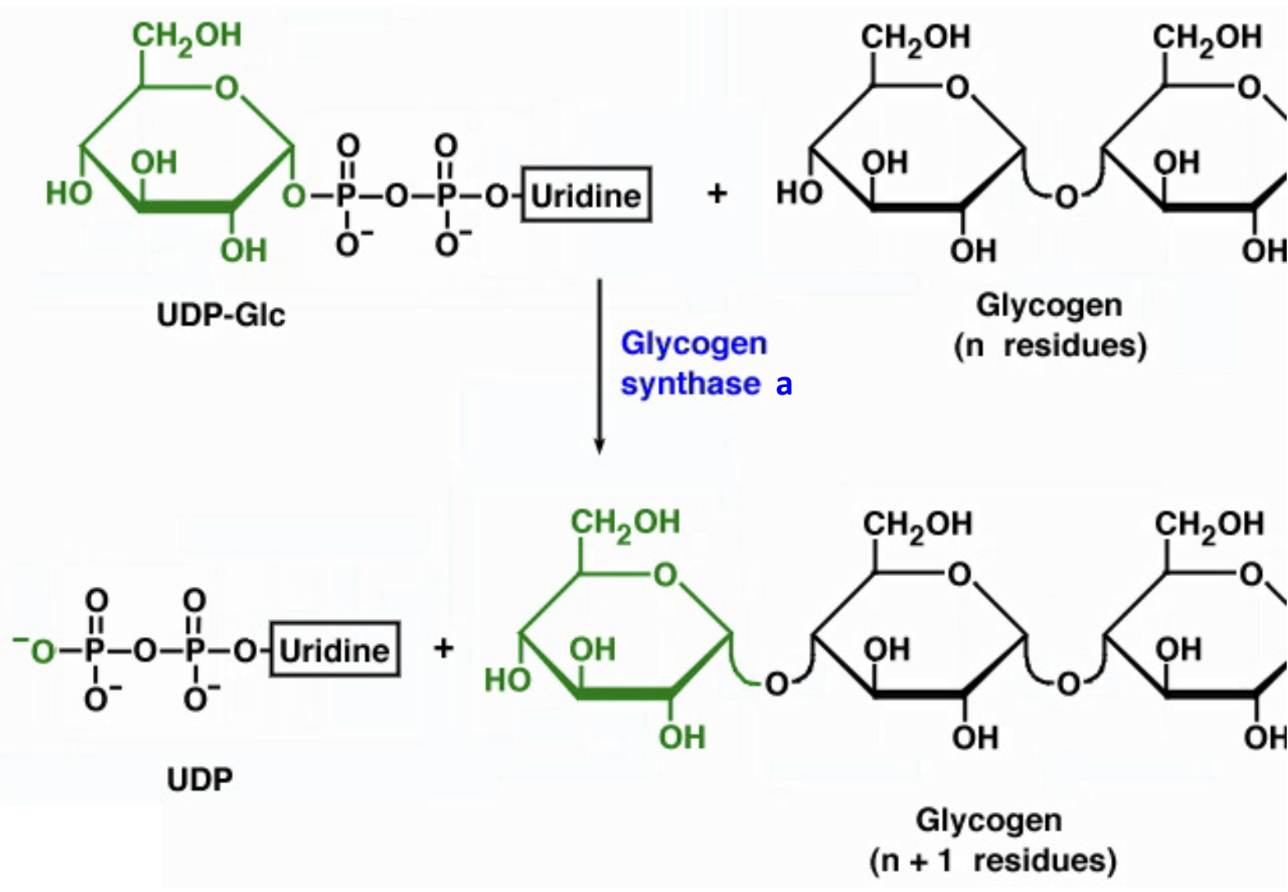
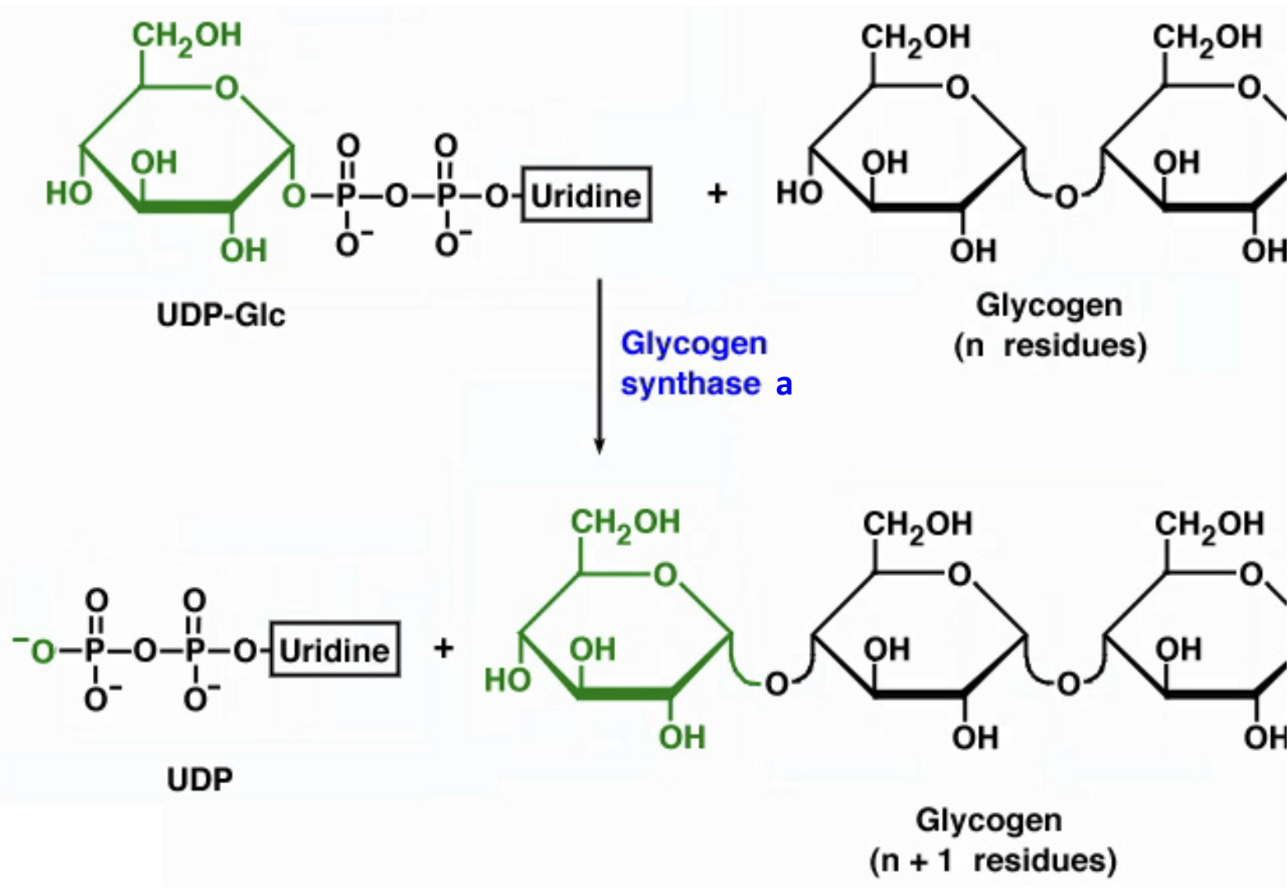
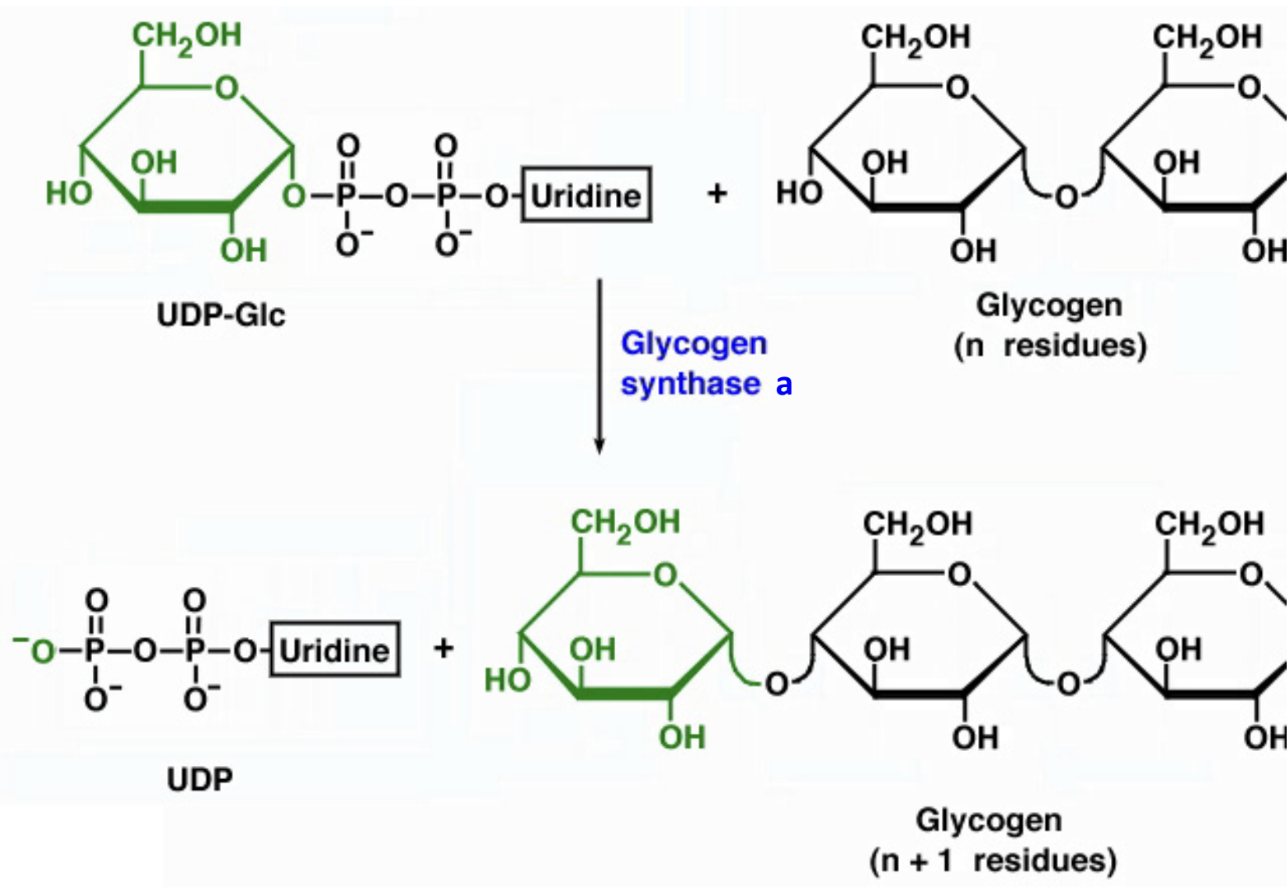
What enzyme catalyzes glycogen chain elongation in glycogenesis?
Glycogen synthase a.
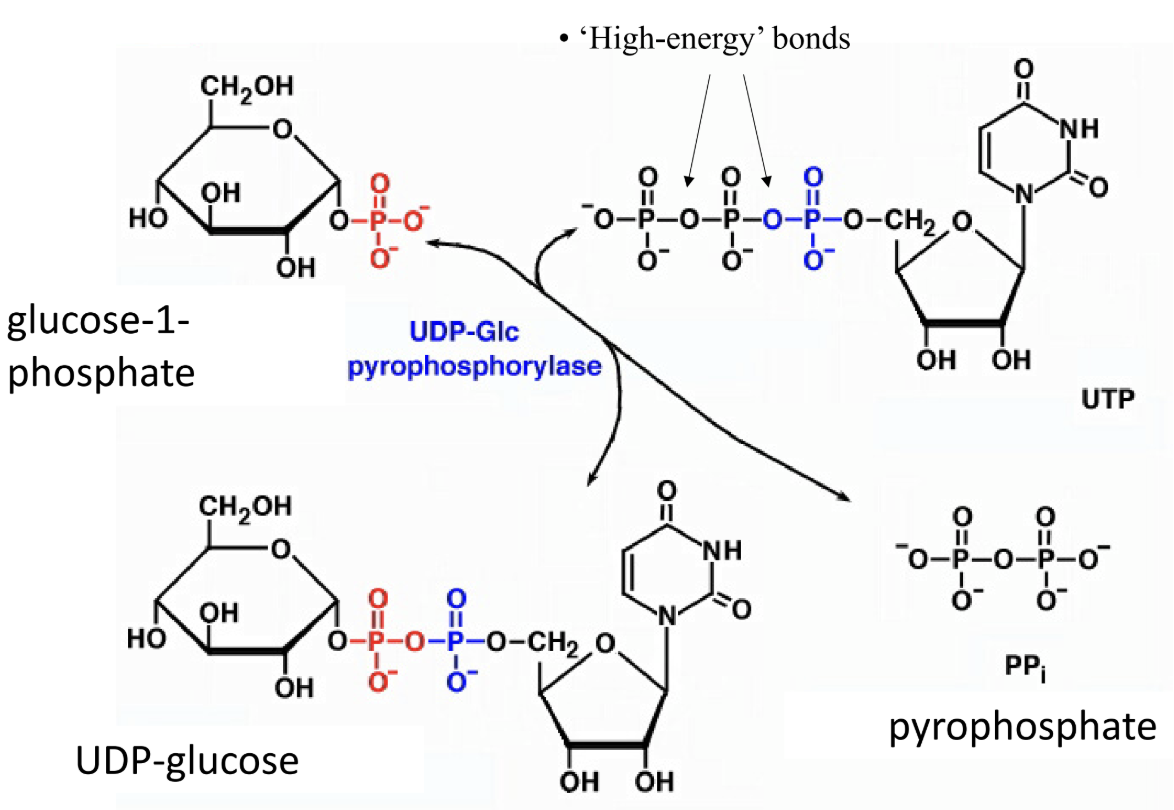
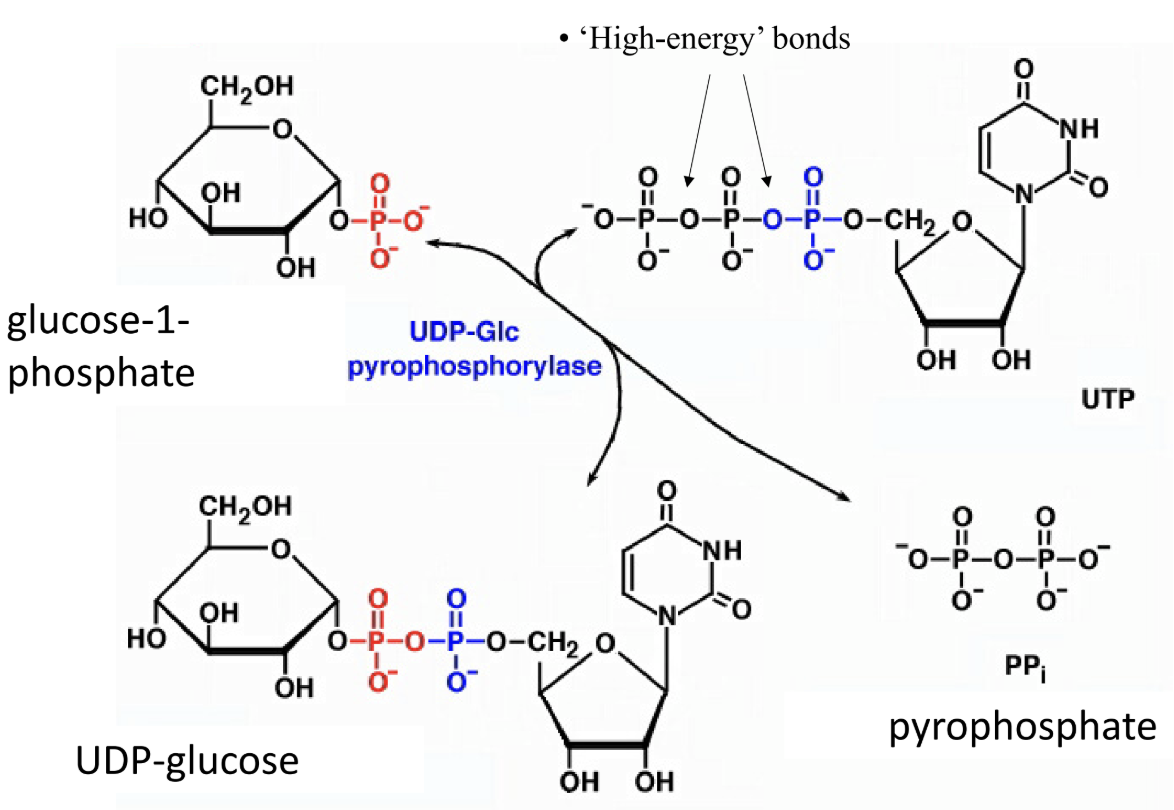
What activated glucose donor is used in glycogenesis?
UDP-glucose.
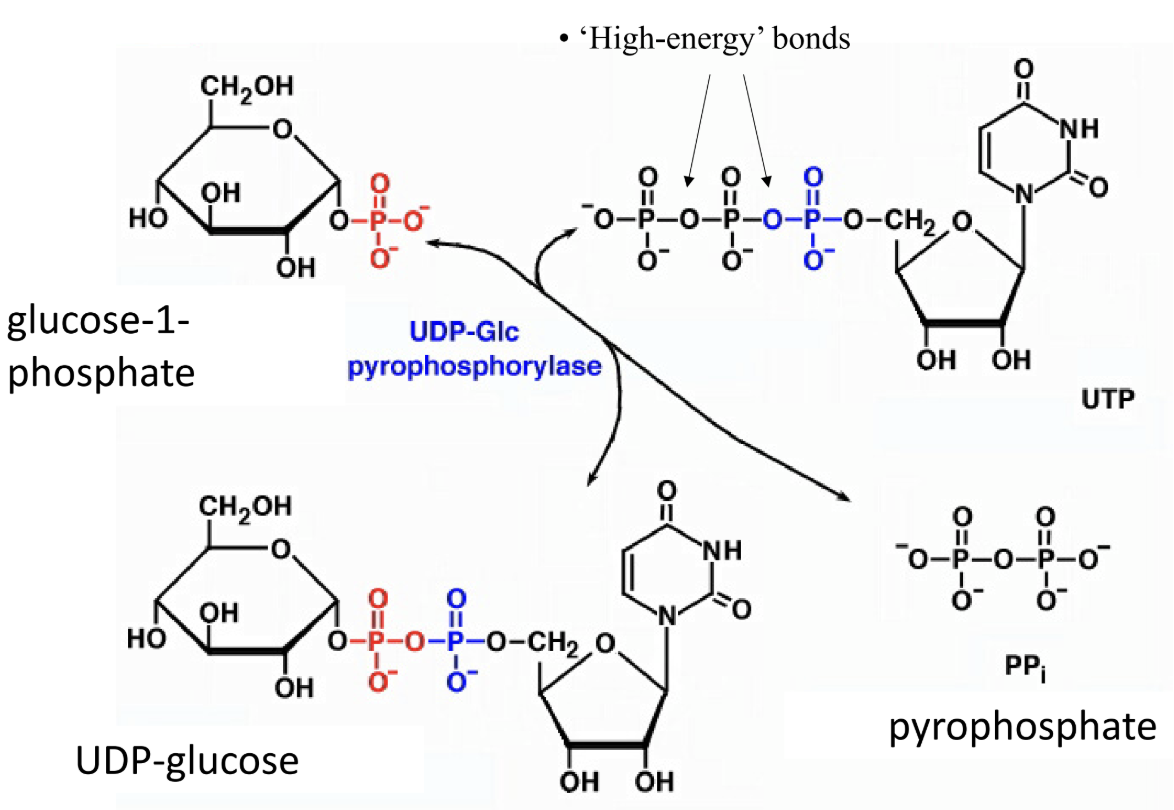
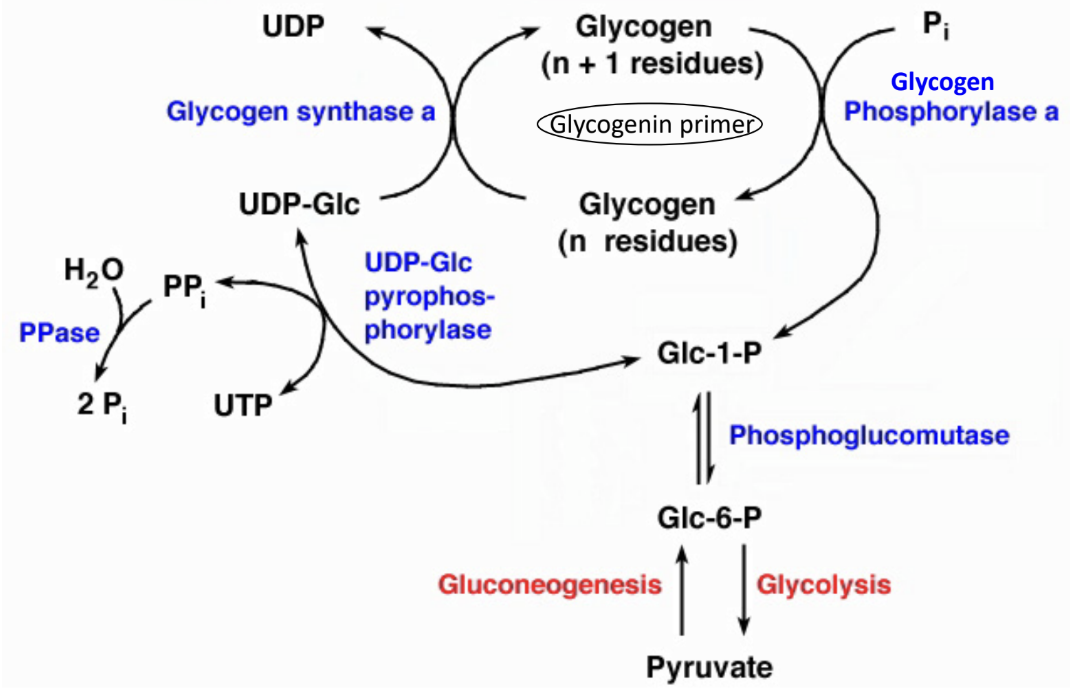
How is UDP-glucose formed?
Glucose-1-phosphate reacts with UTP to form UDP-glucose and pyrophosphate (PPi).
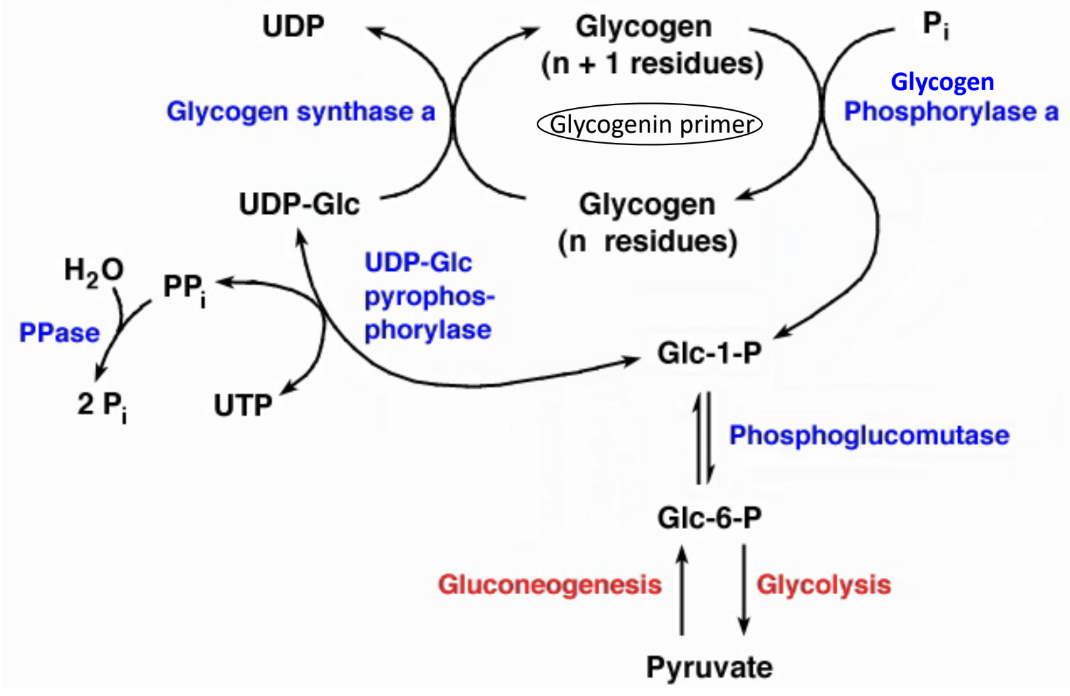
Why is UDP-glucose formation driven forward?
Pyrophosphate is hydrolyzed to 2 Pi by inorganic pyrophosphatase, making the overall process favorable.
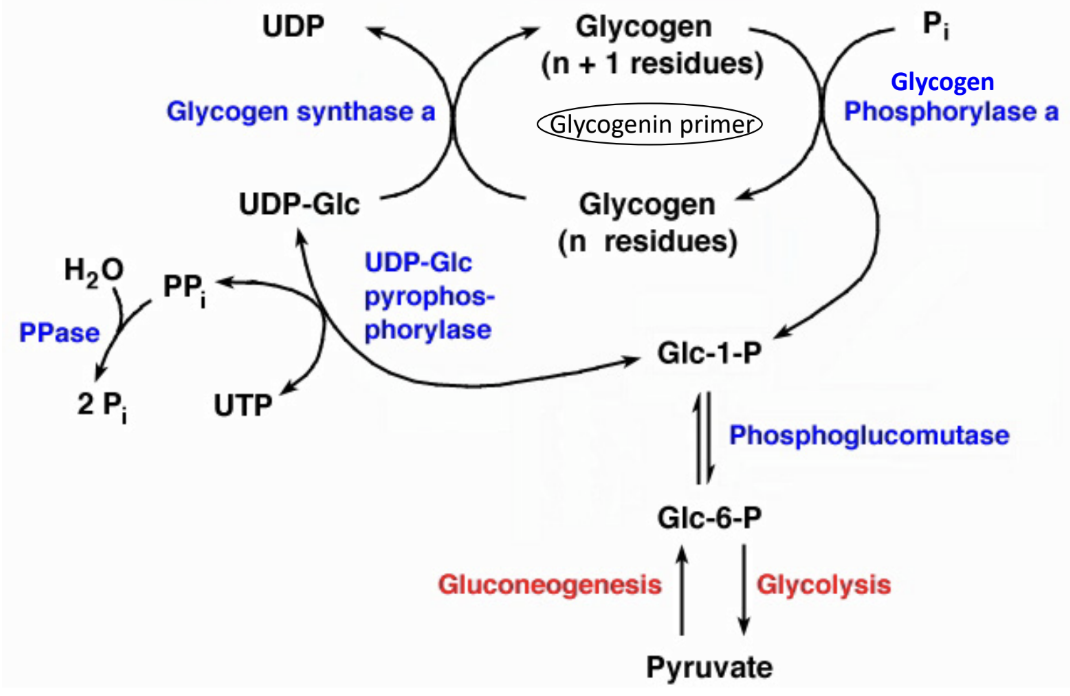
What enzyme makes UDP-glucose from glucose-1-phosphate and UTP?
UDP-glucose pyraophosphorylase.
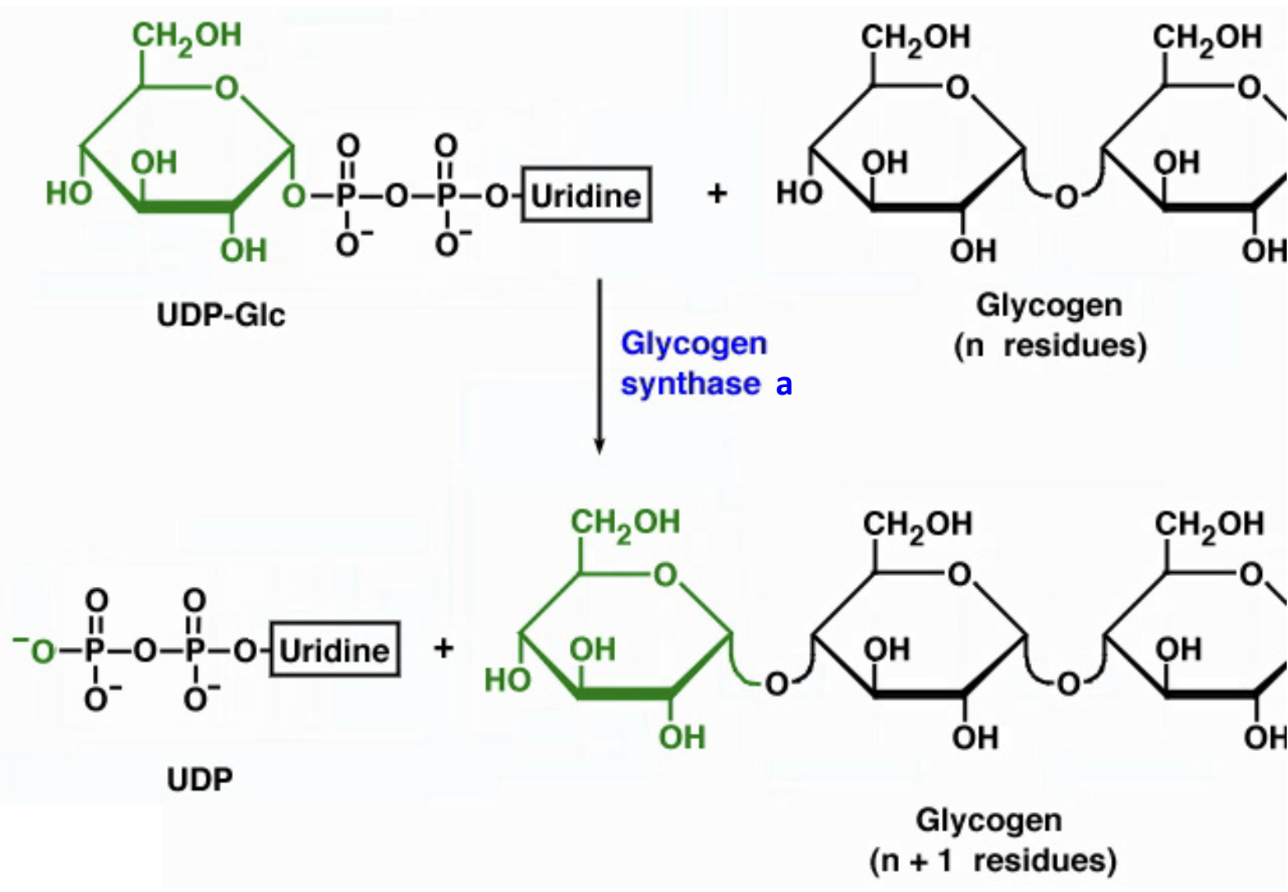
What does glycogen synthase do?
It transfers glucose from UDP-glucose to the nonreducing end of glycogen, forming an alpha-1,4 linkage.
Can glycogen synthase start a new glycogen molecule by itself?
No, it requires a primer.
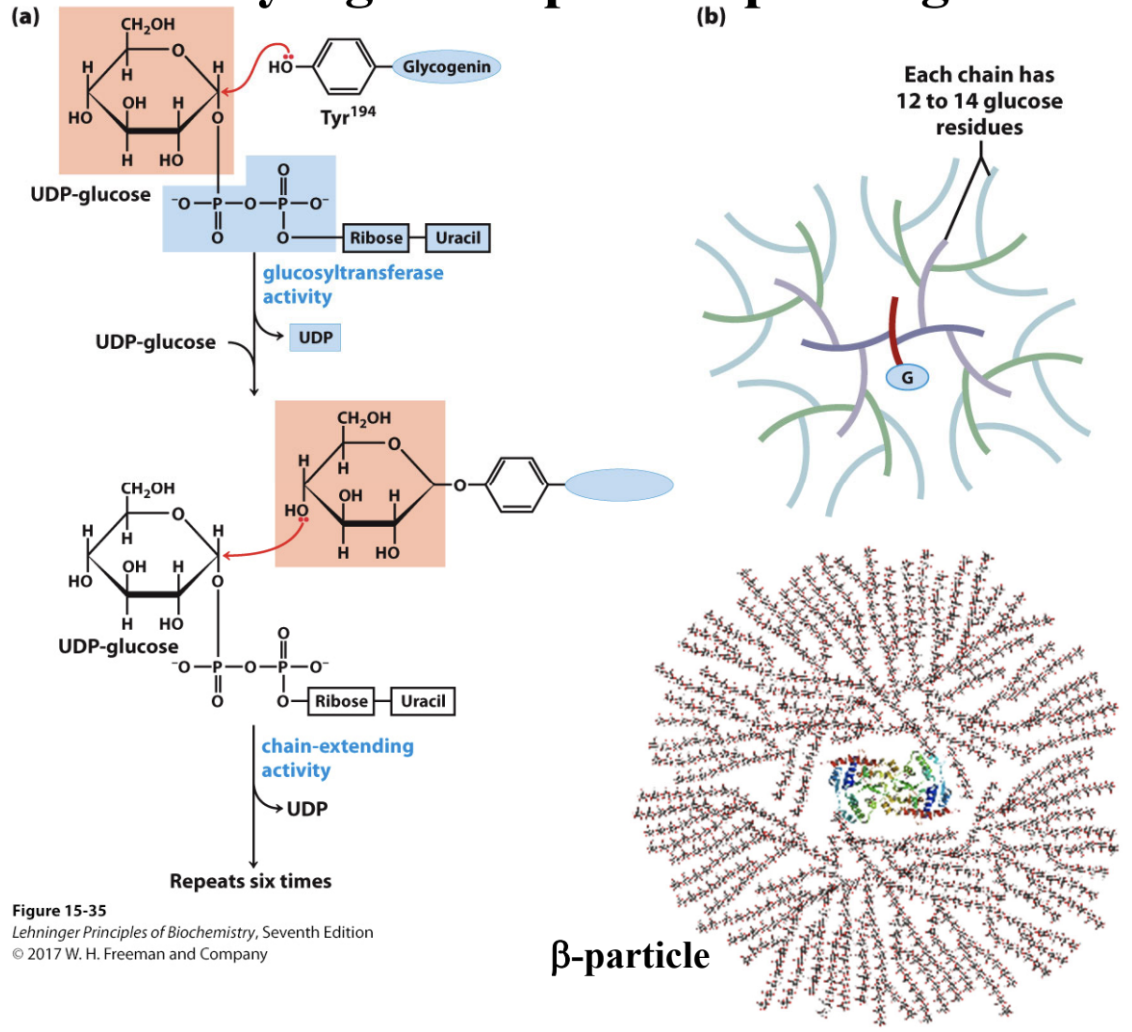
What protein primes glycogen synthesis?
Glycogenin.
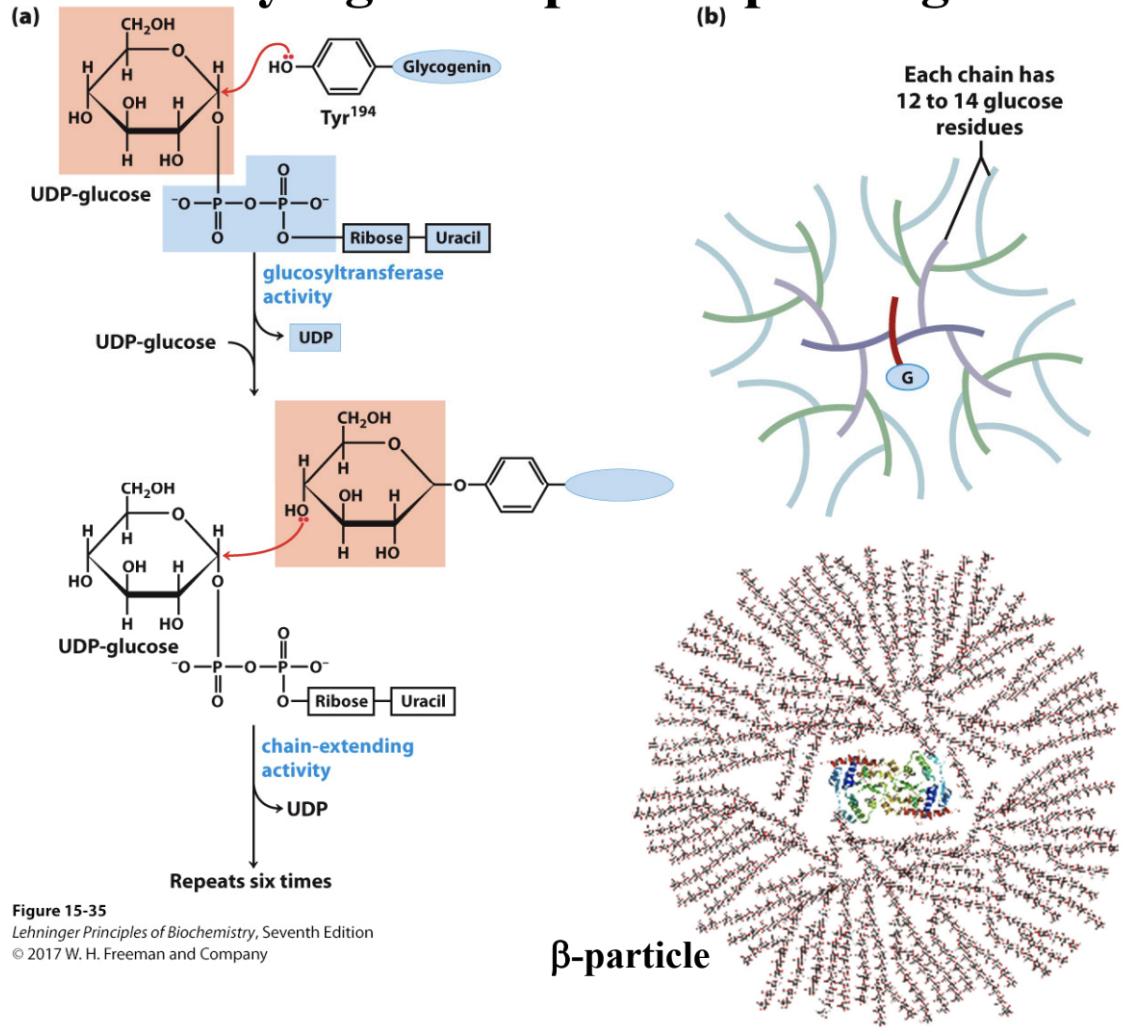
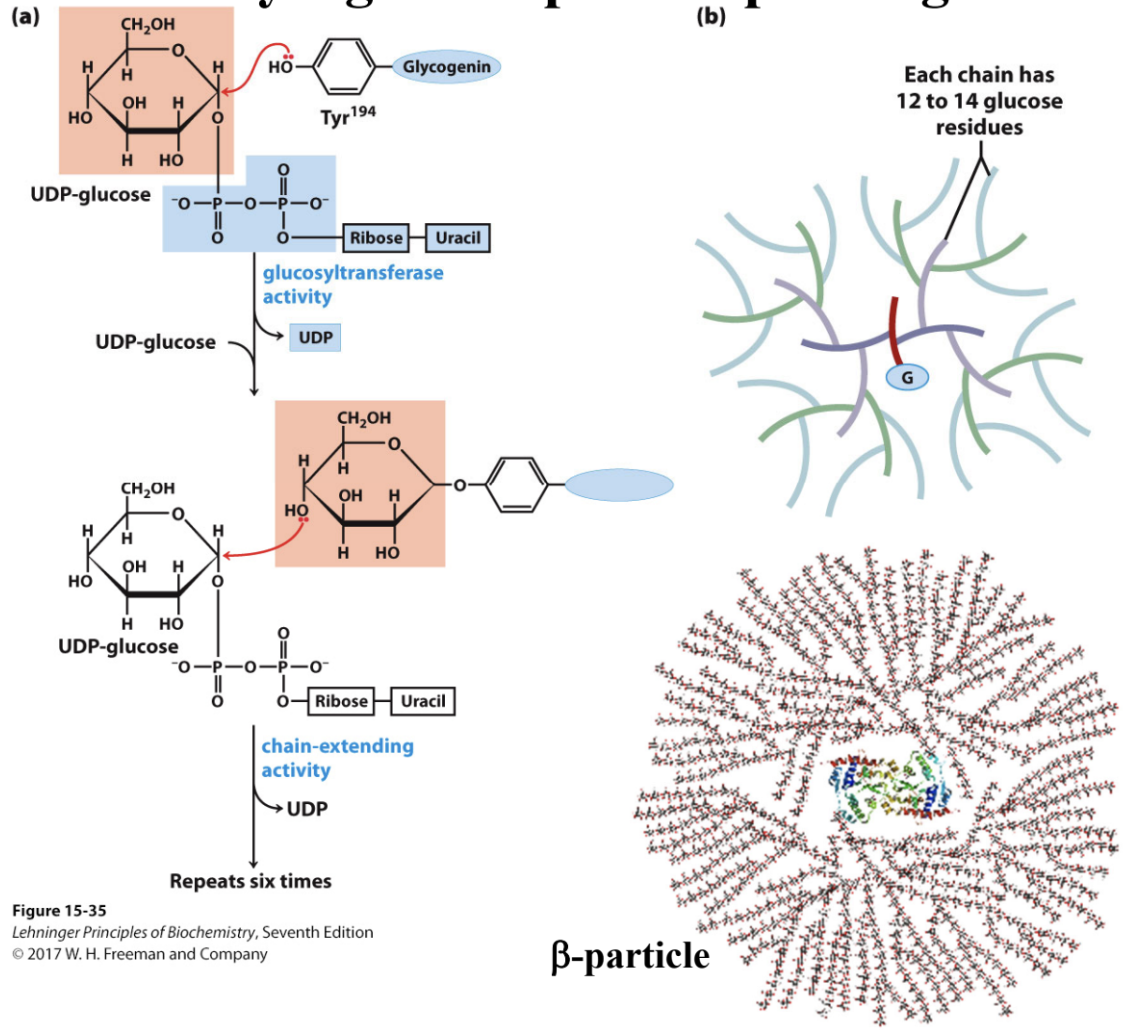
How does glycogenin prime glycogen synthesis?
It autoglycosylates a Tyr residue and builds a short primer of about 8 to 12 glucose residues.
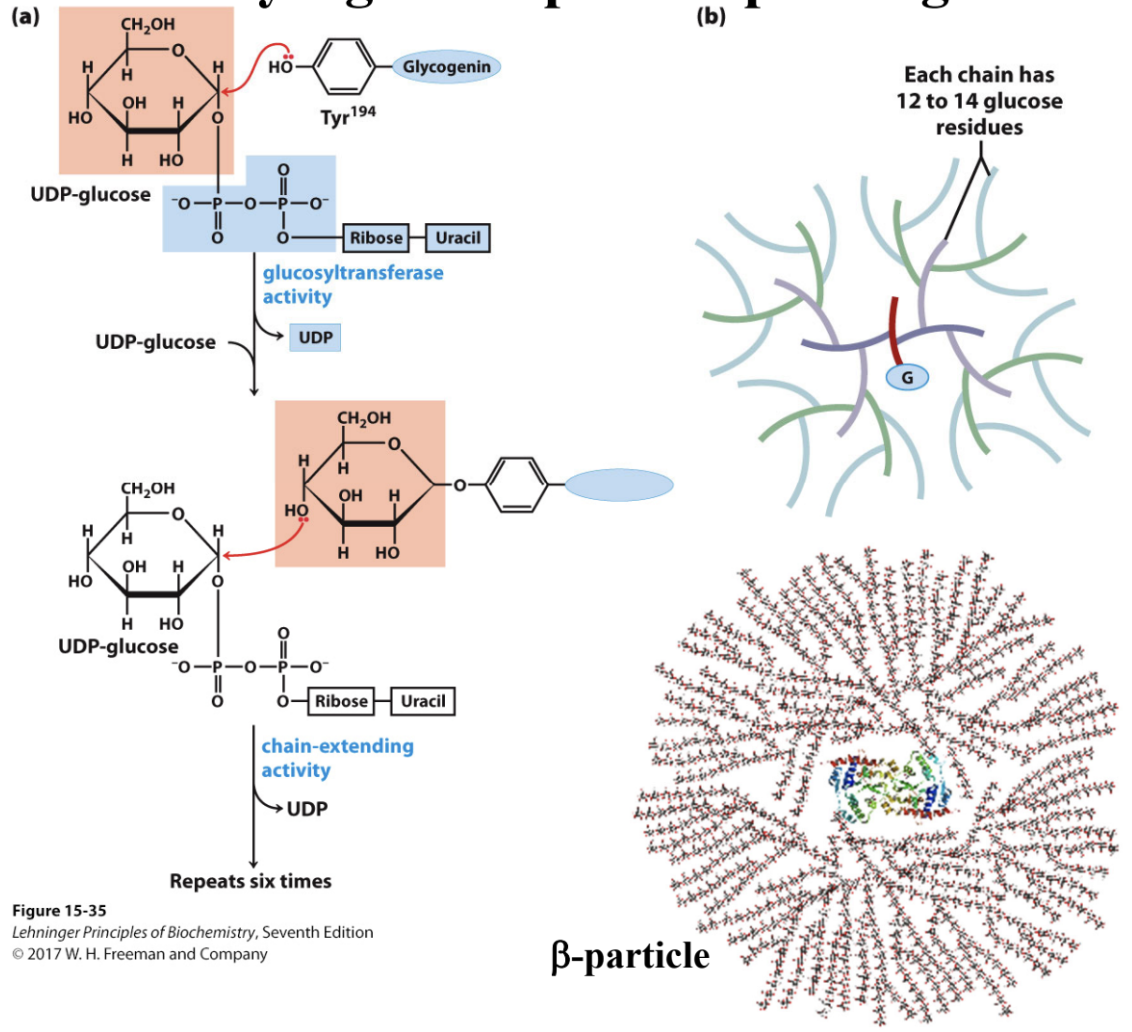
Where is glycogenin located in the glycogen particle?
At the center of the glycogen particle.
What is the reducing end of glycogen associated with?
The glycogenin core.
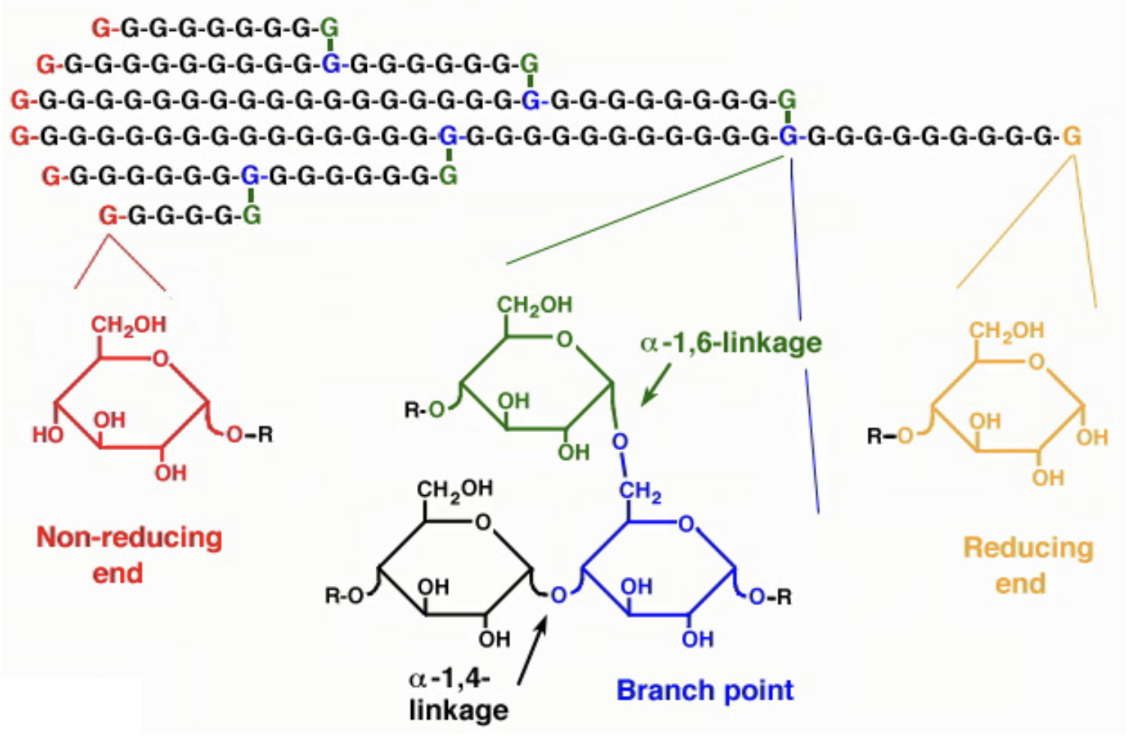
At which ends does glycogen synthesis and breakdown mainly occur?
At the nonreducing ends.
What is the active form of glycogen phosphorylase called?
Glycogen phosphorylase a (GPa).
What is the inactive form of glycogen phosphorylase called?
Glycogen phosphorylase b (GPb).
What is the active form of glycogen synthase called?
Glycogen synthase a (GSa).
What is the inactive form of glycogen synthase called?
Glycogen synthase b (GSb).
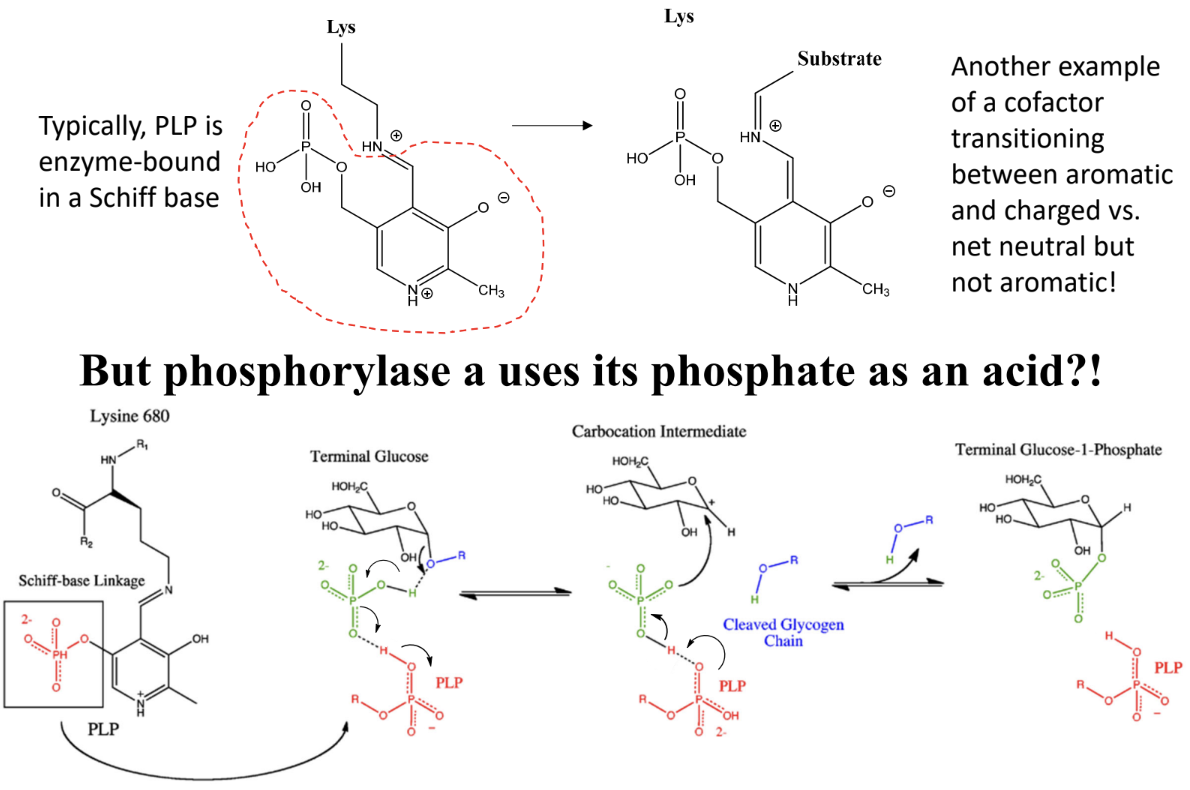
What cofactor is used by glycogen phosphorylase?
Pyridoxal phosphate (PLP).
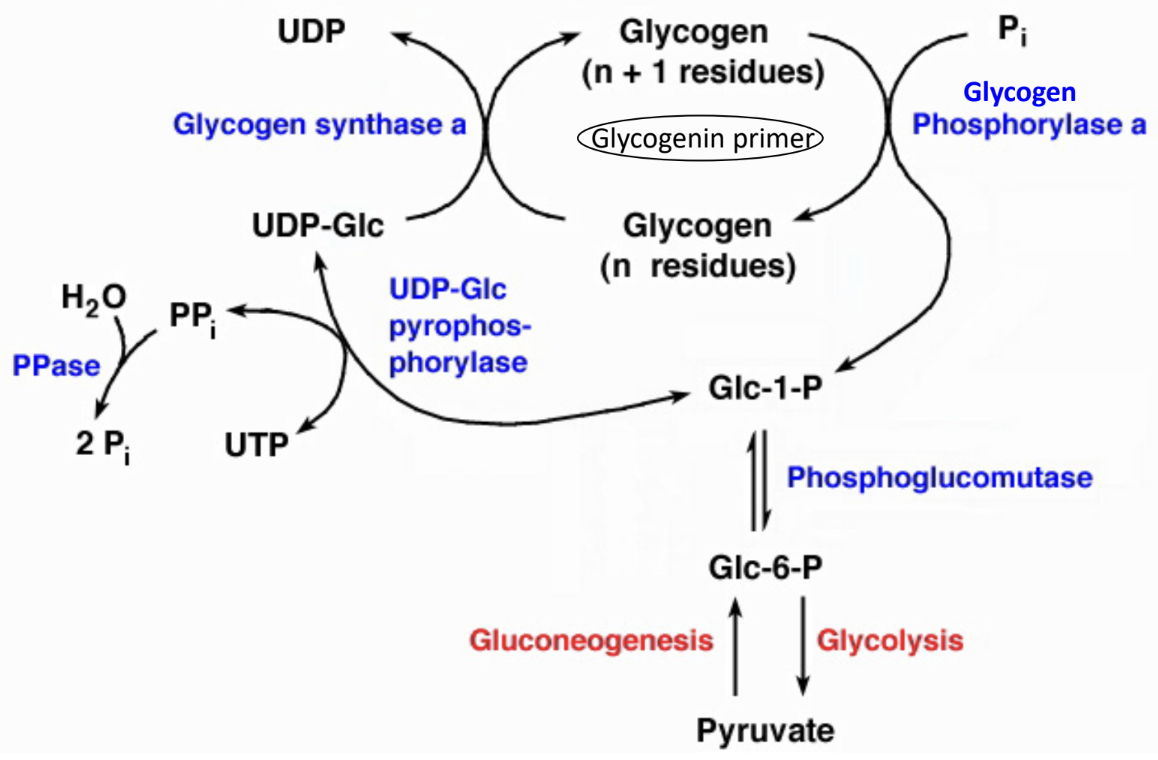
What is the overall pathway connection between glycogen breakdown and central metabolism?
Glycogen is broken down to glucose-1-phosphate
Converted to glucose-6-phosphate by phosphoglucomutase
Enters glycolysis or is converted to free glucose in liver.
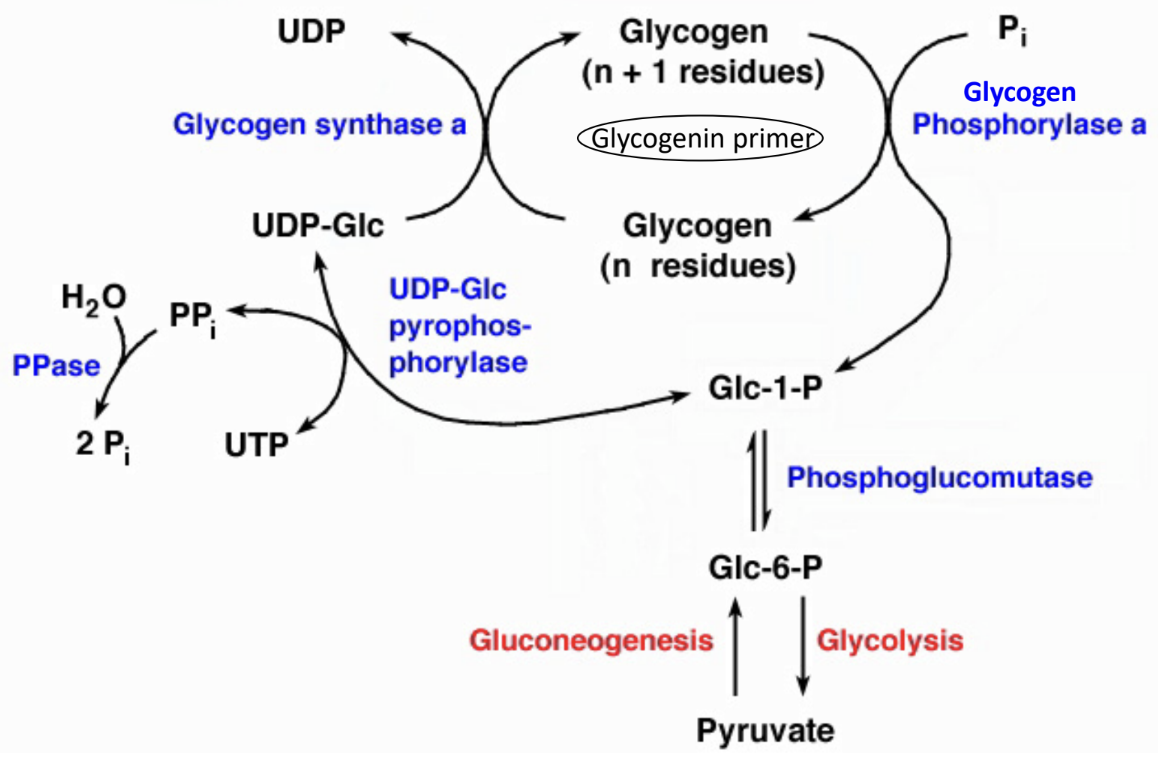
What is the overall pathway connection of gluconeogenesis to central metabolism?
Non-carbohydrate precursors are converted to pyruvate
Pyruvate is converted to glucose-6-phosphate via gluconeogenesis pathway
Glucose-6-phosphate is converted to free glucose (mainly in liver) or used in glycogen synthesis