Current Electricity - AQA A-Level Physics
 Call Kai
 Learn
Learn Practice Test
 Spaced Repetition
 Match
Match Flashcards
 Knowt Play
1/25

Earn XP
Description and Tags
Name | Mastery | Learn | Test | Matching | Spaced | Call with Kai | Chat |
|---|
No analytics yet
Send a link to your students to track their progress
26 Terms
Current
The rate of flow of charge
Potential difference
The energy transferred per unit of charge between two points
Resistance
The opposition to current
Charge carriers
The charged particles that move through a substance as a current
What are the charge carriers in a metal?
The conduction electrons which collide with each other and the fixed, positive ions.
Conventional current
The flow of a positive charge from an anode (+ve) to a cathode (-ve)
What direction is electron flow?
From negative to positive charge.
2 conditions for the flow of current
There are free-moving charge carriers
There is a source of electrical potential energy
What is the emf of a source?
(electromotive force) The electrical energy transferred to each unit charge passing through the source
What is the internal resistance of a source?
The loss of potential difference per unit current passing through the source
Ohm’s law
The pd across a metallic conductor is proportional to the current provided conditions do not change.
Resistivity
How strongly a material resists current
How does increasing temperature in a metal wire increase resistance?
Ions will have more KE and vibrate more
The electrons will collide with the ions at a higher rate, increasing resistance
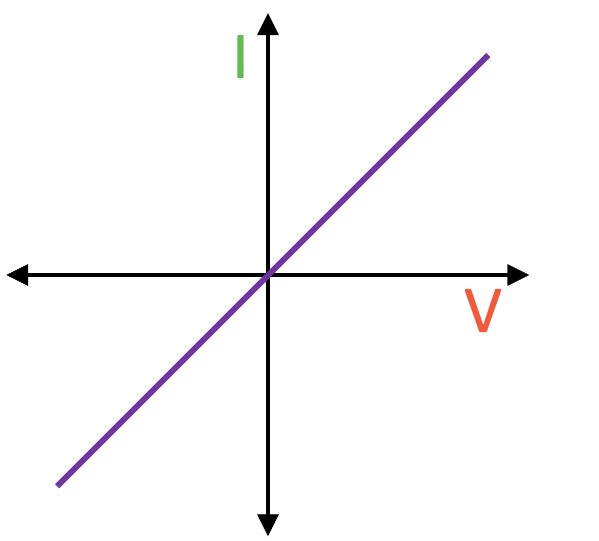
Describe the component this IV graph represents
A fixed, metal, ohmic resistor
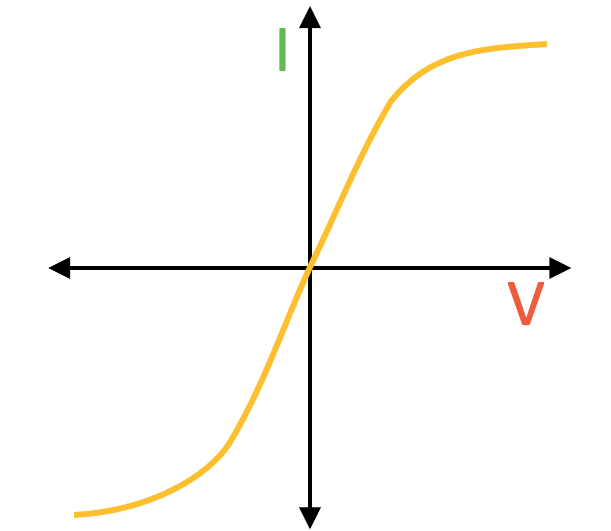
Describe the component this IV graph represents
A filament wire (the greater the current, the greater the resistance)
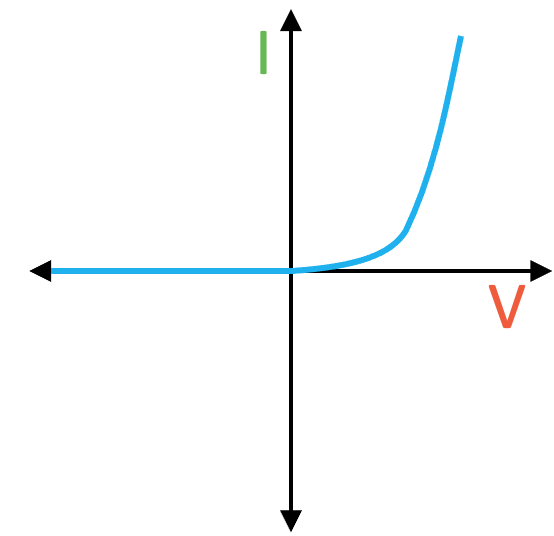
Describe the component this IV graph represents
A diode (current flows about 0.7V and there is a forward bias)
Why does the temperature in a filament lamp increase with potential difference? (3)
As potential increases, current will also increase
Electrons will collide more frequently with metal ions
This transfer KE to the metal ions, meaning they will vibrate more frequently
Current in series
The same across all components
Current in parallel
Separated between branches
total potential difference in series
The sum of potential difference across individual components
potential difference in parallel
The same across components in parallel
Kirchhoff’’s laws (2)
At any junction in a circuit, the sum of currents arriving at the junction = the sum of currents leaving
In any loop around a circuit, the sum of emfs = the sum of pds
Super conductor
A wire/device that has zero resistivity at and below a critical temperature.
How come the current passing through a superconductor has no heating effect?
Because there is no pd across it
Positive temperature coefficient
Resistance increases with increase in temperature
Negative temperature coefficient
Resistance decreases with increase in temperature