2.1.4 The Secret to Signals
 Call Kai
 Learn
Learn Practice Test
 Spaced Repetition
 Match
Match Flashcards
 Knowt Play
1/74

There's no tags or description
Looks like no tags are added yet.
Name | Mastery | Learn | Test | Matching | Spaced | Call with Kai |
|---|
No analytics yet
Send a link to your students to track their progress
75 Terms
How are action potentials generated?
Action potentials are generated by the coordinated opening and closing of voltage-gated ion channels, primarily those for sodium and potassium , in the neuron's axon membrane.5
How does an impulse travel down the neuron?
The nerve impulse, or action potential, travels down the neuron's axon as a wave of depolarization that is continually regenerated along the membrane.1 It is not the actual movement of the ions down the length of the axon, but rather a chain reaction of voltage-gated ion channels opening and closing.
How do neurons communicate to one another at a synapse?
Through a rapid, two-stage process that converts an electrical signal into a chemical signal, and then back into an electrical signal. This is known as chemical synaptic transmission.
What factors work together to form and send signals?
chemical and electrical
Why does the body depend on this system?
To maintain homeostasis.
What type of signal can a neuron generate and send?
An action potential.
What is an action potential?
A brief electrical impulse that travels along the axon of a neuron.
analogy-The specific surge of electricity used to turn on a light bulb.
What is an electrical signal?
Any change in voltage across a cell membrane caused by ion movement (includes both APs and Graded Potentials).
analogy-The specific surge of electricity used to turn on a light bulb.
What is a nerve impulse?
The entire event of signal transmission along a neuron, which is carried by the Action Potential.
analogy-The light being turned on (the visible, intended outcome).
What are Ions?
small,electrically charged atoms.
What two things does fluid around the cell contain?
Small,electrically charged atoms and molecules like sodium and potassium.
Do the number of ions that sit on either side have an impact on charge? So would it be true to say that more positive ions on the inside of the cell means that this side will have an overall more positive charge?
YES!!
How is electricity created?
By the sudden reversal of the overall charge of the neuron
What does this reversal create?
A nerve impulse.
What span the membrane of an axon?What do they allow what to do?
A protein channel.
How many directions can it move in?
It acts like a one-way door.
What does the potassium channel do?
It take potassium out of the cell.
Analogy-Think potassium bananas only want to eat at home and not in public
What does she sodium channel do?
It moves sodium inside of the cell.
Analogy-People think trying sushi is out of their comfort zone or “moving out”
Where do ions move to?
areas of where more ions of the same type are located to areas with less of the same ions.
Analogy-Ions want to get out of the small town and meet new town because they are with the same people everyday.
What other specialized protein does the cell membrane contain?
The sodium potassium pump.
What is the sodium potassium pump’s job? How is able to do this job?
It takes sodium and potassium back to the side where they started. It uses ATP as a energy source to perform this actions.
How many sodium ions does it move out and how many potassium ions does it move in?
It moves 3 sodium out and 2 potassium in.
What does this cause? What is this part called?
More positive ions on the outside of the membrane. Resting potential.
What does the sodium potassium pump help do?
It helps in maintaining a resting potential until the neuron receives a signal!
What happens when a neuron does receive a signal?
Sodium channels along the membrane and let sodium ions into the cell thus making it more positive.
What is this change in charge called? What does it generate?
Depolarization. An electrical signal.
As depolarization happens down the entire membrane of a neuron what moves along the length of the axon passing down the signal?
Action potential
What is the act of a cell returning to its resting state called?"
Repolarization
What happens in repolarization?
The potassium channels open and the potassium ions begin moving out of the cell.
As these positive ions move out of the cell what is this called and what does it return to?
The inside of the cell becomes more negative giving it an overall negative charge. It returns to resting potential.
What does the neuron stay at rest until?
Until another signal initiates the action potential and causes it to depolarize.
What does the ATP derived energy in the sodium-potassium pump do to it?
It changes the conformation(shape) of the pump which allows for the exchange of both potassium and sodium across the lipid bilayer.
What form of transport is this?
active
What does this pump maintain?
-A higher sodium concentration extracellularly
-A higher potassium concentration intracellularly
What does sustaining this equilibrium equate to?
It is critical for many psychological processes like filtration and reabsorption of the kidneys,communications between the neurons in the brain,sperm movement during fertilization,and cardiac muscle contraction in the heart.
What is the definition of a membrane potential?
A difference in voltage across the cell’s membrane.
Describe how the electricity an action potential is generated.
The electricity of an action potential is the reversal of charge in a cell.
What causes the inside of the membrane to reverse charge and begin the action potential?
What causes the inside of the membrane to reverse charge and begin the action potential.
What does tetrodotoxin and tetraethylammonium do?How do researchers use these two chemicals?
They inhibit the sodium and potassium ion channels that drive action potentials. Researchers use these chemicals when the need to shut down nervous or muscular activity and study how action potentials propagate,or isolate the effect of another signaling molecule, drug, or other stimulus.
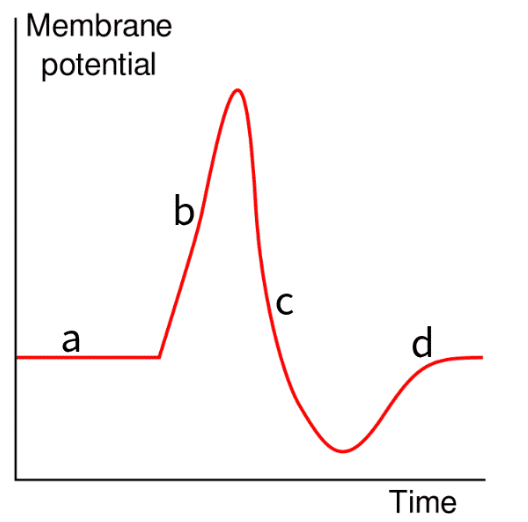
Tetrodotoxin (TTX) inhibits voltage-gated sodium channels. Choose the correct section of the graph affected by TTX.
inhibits-to prevent or hold back from doing something
B
Tetraethyl ammonium (TEA) inhibits voltage-gated potassium channels. After treatment of a neuron with TEA followed by stimulation to trigger an action potential, which of the following statements is true?
The cell will depolarize but not repolarize.
Where do nerve cells communicate with one another?
At a junction or space between them called a synapse.
When the action potential travels down the axon of one neurons,this nerve impulse needs to cross what to do what?
It has to cross the synapse to get to the receiving cell.
What is the synaptic cleft?
The small space between the sending cell and receiving cell.
What could the receiving cell be?
A fellow neuron or muscle or gland.
What is the difference between the synapse and synaptic cleft?
A synapse is the specialized site where a neuron transmits an impulse to another cell (another neuron, a muscle cell, or a gland cell). It is the whole communication structure.The synaptic cleft is the extremely small, fluid-filled gap (typically 20-40 nanometers wide that separates the presynaptic neuron from the postsynaptic cell.
Analogy-The Synapse is the house; the Synaptic Cleft is the driveway.
Explanation-The whole process of chemical transmission occurs across the synapse, with the cleft being the essential space the chemical messenger must traverse.
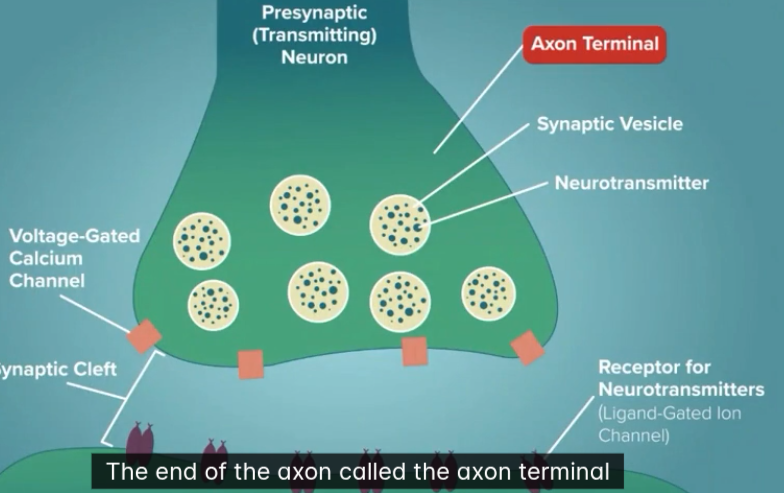
What is the end of an axon terminal called?
The axon terminal.
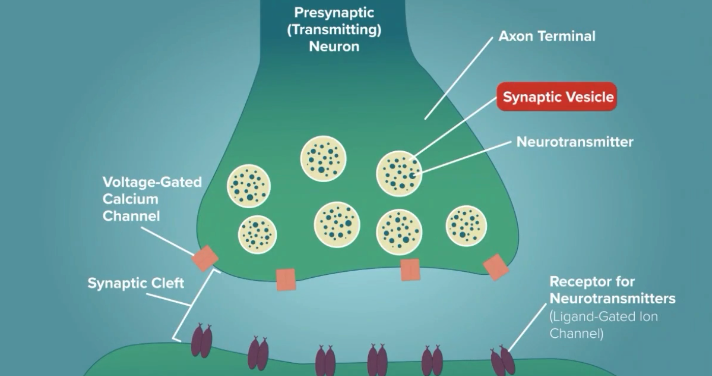
What does it contain?
Small sacs or vesicles that contain chemical signals called neurotransmitters.
Different classes of neurons contain different types of what?
Different types of neurotransimitters.
What is epinephrine and what is its role.
Epinephrine is a neurotransmitter that produces hormones in response to stress and is also referred to as adrenaline.
What is the coordination of both chemical and electrical signals allow you to do?
It allows you to think,sense,and respond.
When a nerve impulse arrives at an axon terminal what does it cause?
It causes calcium ions to move into the cell through calcium channels.
What are calcium channels?
Small gates in the cell membrane
What does the calcium allow the vesicle to do?
It allows the vesicles to fuse to the membrane and release neurotransmitters into the synaptic cleft.
What doe this neurotransmitters then do?
They move across the synaptic cleft and bind to receptor proteins on the receiving cell.
What is special about the receptor proteins?
They are specific to the type of neurotransmitters that binds to them.
Once the neurotransmitters bind to the receptors what happens?
They activate specific ion channels in the cell membrane of the receiving cell which causes depolarization.
What does this depolarization cause?
An action potential travels down the neuron and the receiving cell has just become a sending cell.
What happens when the signal passes to a muscular gland?
The signal moves across the junction and activates muscles cells to generate contraction.
What is the synapse reffered to as?
The neuromuscular junction.
What does this coordination of neurons allow for?
It allows for communication and is how our body senses an reacts to stimuli.
In one or two well-crafted paragraphs, summarize how neurons communicate at the synapse. Your paragraph must include each of the following terms. Underline each term in your paragraph.
An action potential will travel to the end of the axon terminal and this forces the vesicles that contain the neurotransmitters to release them. They will then diffuse across the synaptic cleft which is a part of the synapse. The neurotransmitters will then bind to receptors located on the receiving cell at the dendrites.
Do you agree or disagree with this statement? When you learn something new, you grow new neurons. Use information from the videos and 3D models to support your answer.
The statement is mostly false because the primary process of learning involves strengthening and forming new connections between existing neurons (synaptic plasticity). However, learning can also increase the rate of neurogenesis (the growth of new neurons) in brain regions like the hippocampus.
Explain how neurons convey information using both electrical and chemical signals.
An electrical signal is created by the reversal of the neuron’s overall charge. This action potential that is created will be sent to the axon terminal and as it is sent down this signals the vesicles containing the neurotransmitters to release the neurotransmitters and to diffuse across the synaptic cleft. The neurotransmitters will then bind to receptor proteins on the receiving cells and this generates another electrical signal.
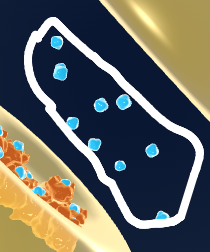
What are neurotransmitters?
Specialised chemicals that act as messengers between neurons.
What does the release and uptake of neurotransmitters govern over?
Most bodily functions,including heart rate,breathing,digestion,and allergic reactions.
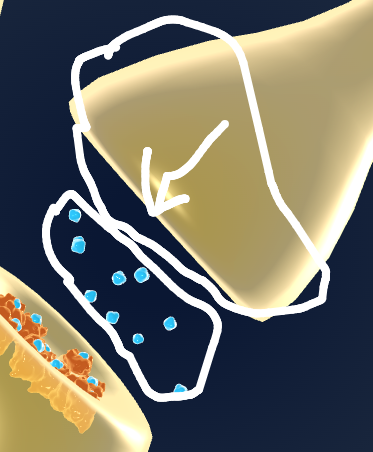
What are the neurotransmitters released from?
The sending neuron into a synapse(space).
What are some common neurotransmitters?
norepinephrine,epinephrine,GABA,histamine,and serotonin
What are action potentials?
a brief electrical impulse that travels along the axon of a neuron
What is a membrane potential?
The difference in voltage across a cell’s membrane.
What is the inside of the membrane at rest charge?
negative
What is the outside of the membrane at rest charge?
positive
What makes the inside of the membrane positive/
An action potential
How do you measure charge?
The comparison in relation to outside
How do you determine the charge?
Charge is comparing in relation to outside.
The inside is negative at rest because positive ions ($\text{K}^+$) are allowed to leak out, and the pump pumps more positives (3 $\text{Na}^+$) out than it brings in (2 $\text{K}^+$).