Gen Path- FINAL TQs
 Call Kai
 Learn
Learn Practice Test
 Spaced Repetition
 Match
Match Flashcards
 Knowt Play
1/168

There's no tags or description
Looks like no tags are added yet.
Name | Mastery | Learn | Test | Matching | Spaced | Call with Kai |
|---|
No analytics yet
Send a link to your students to track their progress
169 Terms
What is the second leading cause of death in the U.S?
Cancer
The initiation of cancer formation is referred to as ?
carcinogenesis
What are the top three estimated new cases of cancer? 100% TQ
1. Prostate/breast
2. Lung/bronchus
3. Colon/rectum
What are the top three cancers that cause death?
1. Lung/bronchus
2. Prostate/breast
3. Colon/rectum
which cancer is the most deadly between men and women?
lung cancer
T/F: Cancer can be a genetic disorder.
TRUE
What are considered "cancer genes" (2)
oncogenes + tumor suppressor genes
What is the name of a benign tumor of fibrotic tissue? TQ
Fibroma
what is the name of a benign tumor of fat tissue? TQ
lipoma
what is the name of a benign tumor of cartilaginous tissue? TQ
Chondroma
what is the name of a benign tumor of glandular tissue? TQ
adenoma
What are "exceptions" to the nomenclature rule for benign tumors? (3)
100% TQ
-Glioblastoma (brain malignancy)
- Melanoma (skin malignancy)
-Lymphoma (malignancy of lymphocytes)
What is a benign tumor of the capillary endothelia?
what is a benign tumor of smooth muscle tissue? TQ
-hemangioma
-Leiomyoma
which type of malignant tumors are most commonly seen in children? TQ
which type of malignant tumors are most common (90% of all cancers)?
-sarcomas
-carcinomas
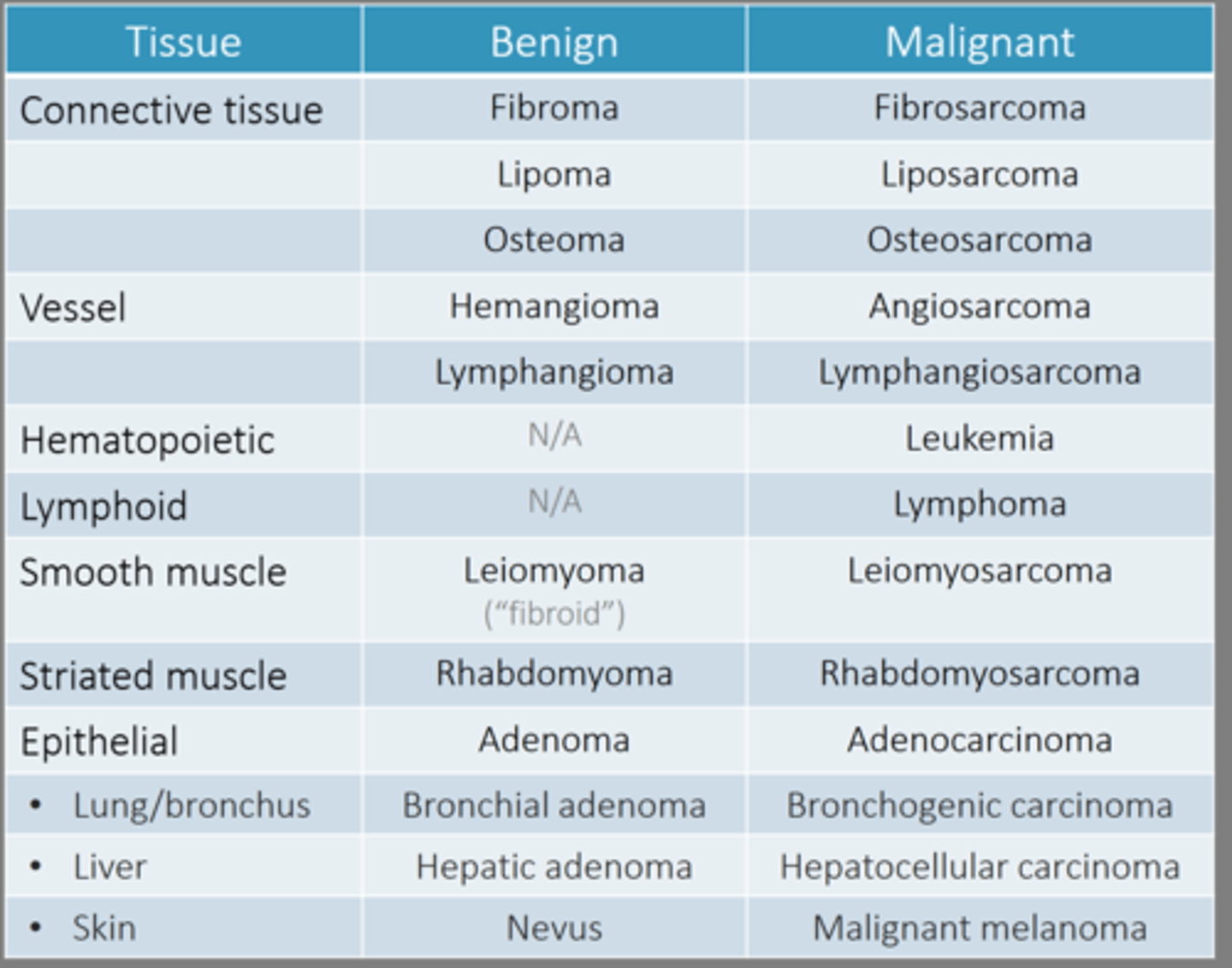
KNOW THE NOMENCLATURE OF TUMORS CHART!!
!! lots of TQs from this
What are the 4 characteristics of neoplasia? (100% need to know)
1. Differentiation/anaplasia
2. Rate of growth
3. Local invasiveness/borders
4. metastasis
Which characteristic of neoplasia refers to the degree of specialization? (how closely cells resemble their mature precursors) TQ
Differentiation
T/F: a highly differentiated cell is more functional and considered to be "normal" cells.
TRUE
A poorly differentiated cells with severe loss of function is considered to be ______________.
anaplastic (anaplasia)
What are the observable features of an cell undergoing anaplasia? (4) 100% TQ
- poorly differentiated (loss of polarity)
- pleomorphic (various cell sizes)
- hyperchromatic (dark staining)
-mitotic figures (cell division)
What would you call a benign tumor of glandular and fibrous tissue? 100% TQ
fibroadenoma
What is the most reliable indicator of cancer? TQ
metastasis
osteosarcoma is commonly spread to the _____________
colorectal cancer is commonly spread to the _____________
prostate cancer is commonly spread to the ____________
-lungs
-liver
-spine
What is the first lymph node that drains the area where a carcinoma is present? TQ
Sentinel lymph node (1st node)
Which node is indicative of abdominal malignancies?
(it is painful at first but then experiences pain)
Virchow's node
What is the most common route for metastatic spread of carcinoma? TQ
lymphatic spread
metastatic spread through the blood is called __________________ metastasis.
it is a very _______ spread.
(enters venous circulation, then travels to the capillary bed)
hematogenous; rapid
GI malignancy commonly spread to the _____________.
Systemic circulation malignancy commonly spreads to the ___________.
Bone and _____________ malignancies are also common for metastatic spread.
100% TQs-(need to understand that malignancies invade into thin, small veins first then to arteries and capillary beds)
liver; lungs; spine
What is the most common form of metastasis for sarcomas? TQ
Hematogenous (through the blood)
Cancer in the stomach/intestines is most likely to have it's second location (metastatic location) where?
in the liver
What are the three levels associated with the progression of a carcinoma?(3)
1. Dysplasia (disorganized cell proliferation)
2. Carcinoma in Situ (no penetration of basement membrane yet)
3. Invasive carcinoma- broken basement membrane, aggressive
What is the ultimate cause of cancer? 100% TQ
genetic alterations
What age range is most common when cancer occurs?
55-75 years old
T/F: any cells categorized as dysplasia or metaplasia can be considered preneoplastic lesions (pre-cancerous lesions)
TRUE
What preneoplastic lesion is an important exception in that it has a 50% risk of developing into cancer? (most preneoplastic legions do not develop into cancer). 100% TQ
GI adenomas
which preneoplastic lesion is found in the oral cavity and is due to use of tobacco (15% malignancy transformation risk)? TQ
Leukoplakia
which preneoplastic lesion has a 5-10% risk of malignant transformation?
actinic keratosis
What are 4 examples of chemical carcinogens ? TQ
1. smoke
2. alcohol
3. asbestos
4. arsenic
What are 4 examples of ionizing radiation considered to be carcinogens? TQ
1. X rays
2. Computed Tomography (ex: CT scan)
3. Cosmic rays
4. UV light (non-ionizing)
What are 4 examples of viral infections that are considered to be carcinogens? TQ
1. Hepatitis B/C
2. Epstein-Barr virus (mono)
3. HPV
4. Kaposi sarcoma Herpesvirus (HHV-8)
Which 3 tissue areas are most sensitive to acute radiation syndrome?
1. Hematopoietic (most affected)
2. GI
3. neurovascular
what is the MOST common type of cancer?
skin cancer
What are the most common types of skin cancer? (3)
Are they affected most commonly by total UV exposure or intense UV exposure?
TQ
1. Basal Cell Carcinoma (total UV)
2. Squamous cell carcinoma (total UV)
3. Melanoma (intense UV exposure)
Which type of oncovirus inserts is genome into the host's DNA?
retrovirus
Which type of oncogenic virus affects T cells, suppresses TP53 and has a 20-50 year latency?
Human T Cell lymphotropic virus 1
What are the two genes of HPV that are at a higher risk for developing squamous cell carcinoma?
What is the main area affected?
- HPV-16 and HPV-18
-cervix
HPV is an oncogenic virus that binds to and inactivates both __________ and ______.
This reduces senescence and decreases apoptosis.
TQ
p53, Rb
Which oncogenic virus infects B cells and epithelial cells and increase risk for B cell (lymphocyte) carcinoma.
Epstein-Barr Virus (mono)
Which oncogenic virus causes chronic inflammation from increase ROS?
It is responsible for 80% of which carcinoma?
Where is this most common ?
-hepatitis B and C
-hepatocellular carcinoma
-MC in Africa and SE Asia
What is the first "cancer bacteria" and causes peptic ulcer disease and chronic inflammation?
helicobacter pylori
What are tumor suppressor genes
they code for proteins that inhibit the cell cycle and promote apoptosis
what are proto-oncogenes
what happens when they are mutated?
-normal genes that regulate growth (GF, receptors, TFs)
-oncogene formed
What are mutated or overexpressed proto-oncogenes?
oncogenes
oncogenes result in ________ of function. They are __________, meaning they only need 1 allele to be mutated to cause cancer.
tumor suppressor genes result in ____________ of function. They are ____________, meaning they need to lose both alleles to develop problems.
gain; dominant
loss; recessive
What is aneuploidy?
Abnormal number of chromosomes.
What are the two classifications of mutations?
Are they environmentally or randomly acquired?
-Driver mutation- most likely environmentally derived
-passenger mutation- random
What type of gene rearrangement occurs when segments of chromosomes are swapped?
What does this result in (when referring to regulation)?
100% TQ
-Balanced translocation
-new location does not have normal regulatory mechanisms
What are 2 ways gene expression can be modified through epigenetics? 100% TQ
1.DNA methylation (silencing)
2. histone modification (enhance/suppress gene activity)
What is the Warburg effect? (think hallmarks of cancer)
100% TQ
Cancer cells use altered metabolism, aerobic glycolysis.
What are the 4 main hallmarks of cancer?
1. altered metabolism (warburg effect)
2. evasion of immune system
3. genomic instability
4. inflammation
What is the role of Rb?
Which phases does is regulate?
100% TQ
-regulate DNA synthesis
-G1 to S phase (when DNA replication occurs)
G1-S phase is regulated by what?
Rb
What does the TP53 gene code for?
p53 protein
What is the most commonly mutated gene in cancer? 100% TQ
TP53 gene (which codes for p53 protein)
What are the three control mechanisms of TP53 gene? TQ
1. quiescence (rest and repair, reversible cell arrest)
2. sensecence (permanent cell arrest)
3. Apoptosis
Which condition is due to an inherited mutation of TP53? TQ
Li-Fraumeni syndrome
what is responsible for immortality of cancer cells? TQ
reactivation of telomerase
What are the characteristics of new blood vessels (angiogenesis) ? TQ
what does this often lead to?
-Haphazard (leaky, tortuous, dilated)
-route for metastasis
What are the most common sites of metastasis? 100% TQ!!! (3)
need to know
1. Lungs
2. Liver
3. Bone marrow (spine)
what type of DNA repair system corrects "spelling errors" (mutations in base pairing)?
what happens with a disorder in this system?
TQ
-DNA mismatch repair
-allow errors to accumulate.
what is an inherited and ineffective version of the DNA mismatch repair system? (example from lecture)
hereditary nonpolyposis colorectal cancer
Which DNA repair system would be used after damage from UV light? TQ
Nucleotide excision repair
Damage of nucleotide excision repair system can result in which condition? TQ
Xeroderma Pigmentosum (cell can't repair after UV damage)
Which type of DNA repair allows for DNA to be exchanged between two homologous chromosomes to repair breaks in DNA?
Homologous Recombination
Which type of cancer is an example of damage to homologous recombination repair system?
Breast cancer (BRCA1 and BRCA2) can be inherited. Those are ineffective inherited homologous repair
For those who inherit BRCA1 or BRCA2 genes, what percent are their chances for developing breast cancer?
70% chance
T/F: inflammation/increase in ROS in the body can be seen as a risk for cancer
TRUE
What is unexplained weight loss and weakness called when seen with cancer patients? TQ
cancer cachexia
Grading of cancer looks at what?
Staging of cancer looks at what?
100% TQ
-degree of cellular differentiation
-degree of spread
What is a "set of nucleotides" that instructs protein syntheses, influences phenotype and is a unit of inheritance. TQ-definition
a gene
What is an alternative form of a gene? TQ-definition
Allele
What is the genetic make up of an organism? TQ-definition
Genotype
What are observable characteristics resulting from genotypes? TQ-definition
Phenotype
T/F: congenital refers to a gene being inherited from a parent. TQ
FALSE! it is present at birth, but NOT related to inheritance
what is the differnce between homozygous and heterozygous alleles?
heterozygous- each allele is different (Yy)
homozygous- each allele is the same (yy, YY)
What two things are altered/compromised in autosomal dominant disorders? 100% TQ (hallmark)
1. structural proteins (ex: collagen, elastin)
2. membrane receptors
Do autosomal dominant disorders have a early or delayed onset? TQ!
delayed
Are autosomal dominant disorders more commonly inherited or spontaneous? TQ!
spontaneous
Autosomal recessive disorders alter what? 100% TQ
enzymes
T/F: In order to get an autosomal recessive disorder, both parents must be carriers.
TRUE
Do autosomal recessive disorders have an early or delayed onset?
Early onset
In X-linked recessive disorders, if the mother is a carrier and the father is unaffected, what are the chances that their son carries the same disorder?
what about if they had a daughter?
-1/4 chance of having disorder
-1/4 change of being a CARRIER
which genetic disorder is an abnormality in fibrillin?
Would this be autosomal dominant or autosomal recessive?
-Marfan's syndrome
-autosomal dominant (since it is effecting a structural protein)
Structural weakness in the elastic fibers of ligaments and the aorta is a common symptom of which genetic disorder? TQ
Marfans
A patient goes into the emergency room for a ruptured aorta. You notice that he is extremely tall and thin, and his history shows that he also has had atlantoaxial instability problems and has a fake eye due to ectopia lentis. What genetic abnormality do you think the patient is experiencing.
Marfan's syndrome
Which condition causes a defect in collagen that leads to hyperextensible skin and hypermobile joints?
Ehlers-Danlos Syndrome
Though a patient may not have ehlers-danlos syndrome, they may have benign hypermobility syndrome. (similar to EDS with hyper extensive joints, but milder).
Which population is this condition most commonly seen in?
-children
-adolescents
-females
-asians
-west Africans
Which autosomal dominant condition leads to the liver's inability to bind/process LDL cholesterol, causing LDL cholesterol to stay in the blood?
Familial Hypercholesterolemia (very common 1 in 500)
What is the difference between heterozygous and homozygous familial hypercholesteremia?
-adult/child onset
-lethal/mild
-treatment?
heterozygous- adult onset, severe atherosclerosis and high risk for CAD or MI, 2-3x amount of LDL found in blood.
homozygous- childhood onset, LETHAL, CAD or MI in childhood, more severe, 5x the amount of LDL cholesterol found in the blood.
Xanthomas (excessive deposits of cholesterol) are most likely occurring with which genetic disorder?
Familial Hypercholesterolemia