PHYS 0220 Astronomy Final Exam
 Call Kai
 Learn
Learn Practice Test
 Spaced Repetition
 Match
Match Flashcards
 Knowt Play
1/239

There's no tags or description
Looks like no tags are added yet.
Name | Mastery | Learn | Test | Matching | Spaced | Call with Kai |
|---|
No analytics yet
Send a link to your students to track their progress
240 Terms
Maximum mass of a neutron star
The maximum mass of a neutron star is between 2.1 and 2.9 solar masses, but most likely on the lower end of that range.
What is a black hole?
A black hole is a gravitational singularity—a point where matter is packed into an infinitely small space. A black hole is so dense that even light cannot escape its gravity.
General relativity
The theory that gravity is not a force pulling objects, but rather the result of mass and energy curving the fabric of spacetime
General relativity is needed to explain the behavior of mass and energy moving at very high speeds (approaching the speed of light) or in a very strong gravitational field.
2 main points to summarize general relativity
1) Mass (and energy) warp spacetime. 2) The shape of spacetime dictates how mass moves.
Spacetime
Spacetime has four dimensions, three spatial dimensions and a time dimension. A spacetime coordinate looks like (ct, x, y, z), where ct is the speed of light multiplied by time.
What can general relativity help predict?
Precession of Mercury’s orbit, gravitational lensing, gravitational redshift of light, black holes, gravitational waves
Precession of Mercury’s orbit
General relativity predicts faster precession of Mercury’s orbit than Newtonian physics. The predictions from general relativity agree with Mercury’s observed orbital precession rate.
Gravitational lensing
Gravitational lensing magnifies what is behind the closer, focused object to allow observers to see galaxies that are super far away. Light follows the shortest path along spacetime, which is distorted by mass.
Will a gravitational lens bend different wavelengths of light differently?
No! Light of all wavelengths will follow the same bent path along curved spacetime.
Gravitational redshift of light
Light loses energy as it moves against a gravitational field, meaning the wave’s frequency decreases and its wavelength increases (aka a redshift).
Schwarzschild radius
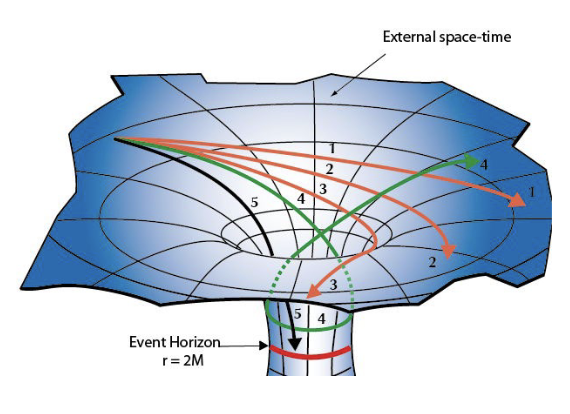
The radius within which light cannot escape the black hole. This radius is directly proportional to the mass of the black hole in a 1:1 ratio.
Event horizon
A boundary of a black hole beyond which light cannot escape. Material within an event horizon is cut off from contact with everything outside.
Tidal forces
A tidal force is the difference between the strength of gravity at two points.
Tidal disruption
If the tidal force is stronger than the internal strength of an object, it will be torn apart or “tidally disrupted.”
What would happen to Earth’s orbit if the Sun were replaced by a solar-mass black hole?
The Earth would continue in its current orbit.
Cygnus X-1
The first accepted black hole detection, showed that an x-ray signal was coming from a binary star, x-rays are more energetic than ultraviolet
Gamma ray bursts
Gamma ray bursts are quick bursts of extremely energetic light from distant galaxies. One likely model for long gamma ray bursts (2+ seconds) is that they come from relativistic jets that are launched during the birth of a stellar mass black hole.
Black hole spin
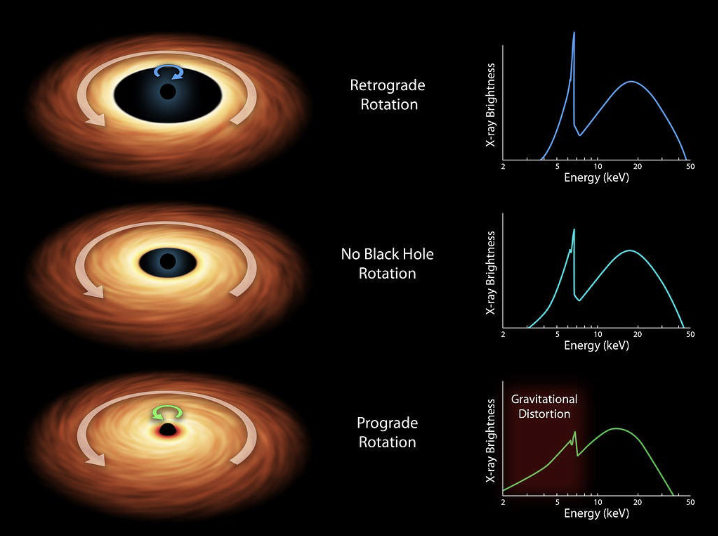
Retrograde rotation is when the black hole and accretion disk surrounding it spin in opposite directions, which emits the highest x-ray brightness. Prograde rotation is when the black hole and accretion disk surrounding it spin in the same direction, which causes gravitational distortion.
Event horizon telescope
By combining radio telescopes across the globe, the Event Horizon Telescope has been able to image the black hole at the center of M87 and our own galaxy. Larger telescopes provide higher resolution.
Stellar mass black holes
About 3-100 solar masses, arise from core collapse when stars die
Supermassive black holes
About 105-1010 solar masses, found at the center of galaxies
Black holes vs wormholes
Black holes are real, wormholes are science fiction
Indirect observation of gravitational waves
The orbital decay/shrinking of a pulsar binary agrees with predictions from general relativity. Very precise measurements of orbital decay determine the presence of gravitational waves. Energy is taken out of the system as the waves radiate outward. The orbit becomes faster as the 2 objects get closer together.
LIGO (Laser Interferometer Gravitational wave Observatory)
LIGO conducts direct detection of gravitational waves via 2 long arms that form a 90º angle with each other. LIGO exchanges information with other gravitational wave observatories around the world to know if a signal was true or false (a signal at only one observatory is likely false).
How does LIGO work?
The 2 long vacuum arms detect tiny shifts in spacetime and emit laser beams that bounce off mirrors at the end of each arm. The reflected laser allows for measurement of the distance of the light’s path. LIGO uses wave superposition to detect events in the universe, like binary systems that are not visible.
Wave superposition
All the light starts on the same phase when first emitted, but when light comes back, the peaks and troughs of the waves may not be perfectly aligned anymore. Constructive interference is when the waves’ peaks line up, and LIGO can detect a gravitational wave form. Destructive interference is when one wave’s peak perfectly lines up with the trough of another wave so that no light reaches LIGO’s detector.
LIGO required sensitivity
Detecting gravitational waves from a black hole merger requires equipment that is sensitive to a fractional length change of at least 10-21
What limits LIGO’s sensitivity?
Noise from things besides gravitational waves, people/animals walking near the detector, stars
Numerical relativity
Numerically solving Einstein’s general relativity equations is a valuable tool for detecting gravitational wave signals. As the orbit shrinks, the orbit gets faster, frequency increases, and wavelength decreases. Once there is a merger, the signal goes flat.
Gravitational Wave Frequency Estimate
Just before the merger of 2 stellar-mass black holes, the frequency of the gravitational wave signal is about 1 kHz (depending on the masses of the black holes involved). Larger masses of the black holes result in a lower frequency.
Finding the source of a GW signal
More detectors (like LIGO) mean better localization of GW signals, that let you know where the merger is happening.
Multi-messenger astronomy
Coordinated observations of astronomical events through multiple types of signals from the same source — electromagnetic radiation, gravitational waves, neutrinos, and cosmic rays.
Cosmic rays
Despite the name, they are not light rays but rather highly energetic particles.
GW170817
“Gravitational wave from 2017, August 17th”…neutron star merger that has a kilonova counterpart. The only GW with an electromagnetic counterpart. Observations of the highest energy radiation from gamma rays and x-rays were important for characterizing this event.
Kilonova
An energetic explosion that occurs when 2 neutron stars or a neutron star and a black hole collide. Binary neutron star mergers are connected to the production of heavy elements like strontium.
The gravitational wave spectrum
Binary systems are really dense, and the frequency of the GW decreases as mass increases.
NANOGrav
A super precise tool that can constrain a dull background signal of many black hole mergers into a low-frequency constant hum. Operates on a much larger scale than LIGO.
The Milky Way overview
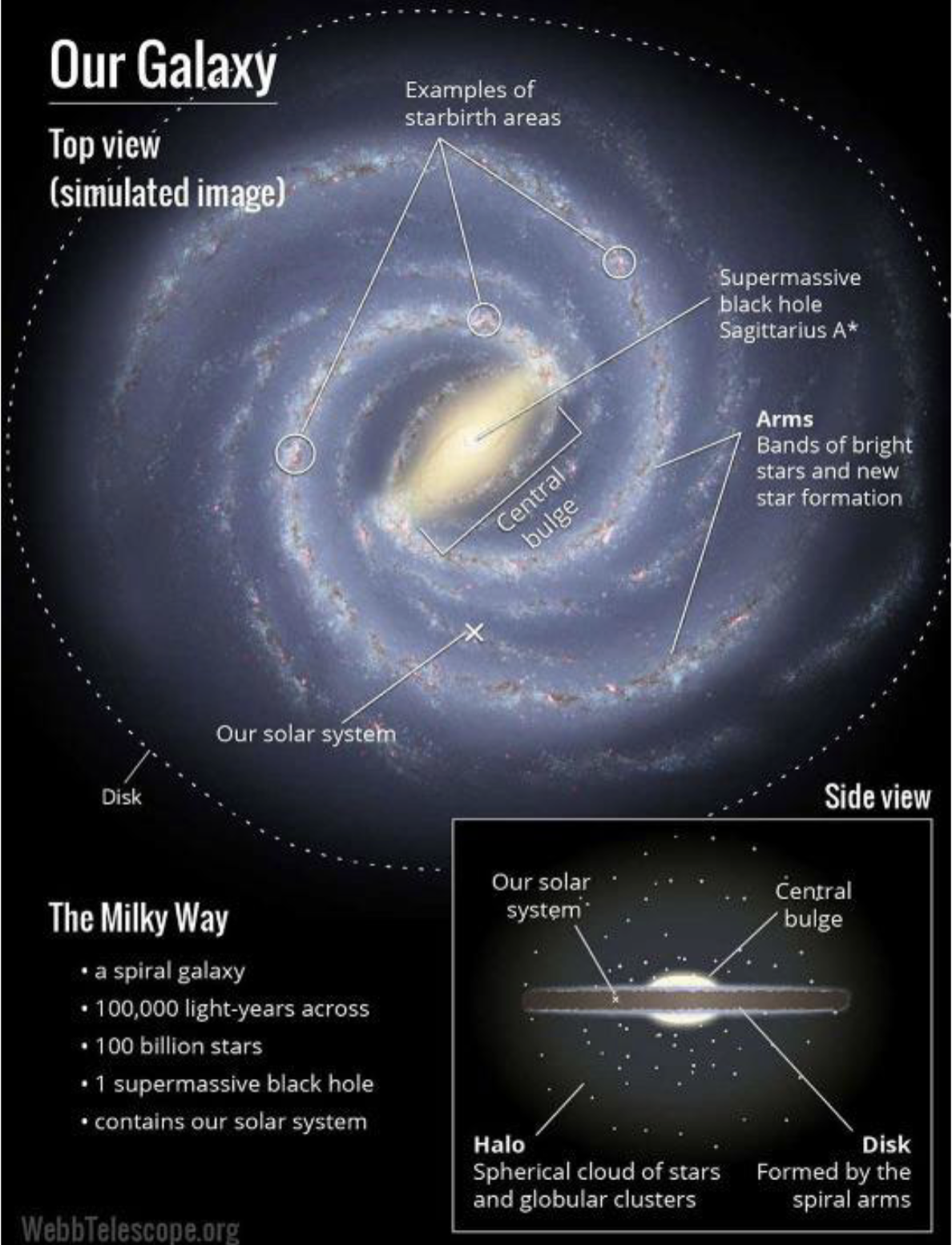
A spiral galaxy, 100 billion stars, contains our solar system, 1 supermassive black hole
Herschel’s Distribution
An incorrect portrayal of what we once thought our galaxy looked like, which was a flattened distribution with our solar system near the center. The assumption that all stars are equally bright was made, but actually, there is radiation we cannot see.
Milky Way dust
The interstellar medium through which visible light cannot pass. There is not a vacuum between stars but rather dust that scatters light. This is why Herschel was incorrect.
Cold Hydrogen Atoms
Both the proton and the electron have spin that can be up or down. These spins are either aligned or opposite. If they are opposite, the atom is just a tiny bit more bound together and have lower energy.
21 cm photon emission line (aka HI emission)
If the spin of the proton or electron flips to the lower energy state (more stable), then a photon with a wavelength of 21 cm is emitted (in the radio wave part of the EM spectrum).
Probability of hydrogen spin flip
The probability of a transition is tiny, but space is big and filled with hydrogen. The galaxy glows at 21 cm wavelength.
Redshifts of HI emission
H1 is neutral hydrogen, and H2 is ionized hydrogen. The spiral arms of our galaxy are traced by HI gas clouds and the molecular clouds.
Milky Way galaxy: Disk
Flattened system, most of the HI and all the molecular clouds. New stars are forming all the time. This is where the spiral arms are. Not uniform. Molecular clouds form a very thin disk of young stars and a thick disk of older stars.
Population 1 stars
More metallic, young stars. Have a high concentration of elements heavier than He. Found in the Milky Way disk
Population 3 stars
Least metallic, oldest stars
Population 2 stars
Intermediates, metallic but not as much as population 1, found in Milky Way bulge
Milky Way galaxy: bulge
Oval region of stars, contains 20% of stars in entire Milky Way, more centrally concentrated, relatively low star formation, most stars it contains are older, stars with high metallicity
Milky Way galaxy: Halo
Diffuse halo of stars, contains globular clusters, contains the oldest, most metal-poor stars, population 2 stars are in the halo
Sgr A Star
Sagittarius A Star, a supermassive blackhole of about 4 million solar masses at the center of the Milky Way galaxy, a very bright radio and x-ray source.
Leavitt Law for Classic Cepheid Variable stars
States that for Cepheid variable stars, there is a direct relationship between their pulsation period (how long it takes to go from bright to dim and back again) and their intrinsic luminosity (the actual amount of energy they emit).
Rule: The longer the period of variation, the brighter the star actually is.
The point of the law is that it turns these stars into standard candles. If you know how bright something actually is, you can figure out how far away it is by seeing how dim it looks from Earth.
Cepheid Variable stars
Standard candles, means that we know how bright they are (therefore we can calculate how far they are)
The Milky Way dwarfs
Around the milky way are a large collection of small and very small galaxies (less than 10,000 stars)
The Local Group
The Milky Way is part of a loose grouping of galaxies, with the galaxies around the Andromeda Galaxy. We are gravitationally bound to the other galaxies in the Local Group and will collide with the Andromeda Galaxy in 5 billion years.
Massive stars’ features
The most massive stars are the hottest —> hotter stars are bluer than redder —> the most massive stars are the most luminous —> the most massive stars are the shortest lived
Old galaxies’ features
Do not have many young stars, redder not bluer
Hubble’s Tuning Fork
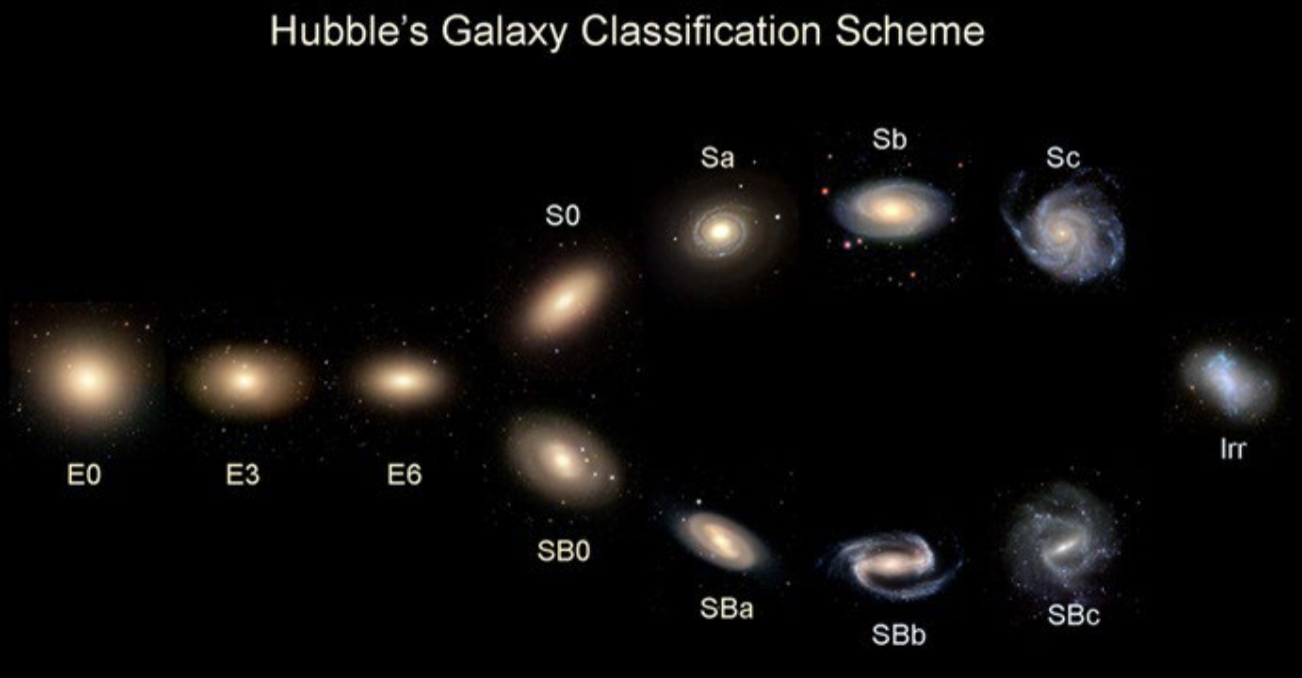
A galaxy classification scheme. The far left is elliptical galaxies, the top prong is spiral galaxies, the bottom prong is spiral galaxies with a bar in the center, and the absolute furthest right is irregular galaxies. As you move further to the left, the elliptical galaxies become more circular. As you move further to the right, you get more spiral arms and the galaxy is less tightly wound.
Elliptical galaxies
Random orbits, settled down state after many spiral galaxies collided
What’s beyond the Local Group?
The galaxy distribution on the sky is not uniform. Galaxies are found in clumps and filaments. Constellations are not real.
Superclusters
Massive groups of galaxies or galaxy clusters, not arranged randomly, formed from merging galaxy clusters
Beyond superclusters
The general theme is that structure is hierarchical. There is some degree of clustering at all scales. Just because there is structure does not mean the big things are gravitationally bound.
Virgo Cluster
The supercluster to which our Milky Way galaxy belongs. Not many blue/young stars, so there have probably been multiple mergers that led to elliptical galaxies. Our Local Group cluster is located at the outskirts of our Virgo Cluster supercluster.
Our astronomical address
Solar system —> Milky Way galaxy —> Local Group —> Virgo Cluster
Coma Cluster
If you know the mass of what is being orbited, then you can calculate orbit speed. The amount of mass needed to produce the light we see from the Coma Cluster was not enough for the calculated orbital speed. This implied there was mass in the Coma Cluster that we could not see (dark matter), since galaxies on the outskirts of this cluster were moving too fast to make sense.
Rotation curves
Rotation curves are made using spectroscopic measurements of galaxies, taking advantage of the Doppler shift technique to map out the orbital velocities of gas and stars.
How does the velocity of material in the Solar system vary with distance from the Sun?
v = k/(r0.5) where v = velocity and r = radius, the velocity of the material falls off with distance
Galaxy rotation curves
Tell us that there is more mass in galaxies than we can see and that the distribution of mass is more spread out. Mass is actually NOT the most concentrated at the center, and faster orbits = more mass
Microlensing
Can be used to find massive compact halo objects (MACHOS). The observer sees a ring of light, and its size is related to the stellar mass.
MACHOS
Massive Compact Halo Objects, which include stellar mass black holes, neutron stars, and brown dwarfs in the galactic halo, do NOT emit much or any light. Ruled out as the primary source of dark matter in the galaxy
Strong lensing
Shows many arc shapes of stretched out galaxies
X-ray lensing
Actually a layering of techniques, tracing out where gas/dust is using x-rays and using lensing to show mass. Layered technique shows clusters merging.
What is dark matter?
We don’t know much. It is matter that is made up of stuff that we don’t understand, has mass, and doesn’t emit/absorb/reflect light.
Indirect astrophysical detection
Methods that are used to study dark matter, such as weak lensing, annihilation, and early universe cosmology.
Weak lensing
Used to study dark matter, traces out where mass is from distorted light
Early universe cosmology
Used to study dark matter, checking to see if there are any unusual temperatures in history that suggest matter
Direct detection of dark matter
Occurs on Earth, some of the dark matter MUST be passing by us at SOME point, so wait for 1 dark matter particle to interact with LUX/ADMX
How do active galaxies look different from ordinary galaxies?
Active galaxies have a brighter center than ordinary galaxies.
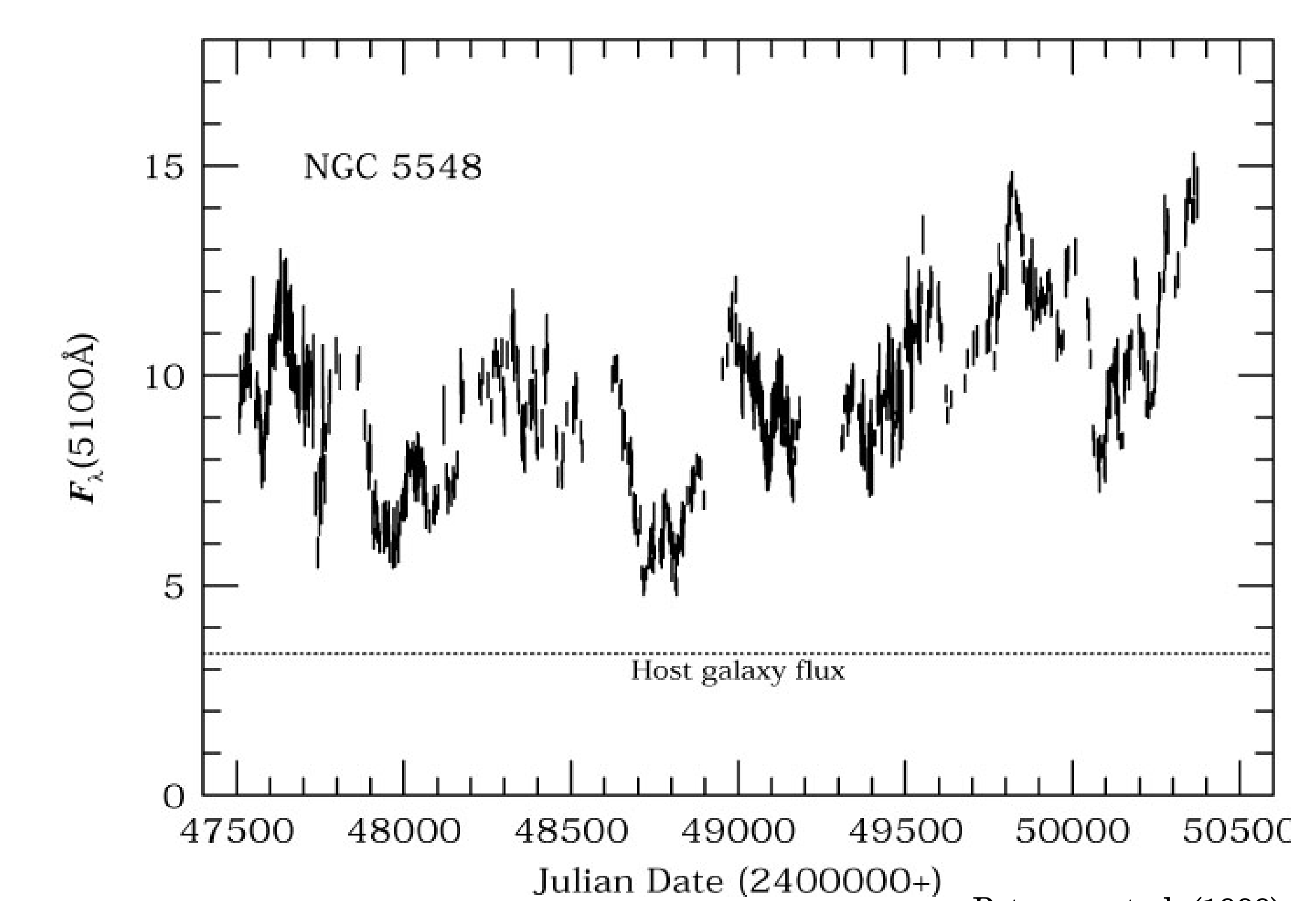
Light curve
A type of plot that shows the amount of light or brightness and the flux of light passing through an area over time.
Interpreting a light curve
There is a lag between when the surface versus the center of a galaxy becomes bright, which is related to the radius of the source in units of light-years. A faster variation indicates a smaller light source. The star’s light dips when the planet is in front.
Active Galactic Nucleus (AGN)
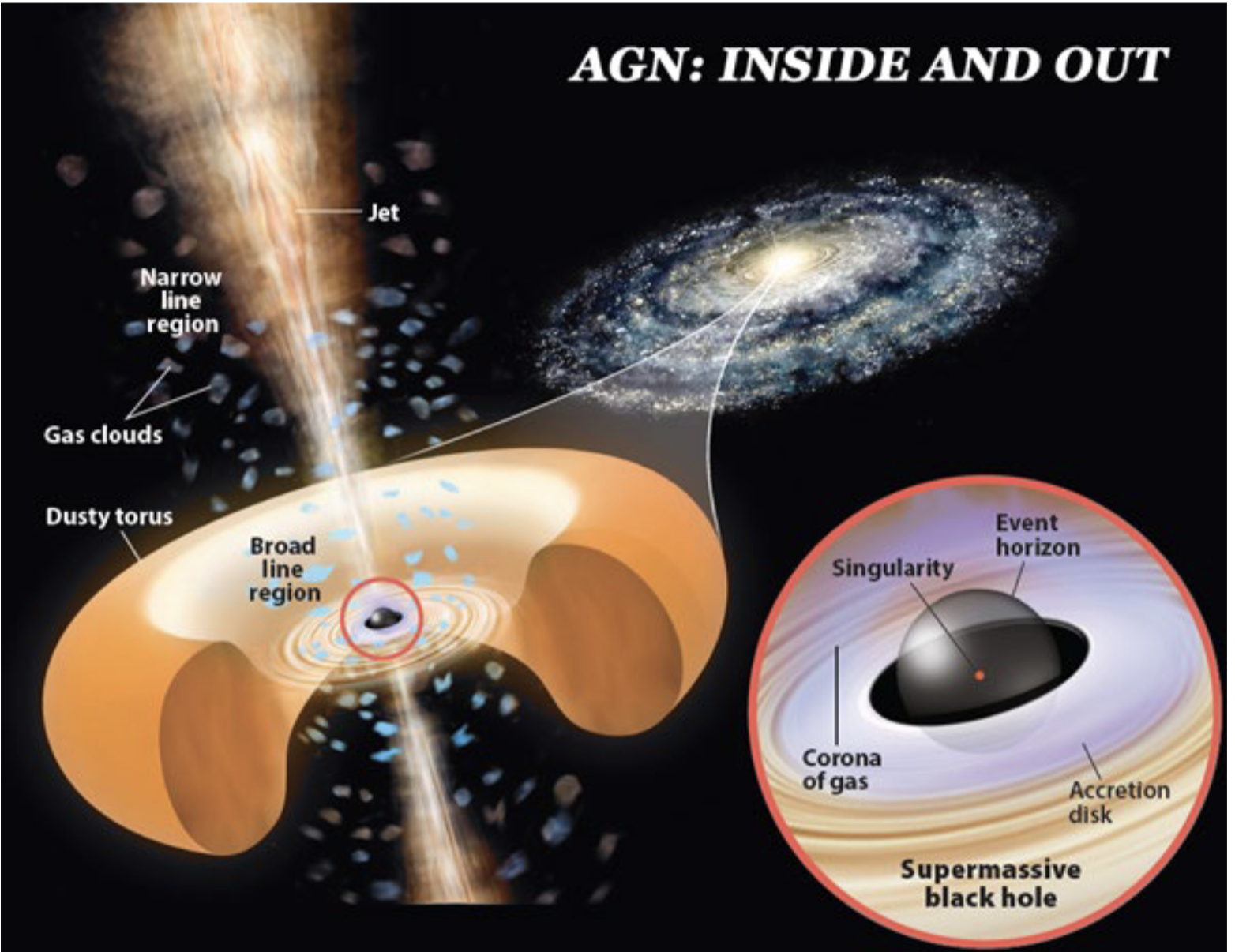
The very bright and compact central region of an active galaxy (one that has light-curve variations on the order of weeks to months)
Radio and x-ray jets
Radio jets extend for millions of lightyears. X-ray jets extend for thousands of lightyears. They both extend perpendicularly outwards from the accretion disk containing active galactic nuclei and/or young stars.
Active Galactic Nuclei (AGNs) as light sources
These sources emit light at all wavelengths, including very high frequencies (x-ray and gamma ray). About 10% are radio loud.
Power source of a galaxy
The power source cannot be chemical reactions or even nuclear reactions. It must be from gravitational collapse in a very strong gravitational field.
Why do we know that stars are NOT the energetic center of galaxies?
The spectrum doesn’t look like a stellar spectrum, and it’s too bright to be explained by starlight. AKA it does not look like a blackbody shape.
AGNs as the center of galaxies
AGNs are supermassive black holes at the center of galaxies that are actively accreting material from a surrounding disk. They are very huge at about a few million solar masses. They compose the very compact/bright/energetic center of galaxies.
Galaxies’ centers
All galaxies have supermassive black holes at the center. Not all galaxies are active, since some central black holes are starving with no material being fed in.
evidence of past activity in the Milky Way
The Milky Way was an AGN a few million years ago, but is not currently.
What determines a galaxy’s activity level?
A galaxy’s activity level depends on its merger history.
Quasar nomenclature
“Quasar” is a shortcut and the same as “Quasi-stellar radio source”…aka “sort of star-like”
Quasars
A very largely redshifted object that is almost stellar/point-like in appearance but has a very non-stellar spectrum consisting of broad emission lines. Originally seen as extraordinarily bright radio sources that looked like stars in optical observations, but then realized to be at a vast distance and have astonishingly high luminosities. Found in the center of a few galaxies, generally lived in the past. Formed from galaxy mergers. The MOST active galactic nuclei
Quasars in a galaxy
Quasars are the brightest end of the AGN zoo. Quasars can accrete around 10 solar masses a year.
Quasar distance
Quasars are extremely distant and redshifted. The average quasar is 10 billion years away.
Why aren’t there nearby quasars?
The universe is evolving. Galaxy mergers that create quasars are less common now than they were in the early universe.
Hubble’s Constant
H0, 70 km/s•Mpc
Redshift Variable
z = (λ - λ0)/λ0 …note that if wavelength λ doubles then z=1
Hubble’s Law Formula
v = H0d
Are we special?
Everything is moving away from us, but astronomers do not like to believe that we on Earth are at a special place in the Universe.
Copernican Principle
Observations from the earth are representative of observations from the average position in the universe.
Friedmann-Lemaitre-Robertson-Walker Metric
A model of space that is HOMOGENEOUS and isotropic but can vary with time (i.e. expand or contract UNIFORMLY). Tells us that space is not fixed for all time.