EVOULTION - New Matireal for FINAL EXAM
 Call Kai
 Learn
Learn Practice Test
 Spaced Repetition
 Match
Match Flashcards
 Knowt Play
1/117

There's no tags or description
Looks like no tags are added yet.
Name | Mastery | Learn | Test | Matching | Spaced | Call with Kai |
|---|
No analytics yet
Send a link to your students to track their progress
118 Terms
Types of animal interactions
Predation
competition,
herbivory
Parasitism
Mutualism
Amensalism
Commensalism
Predation
an interaction where one organism (the predator) kills and consumes another organism (the prey).
Selection acts very strongly on predation, and avoiding predation
Methods of avoiding predation
Posions
Signaling
Tail detachment
Camoflaoug
Hard to eat (shell)
Playing dead
speed,
Large group size
Toxins
A form of avoiding predation
In order to be affective, it must be signaled you are toxic (and a consistent signal across all memebers of that species)
ex.) Monach butterflies
Aposematism
Warning coloration (bright signal)
Types of mimicry involed with toxins
Mulleran mimicry
Batsien mimicry
Batesian mimicry,
Harmless species mimics harmful or toxic species to avoid predation
example nonvenomous king snake mimics venomous coral snake;
Flys that look just like bees
Mullerian mimicry,
Two or more harmful or toxic species share similar warning signals reinforcing predator avoidance
example bees and wasps share similar yellow black coloration
Arms race
consistent directional selection in the context of two coevolving species
ex.) Venus comb and crabs
Geerat Vermeij
Blind fossil researcher that Dr. Rutter knew
Applies his sense of touch to shells in order to determine historical predator prey situations
Rough Skin Newts Arms race example
Newts evolved higher toxcity (TTX Neurotoxin), Gardner snakes evolved more tolerance
Toxins
Tradeoffs with toxins, as it can affect the host to a degree
Genetically toxins come from duplications, specilaizations, and alternative splicing
Neurotoxins evolved independly
Plant defenses to herbivory
mechanical
Spines,Sharp modified leaves that deter herbivores
Chemical
Caffine, nicotine, morphine
Indirect defense
Ants that defend plants from catipillars because the plant provides the ants with food (mutualism)
When plants are damaged by herbivors, they release chemicals that attrack wasps who may attach the herbivores
High cost of plant defense
10% of energy budget goes to defense
Plants that don’t produce toxin have higher fitness
Induced defenses only happen after the plant has been attached a damaged
Tolerance
when plants can be partially eaten but maintain fitness
Herbivore offense examples
Metabolism (can break down plant toxins)
Sequestration,Herbivores take up plant toxins and store them in their own tissues for defense against predators example monarch caterpillars storing milkweed toxins;
Galling (Insects make a home inside a plant, and change plant development)
Trenching - Plants produce a latex substance, and insects cut them to eat it
Gregorious Feeding - Herbivores feed in groups to overwhelm plant defenses and reduce individual exposure example caterpillars feeding in clusters
Sequestration,
Herbivores take up plant toxins and store them in their own tissues for defense against predators example monarch caterpillars storing milkweed toxins;
Galling
(Insects make a home inside a plant, and change plant development)
Trenching
Plants produce a latex substance, and insects cut them to eat it
Gregorious Feeding
Herbivores feed in groups to overwhelm plant defenses and reduce individual exposure example caterpillars feeding in clusters
Parasitism
Interaction where one organism (parasite) lives on or in a host and benefits while harming the host without immediately killing it
Recognition and response is huge for plants protecting against paristism
Parasites can even control host behavior (last of us)
Virulence
propensity of a parasite to harm of kill the host
Rabbit parasite example
Overpopulation of rabbits in Austrialia
Took deadly south american rabbit parasite and brought it to Austrialia
Kill tons of rabbits, yet today rabbitss till persist highlighting their evolution
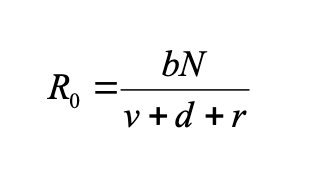
Parasite fitness equation
N = # available hosts
Ro = # of new infections produced by host
b = chance virus with infect a host
v = mortality of host due to parasite
d = mortality due to other reasons
r = rate of host overcoming infection
b and v may be coorleated
Modes of parasitic transmission
horizontal transmission
vertilcal transmission
Horizontal transmission
between individual
typically more deadly
vertical transmission
transmission to offspring
Parasites have ______ with their hosts
congruent phylogenices (they evolve together)
Congruent
similar phylogneies in different groups, usually one is a symbiote or parasite of the other
Less traditional examples of parsistism
Cuckoo bird becomes foster parents for cow birds eggs
The egg mimicry has. evolved through a sex linked gene
Altruism
Behavior where an individual reduces its own fitness to increase the fitness of another individual
Challenges Darwins theory
Direct fitness
a individuals survival reproduction
Indirect fitness
Relatedness and the fitness from the reproduction of a relative
amount of relatedness may determine level of altruism
kin selection
traits are favored by increasing indirect fitness
Hamiltons rule —> rb - c > 0
r = coefficent of relatedness
b = benefit to receipient
c = cost to actor
Eusociality,
Highest level of social organization with cooperative brood care overlapping generations and reproductive division of labor where some individuals reproduce and others do not
Bees
Elements of Eusociality
Reproduction divison of labor
overlapping generations
cooperative care for young
Bees have a unique system of relatedness
Monandry,
Mating system where a female mates with only one male
Evolutionary stable stratgies (ESS)
Strategey that cannot be invaded by another strategey
that once common in a population cannot be invaded or replaced by an alternative strategy because it yields higher or equal fitness
Tit for tat rules of engagement
Dont, not cooperate first
Reliate on those who cheat or betray
Cooperation after retaliation
Hawk vs Dove (Prisoners Dilema)
Idea that individuals make binary choices based on costs and benefits
WIth this, there is game theory that determines which organisms “win” and interaction
Greenbeard effect
an honest signal that indicates cooperation
A green beard gene does THREE things:
Produces a trait (the “green beard”)
Allows individuals to recognize that trait in others
Causes them to preferentially help those individuals
→ Result: Altruism toward non-relatives that share the gene
ex.) Slime mold
examples of mutualisms
Bat and plant species
bad gets food, plant gets polinated
Lichen (alage and fungus)
Coral and protists
Mutualims require….
extreme unique adaptations and come about through coevolution
Reciprocal parasitism
Interaction where two species exploit each other and each imposes a fitness cost on the other;
Benefits of being parasitizing must be greater than the costs of being parasitized. Otherwise it is just one way parasitism.
Interactions can fluctuate between mutualism and parasitism often. And exmaple of this…
Yucca and Yucca moth
Moth lays larave in yucca
Some moths contribute to polination (mutualism)
Other moths simply lay larva (parasistism)
Theres been an evolution of different speices that act different ways
Cospeciation in mutualism is…
commmon with symbiotes
ex.) Aphids, have bacteria inside them that cospeciated
Senecese
decline in fertility and or surviavability over time
Kind of interferes with Darwins theory, because why would an organism body every transition to not reporducing, or dying? It decreases fitness
Organisms like the greeland shark defy this definiton as well
Rate of living hypothesis
Normal processes leave to ireparable damage
transcription, translation, replication etc
damage exceeds repair capacity
Small lived organism have faster metabolisms than long lived organisms
Predictions of “rate of living hypothesis”
1.) Aging rate higher in organisms with high
metabolic rate
2) If repair is maximized: little potential for
selection to increase life span
Stephen Austad
Aging expert that worked with Lions
Mamalian order related to energy expendture
Different organism within the mamalian order expend different levels of energy, and usually this is related to metabolism and ultimatley life span (less energy, lower metabolism, longer life span)
Bats defy this, and have high energy, high metabolism, and relativley high life spans
There seems to be heritability associated with life span
Telomeres associated with lifespan
Telomeres protect chromosome ends but shorten with each cell division eventually reaching a critical length, and shortening starts to effect actual coding DNA.
ex.) Roundworm experiment showed longer teloemeres coorleates to longer lives
p53 and telomere relatioship
p53 is a tumor suppressor, and is involved with telemere degradation
Mutated p53 can limit tumor supression
But hyperactive p53 can contribute to quicker telemore shorting and therefore quicker death and aging
Evolutionary theory of aging
selection doesn’t favor repair or longer lives. Emphasis on early reproduction
Deleterious mutation hypothesis
If you have a deleterious mutation, but it only affects you later in life, then slection will act on it weakly or neutral.
Aka these mutations have small selection coefficents
Pleiotrophy
one gene affects multiple traits
Antagonistics pleiotrophy
A gene that has beneficial affects on one trait, has deleterious traits on another
Single genes, and evolutionary changes can do what related to aging
They can influence youthful or elederly traits by allocating energy to reproduction instead of DNA repair
ex.) Opoosoums who live without cars, live alot longer and reproduce later
Mainland opposums priotize early reproduction, and also age faster
Human diseases associated with Plieotrophy
Huntingtons disease
Cancer
Cystic fibrosis
Alhezimers
menopause
production of eggs/reproductive ability stops
Maybe be a result of the fact human lifespans have only recently extended
Or Grandmother hypothesis
Grandmother hypothesis (realted to menopause)
Study done in orcas
If kin selection exists, and giving birth later in life is dangerous, then individuals may shift their stratigies to being grandmother style parental care, and still recive indirect fitness
How long ago was the universeve formed
~14 Billion ya
How long ago did the Earth + Solar system Form
~4.5 billion years ago
LUCA
Last universal common ancestor from the 3 domains (bacteria, archea, eukarya)
2 Billion years old
Similarties across 3 domains of life:
All cellular life
all use proteins (mRNA and amino acids)
All use DNA templates
Self replication
Outlier to LUCA
Viruses
can be RNA or DNA
other variation
Ribozyme
A hammerhead ribozyme can catalyze simple chemical reactions while also being an RNA
Important for understand orgins and RNA world
RNA World
Theory that RNA dominated the world before LUCA
Evidence supporting RNA World
RNA is important across 3 domains of life
It was proven in the lab that Ribozymes could self replicated (2026)
Miller-Urey Experiment, proved they could create basic amino acids and building blocks under early atmosphere + lightining conditions
Struggled to produce nucleotides (gap in RNA world)
Asteroid theory
Earth got hit by a ton of metors
Murchison Meteorite crashed in Austrilia in 1969
Contained amino acids and nucleotides
Panspermia hypothesis
life orgins from meteors
Protocells
Proteins, amino acids, lipids
that can be induced to form
spheres in the lab, also on
Montmorillonite
Prebiotic soup
,Mixture of simple organic molecules in early Earth environments formed from abiotic processes that served as the raw material for the origin of life
Found on montmorillonite
First orgins of life on Earth
Around 3.7 to 4 Billion year ago, there is eveidence of iron oxidizing bacteria. Evidence highlighted in graphite, which comes from living organisms
There is disagreement about if this is really evidence of life
3.26 Billion years ago: Cells discovered in a South African Rock
Prokaryotic Genome
Distinct from E and A
Circular chromosomes
Millions of bases, thousands of genes
Bigger than viruses, smaller than E
Efficent, most of genes used for protein coding
Plasmids can be exchanged between individuals - horizontal gene transfer
Eukaryotic genome
Nucleous
Organelles
Linear chromosomes
Small % of DNA is protein coding
Barbra McClintock
Corn research, multicolored kernels
Chromosome changing in position
Discoverd transposable elements exist
Stasis,
Long periods where species show little or no evolutionary change;
ex.) Cyanobacteria, stromatolites
Gradualism,
Evolution occurs slowly and continuously over long periods through small changes;
ex) Darwins Evolutionary theory
Punctuated equilibrium
,Evolution is characterized by long periods of stasis interrupted by short bursts of rapid change often during speciation
Cambrian explosion
Transposable elements
jumping genes
Parts of chromosome that ca njump or add to other chromosomes
44% of human genome isTE
Class 1 elements
Transposable elements: retrotransposons
Use an RNA intermediate
Reverse transcriptase, integration (similar to HIV)
Some aruge it is a retrovrius
Retrosequences
,DNA sequences formed when RNA is reverse transcribed and inserted back into the genome often lacking introns and regulatory regions;
Alu elements,
Short repetitive SINE retrotransposons about 300 base pairs long found abundantly in primate genomes that replicate via an RNA intermediate using reverse transcriptase
Class II elements
Class II elements,Transposable elements that move directly as DNA using a cut and paste mechanism mediated by transposase without an RNA intermediate
example DNA transposons
Consequences of transposable elements
Methylation, and some small RNA may protect against transposable elements
Some may be beneficial elements
exxon shuffling
immun system
Hypothesis for the origin of viruses
Very limited knowledge
Hypo 1: Viruses were the first life, and they’re just a pre cellular life relec that has peristed
Hypo 2: Reduction hypothesis - they are some reduced form of cellular oganisms
Hypo 3: Escpae hypothesis - part of a cell that managed to remove itself, and diverge independently
Hypo 4: Viruses initated the 3 domain split, if each domain was initially RNA, and got infected by a DNA virus that transtioned them to DNA (wild theory)
LUCA time range
Somewhere between 2.2 and 4 billion years ago
Eukaryote origin timeline
1.8 billion years ago - Empire mine, Michigan shows possible Alage
Some argue 3 billion years ago - Large archea or Eukaryote found in South Africa, but heavily debated
Cyanobacteria significance,
Photosynthetic bacteria that produced oxygen leading to the Great Oxidation Event which caused extinction of anaerobic organisms and enabled evolution of aerobic and complex life
Ediacaran fossil
Early signs of multicelluar life
Cambrian explosion
Huge explosion of animal diversity (520 millon years ago)
See trilobites appear
Most animals live on the sea bed at this time, but not all of them
Its possible that oxygen flucations + Edicaran extinntion could have enabled the exposion
Ediacaran
,Time period about 635 to 541 million years ago marked by the first large multicellular organisms soft bodied and before the Cambrian explosion
Devonian period significane
420 - 360 million years ago
Vertebrates made the transition to land
Lots of ferns and Forrests of trees
First animals on earth time period
~600 million ya (Edicaran)
Permian
299 - 252 mya
Reptile and Amphibian dominance
Pangea super continent
Ended by HUGE permian extinction
Permian extinction
252 mya
Largest extinction event
99% of all organisms died
Was possibly triggered by huge volcanic eruptions near coal beds
This would have triggered CO2 and methane global warming
Anoxix oceans —> Sulfide reducing bacteria —> Emissions of toxic sulfied
Or it could have been a massive metor impact
Lost of land plants survived
Triassic
251 - 206 MYA
First dinosaours appear
Non -dino reptiles are most dominant
Warm climate, even at poles
Jurrassic Period
206 - 144 MYA
Dinosaurs dominate
First birds and mammals appear
Conifer, fern forrests