Grade 9 Biology
 Call Kai
 Learn
Learn Practice Test
 Spaced Repetition
 Match
Match Flashcards
 Knowt Play
1/74

There's no tags or description
Looks like no tags are added yet.
Name | Mastery | Learn | Test | Matching | Spaced | Call with Kai |
|---|
No analytics yet
Send a link to your students to track their progress
75 Terms
What is the cell theory?
All living things are made up of one or more cells
A functioning cell is the functional unit of life
All cells come from pre-existing cells
What is Mitosis?
The division of nuclear materials so that both cells have complete sets of chromosones.
What exactly happens in mitosis?
It is a type of cell division in which the mother cell divides to produce two new cells.
What happens in prophase?
The cell begins to break down, the chromosomes become visible, and spindle fibers form to organize the chromosomes.
What happens in Metaphase?
Spindle fibers line up the chromosomes in the center of the cell and attach to them. The cell then checks that everything is connected properly.
What happens in anaphase?
The sister chromatids separate and are pulled to opposite ends of the cell, while the cell stretches and becomes longer.
What happens in Telophase?
The spindle disappears, two nuclei form, and the chromosomes decondense
What happens in Interphase?
The cell returns to normal, organelles grow, and it rapid preparation for next division takes place.
What is Asexual reproduction?
Reproduction where one parent produces offspring
Characteristics of Asexual Reproduction
Single parent involved
No fertilization or gamete formation
Occurs in a very short time
Organisms grow rapidly
Offspring is genetically similar
What happens in Fragmentation? / Example
The parent breaks into fragments, and each fragment grows into a new organism. Hydra
What happens in regeneration? / example
The power of growing a new organism from a lost body part. Planaria
What happens in budding? / example
A new organism grows from a bud on the parent. Hydra
What happens in Sporogenesis? / example
An organism produces spores in sacs. When conditions are right, the spores are released and grow into new organisms.
Some disadvantages of asexual reproduction?
Lack of diversity, a single change in environment can eliminate the entire species.
What are homologous pairs of chromosomes?
Two chromosomes that match each other in size and shape
What happens in Prophase I (Meiosis)
Chromosomes condense and pair up with their homologous partners
What happens in Metaphase I (Meiosis)
Homologous pairs align in the center of the cell
What happens in Anaphase I (Meiosis)
Pairs are pulled apart with an entire chromosome moving to each pole of the cell
What happens in Telophase I (Meiosis)
Chromosomes reach opposite polls and the cell divides creating two haploid cells
What happens in Prophase II (Meiosis)
Chromosomes condense and the nuclear envelope breaks down both cells
What happens in Metaphase II (Meiosis)
Chromosomes line up along the center of the cell
What happens in Anaphase I (Meiosis)
Sister chromatids pull apart to opposite poles via spindle fibers
What happens in Telophase II & Cytokenesis (Meiosis)
Nuclear membranes reform around the chromosones and the cell undergoes a final division resulting in four haploid daughter cells
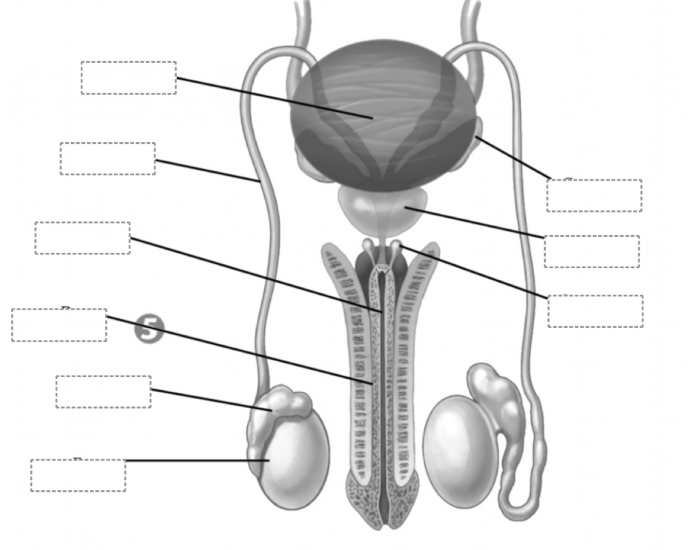
Label this image from top left to top right
Bladder, Vas deferenes, Urethra, Erectile tissue, Epididymus, testes, Bulbourethral gland, Prostrate gland, Seminal vesicle
What are the two main functions of the testes?
Produce sperms and generate testosterone
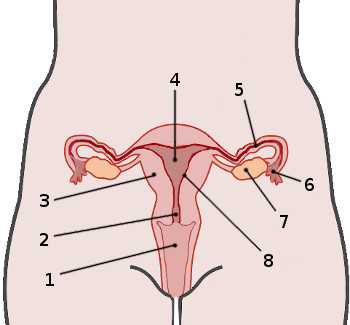
Label this image 4 to 5 (Minus 8)
Uterine cavity, Endometrium, Cervical canal, Vagina, Ovary, Fimbriae, Fallopian tube
What are the two main functions of the ovaries?
They produce eggs and oestrogen or progesterone
Explain fertilization in animals
Sperm fuses with ovum
Nuclei of both gametes combine to form a nucleus
The zygote is formed with characteristics of both parents
What are the four parts of a flower?
Petals, Sepals, Stamen, and Pistil
What is the stamen?
The male reproductive part, consists of anther and filament
What is the pistil?
The female reproductive part, consists of the stigma, style and ovary
What can a flower consist of?
Stamen, stigma or both
Flowers can be both…
Unisexual and bisexual
Examples of a bisexual flower?
China rose
Example of a unisexual plant?
Cucumber
What is pollination?
The process of transferring grains from the anther to the stigma
What is self pollination?
When pollen transfer takes place between the anther and stigma of the same flower
What is cross pollination?
When pollen transfer takes place between the anther and stigma of different flowers of the same species
Some pollinators are;
Water, bees and wind
What does the ‘xx’ chromosome signify?
Offspring is female
What does the ‘xy’ chromosome signify?
Offspring is male
How does the male cell determine the sex of an offspring?
An egg cell will only have ‘x’ chromosome but sperms can have ‘x’ or ‘y’
What is a fetus?
Stage of human development after the embryo stage
What is a phenotype?
Inherited characteristics on the outside
What is a genotype?
Genes making u the chromosome that demonstrate the characteristic
What’s an allele?
A form of a gene
Dominant allele?
Allele that’s always expressed when present
Recessive allele?
Allele expressed only if two copies are present
Homozougous?
Both genes are the same