Bonding
 Call Kai
 Learn
Learn Practice Test
 Spaced Repetition
 Match
Match Flashcards
 Knowt Play
1/19

There's no tags or description
Looks like no tags are added yet.
Name | Mastery | Learn | Test | Matching | Spaced | Call with Kai |
|---|
No analytics yet
Send a link to your students to track their progress
20 Terms
State the equation for total interatomic force
F=FA+FR
When do repulsive forces become significant?
When electron clouds overlap.
Where is equilibrium atomic spacing assumed?
Where the net force is zero.
How is bond potential energy determined?
By integrating force with respect to distance. U=∫ Fdr
At what point is bond potential energy minimum?
At the equilibrium atomic spacing
Why do atoms settle at an equilibrium spacing?
Physical systems tend to minimise energy.
What is a common expression for bond potential energy?
U=−Ar−m+Br−n
What do the constants A B m and n represent in the bond energy equation?
A and B are attraction and repulsion constants while m and n depend on the bond type.
How is interatomic force obtained from bond energy?
By differentiating bond energy with respect to r.
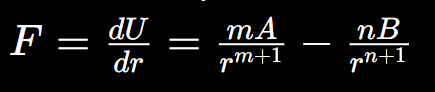
What is the typical value of m for ionic, covalent and metallic bonds?
m = 1
m = 2 and n = 9
m = 1-4
How is equilibrium spacing ro determined?
By setting the net force equal to zero.
How is Young’s modulus related to atomic bonding?
Young’s modulus is related to the slope of the force-separation curve near equilibrium spacing.
What happens to atoms during elastic deformation?
Atoms move slightly away from their equilibrium spacing.
What part of the force-separation curve relates to Young’s modulus?
The initial slope of the force-separation curve
For which materials can Young’s modulus be predicted well using interatomic forces?
metals
elastic deformation comes mainly from stretching of atomic bonds
Why does the interatomic force model fail to predict polymer stiffness accurately
polymer stiffness not controlled only by bond stretching
uncoiling and straightening of long polymer chains
stretching of weak secondary bonds
How do theoretical strengths compare with actual strengths
Theoretical strengths predicted from interatomic force data are much higher than actual measured strengths
What is the typical relationship between UTS and E for metals
Metals often show UTS values around E/100 to E/1000
Why can’t interatomic force data accurately predict metal strength
Because real metals contain defects and dislocations
Which physical property can be explained using the U-r diagram?
Thermal expansion