Self and Personality
 Call Kai
 Learn
Learn Practice Test
 Spaced Repetition
 Match
Match Flashcards
 Knowt Play
1/63

There's no tags or description
Looks like no tags are added yet.
Name | Mastery | Learn | Test | Matching | Spaced | Call with Kai |
|---|
No analytics yet
Send a link to your students to track their progress
64 Terms
Subjective accounts of the self
How we perceive the world, people, and events from our own point of view. This is the focus of self psychology.
Ex: “I feel like everyone in class is judging me.”
Objective accounts of the self
Describing the actual, measurable qualities of a person and determining whether people can accurately report their own thoughts, emotions, and behavior. This is the focus of personality psychology.
Ex: A personality test shows someone scores high on conscientiousness.
An integrated set of beliefs, memories, and generalizations about ourselves. Processing self-relevant information activates the middle of the frontal lobes (Kelley et al., 2002).
The immediate experience of the self in the here and now. It is accessed for a particular situation, impacts behavior, and emphasizes how we are different from others in that context.
Ex: At a job interview, you might think of yourself as "hardworking and professional" — not as a sister or a fashion person, even though those are all still part of you. That professional identity is what's accessible in that moment.
A personality style marked by self-centeredness, grandiose self-views, entitlement, manipulativeness, poor relations with others, and anger when challenged.
Narcissism has been increasing among American college students since 1979 — sometimes called the "Generation Me" phenomenon.
Grandiose narcissism
An approach-oriented form of narcissism characterized by boldness, extraversion, power-seeking, and sensitivity to rewards and opportunities (Krizan & Herlache, 2018).
The tendency to overestimate one's own qualities and abilities relative to others. Related to unrealistic optimism — the belief that good outcomes are more likely to happen to us than to other people.
Ex: most drivers rate themselves as above average.
The tendency to attribute positive outcomes to our own abilities (internal causes) and negative outcomes to external factors, in order to protect self-esteem.
Ex: "I got an A because I'm smart; I got a C because the test was unfair."
Comparing oneself to someone who is less successful on a given dimension in order to boost self-esteem.
Specific type of downward comparison. Comparing your current self to your past self.
Example: "I'm a much stronger writer than I was freshman year."
Comparing oneself to someone who is more successful on a given dimension. Can motivate improvement but may also damage self-esteem.
Ex: comparing your GPA to a higher-achieving classmate.
personality approaches
– Psychodynamic theory
– Humanistic approaches
– Trait approaches
– Social cognitive approaches
Cons of Freudian premises
hard to assess through scientific methods
Psychodynamic Theory
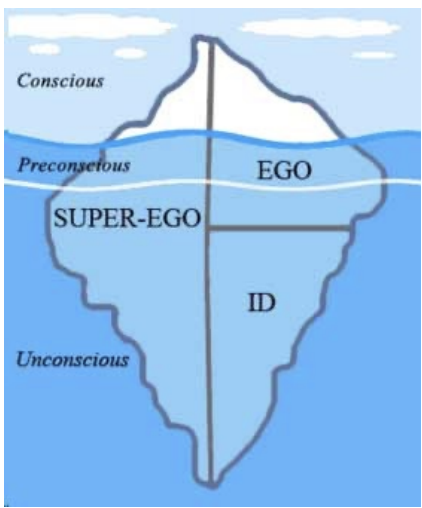
The id
The fully unconscious structure of personality that operates on the pleasure principle — seeking immediate gratification without regard for reality or morality.
Example: "I'm hungry and I need to eat this entire pizza right now."
The superego
The structure of personality that represents the internalized standards of society and one's parents — the moral conscience.
Example: "It's against the rules to play with matches"
The ego
Satisfaction of the wishes of the Id adapted to the current demands of the Superego
It operates on the reality principle and uses defense mechanisms to manage anxiety (Anna Freud, 1936).
Example: "I want the whole pizza (id), and I know I shouldn't (superego), so I'll order a reasonable amount and save some for later."
Denial (defense mechanism)
Refusing to acknowledge the source of anxiety.
Example: a person diagnosed with cancer refuses treatment by insisting the symptoms must have another cause.
Repression (defense mechanism)
Excluding the source of anxiety from conscious awareness entirely.
Example: a person cannot remember the night they were mugged at gunpoint.
Projection (defense mechanism)
Attributing one's own unacceptable qualities to someone else.
Example: a highly competitive person accuses others of being the competitive ones.
Reaction formation (defense mechanism)
Warding off an uncomfortable thought by overemphasizing its opposite.
Example: a teen attracted to a classmate bullies that classmate instead.
Rationalization (defense mechanism)
Creating a seemingly logical excuse for behavior that might otherwise seem shameful.
Example: "Everyone drives after a couple of drinks."
Displacement (defense mechanism)
Shifting the emotional response from its true target to an easier one.
Example: having a terrible day at work and coming home and yelling at family members.
Sublimation (defense mechanism)
Channeling socially unacceptable impulses into constructive or even admirable behavior.
Example: someone with disordered eating becomes a nutritionist who helps others.
Humanistic Approaches
Emphasis in people’s goodness
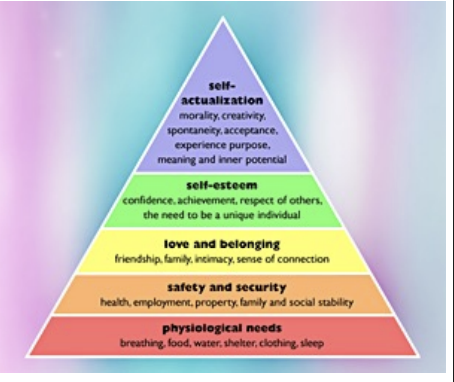
Maslow's deficiency needs
The lower four levels of Maslow's hierarchy: physiological needs, safety and security, love and belonging, and self-esteem. These must be met before a person can pursue growth.
Trait approaches to personality
Approaches that describe personality through stable characteristics — tendencies to act in certain ways consistently over time and across situations.
Traits exist on a continuum.
The Big 5
Five basic personality traits:
Openness
Conscientiousness
Extraversion
Agreeableness
Neuroticism
Openness (Big Five)
The tendency to appreciate new art, ideas, values, feelings, and behaviors. High scorers are creative and imaginative; low scorers are practical, conventional, and rational.
self-report measures
Personality tests that use questionnaires to let people respond to items that reveal traits and behaviors
Locus of control (Rotter)
A person's perception of whether they control what happens to them.
Internal locus: belief that outcomes result from one's own actions. External locus: belief that outcomes are controlled by outside forces like luck or other people.
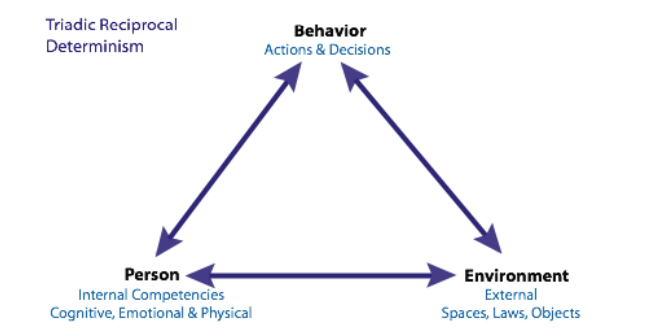
Bandura's Reciprocal Determinism
The theory that personality is explained by the continuous interaction among three factors:
(1) the person's environment
(2) person factors such as characteristics, self-confidence, and expectations
(3) behavior itself.
Each factor influences and is influenced by the others.