Microbiology Lecture 14: Heat-Seeking Missiles - Specific Defense
 Call Kai
 Learn
Learn Practice Test
 Spaced Repetition
 Match
Match Flashcards
 Knowt Play
1/29

Earn XP
Description and Tags
A set of vocabulary flashcards covering the components and mechanisms of the specific immune response, including antigens, lymphocytes, and the lymphatic system.
Name | Mastery | Learn | Test | Matching | Spaced | Call with Kai |
|---|
No analytics yet
Send a link to your students to track their progress
30 Terms
AB
Antibody
AG
Antigens
Innate defenses
Natural ‘inborn’ resistance to most pathogens characterized by nonspecific mechanisms such as physical barriers, phagocytosis, and inflammation.
Specific immunity
The third line of defense involving the body’s ability to recognize and defend itself against distinct invaders and their products via a ‘smart’ system with memory functions.
Antigen
Any molecule or molecular fragment that triggers a specific immune response, including components of bacterial cell walls, capsules, pili, flagella, and proteins of viruses, fungi, and protozoa.
Epitope
A defined region or fragment of a molecule that has antigenic properties; a single large molecule may possess multiple of these.
How can antigens enter the body?
through breaks of the skin and mucous membranes
direct injection→ i.e. needles or bite
through organ transplant and skin grafts
Lymphatic system
A network of organs, fluid-return vessels, and clean-up cells that screen the tissues of the body for foreign antigens.
Lymph
A liquid similar in composition to blood plasma that arises from fluid leaked from blood vessels into surrounding tissues.
Lymphoid cells
Includes lymphocytes (T-cells and B-cells), which are the smallest white blood cells developed from stem cells in red bone marrow.
Lymph nodes
Structures concentrated in the neck, groin, armpit, and abdominal regions that house leukocytes to recognize and attack foreign antigens.
Spleen
An organ that filters bacteria, viruses, toxins, and other foreign matter from the blood, similar in structure and function to lymph nodes.
Mucosa-associated lymphoid tissues (MALT)
Tissues that physically trap foreign particles and microbes, including the appendix, respiratory tract lymphoid tissue, and Peyer’s patches.
Clonal Deletion
A process occurring with both B and T cells where the body ‘edits’ lymphocytes to eliminate all self-reactive cells (autoantigens).
Plasma cells
Short-lived activated B cells that synthesize and secrete antibodies complementary to a specific antigenic determinant.
Memory B cells
Long-lived cells that do not secrete antibodies but display membrane-bound antibodies to initiate rapid production if the same antigen is encountered again.
Immunoglobulins (Ig)
Soluble proteins composed of polypeptides held together by covalent bonds that circulate in blood and lymph to bind antigens.
How are they secreted?
Secreted by plasma cells ( B cells that are actively fighting antigens
Why are antibodies ( Ig) considered part of the humoral immune response?
Because bodily fluid such as lymph and blood were called humor at one point.
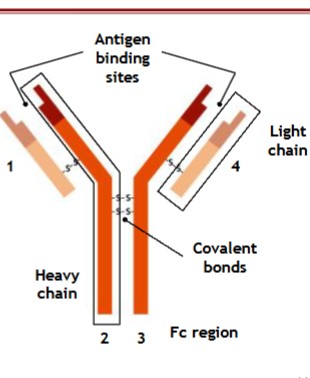
What are the structures of Antibodies
four polypeptides
covalent bonds
Heavy (large) chains a d light (small) chains
two antighen binding sites per antibody molecule
Fc region
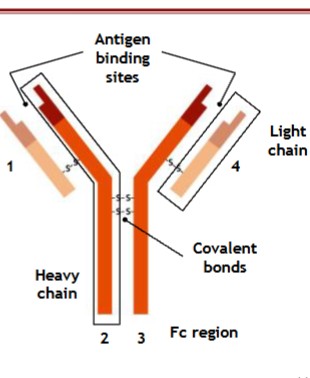
Fc region
The stem region of an antibody molecule.
Five classes of antibodies
IgA, IgD, IgE, IgG, and IgM.
Opsonization
An antibody function that involves phagocyte activation through the coating of an antigen.
Humoral Immune Response
Antibody-mediated immune responses mounted against exogenous pathogens, involving B cell activation and clonal selection.
Antigen Presenting cell (APC)
A cell, such as a macrophage, that displays antigens on its surface to T-helper cells to produce activation signals like cytokines.
T helper cells (CD4)
Cells that recognize the MHC/Ag complex from an APC and direct the specific immune response via chemical signals such as interleukins.
T cytotoxic cells (CD8)
Cells activated by interleukin 2 that trigger apoptosis in any cells carrying an incorrect Ag/MHC complex, defending against cancer and virus-infected cells.
Cell-Mediated Immune Response
An immune response that acts directly against intracellular pathogens (like viruses) and abnormal body cells (like cancer).
Perforin and granzyme
A lethal combination of killing molecules used by the immune system to destroy target cells.