Endocytosis (vesicular transport)
 Call Kai
 Learn
Learn Practice Test
 Spaced Repetition
 Match
Match Flashcards
 Knowt Play
1/3

Earn XP
Description and Tags
Cell biology
Name | Mastery | Learn | Test | Matching | Spaced | Call with Kai |
|---|
No analytics yet
Send a link to your students to track their progress
4 Terms
Endosome maturation
Material is enclosed in portion of membrane à invaginates à pinches off forming an endocytic vesicle.
These vesicles fuse with an early endosome = primary sorting station.
Some vesicles bud off early endosome that recycle endocytosed cargo back to the plasma membrane, either directly or through a recycling endosome.
The developing late endosome moves along microtubules to the cell interior.
They fuse with one another or endolysosomes to form lysosomes and degrade content.
All stages are connected via transport vesicles with the TGN, which provides continuous supply of newly synthesizes lysosomal proteins
Receptor mediated endocytosis (RME)
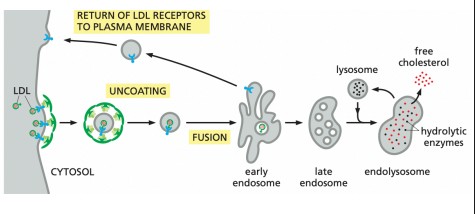
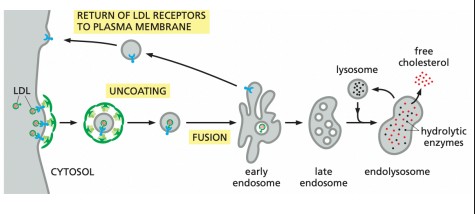
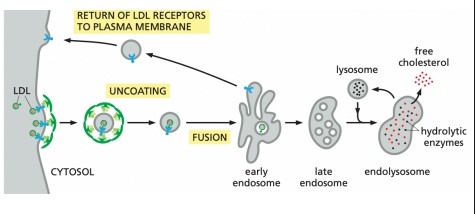
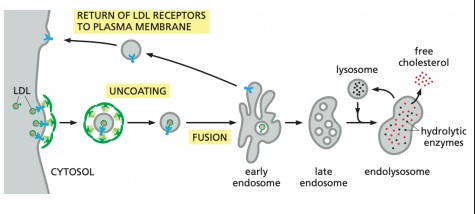
Molecules bind to receptors and enter cells in coated pits. Common example is cholesterol, needed for the plasma membrane.
The LDL hits the LDL receptors on the outside of the plasma membrane.
The receptors clump together, and on cytoplasmic side bind to adaptor proteins, which recruit clathrin coating.
The vesicle forms and sheds the coating.
It then fuses with an early endosome and the receptor returns to the plasma membrane.
The late endosome fuses with a lysosomes and cholesterol gets release into cell so it can be used.
Phagocytosis
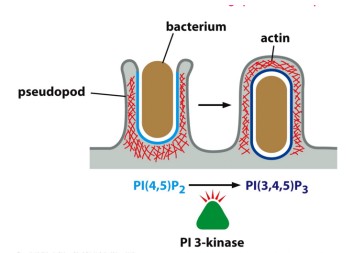
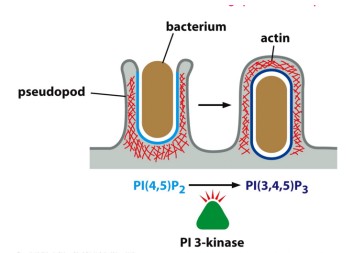
Involves the ingestion of big materials and is mediated by actin.
The cell uses large endocytic vesicles called phagosomes which form when the cell extends pseudopods. These are shaped by localized actin polymerization, and they engulf the particle and fuse at their tips to form a phagosome. The polymerization of the PIPs stimulates the actin polymerization Phagosomes fuse with lysosomes and the material is degraded
/
/