AP Gov Chapter 4 Test
 Call Kai
 Learn
Learn Practice Test
 Spaced Repetition
 Match
Match Flashcards
 Knowt Play
1/49

Earn XP
Name | Mastery | Learn | Test | Matching | Spaced | Call with Kai |
|---|
No analytics yet
Send a link to your students to track their progress
50 Terms
The best way to prevent from the encroachment of the representative body is to have a steady, upright, and ___________ administration of the laws.
A. exclusive
B. impartial
C. independence
D. legislature
E. precedent
F. preferred
G. resolve
H. rights
I. void
B
The judiciary, due to the nature of its functions, will be the least dangerous to the __________ of the Constitution.
A. exclusive
B. impartial
C. independence
D. legislature
E. precedent
F. preferred
G. resolve
H. rights
I. void
H
To ensure firmness and _____________ of decisions, judges must have permanency in office.
A. exclusive
B. impartial
C. independence
D. legislature
E. precedent
F. preferred
G. resolve
H. rights
I. void
C
The Court’s duty is to declare all acts contrary to the ideals and principals of the Constitution________.
A. exclusive
B. impartial
C. independence
D. legislature
E. precedent
F. preferred
G. resolve
H. rights
I. void
I
The courts were designed to be an intermediate body between the people and __________.
A. exclusive
B. impartial
C. independence
D. legislature
E. precedent
F. preferred
G. resolve
H. rights
I. void
D
The interpretation of the laws is the proper and ___________domain of the courts.
A. exclusive
B. impartial
C. independence
D. legislature
E. precedent
F. preferred
G. resolve
H. rights
I. void
A
The prior act of a superior court ought to be ________ to the subsequent act of an inferior and subordinate authority.
A. exclusive
B. impartial
C. independence
D. legislature
E. precedent
F. preferred
G. resolve
H. rights
I. void
F
The Constitution ought to be ___________ to the statute, the intention of the people to the intention of their agents.
A. exclusive
B. impartial
C. independence
D. legislature
E. precedent
F. preferred
G. resolve
H. rights
I. void
F
When two laws exist at one time and clash either in part or in their entirely it is the jurisdiction of the courts to ___________ the meaning and operation of the laws.
A. exclusive
B. impartial
C. independence
D. legislature
E. precedent
F. preferred
G. resolve
H. rights
I. void
G
___________ must unavoidably swell to a very considerable bulk and must demand long and laborious study to acquire a competent knowledge of them.
A. exclusive
B. impartial
C. independence
D. legislature
E. precedent
F. preferred
G. resolve
H. rights
I. void
E
A significant constraint to the United States Supreme Court’s authority lies in its inability to
A. overturn previous Supreme Court rulings
B. use previous dissents for future court decisions
C. add to their docket emergent cases carrying national consequences
D. to get Congress, the President, or the states to enforce its more unpopular rulings
Which of the following best describes an example of amicus curiae?
A. An argument challenging the President’s constitutional authority to seize steel mills
B. The NAACP’s legal brief in support of a black girl’s request to attend an all white school
C. The Court’s ruling that all persons have the right to a court appointed attorney
D. The Court’s ruling that burning a United States flag is a protected form of speech
B
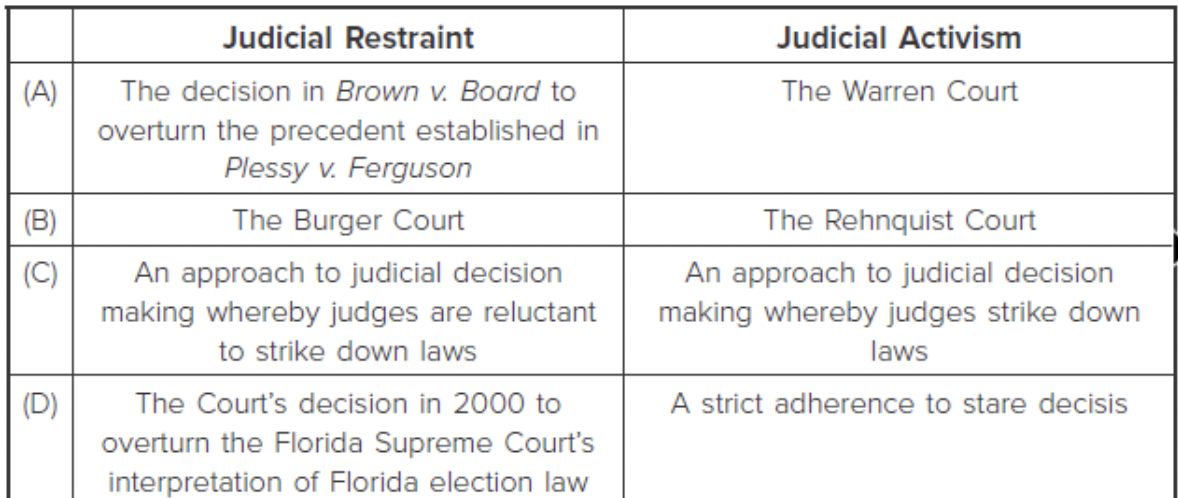
Which of the following is an accurate comparison of judicial restraint and judicial activism?
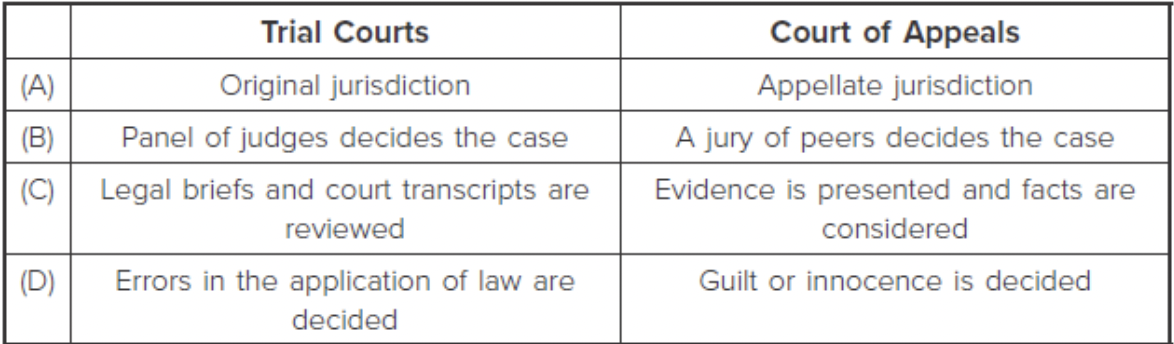
Which of the following is an accurate comparison of trial and courts of appeals?
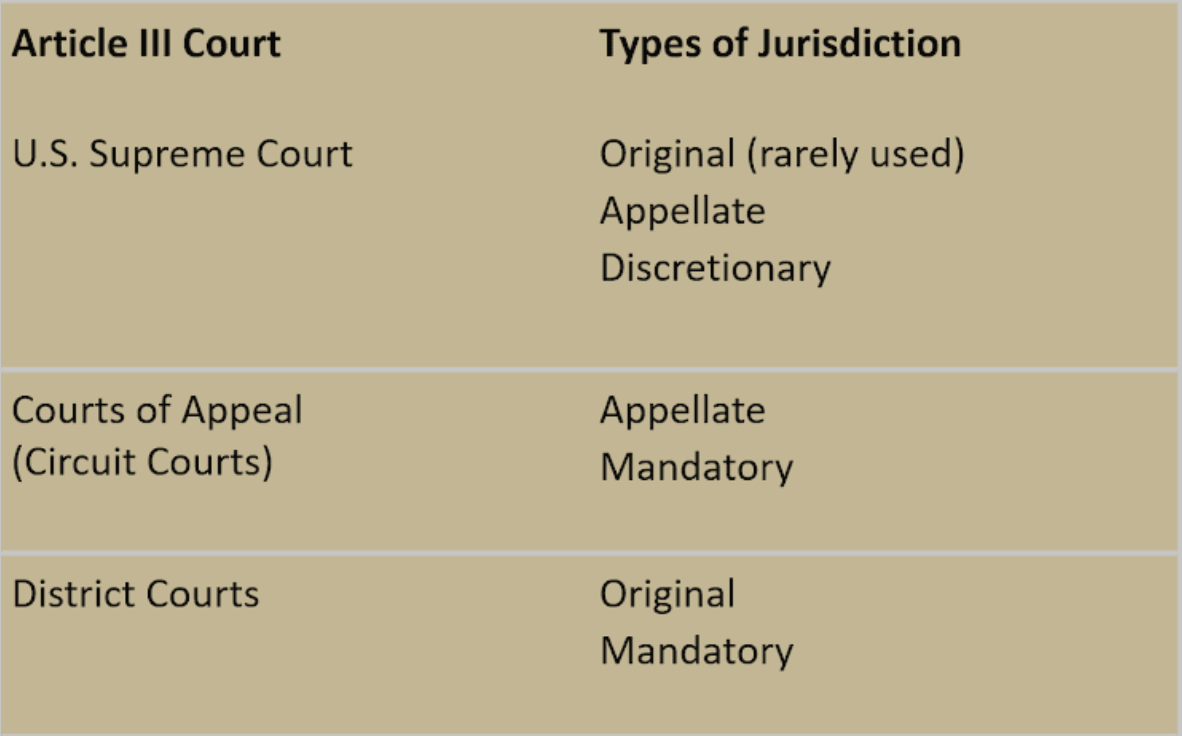
Based on the chart below, which of the following is an accurate description of Article III Courts?
A. Courts created by Congress that help administer and resolve conflicts over specific federal legislation
B. Courts created with the power to decide only those cases over which the Constitution gives them authority
C. Federal trial courts with mandatory jurisdiction
D. Federal courts with mandatory, appellate jurisdiction
B
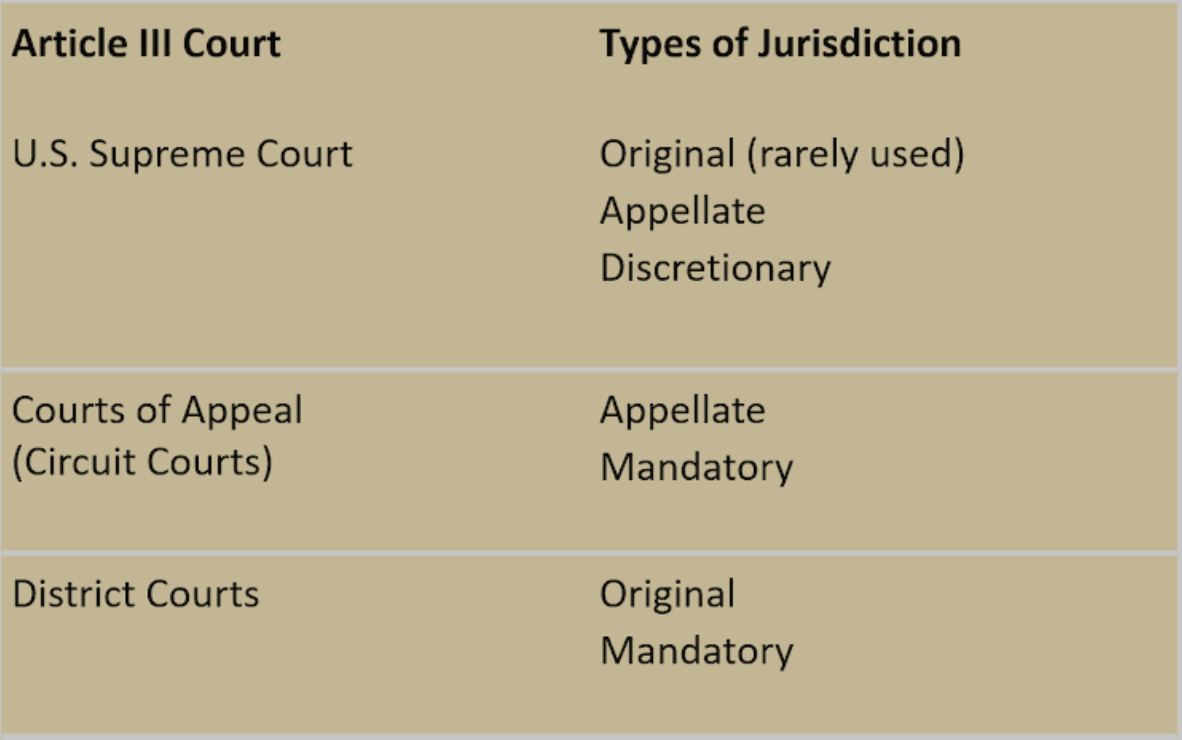
Which of the following is the most important source of the Supreme Court’s caseload?
A. Original jurisdiction
B. Cases referred from state supreme courts
C. Appellate jurisdiction
D. Cases directly referred to the court by the President
C
The doctrine of stare decisis refers to
A. The authority of the court to declare certain actions by the federal government to be unconstitutional
B. A person’s right not to be prosecuted a second time for the same crime
C. The Court’s commitment to applying previous precedents and decisions to a current case
D. The power of the higher court to review and, when necessary, overturn a lower court’s decision
There are ________ federal district courts.
A. 9
B. 13
C. 53
D. 94
For handling cases at the courts of appeal level, the United States is divided into ________ judicial circuits.
A. 9
B. 13
C. 53
D. 94
The most common way for the Supreme Court to put a case on its docket is by issuing a(n) ________, a formal document that calls up a case which deals with a Constitutional question or in which state laws are claimed to violate federal law.
A. stare decisis
B. writ of certiorari
C. amicus curiae brief
D. per curiam decision
Judicial philosophy in which justices create and influence law from the bench.
A. Judicial Review
B. Judicial Activism
C. Judicial Restraint
Judicial philosophy in which justices reaffirm previous legal decisions
A. Judicial Review
B. Judicial Activism
C. Judicial Restraint
Idea that the Supreme Court has the ability to determine if the actions of government or government officials is constitutional
A. Judicial Review
B. Judicial Activism
C. Judicial Restraint
The reluctance to interpret the law and to hesitate to overturn existing legal precedent unless it is obviously unconstitutional is called what?
A. Judicial Review
B. Judicial Activism
C. Judicial Restraint
This concept holds that judges should actively interpret the Constitution, statutes and precedents in light of established principles when elected representatives fail to act in clear accord with these principles.
A. Judicial Review
B. Judicial Activism
C. Judicial Restraint
This concept holds that judges should broadly defer to precedent and to decisions made by legislatures.
A. Judicial Review
B. Judicial Activism
C. Judicial Restraint
Which of the following statements describes judicial activism?
A. Judges have the power to interpret the Constitution and declare a law unconstitutional
B. Judges rely on past decisions and their precedents when making decisions in new cases
C. Judges ought to freely strike down laws that are inconsistent with their understanding of the Constitution
D. Judges should limit the exercise of their own power to interpreting the Constitution according to its original intent
Which of the following statements best describes judicial restraint?
A. Judges have the power to interpret the Constitution and declare a law unconstitutional
B. Judges rely on past decisions and their precedents when making decisions in new cases
C. Judges ought to freely strike down laws that are inconsistent with their understanding of the Constitution
D. Judges should limit the exercise of their own power to interpreting the Constitution according to its original intent
Philosophy proposing that judges should interpret the Constitution to reflect what the framers intended and what its words literally say.
A. Judicial Review
B. Judicial Activism
C. Judicial Restraint
D. Original Jurisdiction
Which of the following statements best explains how judicial activism influences decisions made by individual justices when deciding cases heard by the Court?
A. Justices are influenced by the public opinion on a case rather than constitutional interpretation
B. Justices are less likely to strike down laws and policies as unconstitutional
C. Justices are influenced by the social effects the decision might have on the public
D. Justices are more likely to defer to previous Supreme Court decisions
C
The free exercise clause of the first amendment to the Constitution can be limited when actions
A. Conflict with longstanding traditions and laws
B. Advance the religion of one over another
C. Create heightened scrutiny
D. Prohibit a religious group from forming
In the case of ________, the Supreme Court ruled that the Bill of Rights restrained only the national government, not states and cities.
A. Miranda v. Arizona
B. Gitlow v. New York
C. Barron v. Baltimore
D. Engel v. Vitale
Which of the following is true about selective incorporation?
A. It has been a key enumerated component of the Constitution
B. It incorporates state constitutions to the national government
C. It requires that the Bill of Rights be applied to the states on a case by case basis
D. It requires that all aspects of the Bill of Rights be applied to the states
In deciding to incorporate parts of the Bill of Rights into state laws since 1925, the Supreme Court has relied on the due process clause of the
A. First Amendment
B. Fifth Amendment
C. Eighteenth Amendment
D. Fourteenth Amendment
The state cannot hold prayers in public schools, even if participation is not required and the prayer is not tied to a particular religion because it violates the First Amendment and the Establishment Clause
A. Lemon v. Kurtzman (1967)
B. School District of Abington v. Schempp (1963)
C. Gitlow v. New York (1925)
D. Engel v. Vitale (1962)
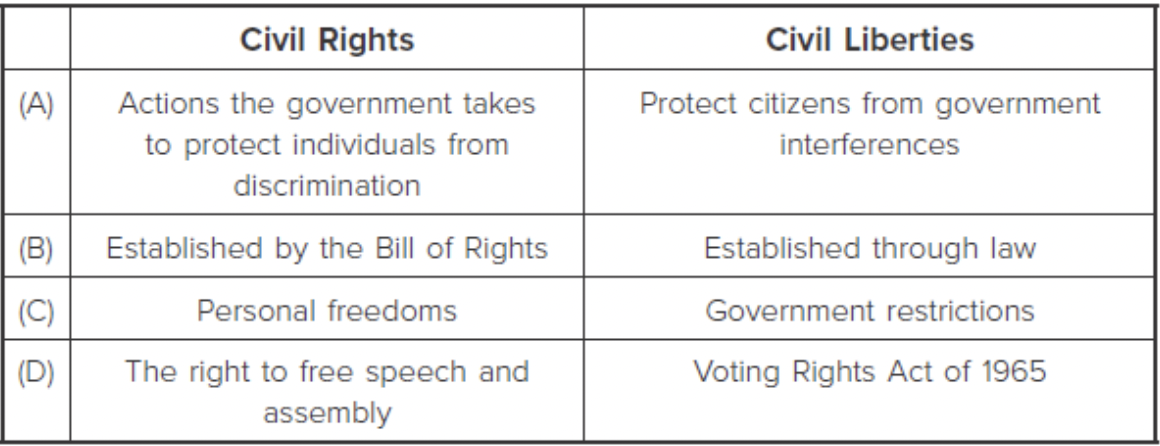
Which of the following is an accurate comparison of civil rights and civil liberties?
________ refers to a government's censorship of material before it is published.
A. Prior restraint
B. Equal protection
C. Probable cause
D. The exclusionary rule
The publication of statements known to be false that are malicious and tend to damage a person's reputation is called
A. fraud
B. slander
C. libel
D. obscenity
Unreasonable searches and seizures are specifically forbidden in the
A. Third Amendment
B. Fourth Amendment
C. Fifth Amendment
D. Sixth Amendment
Cruel and unusual punishment is forbidden by the
A. Fifth Amendment
B. Sixth Amendment
C. Seventh Amendment
D. Eighth Amendment
The ________ Amendment, adopted in 1870, guaranteed the right of African Americans to vote at least in principle.
A. Thirteenth
B. Fourteenth
C. Fifteenth
D. Sixteenth
All of the following methods were used in attempts to keep blacks from voting EXCEPT:
A. Poll taxes
B. Literacy tests
C. Heightened scrutiny test
D. Grandfather clauses
Poll taxes for federal elections were outlawed in the
A. Civil Rights Act of 1964
B. Tax Reform Act of 1963
C. Voting Rights Act of 1965
D. Twenty-fourth Amendment
D
The Civil Rights Act of 1964
A. ended the white primary
B. guaranteed minority groups the right to vote
C. ended discrimination in the purchase or rental of housing
D. guaranteed equal access to hotels, restaurants, and other public accommodations
The ________ banned gender discrimination in employment by law.
A. Fair Labor Standards Act
B. Civil Rights Act of 1964
C. Nineteenth Amendment
D. Gender Equity Act of 1972
Which is responsible for enforcing the Voting Rights Act?
A. Congress
B. State governments
C. The U.S. Justice Department
D. The Equal Opportunity Commission
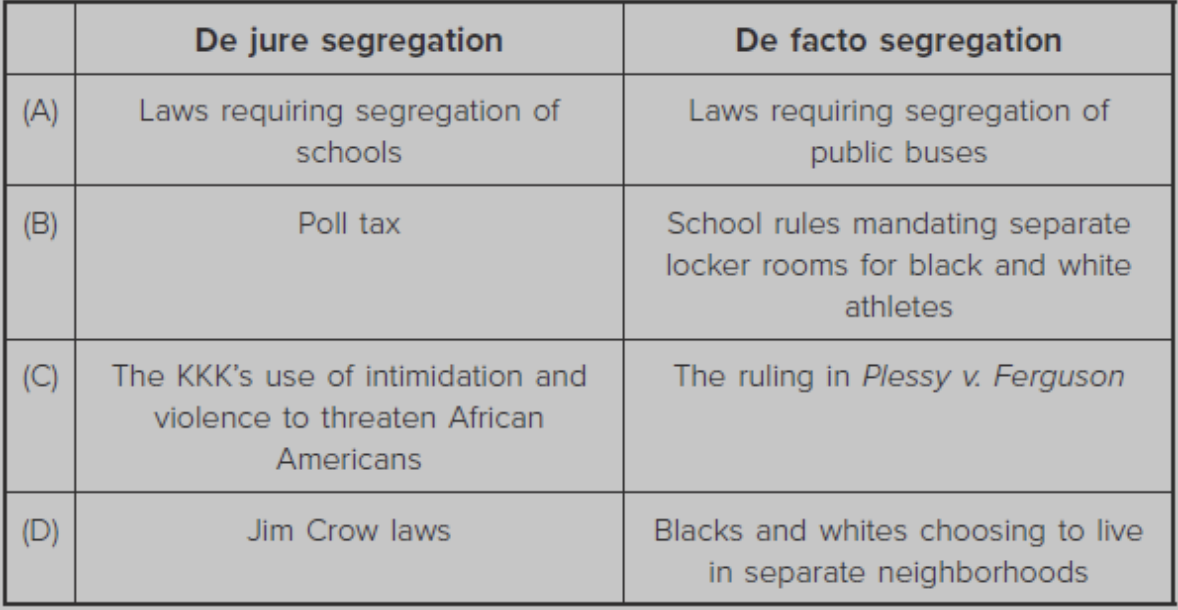
Which of the following scenarios is an accurate comparison of de jure and de facto segregation?
This question is based on the following excerpt from a major Supreme Court decision: "…Such considerations apply with added force to children in grade and high schools. [...] Therefore, we hold that the plaintiffs…are by reason of the segregation complained of, deprived of the equal protection of the laws guaranteed by the 14th Amendment." The “separate but equal” precedent referred to above was established by which of the following cases?
A. Dred Scott v. Sanford, 1857
B. Plessy v. Ferguson, 1896
C. Brown v. Board of Education, 1954
D. Harper v. Virginia State Board of Elections, 1966
Which of the following is an example of a legal affirmative action policy?
A. A sports team’s desire to have an all-female basketball squad
B. A firehouse with a quota system that only selects minority candidates
C. An airline’s requirement that all flight attendants be over 5 feet tall
D. A university’s use of race as one factor of consideration for admittance to its law school
D
In 1990, Congress enacted the ________, a far-reaching law to protect a particular group of Americans from discrimination, ignoring those who claimed the price tag would be too high.
A. Children's Rights Act
B. Gay and Lesbian Civil Rights Bill
C. Americans with Disabilities Act
D. Native-Americans Inclusion Act
C