Cheat Sheet 16: Nervous System
 Call Kai
 Learn
Learn Practice Test
 Spaced Repetition
 Match
Match Flashcards
 Knowt Play
1/56

There's no tags or description
Looks like no tags are added yet.
Name | Mastery | Learn | Test | Matching | Spaced | Call with Kai |
|---|
No analytics yet
Send a link to your students to track their progress
57 Terms
Nervous System
The highly complex system that is responsible for coordinating our sensory and motor functions by transmitting signals around our body.
Glial Cells
Capable of dividing.
Neuron
Consists of several dendrites, single branched axon, and cell body (soma) - cannot divide.
Oligodendrocytes
Produce myelin in CNS.
Sensory (Afferent)
Receive initial stimulus from environment.
Schwann Cells
Produce myelin in PNS.
Microglia
CNS phagocytes.
Association (Interneuron)
Receive input from sensory and send to motor neuron -- Make up 99% of the body's neurons.
Ependymal Cells
Circulate CSF with cilia.
Satellite Cells
Support cells in PNS.
Motor (Efferent)
From brain, stimulate target cells (effectors) to elicit response.
Dendrites
Receive information to transfer to cell body.
Axon Hillock
Site of action potential generation.
Axon
Transfer impulses away from cell body.
Astrocytes
Physically support CNS neurons; maintain nutrient and mineral balance.
Peripheral Nervous System (PNS)
Utilizes preganglionic/postganglionic axons, various neurotransmitters, and differing receptors to act on the effector organs (targets).
Central Nervous System (CNS)
Contains the brain, spinal cord, and interneurons.
Blood-Brain Barrier
A blockade of cells that prevents or slows the passage of drugs, ions, and pathogens into the CNS; permeable to O2, CO2, glucose, and small non-polar molecules.
Somatic Nervous System
Innervates skeletal muscle.
Forebrain
Largest part of the brain.
Autonomic Nervous System
Controls involuntary bodily functions.
Sympathetic Branch
Involved in fight or flight responses, increasing blood pressure & heart rate, ejaculation, and generation of energy.
Limbic System
Includes hippocampus, amygdala, and hypothalamus; responsible for behavioral and emotional responses.
Cerebrum
Contains cerebral cortex; divided by lobes (telencephalon subdivision).
Diencephalon
Subdivision including thalamus, hypothalamus, and pineal gland.
Frontal Lobe
Responsible for conscious thought (attention).
Parietal Lobe
Responsible for sensory functions; somatosensation, proprioception.
Temporal Lobe
Responsible for sound processing/interpretation.
Occipital Lobe
Responsible for visual input.
Hindbrain
Posterior part of the brain.
Cerebellum
Balance and coordination.
Parasympathetic Branch
Rest and digest functions.
Brainstem
Connects cerebrum to spinal cord.
Pons
Relay center between cortex and cerebellum.
Medulla oblongata
Controls breathing, heart rates, and gastrointestinal activity.
Na+/K+ Pump
Maintains resting potential of -70 mV using ATP.
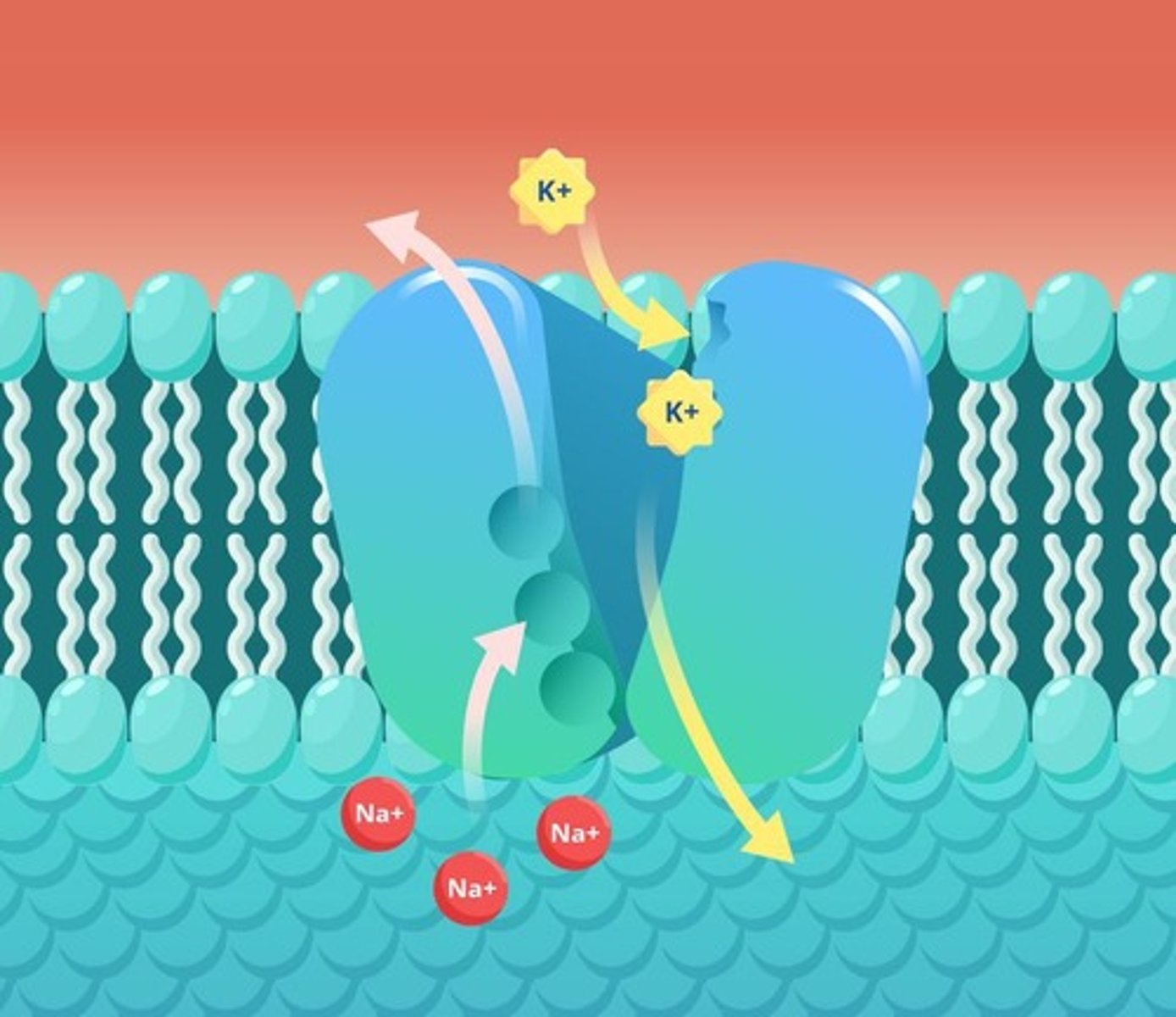
Resting Potential
-70 mV with K+ higher inside the cell; Na+ higher outside.
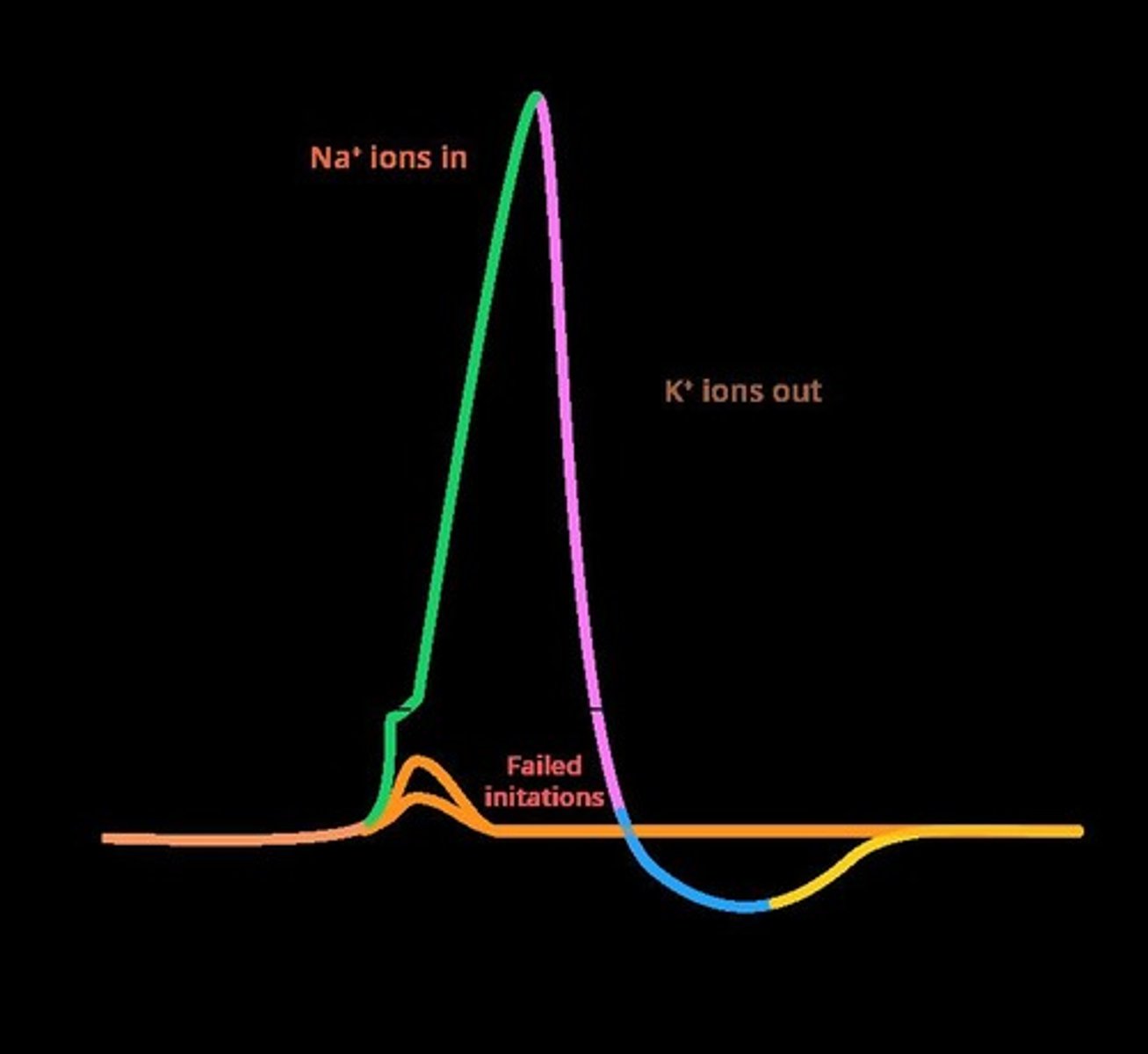
Depolarization
Stimulus increases neuron's potential with the opening of gated ion channels.
Repolarization
Polarization is restored with K+ moving out of gated ion channels.
Hyperpolarization
Excess K+ leaving neuron before channels fully close.
Refractory Period
Neuron unresponsive to new stimulus until the Na+/K+ pump returns ions to resting potential locations.
Mechanoreceptors
Respond strongly to their own stimuli and weakly to others; for touch.
Thermoreceptors
Respond to temperature changes.
Nociceptors
Respond to pain.
Electromagnetic Receptors
Respond to light.
Chemoreceptors
Respond to taste, smell, and blood chemistry.
Neurotransmitters
Chemical messengers that transmit signals across a synapse.
Acetylcholine (ACh)
Binds to ACh receptors on post-synaptic membrane for nerve transmission.
Glutamate
Most common CNS neurotransmitter in vertebrates; excitatory.
GABA
Found in brain; inhibitory neurotransmitter.
Glycine
Found in CNS outside brain; inhibitory neurotransmitter.
Epinephrine (E)
Acts in sympathetic nervous system; causes bronchodilation and vasodilation to lungs and skeletal muscles.
Norepinephrine (NE)
Acts in sympathetic nervous system; causes vasoconstriction to the digestive system and kidneys.
Action Potential
All-or-nothing response of a neuron to a stimulus.
Sensory Receptors
Specialized cells that detect and respond to sensory stimuli.
Increased digestion, relaxation, and sexual arousal
Effects of the parasympathetic nervous system.
Voltage-gated Ca2+ channels
Activated by action potential for calcium to enter the neuron.