MEMORY AND LEARNING UNIT 4 - Operant Conditioning
 Call Kai
 Learn
Learn Practice Test
 Spaced Repetition
 Match
Match Flashcards
 Knowt Play
1/16

There's no tags or description
Looks like no tags are added yet.
Name | Mastery | Learn | Test | Matching | Spaced | Call with Kai |
|---|
No analytics yet
Send a link to your students to track their progress
17 Terms
three term contingency? 1 pt
antecedent→ réponse→ consequent
operant/instrumental response? 4 pts
responses thart are affected by their consequences unlike classical conditioning
consequences will affect the probability of that response being emitted
the frequency of the response can increase or decrease
teleonomic significance (temporary reappearance of an extinguished conditioned response following the presentation of a novel or unexpected stimulus) instead of teleologic significance (behavior in terms of its purpose or goal)
differences between operant conditioning and classical conditioning? 4 pts
CC only has antecedent→ response while OC has antecedent→ response→ consequent
CC only antecedent influences the response while in OC both antecedent and consequent influence
stimulus elicits responses in CC while in OC it evokes them
response in OC is not a reflex because it is controlled by the consequent as well while in CC it is an automatic reflex
operant class responses? 1 pt
responses that have access to the same consequences
reinforcer? 1 pt
a consequent stimulus that alters subsequent behavior by increasing the response that follows and this enhancemend decreases after its removal/termination
punisher? 1 pt
a consequent stimulus that alters subsequent behavior by decreasing the response that follows and this decrement decreases once it is removed/terminated
contingency? 2 pts
positive- the response leads to the access of a stimulus
negative- the response leads to the removal or termination or prevention of a stimulus
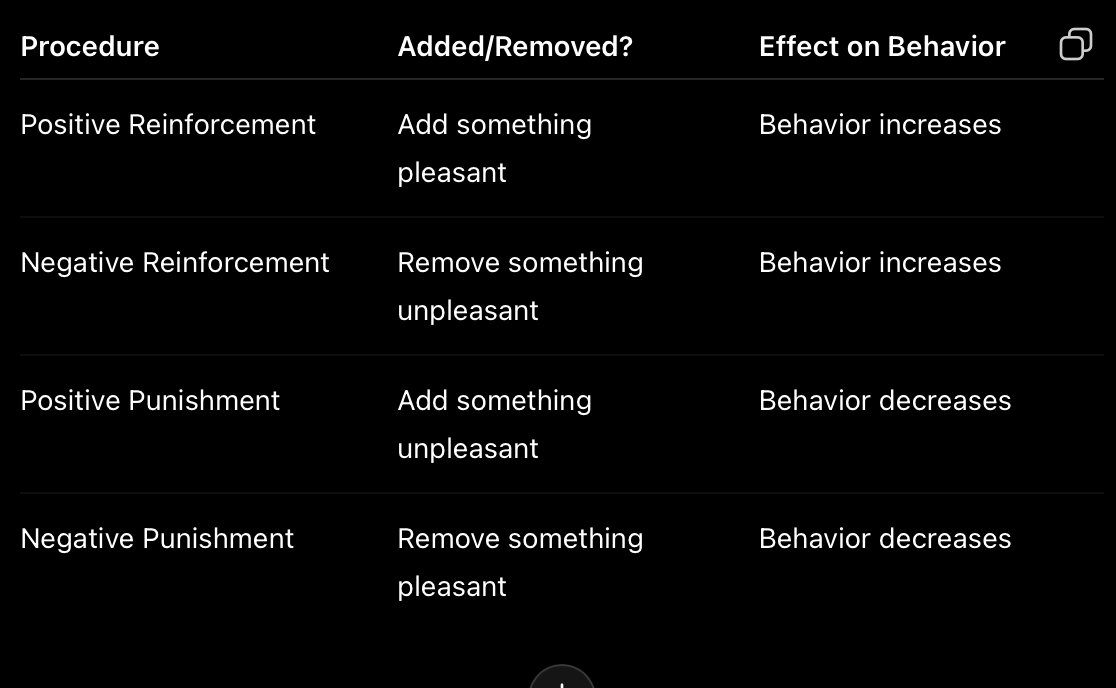
operant conditioning procedures? 4 pts
something pleasant added following behavior that leads to access/increase of the behavior- positive reinforcement (Antecedent→R→Sr)
something negative removed following behavior that leads to removal or termination of the behavior- negative reinforcement (Antecedent→R→Sr)
something negative added following a behavior that leads to the decrease of the behavior- positive punishment (Antecedent→R→Sp)
something pleasant removed following a behavior that leads to the decrease of the behavior- negative punishment (Antecedent→R→Removal of Sr)
E. L. thorndike: the law of effect? 1 pt
behaviors followed by pleasant consequences makes responses more probable while those followed by unpleasant consequences are less probable
shaping in operant conditioning? 5 pts
reinforces the response movement rather than the organism
procedure in which a desired behavior is taught by reinforcing successive approximations toward the target behavior
both antecedent and response change
when in each step only reinforce the step that the new behavior is shown in not in the onew prior
successive approximations towards desired outcome
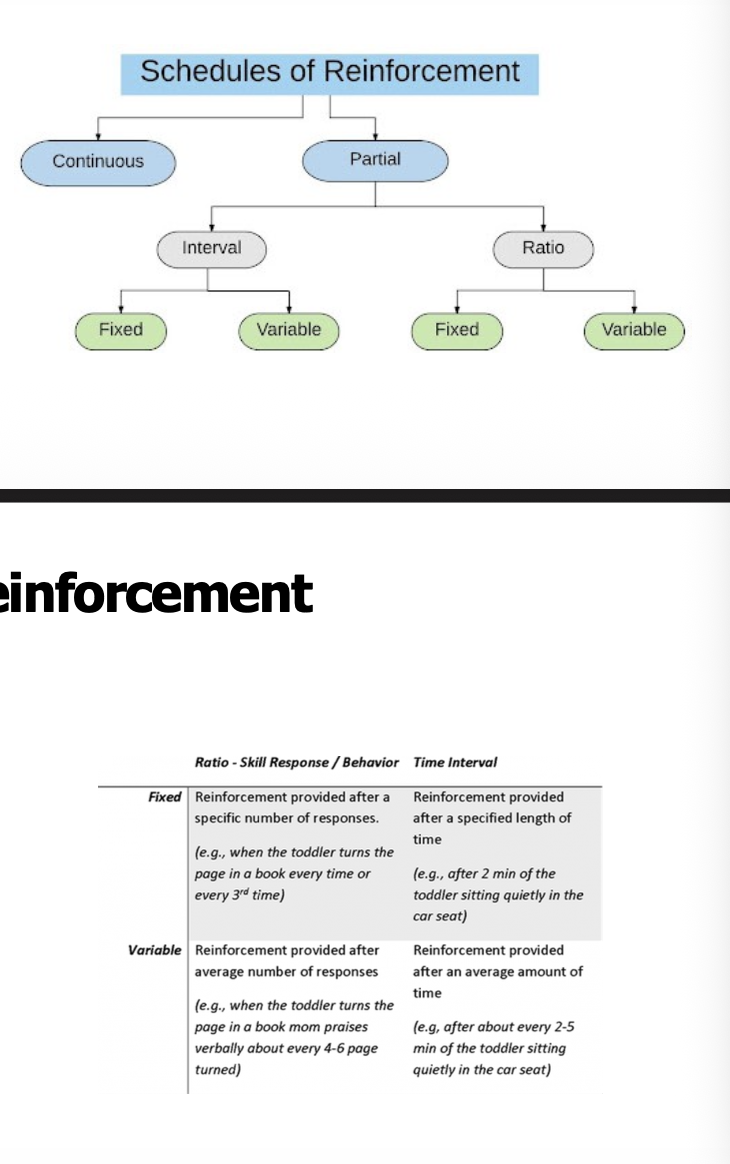
schedules of reinforcement? 6 pts
rule that determines which occurence of operant response gets reinforced
continous reinforcement- every correct response is reinforced
partial reinforcement- only some responses are reinforced
four main types:
fixed ratio- reinforcement occurs after a fixed number of responses
variable ratio- reinforcement occurs after an unpredictable amount of responses
fixed interval- reinforcement becomes available after a fixed amount of time
variable interval- reinforcement occurs after varying intervals of time
operant extinction? 1 pt
stoppping the positive or negative reinforcement contingency for a previously reinforced response that causes the frequency of the response to decrease
contigency = 0
extinction burst? 1 pt
a temporary increase in a behavior after the reward for that behavior stops
primary reinforcers? 2 pts
function as a reinforcer without prior learning
they are naturally reinforcing because they satisfy a biological need e.g food, water, warmth
secondary reinforcers? 3 pts
acquire their reinforcing value through learning and association with primary reinforcers
not naturally reinforcing
they become rewarding because they predict something rewarding e.g. money, good grades, praise
automatic vs social reinforcement? 2 pts
automatic- happens when the behavior itself produces the reward without another person involved
social- happens when another person provides the reward after the behavior
premack’s principe? 1 pt
a high probability behavior can be used to reinforce a low probability behavior