AQA A level Chem 3.6 Organic Analysis
 Call Kai
 Learn
Learn Practice Test
 Spaced Repetition
 Match
Match Flashcards
 Knowt Play
1/9

Earn XP
Description and Tags
Name | Mastery | Learn | Test | Matching | Spaced | Call with Kai | Chat |
|---|
No analytics yet
Send a link to your students to track their progress
10 Terms
A student has samples of these four compounds but does not know which is which:
• butanoic acid
• 2-methylpropanal
• 2-methylpropanoic acid
• 2-methylpropan-1-ol
Step 1: Two of these compounds can be identified by simple chemical tests. Step 2: The other two compounds, that contain the same functional group as each other, can then be distinguished using a spectroscopic technique. Describe how these two steps could be used to identify which compound is which. (6)
Level 3 5-6 marks All stages are covered and each stage is generally correct and virtually complete
Stage 1
To identify 2-methylpropanal
Add Tollen’s reagant
(and the positive result for 2-methylpropanal) is silver mirror
Stage 2
To identify 2-methylpropan-1-ol
add acidified potassium dichromate
(and the positive result willl be) the colour change of the solution from orange to green
The Tollen’s reagant test should be done first to distinguish aldehyde from alcohol
Stage 3
to distinguish the acids,
use IR spectroscopy to distinguish the two acids
use the finger-print region of IR spectrum to look for exact match to spectra of known compounds
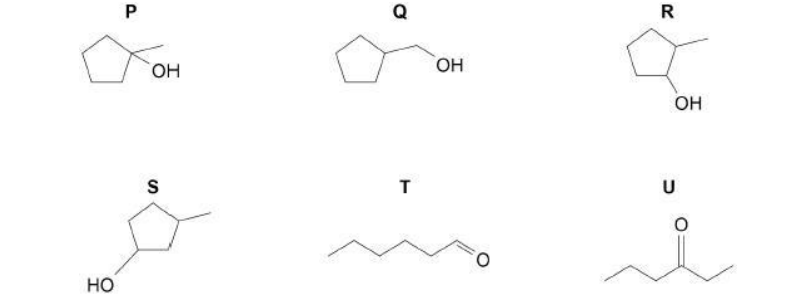
This question is about the structural isomers shown
Separate samples of each isomer are warmed with ethanoic acid and a few drops of concentrated sulfuric acid.
In each case the mixture is then poured into a solution of sodium hydrogencarbonate.
Identify the isomer(s) that would react with ethanoic acid.
Suggest a simple way to detect if the ethanoic acid reacts with each isomer. Give a reason why the mixture is poured into sodium hydrogencarbonate solution. (3)
P, Q, R, S (1)
Sweet smelling liquid (1)
to react with (excess acid) (1)
esterification occurs which when a carboxylic acid reacts with an alochol to form an ester and water
The oxidation of propan-1-ol can form propanal and propanoic acid
In a preparation of propanal, propan-1-ol is added dropwise to the oxidising agent and the aldehyde is separated from the reaction mixture by distillation.
Give two ways of maximising the yield of propanal obtained by distillation of the reaction mixture. (2)
Keep the temperature of the reaction mixture below the boiling point of propan-1-ol (1)
Cool the distillate / collecting vessel (1)
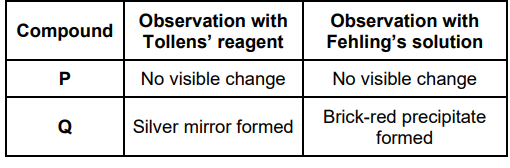
Compounds A, B, C and D are isomers with the molecular formula C4H10O
Compounds A and B are both straight-chain compounds. A can be oxidised to form P. B can be oxidised to form Q.
P and Q are isomers with molecular formula C4H8O
Tollens’ reagent and Fehling’s solution can be used to distinguish between isomers P and Q. The results shown in the table are obtained.
Use the information about compounds P and Q to identify compounds A and B. Explain your answer with reference to the functional groups in P and Q. (3)
A = butan-2-ol (1)
B= butan-1-ol (1)
Product from A / P is a ketone AND product from B/Q is an aldehyde (1)
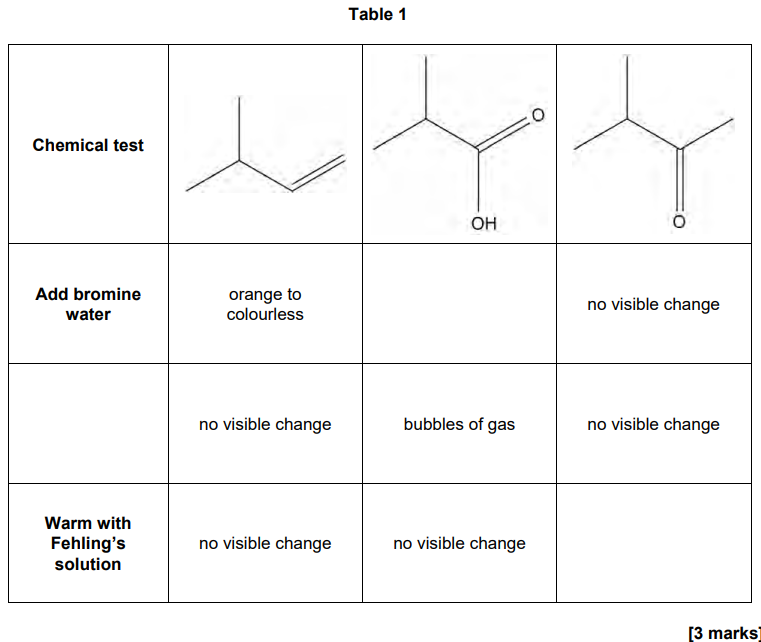
Complete the empty boxes in the table. (3)
Row 1 = no (visible) change (1)
Row 2 = sodium hydrogencarbonate (1)
Row 3 = no (visible) change/reaction (1)
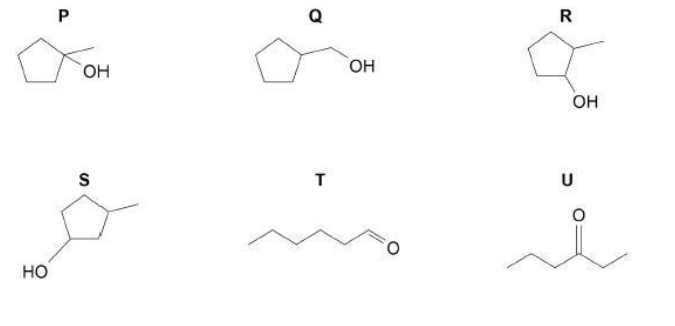
This question is about the structural isomers shown.
Describe fully how infrared spectra can be used to distinguish between isomers R, S and T. Use data from Table A in the Data Booklet in your answer. (4)
R&S have an O-H alcohols peak at 3230-3550 cm-1(1)
T has C=O peak at 1680-1750 cm-1(1)
R&S (unique) fingerprint region or below 1500 cm-1 (1)
Compare to a database/ known spectra (and look for an exact match) (1)
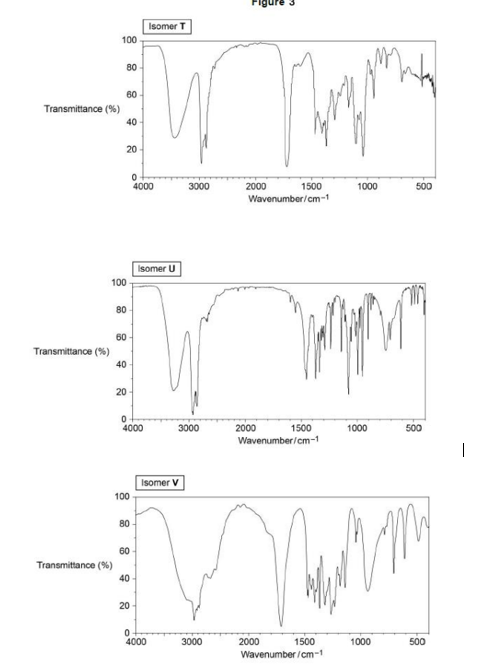
The infrared spectra shown in Figure 3 are those of three different isomers of C6H12O2, isomers T, U and V
Identify the functional group(s) present in each isomer T, U and V of C6H12O2 using Table A in the Data Booklet. Explain your answer (6)
(Isomer T)
Signals due to OH (alcohol) at 3230-3350 and C=O at 1680-1750 (1)
OH and C=O (functional groups) separated in molecule (1)
(Isomer U)
(only) signal for OH (alcohol) at 3230-3350 (1)
2 x OH groups present/diol/OH & cyclo(ether) structure (1)
(Isomer V)
signals due to OH (acid) at 2500-3000 (and C=O at 1680-1750) (1)
-COOH present (1)
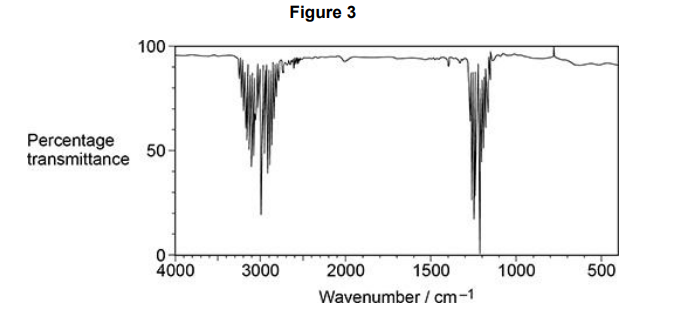
Figure 3 shows the infrared spectrum of methane.
Use information from Figure 3 to explain why methane acts as a greenhouse gas (1)
Methane absorbs IR radiation/ Methane absorbs radiation/light around 3000 and/or 1200 (cm-1 )

A student plans a series of chemical tests to confirm the identities of four organic liquids. This is the student’s method. To separate test tubes containing samples of each liquid:
Test 1 add potassium dichromate(VI) solution and warm gently
Test 2 add Fehling’s solution and cool in iced water
Test 3 add sodium hydrogencarbonate solution and test any gas produced with a lighted splint
Test 4 add bromine water and shake at room temperature.
The missing reagant is added and the mistakes are corrected
Identify the liquid(s), J, K, L and M, that would react in test 3 and the correct observation (2)
Liquid(s) that react with Test 3 : J,L (1)
Expected observation : (colourless gas that turns) limewater cloudy (1)
Which compound has the empirical formula C2H4O?
A butanal
B ethanoic acid
C ethanol
D methylpropanoic acid (1)
D (1)