Econ Exam #3
 Call Kai
 Learn
Learn Practice Test
 Spaced Repetition
 Match
Match Flashcards
 Knowt Play
1/223

There's no tags or description
Looks like no tags are added yet.
Name | Mastery | Learn | Test | Matching | Spaced | Call with Kai |
|---|
No analytics yet
Send a link to your students to track their progress
224 Terms
the law of demand and price elasticity
The law of demand states that price and quantity demanded are inversely related, ceteris paribus
But it doesn't tell us by what % the quantity demanded changes as price changes
Suppose price rises by 10%. As a result, quantity demanded falls.
elasticity
The general concept of elasticity provides a technique for estimating the response of one variable to changes in another. It has numerous applications in economics.
Price Elasticity of Demand (Consumers)
A measure of the responsiveness of quantity demanded to changes in price.
elasticity is not slope
for a linear demand function (straight line) slope is constant
elasticity (Ed) changes along the demand curve
calculating price elasticity of demand
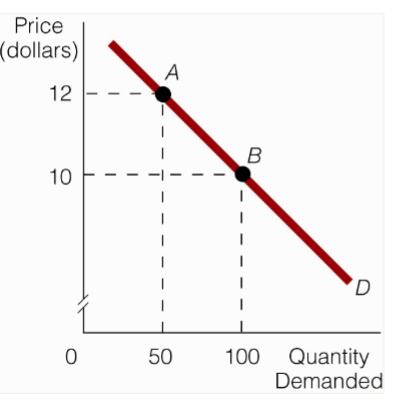
identify two points on a demand curve
when calculating price elasticity of demand, we use the average of the two quantities demanded
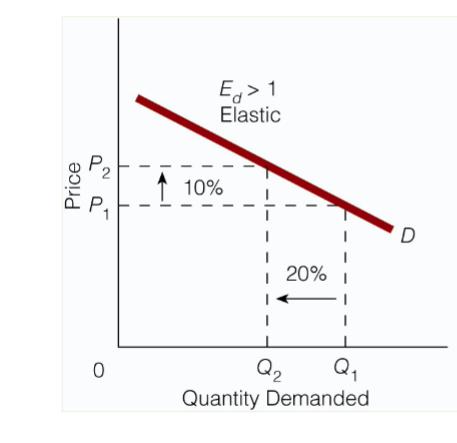
graphical representation of price elastic demand
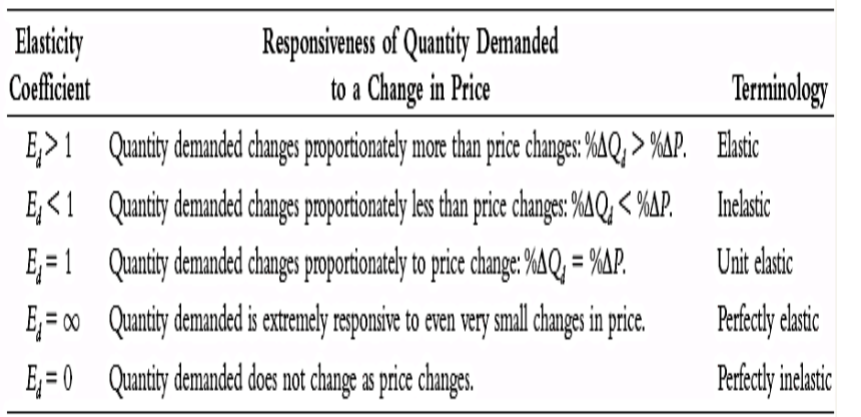
the % change in quantity demanded is greater than the % change in price
quantity demanded changes proportionately more than price changes
graphical representation of price inelastic demand
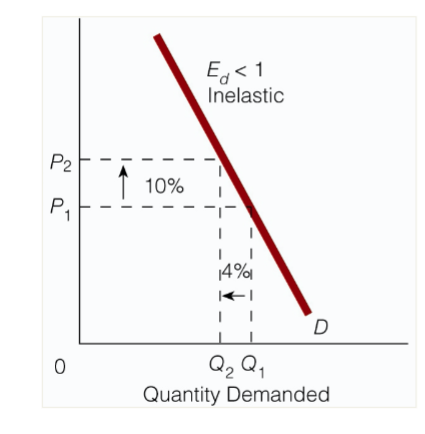
the % change in quantity demanded is less than the % change in price
quantity demanded changes proportionately less than price changes
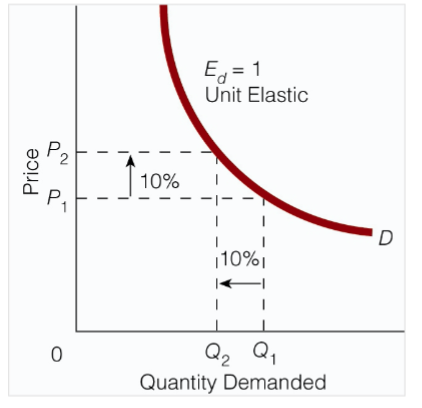
graphical representation of price unitary elastic demand
the % change in quantity demanded is equal to the % change in price
quantity demanded changes proportionately to price changes
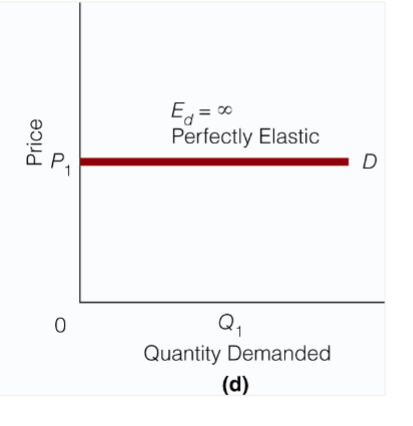
graphical representation of perfectly elastic demand
a small % change in price causes an extremely large % change in quantity demanded (from buying all to buying nothing)
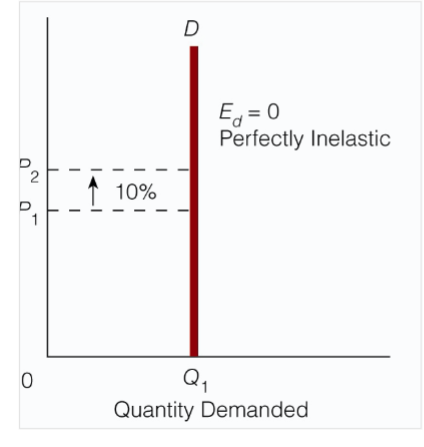
graphical representation of perfectly price inelastic demand
quantity demanded doesn’t change as price changes
price elasticity of demand summary
price elasticity and total revenue
total revenue (TR): of seller equals the price of a good times the quantity of the good sold (PxQ)
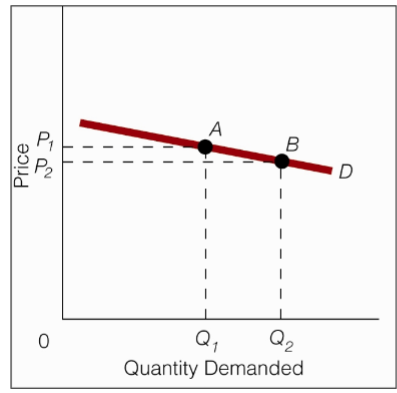
elastic demand and total revenue
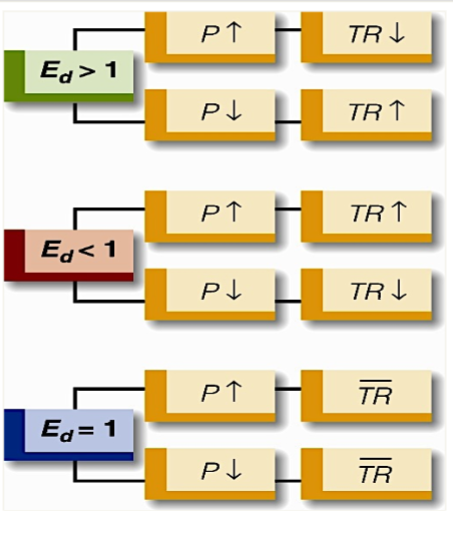
if demand is elastic, the % change in quantity demanded is greater than the % change in price
when demand is elastic, price and total revenue are inversely related
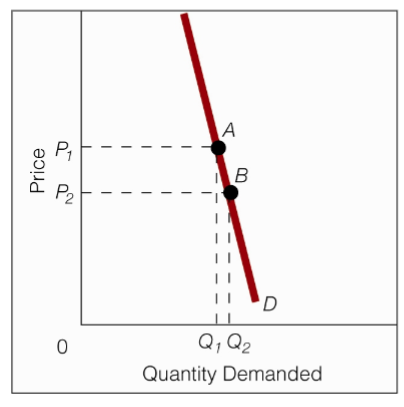
inelastic demand and total revenue
if demand is inelastic, the % change in quantity demanded is less than the % change in price
when demand is inelastic, price and total revenue are directly related
unit elastic demand and total revenue
if demand is unit elastic, the % change in quantity demanded is equal to the % change in price
elasticity, price changes, and total revenue
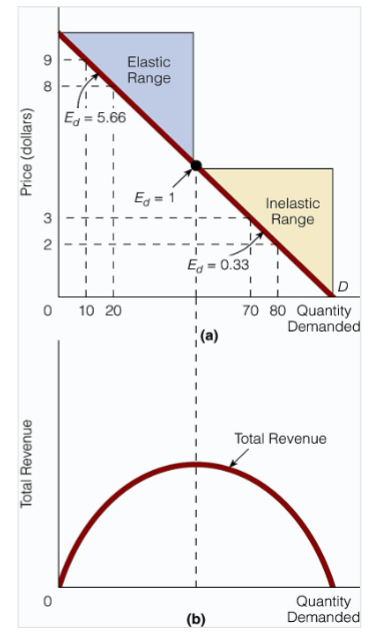
price elasticity of demand along a straight-line demand curve
In (a), the price elasticity of demand varies along the straight-line downward-sloping demand curve.
There is an elastic range to the curve (where Ed > 1) and an inelastic range (where Ed < 1).
At the midpoint of any straight-line downward-sloping demand curve, price elasticity of demand is equal to 1 (Ed = 1)
Part (b) shows that in the elastic range of the demand curve, total revenue rises as price is lowered. I
In the inelastic range of the demand curve, further price declines result in declining total revenue.
Total revenue reaches its peak when price elasticity of demand equals 1.
detriments of price elasticity
# of substitutes
necessities versus luxuries
% of ones budget spent on the good
time
number of substitutes
the more substitutes for a good, the higher the price elasticity of demand; fewer substitutes for a good, the lower the price elasticity of demand
necessities versus luxuries
generally, the more that a good is considered a luxury (a good that we can do without) rather than a necessity (a good that we can’t do without), the higher the price elasticity of demand
% of ones budget spent on the good
the greater the % of one’s budget that goes to purchase a good, the higher the price elasticity of demand; the smaller the % of one’s budget that goes to purchase a good, the lower the price elasticity of demand
time
the more time that passes (since the price change), the higher the price elasticity of demand for the good; the less time that passes, the lower the price elasticity of demand for the good
cross elasticity of demand
measures the responsiveness in quantity demanded for one good to changes in the price of another
ex: hot dogs and ketchup/mustard are complements
ex: hot gods and burgers are substitutes
income elasticity of demand
measures the responsiveness of quantity demanded to changes in income
income elastic: the % change in quantity demanded of a good is greater than the % change in income
income inelastic: the % change in quantity demanded of a good is less than the % change in income
income unit elastic: the % change in quantity demanded of a good is equal to the % change in income
price elasticity of supply
measures the responsiveness of quantity supplied to changes in price
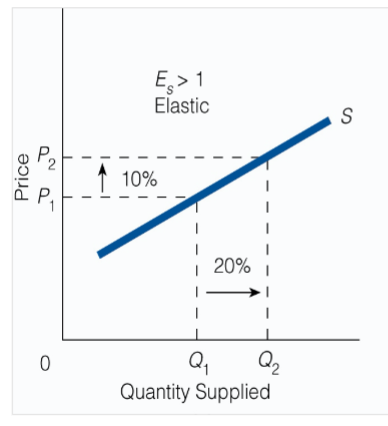
graphical representation of elastic supply
The percentage change in quantity supplied is greater than the percentage change in price: Es > 1 and supply is elastic.
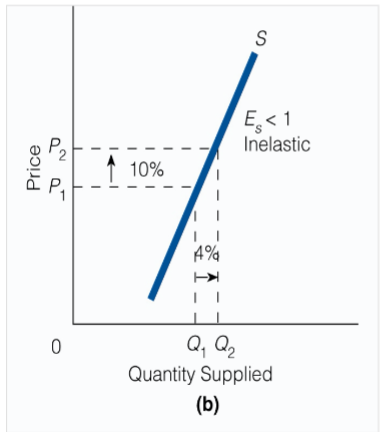
graphical representation of inelastic supply
The percentage change in quantity supplied is less than the percentage change in price: Es < 1 and supply is inelastic.
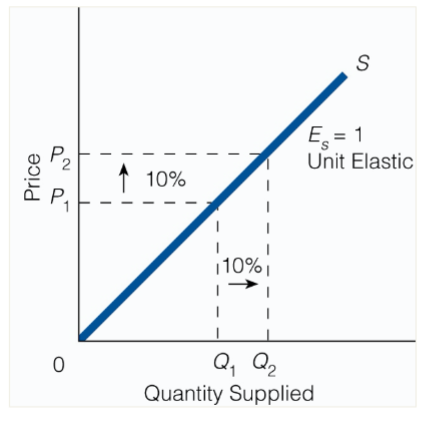
graphical representation of unit elastic supply
The percentage change in quantity supplied is equal to the percentage change in price: Es = 1 and supply is unit elastic.
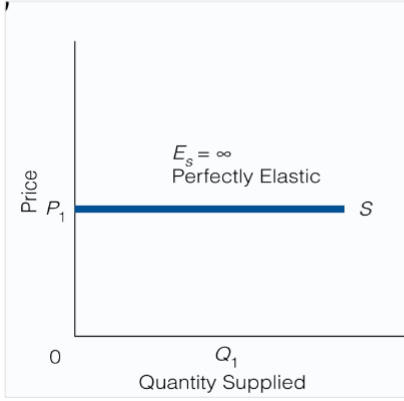
graphical representation of perfectly elastic supply
A small change in price changes quantity supplied by an infinite amount: Es = ∞ and supply is perfectly elastic.
price elastic graphical representation of supply
A change in price does not change quantity supplied: Es = 0 and supply is perfectly inelastic.
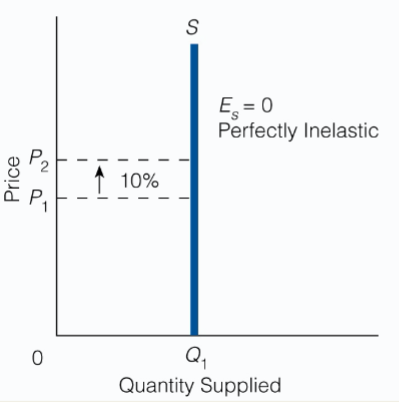
price elasticity of supply and time
The longer the period of adjustment is to a change in price, the higher the price elasticity of supply will be.
This refers to goods whose quantity supplied can increase with time, a characteristic of most goods. The obvious reason is that additional production takes time.
It does not, however, cover instances when additional production may be impossible, say, original Picasso paintings.
housing prices and elasticity of supply
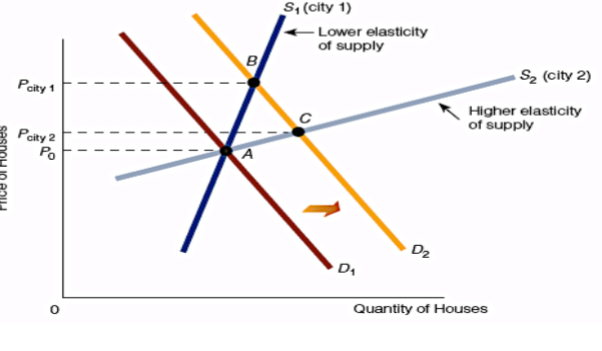
S1 rep resents the supply of housing in city 1, and S2 represents the supply of housing in city 2.
S1 has lower elasticity of supply than S2.
Suppose the demand for housing in each city rises from D1 to D2. As a result, the price of houses rises in both cities, but it rises by more in city 1 than city 2. In other words, the lower the elasticity of supply, the greater the increase in price.
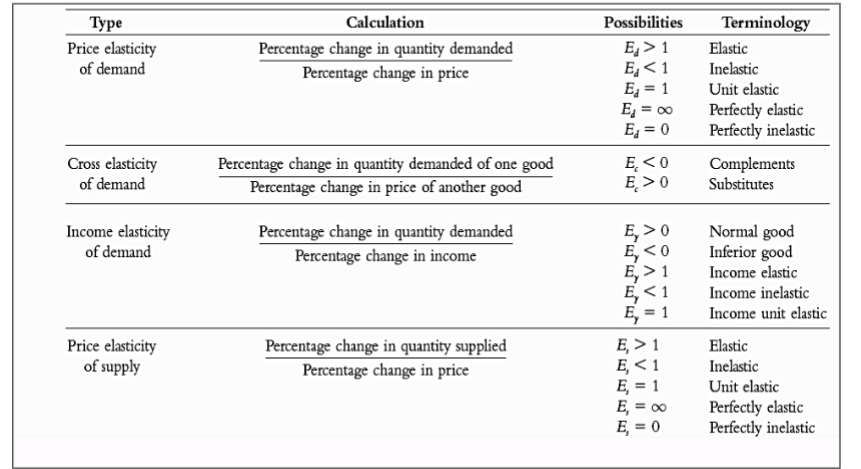
summary of the four elasticity concepts
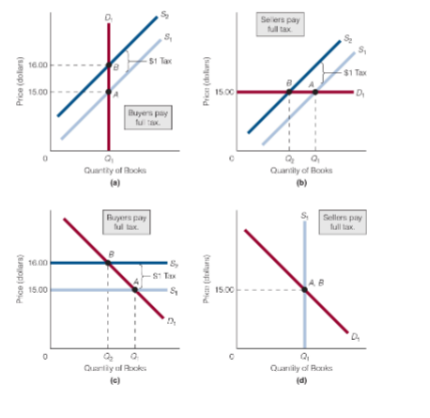
elasticity and the tax
utility theory
Utility is a measure of the satisfaction, happiness, or benefit that results from the consumption of a good
A UTIL is an artificial construct used to measure utility
Total utility is the total satisfaction a person receives from consuming a particular quantity of a good
Marginal utility is the additional utility a person receives from consuming an additional unit of a particular good
law of diminishing marginal utility
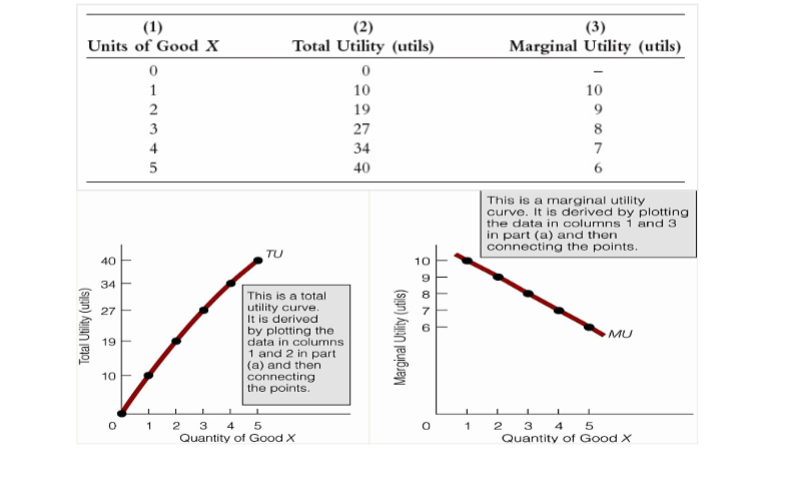
The marginal utility gained by consuming equal successive units of a good will decline as the amount consumed increases
The total utility of something can be rising as the marginal utility of that something is falling
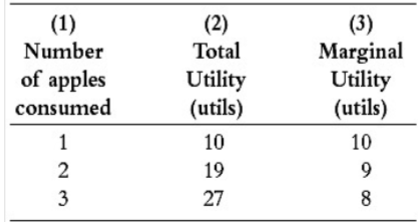
total utility, marginal utility, and the law of diminishing marginal utility
Both total utility and marginal utility are expressed in utils
Marginal utility is the change in total utility divided by the change in the quantity consumed of the good
law of diminishing marginal utility- application
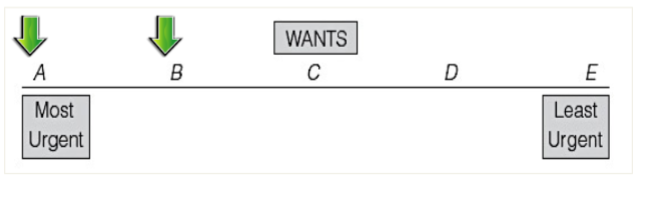
the law of diminishing marginal utility is based on the idea that if a good has a variety of uses but only 1 unit of the good is available, then the consumer will use the first unit to satisfy his or her most urgent want
if 2 units are available, the consumer will use the second unit to satisfy a less urgent want
interpersonal utility comparison
Comparing the utility of one person receives from a good, service, or activity with the utility another person receives from the same good, service, or activity
no interpersonal utility comparison
Caution: the utility obtained by one person cannot be scientifically or objectively compared with the utility obtained from the same thing by another person bc utility is subjective
consumer equilibrium
The analysis is based on the assumption that individuals seek to maximize utility
Occurs when the consumer has spent all income and the marginal utilities per dollar spent on each good purchased are equal
Where the letters A-Z represent all the goods a person buys
marginal utility analysis and the law of demand
Marginal utility analysis can be used to illustrate the law of demand, which states that price and quantity demanded are inversely related, ceteris paribus.
Starting from consumer equilibrium in a world containing only two goods, A and B, a fall in the price of A will cause MUA /PA to be greater than MUB /PB.
As a result, the consumer will purchase more of good A to restore herself to equilibrium.
marginal utility analysis and the law of demand
Marginal utility analysis can be used to illustrate the law of demand, which states that price and quantity demanded are inversely related, ceteris paribus.
Starting from consumer equilibrium in a world containing only two goods, A and B, a fall in the price of A will cause MUA /PA to be greater than MUB /PB.
As a result, the consumer will purchase more of good A to restore herself to equilibrium.
diamond-water paradox
The paradox: Water is cheap, and diamonds are expensive!
The observation that things that have the greatest value in use sometimes have little value in exchange and things that have little value in use sometimes have the greatest value in exchange.
How can this be explained???
Utility theory provides a solution!
diamond-water paradox resolved
The total utility of water is high because water is extremely useful.
The total utility of diamonds is low in comparison because diamonds are not as useful as water.
The marginal utility of water is low because water is so plentiful that people end up consuming it at low marginal utility.
The marginal utility of diamonds is high because diamonds are so scarce that people end up consuming them at high marginal utility.
Do prices reflect total or marginal utility? Marginal utility.
behavioral economics
Behavioral economists argue that some human behavior doesn't fit neatly- at a minimum, easily- into the traditional economic framework
Behavioral economists believe they have identified human behaviors that are inconsistent with the model of men and women as rational, self-interested, and consistent
these behaviors include the following
Individuals are willing to spend some money to lower the incomes of others even if it means their incomes will be lowered
Individuals don't always treat $1 as $1; some dollars seem to be treated differently from other dollars
Individuals sometimes value a good more if it is theirs than if it isn't theirs and they are seeking to acquire it (endowment effect)
business firm
An entity that employs factors of production (resources) to produce goods and services to be sold to consumers, other firms, or the government
Supply side
market coordination- invisible hand
The process in which individuals perform tasks, such as producing certain quantities of goods, based on changes in market forces, such as supply, demand, and price
managerial coordination and business firms- visible hand
The process in which managers direct employees to perform certain tasks
why do business firms arise in the first place?
Firms are formed when benefits can be obtained from individuals working as a team
Efficiency of working together
Sum of team production > sum of individual production
problem of and solutions for “team” work
problem: shirking- the behavior of a worker who is putting forth less than the agreed to effort
solution: monitor- person (manager) in a business firm who coordinates team production and reduces shirking
problem: monitor shirking
solution: make the monitor a residual claimants- persons who share the profits of a business firm
the efficiency wage theory (above-market wage will reduce shirking)
human resource management
why firms exist as an alternative to having a separate contract with each factor of production- Ronald Coase
“The costs of negotiating and concluding a separate contract for each exchange transaction which takes place on a market must also be taken into account. . . .
It is true that contracts are not eliminated when there is a firm, but they are greatly reduced. A factor of production (or the owner thereof) does not have to make a series of contracts as would be necessary, of course, if this co-operation were a direct result of the working of the price mechanism. For this series of contracts is substituted one.
At this state, it is important to note the character of the contract into which a factor enters that is employed within a firm. The contract is one whereby the factor [the employee], for a certain remuneration (which may be fixed or fluctuating), agrees to obey the directions of an entrepreneur within certain limits.” Ronald Coase
markets: inside and outside the firm
economics is largely about trades or exchanges; it’s about market transactions
in supply-and-demand analysis, the exchanges are btw buyers of goods and services and sellers of goods and services
in the theory of the firm, the exchanges take place at two levels:
(1) at the level of individuals coming together to form a team
(2) at the level of workers choosing a monitor
employees submit to the monitor’s commands because they realize that only a well-known team will yield the benefits they desire
firm’s objective: maximizing profit
The difference btw total revenue and total cost
explicit and implicit cost
explicit cost- a cost incurred when an actual (monetary) payment is made
implicit cost- a cost that represents the value of resources used in production for which no actual (monetary) payment is made (opportunity cost)
accounting, economic, and normal profit
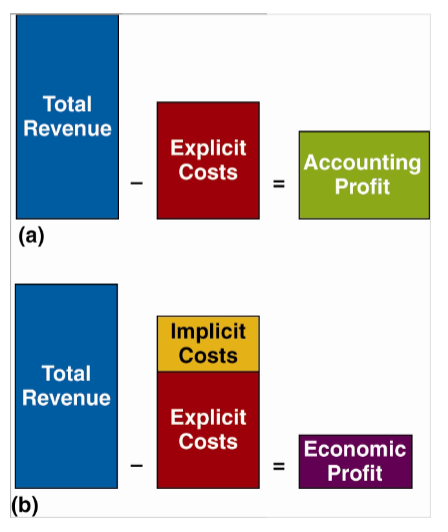
Accounting profit: the diff btw total revenue and explicit costs
Economic profit: the diff btw total revenue and total cost, including both explicit and implicit costs
Normal profit: zero economic profit. A firm that earns normal profit is earning revenue equal to its total cost (explicit plus implicit costs). This is the level of profit necessary to keep resources employed in that particular firm
production and cost: fixed and variable inputs
Production is a transformation of resources or inputs into goods and services
Fixed input: an input whose quantity cannot be changed as output changes
Variable input: an input whose quantity can be changed as output changes
production and cost: short and long run
marginal physical product (MPP)
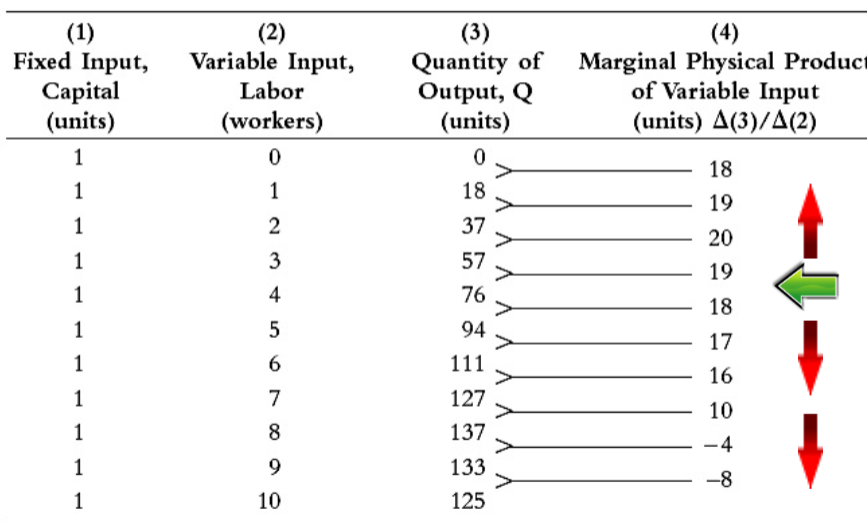
The change in output that results from changing the variable input by one unit, holding all other inputs fixed
production in the short run and the law of diminishing marginal returns
In the short run, as additional units of variable input are added to fixed input, the marginal physical product of the variable may increase at first
Eventually, the marginal physical product of the variable input decreases
The point at which marginal physical product decreases is the point at which diminishing marginal returns have set in
law of diminishing marginal returns
As ever-larger amounts of a variable input are combined with fixed inputs, eventually, the marginal physical product of the variable input will decline
production in the short run and the law of diminishing marginal productivity
fixed, variable, total, and marginal cost
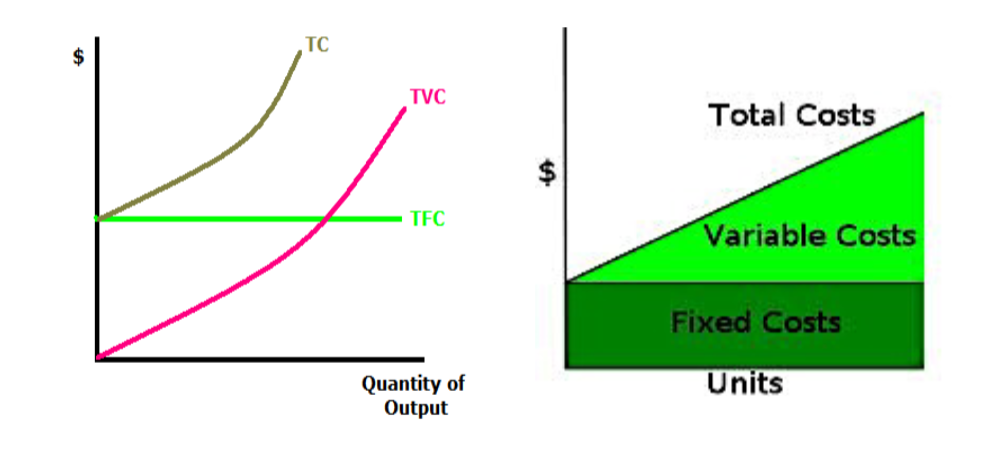
Fixed costs (FC): costs that do not vary with output; the costs associated with fixed inputs
Variable cost (VC): costs that vary with output; the costs associated with variable inputs
Total cost (TC): the sum of fixed costs and variable costs. TC = TFC + TVC
Marginal cost (MC): the change in total cost that results from a change in output
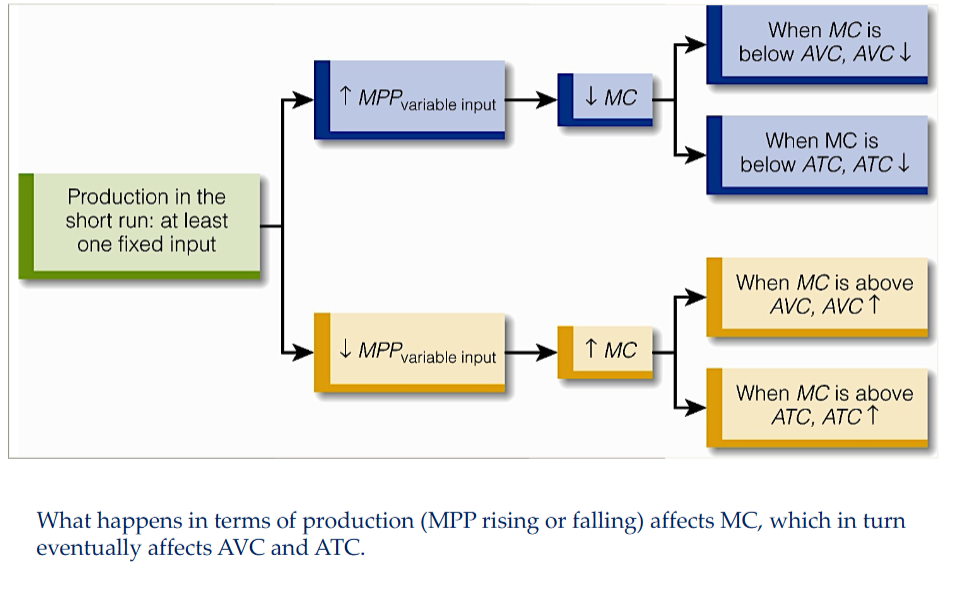
marginal physical product and marginal cost
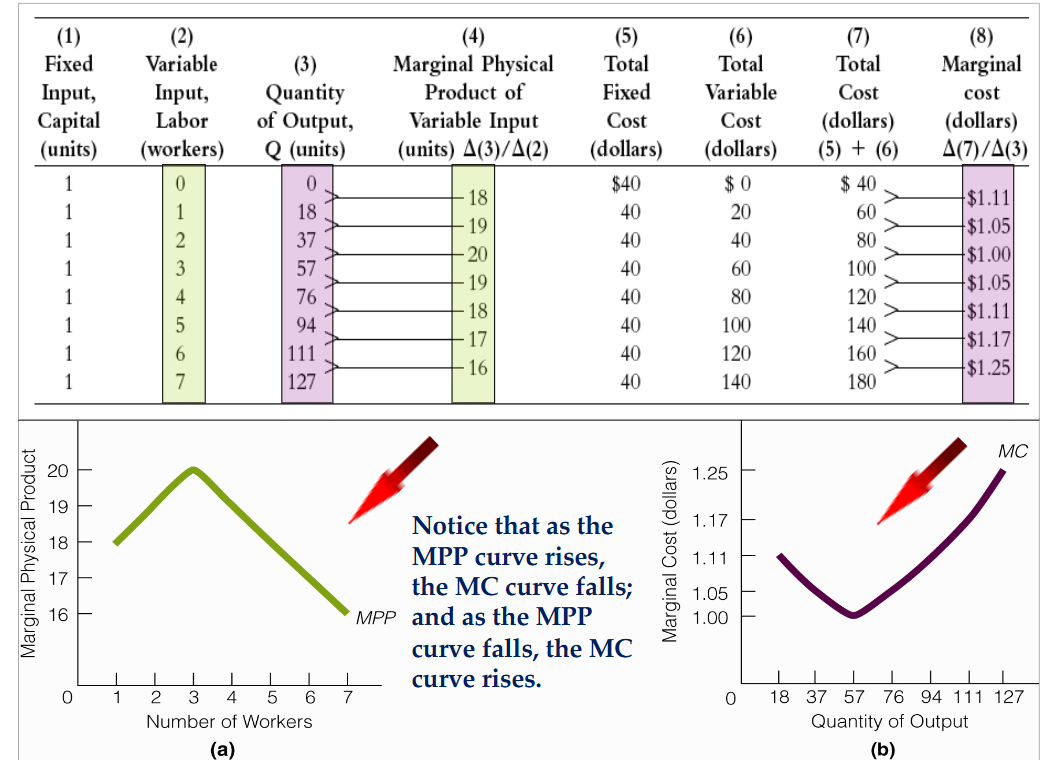
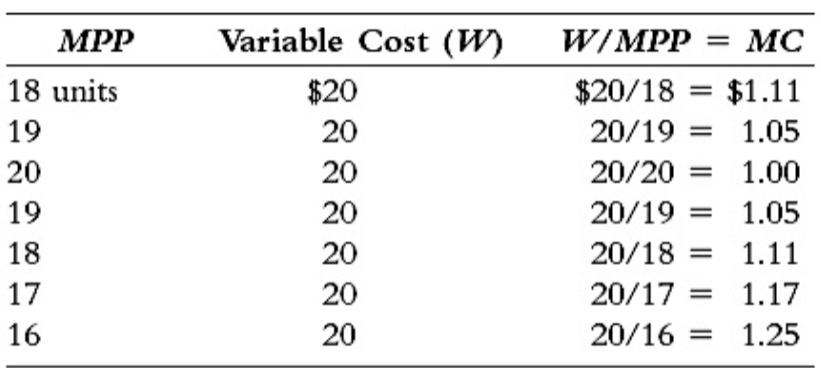
how MPP affects MC
average productivity
When the news media uses the word productivity, it is usually referring to average physical product instead of marginal physical product
To illustrate the difference, suppose 1 worker can produce 10 units of output a day and 2 workers can produce 18 units of output a day.
Marginal physical product is 8 units (MPP of labor = ∆Q / ∆L). Average physical product, which is output divided by quantity of labor is equal to 9 units.
labor productivity
Labor productivity is used in newspapers and in gov docs, it refers to the average (physical) productivity of labor on an hourly basis
By computing the average productivity of labor for diff countries and noting the annual % changes we can compare labor productivity btw and within countries
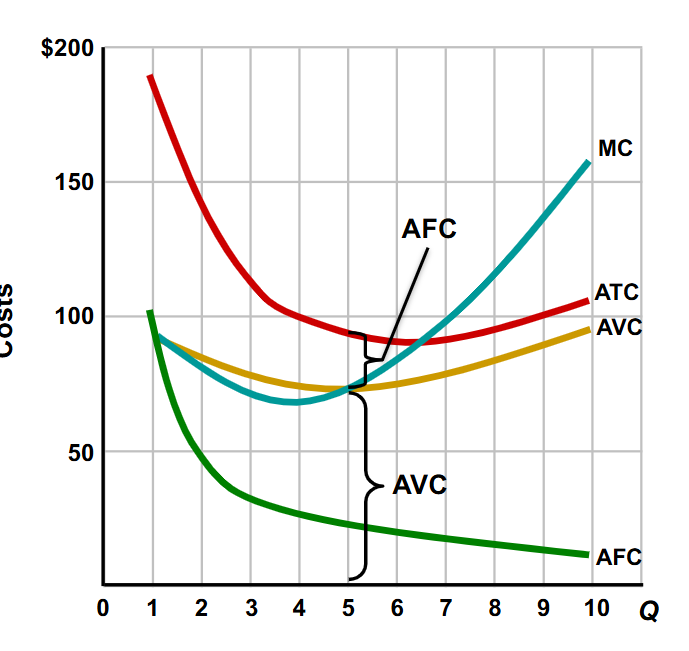
average fixed, variable, and total cost
Average fixed cost (AFC): total fixed cost divided by quantity of output
Average variable cost (AVC): total variable cost divided by quantity of output
Average total cost (ATC) or Unit Cost: total cost divided by quantity of output
average-marginal rule
When the marginal magnitude is below the average magnitude, the average magnitude falls
When the marginal magnitude is above the average magnitude, the average magnitude rises
average and marginal cost curves
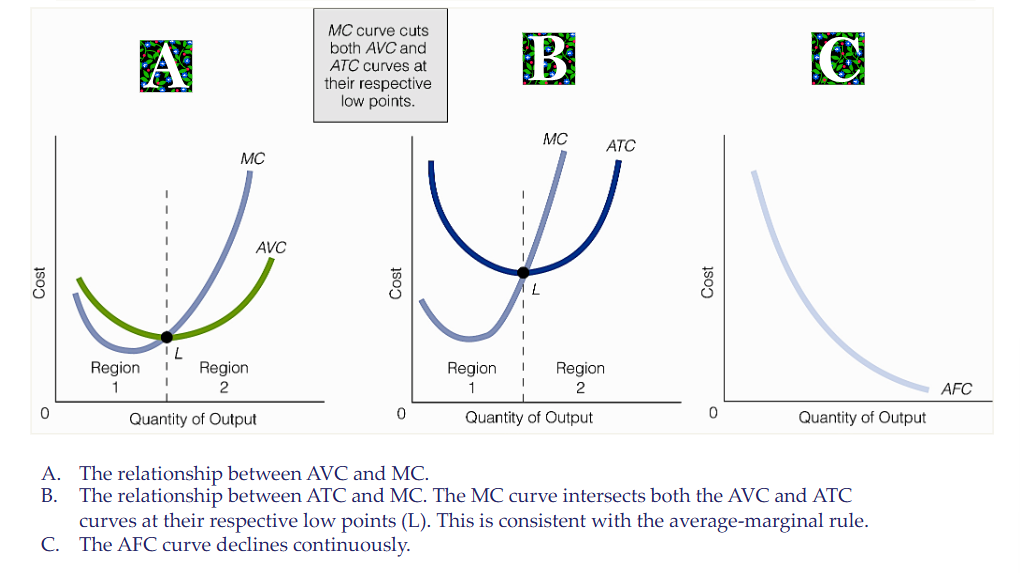
tying short-run production to costs
sunk cost
A cost incurred in the past that cannot be changed by current decisions and therefore cannot be recovered
Economists advise individuals to ignore sunk costs
production and costs in the long run
In the short run, there are fixed costs and variable costs; therefore, total cost is the sum of the two
A period of time in which all inputs in the production process can be varied (no inputs are fixed). In the long run, there are no fixed costs, so variable costs are total costs
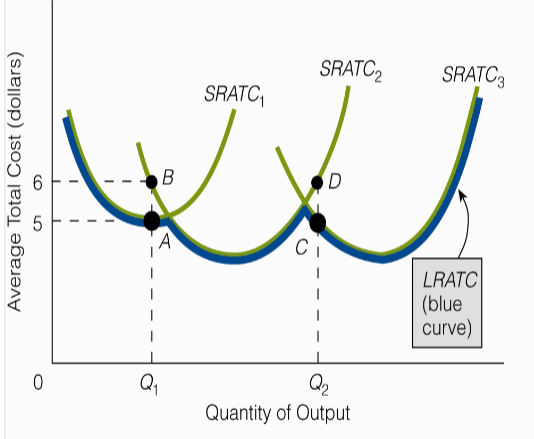
long-run average total cost (LRATC) curve
A curve that shows the lowest (unit) cost at which the firm can produce any given level of output
there are three short-run average total cost curves for three different plant sizes
if these are the only plant sizes, the long-run average total cost curve is the heavily shaded, blue scalloped curve
LRATC
the long-run average total cost curve is the heavily shaded, blue smooth curve
the LRATC curve is not scalloped because it’s assumed that there are so many plant sizes that the LRATC curve touches each SRATC curve at only one point
economies of scale
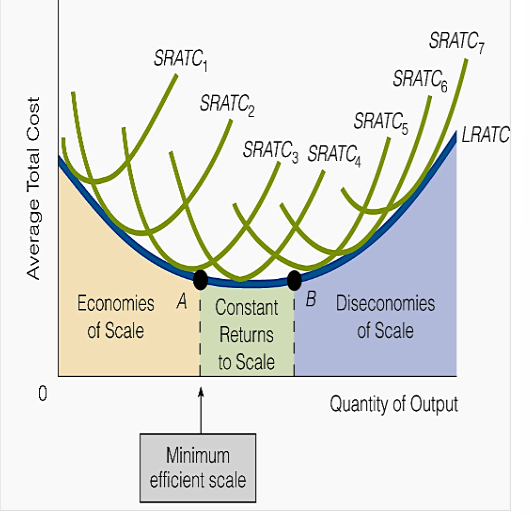
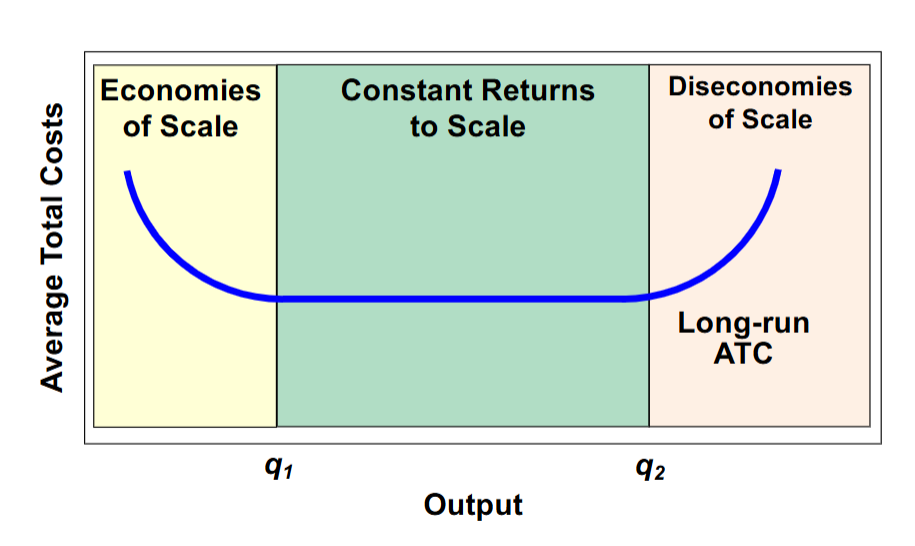
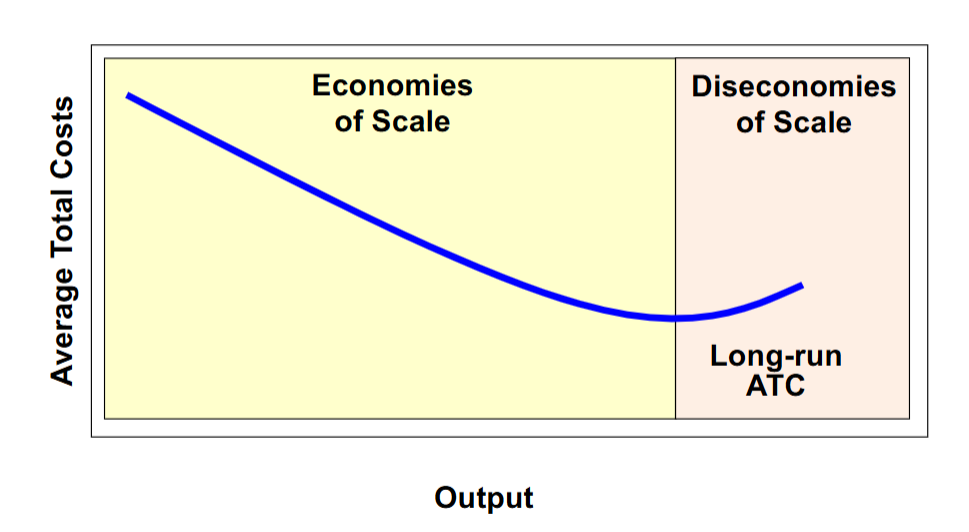
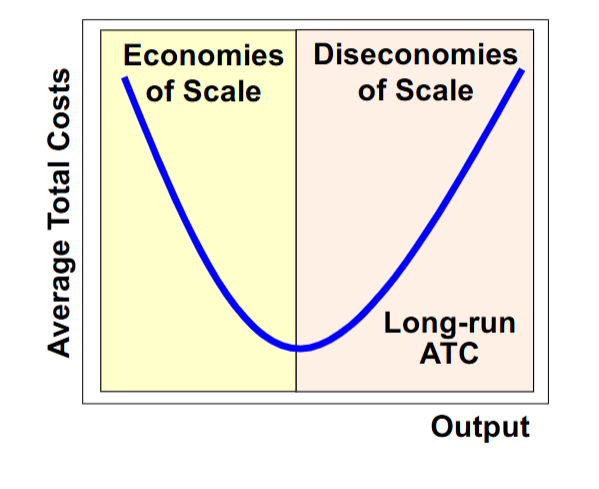
Economies of Scale exist when inputs are increased by some percentage and output increases by a greater percentage, causing unit costs to fall. (LRATC is falling)
Constant Returns to Scale exist when inputs are increased by some percentage and output increases by an equal percentage, causing unit costs to remain constant. (LRATC is constant)
Diseconomies of Scale exist when inputs are increased by some percentage and output increases by a smaller percentage, causing unit costs to rise. (LTRAC is rising)
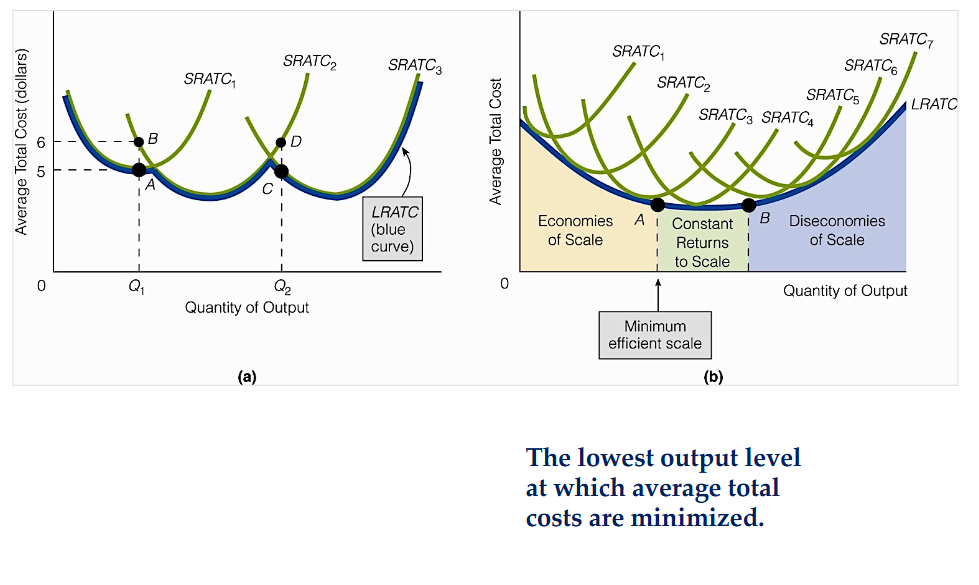
Minimum Efficient Scale - The lowest output level at which average total costs are minimized.
why economies of scale?
Up to a certain point, long-run unit costs of production fall as a firm grows. There are two main reasons for this:
Growing firms offer greater opportunities for employees to specialize.
Growing firms can take advantage of highly efficient mass production techniques and equipment that ordinarily require large setup costs and thus are economical only if they can be spread over a large number of units.
why diseconomies of scale?
In very large firms, managers often find it difficult to coordinate work activities, communicate their directives to the right persons in satisfactory time, and monitor personnel effectively.
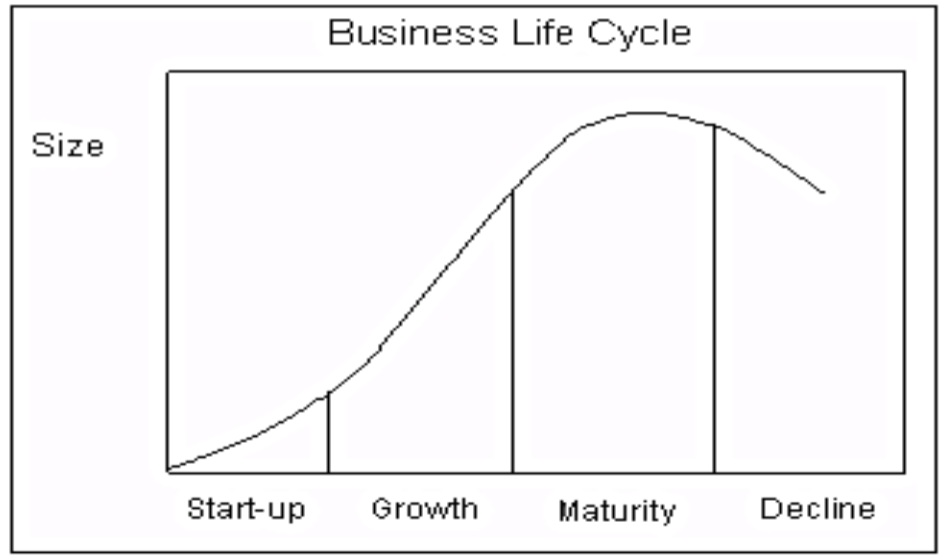
business life cycle
shifts in cost curves
a firm’s cost curves will shift if there is a change in:
taxes
input prices
technology
cost curves
long-run production costs
the firm can change all input amounts, including plant size
all costs are variable in the long run
long-run ATC
different short-run ATCs
economies of scale
economies of scale
labor specialization
managerial specialization
efficient capital
other factors
constant returns to scale
diseconomies of scale
control and coordination problems
communication problems
worker alienation
shirking
minimum efficient scale (MES)
lower level of output where long-run average costs are minimized
can determine the structure of the industry
MES and Industry Structure
TFC, TVC, and TC
market structure
A particular environment of a firm, the characteristics of which influence the firm's pricing and output decisions
diff forms of market structure
Perfect competition
Monopolies
Oligopolies
the theory of perfect competition
A theory of market structure based on four assumptions:
There are many sellers and many buyers, none of which is large in relation to total sales or purchases.
Each firm produces and sells a homogeneous product.
Buyers and sellers have all relevant information with respect to prices, product quality, sources of supply, and so on.
There is easy entry into and exit from the industry.
a perfectly competitive firm is a price taker
A seller that doesn't have the ability to control the price of the product it sells; it takes the price determined in the market
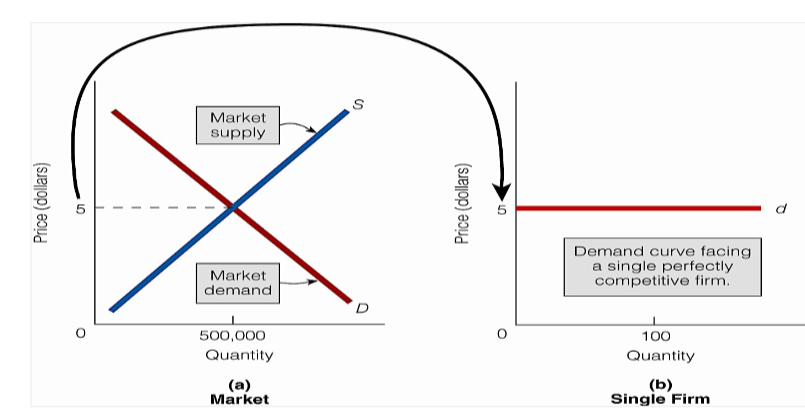
market demand curve and firm demand curve in perfect competition
The market, composed of all buyers and sellers, establishes the equilibrium price (a)
A single perfectly competitive firm then faces a horizontal (flat, perfectly elastic) demand curve
marginal revenue (MR)
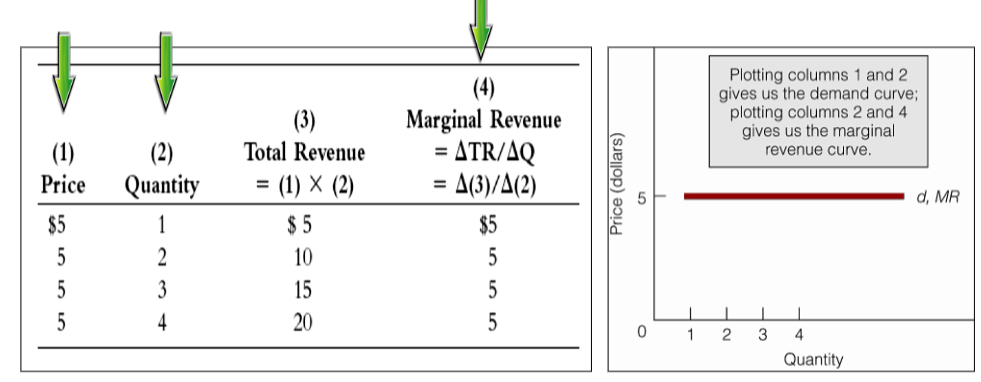
The change in total revenue that results from selling one additional unit of output
the demand curve and the marginal revenue curve for a perfectly competitive firm
by computing marginal revenue, we find that it is equal to price
by plotting columns 1 and 2, we obtain the firm’s demand curve
by plotting columns 2 and 4, we obtain the firm’s marginal revenue curve
the two curves are the same
quantity of output the perfectly competitive firm will produce
The firm’s demand curve is horizontal at the equilibrium price. Its demand curve is its marginal revenue curve. The firm produces that quantity of output at which MR = MC
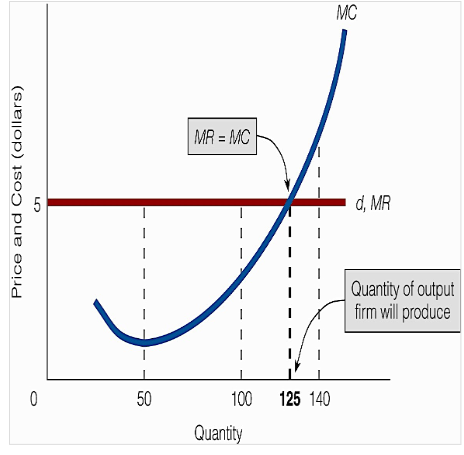
profit maximization rule
profit is maximized by producing the quantity of output at which MR = MC
for perfect competition, profit is maximized when P = MR = MC
resource allocative efficiency
Producing a good—any good—until price equals marginal cost ensures that all units of the good are produced that are of greater value to buyers than the alternative goods that might have been produced.
A firm that produces the quantity of output at which price equals marginal cost (P = MC) is said to exhibit resource allocative efficiency.
For a perfectly competitive firm, profit maximization and resource allocative efficiency are not at odds.
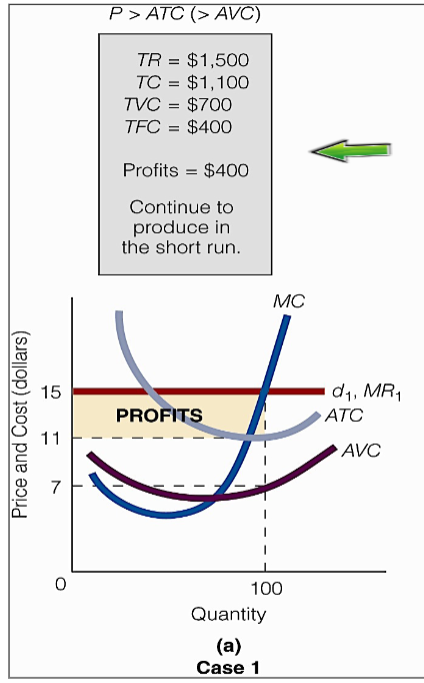
perfect competition in the short-run
profit maximization and loss minimization for the perfectly competitive firm - case I
in case 1, TR TC and the firm earns profits
it continues to produce in the short run
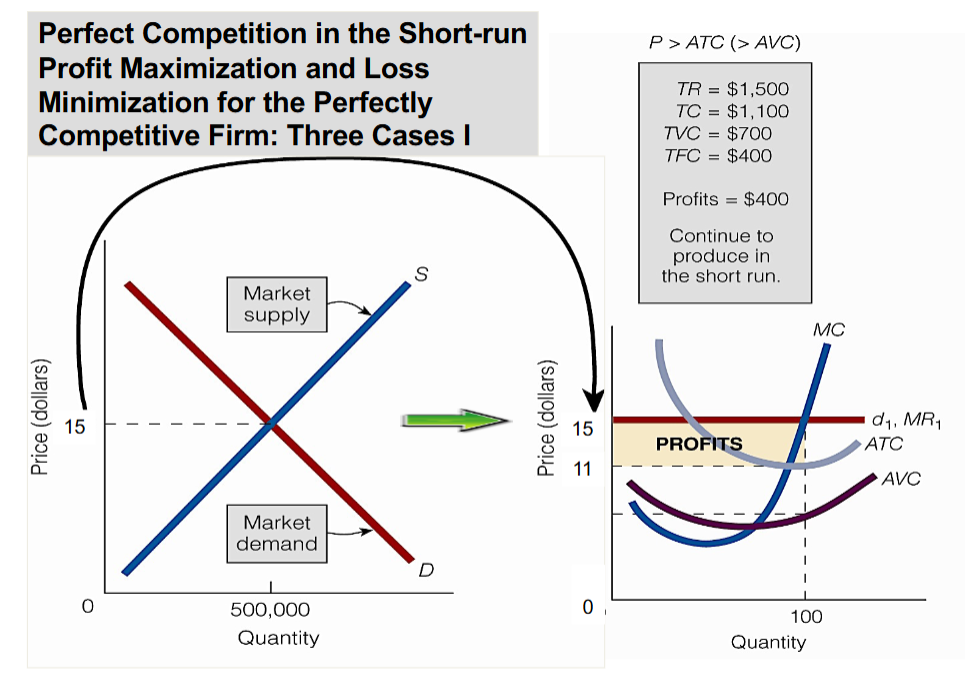
perfect competition in the short-run
profit maximization and loss minimization for the perfectly competitive firm - case II
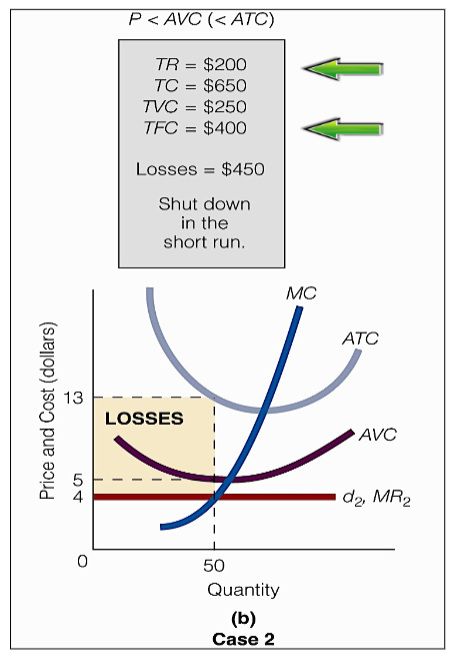
in case 2, TR < TC and the firm takes a loss
it shuts down in the short run bc it minimizes its losses by doing so