Model Overfitting, Model Selection and Nearest Neighbor Classification
 Call Kai
 Learn
Learn Practice Test
 Spaced Repetition
 Match
Match Flashcards
 Knowt Play
1/47

There's no tags or description
Looks like no tags are added yet.
Name | Mastery | Learn | Test | Matching | Spaced | Call with Kai | Chat |
|---|
No analytics yet
Send a link to your students to track their progress
48 Terms
(T/F) Model fitting shows poor generalization performance
True
Steady ________ but the __________ increases as the tree size increases
training error, testing error
Even if we try to show the lowest error on the training set, it memorizes the _______
noise or outliers
What causes the training error to keep steady while the testing error increases with the tree size?
The limited training size and high model complexity
Pruning provides _________ and __________ tree depth
early stopping(it stops expanding the tree), limits
What is the goal with the model selection use of a validation set?
Estimated a models generalization error using “out-of-sample” data
A better indication of real-world performances carefully balancing the data split to ensure both ___________ and ___________
robust model training, reliable error evaluation
Evaluates the model on a ____________ validation set that is ____________ from the training process
seperate, excluded
What are the pruning stopping conditions (Pre-pruning)?
stop if all instances belong to the same classes
stop using if all attribute values are the same
stop if the number of instances are less than some user specified threshold
stop if the class distribution of instances are independent of the available features (e.g. GINI or INFORMATION GAIN)
stop if the estimated generalization error falls below a certain threshold
Name a post pruning procedure
Subtree replacement
With subtree replacement, you trim the nodes of a decision tree in a _______________. If _____________ error improves after trimming, replace _________ by a __________ .
bottom up fashion, generalization, sub-tree, leaf node
The class label of a leaf node is determined from the majority class of instances in the ______________
sub-tree
Pros of a decision tree
versatile
extremely fast at classifying unknown records
relatively inexpensive to construct
robust to noise (especially when methods to avoid overfitting are employed)
can easily handle redundant attributes
can easily handle irrelevant attributes
Cons of a decision tree
interacting attributes: attributes that are able to distinguish between classes when used together
But individually, they provide little to no information
due to the greedy nature of the splitting criteria in decision trees, such attributes could be passed over in favor of other attributes that are not as useful
Large Decision Tees are hard to intepret
Tree pruning is needed to tackle overfitting
Occam’s Razor
given two models of similar generalization errors, one should prefer the simpler model over the more complex model
A complex model has a greater chance of…
being fitted accidentally
Model Evaluation
estimates the performance of classifiers on previously unseen data
Hold-out
reserving k% for training and 100 - k% for testing
Cross Validation (K-Fold)
is a type of repeated hold out that partitions the data into k disjoint subsets, training with k - 1 partitions and testing with the remaining one
Model fitting
A model memorizes training data but performs poorly on unseen data
Class Imbalance
Lots of classification problems where the classes are skewed (more records from one class than another) causing models to bias towards the majority
Evaluation measures such as accuracy are not well suited for …
imbalanced class
______________ can fail to detect more trivial models and rare classes that can be more interesting
frauds
intrustions
defects
class imbalance
Oversampling
replicating instances from minority labels
Downsampling
is when the frequency of the majority class is reduced to match the frequency of the minority class
Oversampling and Downsampling does NOT…
reflect the real distribution of data and may lead to poor generalization
Percision
the fraction of positive examples predicted correctly by the model from all positive predictions
True Positive Rate (sensitivity)
the faction of positive examples predicted correctly by the model from all the positive examples
True Negative Rate (specificity)
the fraction of negative examples predicted correctly by the model
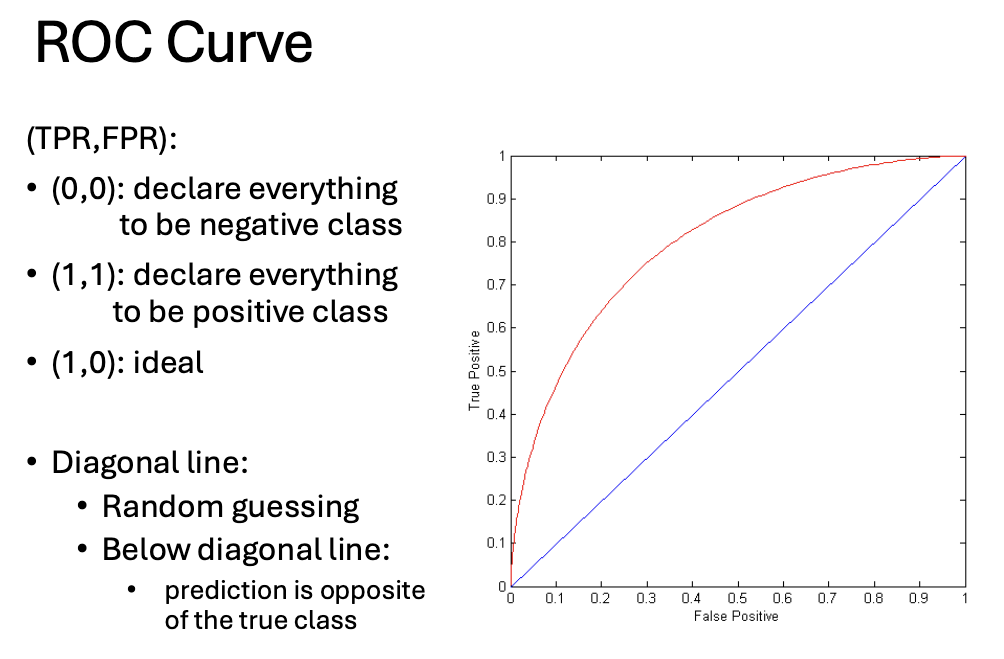
ROC (Receiver Operating Characteristics)
is a graphical approach for displaying the trade-off between detection rate and false alarm rate plotting TPR against FPR
To draw a ROC curve, classifier must produce ____________ output
continuous-valued
Nearest Neighbor classification is mainly used when all attribute values are _______________ although they can be modified to deal with _______________
continuous, categorical attributes
Nearest Neighbor Classification
estimates the classification of an unseen instance using the classification of the instance or instances that are the closest to it (lazy learner)
Pros of KNN
simple and intuitive
no training phase
versatile
adaptable to multi-class problems
Cons of KNN
computationally expensive
sensitive to feature scaling
choice of K and distance metric
K-NN can struggle with imbalanced datasets
If k is too small, it can be …
sensitive to noise points
If k is too large…
the neighborhood may include points from other classes
A major problem when using the Euclidean distance formula (and many other distance measures) is that the __________ frequently swamp the ____________
large values, smaller one
What proximity measure is the best for documents?
co-sine similarity
Class weighting is crucial in critical systems like:
spam filtering and cancer diagnosis
A nearest neighbor classifier represents each example as a _________ in a d-dimensional space where d is the number of attributes
data point
Given a test instance, we compute its proximity to the _____________ according to one of the proximity measures
training instances
Find the k training instances that are ________ to the unseen instance. Take the ___________ classification for these k instances.
closest, most commonly occurring
Outputs are used to ____ test records, from the most likely positive class record to the least likely positive class record
rank
By using different thresholds on this value, we can create _________________ of the classifier with TPR/FPR tradeoffs
different variations
Many classifiers produce only ___________________
discrete outputs (i.e., predicted class)
How do you construct an ROC curve?
Use a classifier that produces a continuous-valued score for
each instance
• The more likely it is for the instance to be in the + class, the
higher the score
• Sort the instances in decreasing order according to the score
• Apply a threshold at each unique value of the score
• Count the number of TP, FP, TN, FN at each threshold
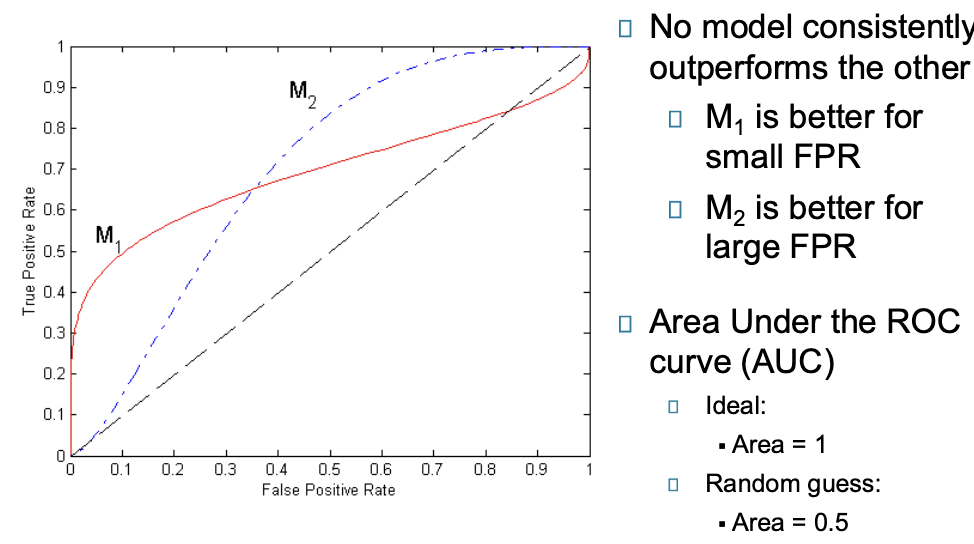
No model consistently ___________ the other
outperforms