Lesson 7: Translation
 Call Kai
 Learn
Learn Practice Test
 Spaced Repetition
 Match
Match Flashcards
 Knowt Play
1/110

There's no tags or description
Looks like no tags are added yet.
Name | Mastery | Learn | Test | Matching | Spaced | Call with Kai |
|---|
No analytics yet
Send a link to your students to track their progress
111 Terms
What does AUG (start codon) code for?
Methionine
How many tRNA’s must each cell contain at a minimum?
20 (one for every amino acid)
Why does tRNA have some modified bases?
for stabalizatrion, flexability, and wobble-pairing
What is the Acceptor stem?
amino acid becomes covalently attached to tRNA at the 3’ end of this stem
What is the Anticodon arm?
contains the anticodon, a three-base sequence that binds to a complementary codon in mRNA
What is the TyC arm?
contains thymidylate (T) and pseudouridylate (y) followed by C
What is the D arm?
contains dihydrouridylate (D)
What is the Variable arm?
ranges from 3-21 nucleotides
How are tRNA named?
named for the amino acid that they carry (e.g. tRNAPhe)
What is the “wobble” position?
the 5’ anticodon position has some flexibility in base pairing; 3rd base of an mRNA codon (and the corresponding 1st base of the tRNA anticodon) where base-pairing is flexible.
What is the Isoacceptor tRNA molecules?
different tRNA molecules that bind the same amino acids
What is the purpose of the wobble?
allows some tRNA molecules to recognize more than one codon
How are Isoacceptor tRNAs identified?
Roman numerals or codons: tRNAI Ala, tRNAII Ala or tRNAGCG Ala
How many different tRNA do Bacteria have?
30-60 different tRNA
How many differnt tRNAs do Eukaryotes have?
up to 80 different tRNAs
What is Aminoacyl-tRNA?
amino acids are covalently attached to the 3’ end of each tRNA molecule
How are Aminoacyl-tRNA named?
alanyl-tRNA^Ala
The activation of an amino acid by aminoacyl-tRNA synthetase requires what?
ATP
What enzyme activates amino acids?
aminoacyl-tRNA synthetase
What direction does the ribosome complex move along the template mRNA?
5’ → 3’
What direction is polypeptide synthesized in?
N (‘5) → C (3’)
All ribosomes contain ______ subunits of _____size
two, unequal
When is the ribosomal complex assembled?
start of mRNA coding sequence
When is the ribosomal complex terminated?
end of mRNA coding sequence
What does the Ribosomal complex consist of?
ribosomal subunit
mRNA template to be translated
initiator tRNA
protein initation factors
Each cell contains at least two methionyl-tRNAMet molecules which recognize AUG, these are?
initiator tRNA
tRNA^Met
What does the initiator tRNA recongnize?
initiation codons
What does the tRNA^Met recongnize?
only internal AUG
What is the initiator tRNA in bacteria?
N-formylmethionyl-tRNAf Met
What is the initiator tRNA in Eukaryotes?
methionyl-tRNAi Met
What does N-formylmethionyl-tRNAf^Met have that methionyl-tRNAi^Met does not?
an extra carboxide group
In prokaryotes, the 30S ribosome binds to what to start translation?
Shine Dalgarno sequence
What else does the Shine Dalgarno sequence bind to?
a complementary base sequence at the 3’ end of the 16S rRNA
Different between the naming of the Prokaryotes vs Eukaryotes Initiation factors?
the letter “e” (IF-1 vs eIFs)
What are Initiation factors?
help form the initaition complex
What does Eukaryotic initiation factor 4 (eIF-4), (or cap binding protein, CBP) do?
binds to the (5’ end) 7methylguanylate cap of eukaryotic mRNA
The initiator tRNA is in the which site?
P site
Which site is ready to receive an aminoacyl-tRNA?
A site
What is step 1 of elongation?
Positioning the correct aa-tRNA in site A
What is step 2 of elongation?
Formation of a peptide bond
What is step 3 of elongation?
Shifting mRNA by one codon
How many phosphoanhydride bonds are cleaved for each amino acid added to a polypeptide chain?
4
How many P bonds are broken (ATP used) for amino acid activation?
2
How many P bonds are broken (ATP used) for elongation?
2
How many P bonds are used for 100 amino acids?
100 amino acid = 99 bonds
99 × 4 = 396 broken
How many ATP/GTP are used for translation?
1 ATP (= 2 P) for activation and 2 GTP (= 2GDP + 2P) for elongation
What can Puromycin do?
An antibiotic that resembles the 3’ end of an aminoacyl-tRNA, and can enter the A site of a ribosome. The peptidyl-puromycin formed is bound weakly in the A site and dissociates, terminating protein synthesis
Ribosomal Protein Synthesis Is Coupled to what in E. coli?
Ribosome Assembly
When elF-2 (elongation factor II) is phosphorylated, what happens?
protein syntheiss is inhibited
What does elF-2 do?
binds GTP + initiator tRNA (Met-tRNAi), forming a complex and delivers tRNA to the ribosome → translation begins
When DNA interacts with Polymerase I, what is produced?
rRNA
When DNA interacts with Polymerase II, what is produced?
mRNA
When DNA interacts with Polymerase III, what is produced?
tRNA
What is the A site?
aminoacyl site
What is the P site?
Peptidyl site
What is the E site?
exit site
What is the function of the A site?
Where charged tRNAs enter the ribosome
What is the funtion of the P site?
Holds onto the growing peptide chain (also holds 1st amino acid: Met)
What is the function of the E site?
Where tRNAs are ejected from the ribosome after their amino acid has been incorporated into the growing peptide chain
What ribosomal subunit are A, P, E sites located?
large, 60S subunit
What ribosomal subunit is the mRNA binding site located?
small, 40S subunit
What is the Wobble?
Nontraditional base pairing between the 5ʹ nucleotide (1st nucleotide) of the anticodon and the 3ʹ nucleotide (3rd nucleotide) of the codon. → this allows same tRNA to translate more than one codon as long as the amino acid is the same
What is an example of the wobble effect?
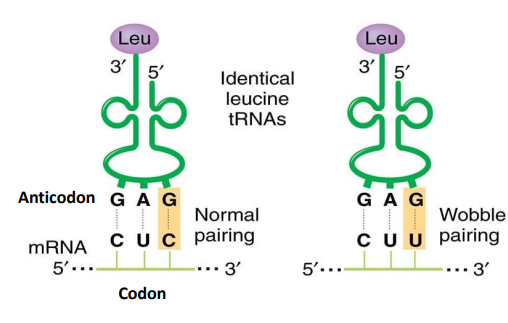
How many tRNA are required for 61 codons because of genetic code redundancy?
32
In eukaryotic translation initiation, 5’ cap is directly connected to what?
40S subunit
In prokaryotic translation initiation, shrine-dalgarno is directly connected to what?
30S subunit
What do Pseudomonas and diphtheria toxin inhibit?
ADP-ribosylation of eEF-2
What do shiga toxins inhibit?
Aminoacyl-tRNA binding to A site
What do shiga toxins do?
cuts 28s rRNA on 60S Eukaryotic subunit
What two Aminoglycosides are involved in prokaryotic translation?
Steptomycin and Gentamycin
What effect do the two Aminoglycosides have in prokaryotic translation?
indirectly inhibit translation by cause misreading of mRNA or interupting translation initation
What part of the ribosome comlex is indirectly impacted by the two aminoglycosides?
30S subunit
What is Linezolid?
antibiotic that targets the 50S ribosomal subunit
What interferes with the 16S rRNA of the 30S ribosomal subunit interfering with Shine Delgerno?
Aminoglycosides
What are macrolides?
antibiotics that target the bacterial ribosome (50S) and interfere with translation elongation
What does Clindamycin do?
interferes with the peptidyl transferase center and disrupts movement of the ribosome along mRNA, freezes elongation on the 50S subunit
What does tetracycline do?
antibiotic that targets the 30S ribosomal subunit and blocks aminoacyl-tRNA from binding to the A site so no new amino acid can be added to the growing peptide chain
What does Chloramphenicol do?
an antibiotic that targets the 50S ribosomal subunit and inhibits the peptidyl transferase enzyme preventing formation of peptide bonds between amino acids or preventing them from linking together
eEF-2 (Eu) is a what?
G-protein
What is Gray Baby syndrome?
a serious and potentially fatal condition in newborns caused by chloramphenicol toxicity.
What are 3 factors of I-Cell disease?
Fibroblasts
Mannose-6-phosphate.
Coarse facial features
What are Fibroblasts?
Very common to find the presence of inclusion bodies in fibroblasts
What is Mannose-6-phosphate?
Before going to the lysosome, enzymes must be tagged by M6P, I-cell disease will not => large inclusions from molecules that should’ve been degraded by the lysosome and are just sitting there … forever waiting
What are Coarse facial features?
add to that joint pain and psychomotor retardation in a young child
What is i-Cell disease?
defect in phosphotransferase
Where does transcription occur in Eukaryotes?
Nucleus
Where does transcription occur in Prokaryotes?
Cytoplasm
Where does translation occur in prokaryotes?
cytoplasm, on ribosome (somtimes on RER)
Where does translation occur in Eukaryotes?
cytoplasm, on ribosome (somtimes on RER)
Where does the protein go after translation?
Golgi → vesicle → final destination
What happens in the Golgi?
other sugars are added
What are heat shock proteins?
a type of chaperone proteins, used to help fold complex proteins
What are the Enhancer region response elements?
GRE = glucucoid response element
CRE = cGMP response element
ERE = estrogen response element
Harmones bind to the response elements and cause the DNA to?
bend so its easier to transcribe
Peroxisome proloferator activated receptors (PPARs) (alpha and gamma)
Harmone response element regulates multiple aspects of lipid metabolism
activated by fibrates and thiazolidinediones
fibrates effect
acts on PPAR-alpha and lowers TGs
thiazolidinediones effect
acts on PPAR-gamma and lowers TGs
cyclooxygenage II is located downstream of what?
NFkB (nuclear factor kappa-B)
What is NFkB (nuclear factor kappa-B) involved in?
Regulates expression of many genes in the immune system and is involved in inflamation
Glucocorticoids effect
decreases signaling because decreased kB element binding