AP Gov Pol - Political Participation
 Call Kai
 Learn
Learn Practice Test
 Spaced Repetition
 Match
Match Flashcards
 Knowt Play
1/71

There's no tags or description
Looks like no tags are added yet.
Name | Mastery | Learn | Test | Matching | Spaced | Call with Kai |
|---|
No analytics yet
Send a link to your students to track their progress
72 Terms
Who has the original franchise?
When the nation was first born, it was only white, land owning males who could vote, but it was extended to universal male suffrage fairly soon afterward with the removal of property requirements.
Expanding political rights
Constitution
15th Amendment
Race
17th Amendment
Senators elected by the people
19th Amendment
Women
23rd Amendment
Allowed Citizens in DC to vote
24th Amendment
No Poll Taxes
26th Amendment
Voting age lowered to 18
Rational choice voting
Voting based on what is perceived to be in the citizen’s individual interest
Retrospective voting
Voting to decide whether the party or candidate in power should be re-elected based on the recent past
Prospective voting
Voting based on predictions of how a party or candidate will perform in the future
Party line
Supporting a party by voting for candidates from one political party for all public offices across the ballot
Factors that effect voting behavior
Demographics
Political Efficacy/Engagement
Structural Barriers
The Type of Election
Demographic - factor explain
Demographics play a role in voter behavior as general trends indicate that women tend to vote more for Democrats, while men tend to vote more for Republicans; younger voters, when they do turn out, tend to favor Democrats, whereas older voters tend to favor Republicans; and certain religious demographics, such as Evangelical Christians, tend to have deep loyalties to the Republican party, while Jews tend to vote more for Democrats.
How does political efficacy impact voters
Political efficacy is a citizen’s sense of whether or not their vote can make a difference, which can then impact their voting behavior positively or negatively.
Structural barriers to voting
Polling hours
Availability of absentee ballots
Confusing directions
Long Lines
ID requirements
Why does election type matter?
The type of election impacts voter behavior because many more people choose to vote in a presidential election than in congressional, state, or county elections.
Factors influencing voters choice
Party Identification and ideological orientation
People registered with a party tend to vote for that party.
Candidate Characteristics
Candidate-centered elections
Contemporary Political Issues
Demographics
Religious beliefs of affiliations, gender, race and ethnicity, and other demographic characteristics.
Candidate characteristics
Candidate characteristics have a significant impact on voter behavior, as individuals may be swayed to vote for a candidate based on their perceived qualities such as honesty, likability, and trustworthiness.
Impact of contemporary issues
Contemporary political issues can strongly influence voter behavior, as seen in historical examples like the Vietnam War, where the government’s mishandling and deceit prompted voters to oust the Republicans and favor the Democrats
Single issue voters
Single issue voters are people who base their votes on the candidates’ stances on a single question of public policy.
Ideologically controversial issues such as abortion and gun control are most commonly subject to single issue voting.
Fun with “linkage institutions”
Linkage institutions are channels that allow individuals to communicate their preferences to policy-makers:
Parties
Interest Groups
Elections
Media
The functions of political parties in the election process
The functions and impact of political parties on the electorate and government are represented by:
Mobilization and education of voters
Party platforms
Candidate recruitment
Campaign management, including fundraising and media strategy
The committee and party leadership systems in legislatures
The Party Platform
A party platform, also known as a party program or party manifesto, is a formal document outlining a political party's principles, goals, and positions on various issues. It serves several key purposes:
Articulates the party's vision: It provides a clear picture of what the party stands for, what they believe in, and what they aim to achieve if elected.
Guides candidates: The platform serves as a guide for individual candidates within the party, providing them with a framework for their own campaign promises and positions.
Informs voters: Platforms offer voters valuable information about the party's stances on various issues, enabling them to make informed choices during elections.
Political parties seek coalitions
Coalitions help parties broaden their appeal and find success with voters by allowing parties to adjust their proposals and platform emphases to cater to the desires of specific demographic groups, such as Millennials or retired persons. This strategic alignment with different coalitions enables parties to reach a larger voter base and potentially influence election outcomes.
Party reallignment
Party realignment can influence political parties by prompting them to make changes in response to large groups of voters shifting their support from one party to another.
Significant defeats in elections can serve as signals to the losing party that they are out of touch with the nation’s desired outcomes, leading to the need for adjustments and tweaks to regain competitiveness.
How does psychographic analysis help political parties?
Psychographic analysis helps political parties by providing insights into the inner motivations, aspirations, and desires of voters, allowing parties to tailor their policies, messaging, and candidate presentation to appeal to a wide base of voters. Parties gather this information through the mining of databases which enables them to refine their strategies and effectively connect with their target audience.
Proportional voting
Proportional voting is a system where seats in a legislative body are allocated to parties based on the percentage of votes they receive, allowing third parties a chance to be represented in proportion to their support. We generally don’t have this nationally. State/local level may have a version.
Winner takes it all/districts
an electoral system in which a single political party or group can elect every office within a given district or jurisdiction. Winner-take-all is contrasted with proportional representation, in which more than one political party or group can elect offices in proportion to their voting power.
Kills “multiple party system,” / third parties, not great for minority representation as allows only largest, most popular parties to win.
Why do third parties struggle?
Third Party: (A party not Republican or Democrat in US)
Winner-Take-All elections
Their agendas are often absorbed by the major parties which is why they still try.
Major Parties control state voting regulations and make it difficulty for 3rd Parties to get on ballots
How a single member district hurts 3rd parties
Single-member districts (aka: “only one winner”) make it very difficult for third parties to ever win a nationwide election because in this system, the candidate who receives the most votes wins, and there is only one winner, unlike proportional voting systems where seats are allocated based on the percentage of votes, making it harder for third parties to gain representation in the absence of a majority support.
What is an interest group?
a group of people that seeks to influence public policy on the basis of a particular common interest or concern.
Benefits of an interest group
Interest groups may represent very specific or more general interests that otherwise would have a smaller voice
Educate voters and office holders,
Draft legislation, and
Mobilize membership to apply pressure on and work with legislators and government agencies
Potential issues of an interest group
Too Much Influence over the legislation and executive process
May not be in the interest of the majority of people
Factors that may affect the power of interest groups
Inequality of political and economic resources
Unequal access to decision makers
“Free riders (#30)” problem (not everyone does the work.. they just reap the benefits and can limit power of groups).
How do interest groups use lobby to influence politics
engaging in direct communication with lawmakers
providing expertise on policy matters, drafting legislation
working to educate the public about their issue
seeking to influence policymakers and shape legislation in their favor.
What is an issue network?
An issue network refers to a temporary cooperative network that forms among different interest groups when a specific issue intersects their concerns, allowing
them to temporarily set aside differences and collaborate towards a common goal, even if they may have conflicting positions on other matters.
How are interest groups, social movements, and protest movements similar as they work toward policy outcomes?
These movements share the common goal of influencing policy outcomes.
While interest groups rely on organized structures and funding, social and protest movements operate in a more grassroots and citizen-driven manner, often employing civil disobedience to draw attention to injustices, yet they have still been able to achieve policy changes.
What is the role and function of elections as a linkage institution?
provide a mechanism for selecting political representatives and leaders, allowing citizens to participate in the democratic process.
In primary elections, caucuses, and national conventions, candidates compete for party nominations, ultimately leading to the general election… and give people a democratic choice.
General Election
s normally are fixed on a set date by law and occur at set intervals. Candidates compete for votes amongst the general public.
A special election
is an election that takes place outside of the regular election cycle. It is often held to fill a vacancy in an elected office or to allow the public to vote on a specific issue.
When a senator resigns or dies in office, a special election may be held to fill the vacancy.
A city council may call a special election to ask voters to approve a new tax or bond measure.
Primary elections
Elections in which members of the party indicate which candidate they want to represent them
Closed primary
Voters must cast a ballot for a candidate which aligns with the votes declared party (Ex. Nevada). Voters can only vote in a partys primary election if they are registered with that party
Open primary
Voters can vote for a candidate representing any party regardless of the part reflected. Voters can vote for a candidate of either party, regardless of their party affiliation
Semi closed primary
Unaffiliated voters can participate in any party primary they chose. However, voters registered with a party cannot vote in another party’s primary
Caucus
A gathering of registered voters to discuss and determine the nomination of a candidate
Primary
A vote by ballot to determine the nomination of a candidate
Advantages of Incumbency
Most incumbents win re-election
senate seats more vulnerable than House
Incumbent advantages over opponents
providing constituent services
visible presence
influence legislation and spending within district
free media access
experience in elections
What is a Midterm Election?
Takes place mid-way through the term of a President (two years).
Why are they important?
House and Senate may change parties
Referendum on first two years of President
What is a “faithless elector”
An electoral college member who casts a vote in contradiction to the popular vote outcome of their state, deviating from the expected behavior of voting in line with the people’s choice.
Most States have laws against this
Media as a linage institution
Media shapes how the public sees issues though reporting on new events, investigative journalism, and political commentary
Media uses polls to turn elections and government into a “horse race”
Based more on popularity and other factors and less on qualifications and issues
How have political parties changed?
Candidate Centered Campaigns
Lesser role for party in Candidate Selection
Platforms are developed to appeal to certain voters
Republicans: Evangelical - Democrats: Young Voters
Parties use communication technologies to reach voters and respond quickly
Twitter/Email/Social Media etc
Party structure changes
The structure of parties has been influenced by:
Critical elections and regional realignments
Gerrymandering, The Southern States
Campaign finance law
Citizens United / McCain Feingold
Changes in communication and data-management technology
The Internet Age
Processes and outcomes that impact presidential elections
Incumbency advantage phenomenon
Open and closed primaries
Caucuses
Party conventions
Congressional and State elections
The Electoral College
Processes and outcomes that impact Congressional elections
Incumbency advantage phenomenon
Open and closed primaries
Caucuses
General (mid-term and presidential) elections
What are the Advantages of Incumbency?
The incumbency advantage refers to the benefits and advantages enjoyed by an incumbent candidate (someone currently holding the office) seeking re-election compared to their challengers. These advantages can contribute significantly to their chances of winning. They include
Name Recognition
Access to Resources / Information
Experience / Record in Office
Optics
How campaign organizations and strategies affect the election process
Dependance on professional consultants
Rising campaign costs and intensive fundraising efforts
Duration of election cycles
Social media for communication and fundraising
The nature of democratic debate and level of political knowledge among citizens is impacted by:
Increased media choices
Ideologically oriented programming
Consumer-driven media outlets and emerging technologies that reinforce existing beliefs
Uncertainty over credibility of news sources and information
Campaign Finance as a Linkage Institution
People / Corporations participate in the political process by donating their money.
Reflects their ideology
Want favorable treatment in return
Federal Elections Commission (FEC)
responsible for enforcing and regulating campaign finance laws
setting limits on individual and PAC donations to political candidates
ensure fair elections
prevent the violation of the first amendment’s protection of free speech.
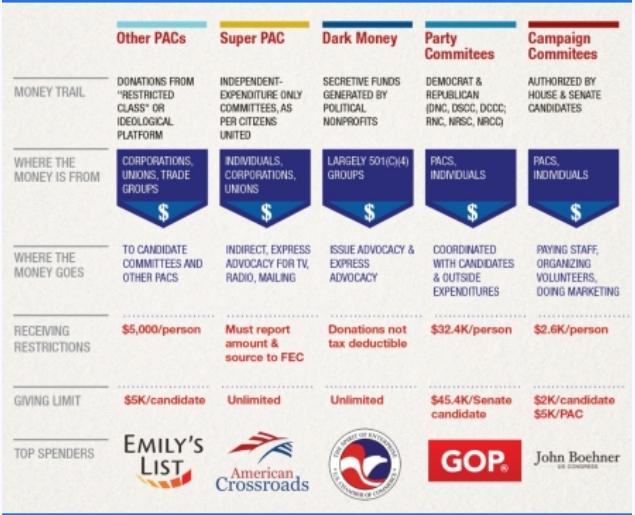
Different types of PACs (Political Action Committees) and how they influence elections
Connected PAC
established by corporations or entities like labor unions, which can only collect funds from members of the associated organization and donate limited amounts directly to candidates, while having the ability to raise unlimited funds as long as indicial contributions limits are followed.
Non-connected PAC
an independent political action committee (PAC) focused on a specific public interest, not associated with any organization., with limited donations by law, but the ability to directly contribute to a candidates campaign.
Super PAC
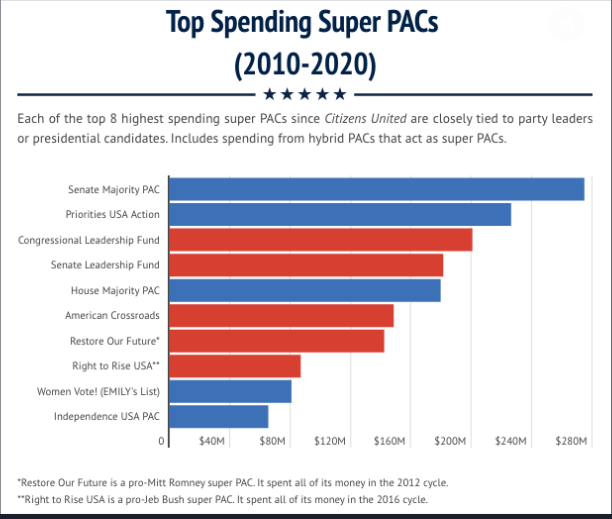
an independent political action committee that can accept unlimited donations from anyone, but is prohibited from coordinating directly with a candidate, leading to concerns about the influence of wealth on democracy.
Top Spending Super PACs
Bipartisan Campaign Finance Reform Act of 2002 (McCain Feingold Act)
Attempt to ban “soft money”
“Stand by Your Ad” - “I’m so and so and I approve this message”
Citizens United v. FEC (2010)
Debate over campaign finance has increased in recent years. What do you think about it?
The Bipartisan Campaign Reform Act (BCRA) 2002
increased the limits on hard money donations to campaigns
Restricted the influence of soft money by placing regulations on its spending, such as the requirement for candidate-associated advertisements to include a statement of approval from the candidate.
Hard Money:
Donations made directly to a candidate's campaign, regulated strictly by the FEC (Federal Election Commission) with limits on amounts.
Subject to federal limits
May only come from an individual or a political action committee
Monitored by the Federal Election Committee
Soft Money:
Donations to parties or committees for "party-building" activities (e.g., voter registration, ads not directly supporting a candidate), which are not subject to strict federal limits.
No limits to amount recieved
Can come from individuals, committees, or corporations
Indirect contributions to political parties and political action committees
Can’t be directly limked to, or directed by, the political candidate(s) they support
The Media As a Linkage Institution
Media links people to news, events, and helps shape public opinion.
Acting as “Gatekeeper”:
Media decides what people see and what stories are important
Historical Change:
From basic information to For-Profit Infotainment… they work to get money and clicks.
Fairness Doctrine:
Must give equal time to each candidate on national airwaves… however it was overturned in the 1980s.
Echo Chambers:
one way to get money and clicks to to “feed” people what they like or what they know will aggravate them. Like-minded people can meet more easily to commiserate.
Investigative Journalism:
Has worked to expose some of the largest stories .. bring to light issues and spark public outrage
Diversity in media choice and its influence on political institutions and behavior
Political participation impacted by variety of media coverage
analysis and commentary on political events
Rapidly increasing demand for media
Media bias
Bad for democracy or a natural product of our political culture?
Media ownership
Partisan news sites
Political Actors that Influence Public Policy Outcome
Single issue groups (NRA, MADD), ideological/social movements, protest movements
Competing actors
Interest groups
Social movements
Military
Bureaucratic institutions
Elections and political parties are related to major policy shifts, could cause political realignments