adaption & optimality- behavioural ecology
 Call Kai
 Learn
Learn Practice Test
 Spaced Repetition
 Match
Match Flashcards
 Knowt Play
1/28

There's no tags or description
Looks like no tags are added yet.
Name | Mastery | Learn | Test | Matching | Spaced | Call with Kai |
|---|
No analytics yet
Send a link to your students to track their progress
29 Terms
why is it theorised there is monogamy, and polygyny (& others ofc)
-females distributed according to resources (food/ nest sites, cuz their reproductive success depends on it)
-males distributed in relation to females (male reproductive success limited by access to females)
(proven as in dispersed food, when females experimentally aggregated-> aggregated males)
whats anisogamy
unequal gametes- parental investment
what does dispersed females + dispersed males =, aggregated females + aggregated males=
dispersed M + F = monogamy
aggregated M + F = polygyny
whats polygyny, polyandry, polygynandry vs promiscuity
M + FFF = polygyny
F + MMM = polyandry
FFFF + MMMM = polygynandry
F F F F + M M M M = (unstructured) promiscuity
what the difference in mating styles when females solitary, and the range is defendible vs non defensible by male
defensible- stable monogamy e.g. in klipspringer antelopes
non-defensible- temporary monogamy/ promiscuity e.g. in orangutangs
what the mating styles when females social, and the range is non defensible by male
defensible- single male/ multi male harem (polygyny/ polygynandry)(buffalo)/ seasonal harems (red deer)
whats the mating style when female nor resources can be defended
Lekking- groups of males display on tiny resource-free territories, females not defended (e.g. in black grouse)
how does lekking work? (even though its rare)
males aggregate cuz - signal-pooling- increase female attention, hotshots- satellite males aggregating around high quality males, avoids predation (vigiland, dilution), hotspots- female encounters are high (e.g. overlaps in female ranges, attractive resources)
females visit leks cuz- hotspots- places females visit for other reasons, can make direct comparisons between males
what are some issues with behavioural ecology
-implies genetic determinism (genes interact with environmental factors to produce behavioural phenotypes)
-anthropomorphic language (extrapolation from humans to animals, animals are responding to stimuli in a (usually) adaptive way and may not “intend”)
-’just-so’ storytelling (tell story that happen to fit observations)
how can you avoid ’just-so’ storytelling
-make precise testable predictions
-observations + experiments + comparative approach
why is it thought daily/ seasonal routines exist, e.g. song singing in the morning of birds (at dawn and dusk)
-strategic regulation of energy reserves (since lose more on colder nights, budget for worst case scenario)
-Sound transmission is best at dawn - physical & biological factors
-Circadian cycles of male hormones
-Overnight mortality of territory holders and/or mates
-low foraging efficiency at dawn (evidenced)
but many more explanations given
whats the pros and cons of storing fat reserves
pros- avoiding starvation, fuel for breeding, migration, etc
cons- spend more time foraging, flying takes more energy, slower & less agile, increased risk from predators
what are SDP models and how do they work
stochastic dynamic programming models
-identify optimal state at end of a series of days
-link short term decision making to long-term fitness via working backwards from the end of the final day, compute the sequence of behaviours which allow the bird to reach this end-state
whats state-dependent models
models describing how state affects behaviour at different times of day & night (the cost & benefits of different behaviours)
state- aspect of an animals biology that affect its long-term fitness (e.g. energy reserves, assessment of foraging success, prediction of future temperatures)
how can you test SDP models of behavioural routines?
-test key assumptions (e.g. is singling costly- energy/ time/ attract predator- mass was unaffected by song singing)
-test predictions about how the environment affects state, how state affects behaviour (environment -> state-> behaviour) (e.g. birds lose more fat on cold nights= evidenced extra 0.5g lost every 10deg drop, birds sing more at dawn when they are fat- evidenced so maybe singing costly)
-test predictions about average daily routines, testing models can highlight ways in which they are unrealistic (improved models)
why are some signals honest even when interests differ
index-unfakeable indices- signals that cannot be faked (e.g. tigre scratch marks on tree proving height)
-handicap signals- reliable cause they are costly (e.g. peacock tail) (strategic cost- cost needed to prevent cheating not efficacy cost required to transmit the info)
-badges of status- decrease costs of establishing dominance hierarchies by avoiding escalation
whats zahavi’s handicap model of honest signalling
-signals are more costly for low quality males
-net benefits of signalling are higher for high quality males
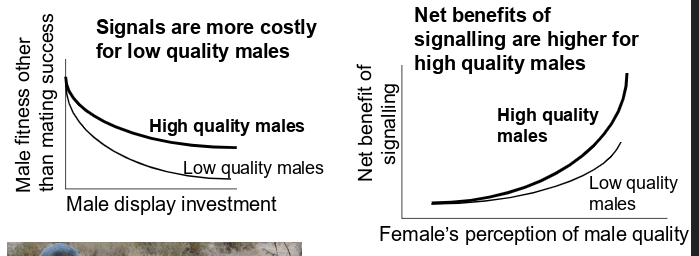
what are the conditions for handicap signals
Signalling is costly to the sender
Signalling level influences receiver’s response
Signallers perceived as being the same quality are treated similarly
A unit of signalling effort is more costly to low than high quality males
what are some strategic costs of signalling
sound production- energetically costly (e.g. male sage grouse use twice as much energy)
chemicals- physiological costs (e.g. pigments & pheromones)
what are some trade offs in signal production
-opposing selection pressure on signal design- attracting mates vs attracting predators
-costs can develop from signal elaboration e.g. barn swallow tail streamers- aerodynamic function & mate attraction
how does stotting/ pronking work in gazelles?
-they don’t stott around cheetahs- decreases when cheetahs in vicinity
-do stott around wild dogs - higher stating rate= less likely to be killed by wild dogs
whats some hypotheseses around stotting in gazelles
itsa a signal to predators e.g. shows gazelle detected the predator ‘i can see you’, prove prey is healthy ‘healthy enough to outrun’, etc
a signal to other gazelles e.g. warning ‘oi look out’ / asking for mothers help
not a signal
give an example of badges of status
-bigger patch of black on bird= more dominant
-badge size correlated with dominance rank & aggressiveness
-if subordinate painted black- punished, if subordinate transplanted w testosterone & became aggressive still failed to rise in status, if subordinate painted black & implanted w testosterone rose in status
-shows that cheats are punished so they dont
in your given example how are these badges costly
increased testosterone -> Inc metabolic rate, suppressed immune function
what can ‘cost-free’ signals (no strategic cost) be stabilised by
-common interest that overrides different preferences
-relatedness
-reciprocation & reputation
-punishing of false signals
-unfakeable index
what are non-signalling evolutionarily stable strategies (ESS)
behaviours such as deception
whats some examples of deception
-sender indicates a situation which is not real, sender benefits at the expense of receiver
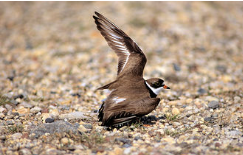
anti-predator deception (e.g. plovers feigning injury near nest),
deceptive mimicry- deceptive predators and parasites,
sexual mimicry (males pretending to be females to gain sneaky matings)
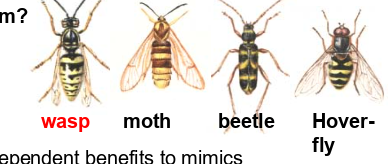
whats Batesian mimicry
palatable species pretend to be unpalatable - stealing protection from defended models e.g. moth pretend to look like wasp
whats Müllerian mimicry
unpalatable species coevolve similar patterns- share the cost of educating & reminding predators of the meaning of the signal (strength in numbers) (once predators have learnt about a warning signal, it makes sense for other defended species to use the same signal)
however predators may differ in their assessment of prey profitability (satiated vs hungry predators)/ differ in their ability to cope with toxicity