Part 6.1-INFLAMMATION
 Call Kai
 Learn
Learn Practice Test
 Spaced Repetition
 Match
Match Flashcards
 Knowt Play
1/26

Earn XP
Description and Tags
Proverbs 16:3
Name | Mastery | Learn | Test | Matching | Spaced | Call with Kai |
|---|
No analytics yet
Send a link to your students to track their progress
27 Terms
a. Inflammatory and autoimmune disorders
Rheumatologic disorders are commonly described as:
a. Inflammatory and autoimmune disorders
b. Infectious diseases of the lungs
c. Disorders of the digestive tract
d. Endocrine abnormalities
b. Musculoskeletal system
Rheumatologic disorders primarily affect the:
a. Respiratory system
b. Musculoskeletal system
c. Nervous system only
d. Reproductive system
c. Joints, muscles, bones, tendons, and ligaments
Which structure is commonly affected in rheumatologic disorders?
a. Bones, tendons, ligaments, and lungs
b. Joints, muscles, bones, liver and pancreas
c. Joints, muscles, bones, tendons, and ligaments
d. Retina muscles, bones, tendons, and ligaments
a. A non-specific immune response against an adverse stimulus
Inflammation is best defined as:
a. A non-specific immune response against an adverse stimulus
b. A specific immune response against an adverse stimulus
c. Permanent tissue destruction
d. Loss of blood circulation
a. Microbial invasion and physical injury
Inflammation is triggered by:
a. Microbial invasion and physical injury
b. Chemical invasion and physical injury
c. Microbial invasion and chemical injury
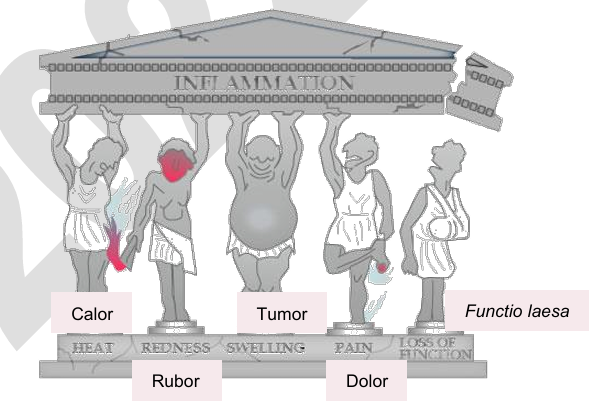
Cardinal Signs of Inflammation
c. Rubor
Which cardinal sign of inflammation refers to redness?
a. Calor
b. Tumor
c. Rubor
d. Dolor
a. Calor
Which cardinal sign of inflammation refers to heat?
a. Calor
b. Rubor
c. Tumor
d. Functio laesa
b. Tumor
Which cardinal sign of inflammation refers to swelling?
a. Dolor
b. Tumor
c. Rubor
d. Calor
b. Dolor
Which cardinal sign of inflammation refers to pain?
a. Tumor
b. Dolor
c. Rubor
d. Functio laesa
c. Loss of function
Functio laesa refers to:
a. Redness
b. Heat
c. Loss of function
d. Swelling
d. Overreactive immune response
Autoimmune diseases arise from:
a. Underactive immune response
b. Hormonal imbalance
c. Viral replication
d. Overreactive immune response
c. T cells and B cells
Which immune cells are mainly involved in autoimmune disease responses?
a. White blood cells
b. Platelets and neutrophils
c. T cells and B cells
d. Hepatocytes
a. Normal substances and tissues present in the body
Autoimmune diseases adversely target:
a. Normal substances and tissues present in the body
b. Foreign substances and tissues present in the body
c. Microorganisms
d. Environmental toxins
a. Synovium
[Rheumatologic Diseases]
Rheumatoid arthritis primarily affects the:
a. Synovium
b. Alveoli
c. Kidney cortex
d. Cardiac valves
a. Multiple symmetrical arthritis
Rheumatoid arthritis is commonly characterized by:
a. Multiple symmetrical arthritis
b. Single symmetrical arthritis
c. Non-inflammatory degeneration
d. Skin ulceration
c. Morning joint stiffness lasting >1 hour
A characteristic feature of rheumatoid arthritis is:
a. Evening joint stiffness
b. Absence of hand involvement and joint stiffness
c. Morning joint stiffness lasting >1 hour
d. Non-inflammatory pain
a. Hand joints
Which joints are commonly involved in rheumatoid arthritis?
a. Hand joints
b. Skull sutures
c. Rib cartilage
d. Eye muscles
b. Non-inflammatory and not autoimmune
Osteoarthritis is best described as:
a. Autoimmune disease
b. Non-inflammatory and not autoimmune
c. Inflammatory and not autoimmune
d. Non-inflammatory and autoimmune
c. Osteoarthritis
The most common rheumatologic disease is:
a. Rheumatoid arthritis
b. Systemic lupus erythematosus
c. Osteoarthritis
d. Ankylosing spondylitis
b. Lupus
Systemic lupus erythematosus (SLE) is commonly known as:
a. Arthritis
b. Lupus
c. Bamboo spine disease
d. Synovitis syndrome
b. Butterfly-shaped rash
A classic feature of lupus is:
a. Bamboo spine
b. Butterfly-shaped rash
c. Cartilage degeneration only
d. Tendon rupture
a. Photosensitivity
Patients with lupus commonly exhibit:
a. Photosensitivity
b. Heat intolerance only
c. Hair overgrowth only
d. Hearing loss only
a. Nephritis
A major renal complication of lupus is:
a. Nephritis
b. Kidney stones
c. Renal cancer
d. Hydronephrosis
b. Bamboo spine
Ankylosing spondylitis is associated with:
a. Butterfly rash
b. Bamboo spine
c. Kidney inflammation
d. Symmetrical hand arthritis
d. Ankylosing spondylitis
Enthesitis is commonly associated with:
a. Osteoarthritis
b. Acute infection
c. Lupus only
d. Ankylosing spondylitis
b. Ankylosing spondylitis
Sacroiliitis is a hallmark finding of:
a. Rheumatoid arthritis
b. Ankylosing spondylitis
c. Osteoarthritis
d. Lupus nephritis