Biomechanics lecture 5b
 Call Kai
 Learn
Learn Practice Test
 Spaced Repetition
 Match
Match Flashcards
 Knowt Play
1/23

There's no tags or description
Looks like no tags are added yet.
Name | Mastery | Learn | Test | Matching | Spaced | Call with Kai |
|---|
No analytics yet
Send a link to your students to track their progress
24 Terms
relative angle
formed between longitudinal axes of two adjacent body segments articulating at a joint, for example the lead knee when sprinting
absolute angle
angular orientation of a single body segment with respect to a fixed line of reference, for example the trunk with respect to vertical (back pain)
angular displacement
change in angular position from initial to final angular position, vector equivalent of angular distance, measured in units of degrees, radians, or rotations
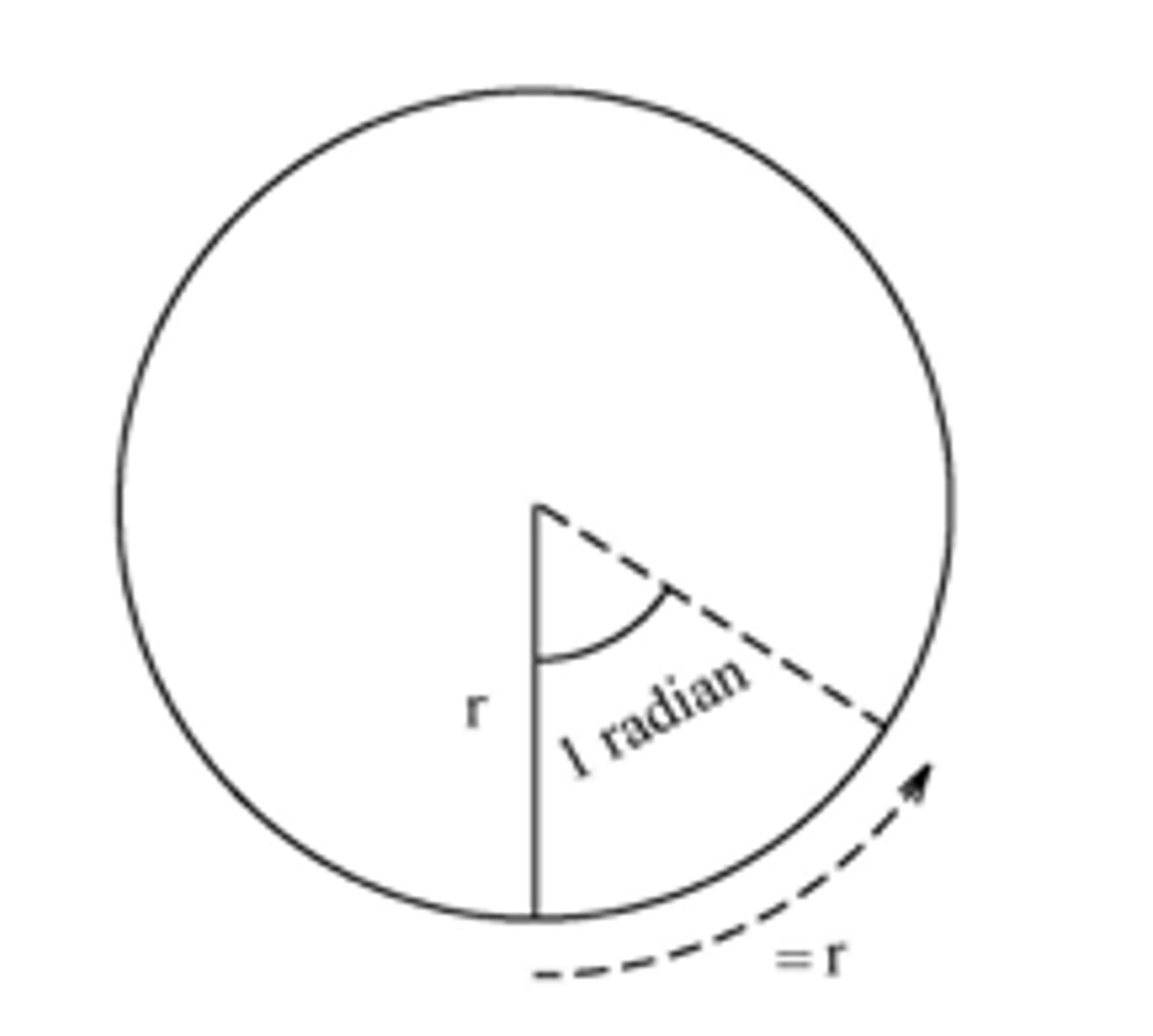
what is a radian
the size of the angle subtended at the center of a circle by an arc equal in length to the radius of the circle
90 degrees is equal to
1/2 pi radians
180 degrees is equal to
pi radians
270 degrees is equal to
3pi/2 radians
360 degrees is equal to
2pi radians (1 revolution)
angular displacement is positive when motion is
counterclockwise
angular displacement is negative when motion is
clockwise
the angle theta is defined to be
the arc length (s) divided by the radius (r)
1 radian is equal to 360/2pi which equals
57.3 (the conversion)
angular velocity
rate of change in angular position measured in degrees per second or radians per second
what is the relationship between linear and angular displacement
the greater the radius between a given point on a rotating body and the axis of rotation, the greater the linear distance traveled by that point during an angular motion
what is the relationship between linear and angular velocity?
since velocity is displacement over time, linear and angular velocity are related by the same factor that relates displacement: the radius of rotation
formula relating linear and angular MOTION
s (arc length) = r(theta/angle)
formula that related linear and angular VELOCITY
V (velocity) = rw (omega[angular velocity])
angular acceleration
rate of change in angular velocity, measured in units of degrees per second squared or radians per second squared, alpha
what is the relationship between linear and angular ACCELERATION
the acceleration of a body in angular motion can be resolved into two perpendicular linear acceleration components
What is tangential acceleration
a sub t, component of acceleration of angular motion directed along a tangent to a path of motion. Represents change in linear speed
tangential acceleration equation
a sub t = ((v2 - v1)/t)r
what is radial acceleration?
a sub r. Component of acceleration of angular motion directed toward the center of curvature. Represents change in direction.
radial acceleration equation
a sub r= v^2/r
ANOTHER equation for tangential acceleration
a sub t = angular acceleration (alpha/a) x r