Chapter 9
 Call Kai
 Learn
Learn Practice Test
 Spaced Repetition
 Match
Match Flashcards
 Knowt Play
1/74

There's no tags or description
Looks like no tags are added yet.
Name | Mastery | Learn | Test | Matching | Spaced | Call with Kai |
|---|
No analytics yet
Send a link to your students to track their progress
75 Terms
intracellular digestion
a part of metabolism
involves the oxidation of glucose and fatty acids for energy.
extracellular digestion
the process by which these nutrients are obtained from food occurs within the lumen of the alimentary canal
alimentary canal
runs from the mouth to the anus and is sectioned off by sphincters
sphincters
circular smooth muscles around the canal that can contract to allow compartmentalization of function
Digestion
the breakdown of food into its constituent organic molecules: starches and other carbohydrates into monosaccharides, lipids (fats) into free fatty acids and glycerol, and proteins into amino acids
Mechanical digestion
physical breakdown of large food particles into smaller food particles
involves mastication
Chemical digestion
the enzymatic cleavage of chemical bonds, such as the peptide bonds of proteins or the glycosidic bonds of starches\
relies on enzymes from saliva produced by the three pairs of salivary glands
Absorption
the transport of products of digestion from the digestive tract into the circulatory system for distribution to the body’s tissues and cells.
oral cavity → pharynx → esophagus → stomach → small intestine → large intestine → rectum
What is the pathway of the digestive tract
enteric nervous system
a collection of one hundred million neurons that govern the function of the gastrointestinal system.
peristalsis
rhythmic contractions of the gut tube, in order to move materials through the system
triggered by neurons in the digestive tract
oral cavity
plays a role in both mechanical and chemical digestion of food
mastication
the breaking up of large food particles into smaller particles
using the teeth, tongue, and lips.
Salivary amylase
capable of hydrolyzing starch into smaller sugars (maltose and dextrins),
lipase
catalyzes the hydrolysis of lipids
bolus
mass of chewed food formed by the tongue
pharynx
the cavity that leads from the mouth and posterior nasal cavity to the esophagus
The nasopharynx, the oropharynx, and the laryngopharynx
What are the three parts of the pharynx
nasopharynx
behind the nasal cavity
oropharynx
at the back of the mouth
laryngopharynx
above the vocal cords
epiglottis
a cartilaginous structure that folds down to cover the laryngeal inlet
esophagus
muscular tube that connects the pharynx to the stomach.
top third of the esophagus is composed of skeletal muscle, the bottom third is composed of smooth muscle, and the middle third is a mix of both.
skeletal muscle
somatic (voluntary) motor control
peristalsis
rhythmic contraction of smooth muscle that propels food toward the stomach
squeezes, pushes, and propels the bolus toward the stomach
emesis (vomiting)
reversal of peristalsis
upper esophageal sphincter
muscles of the oropharynx
responsible for swallowing
lower esophageal sphincter (cardiac sphincter)
muscular ring that relaxes and opens to allow the passage of food as the bolus approaches the stomach
weakess here can cause GERD, which causes heartburn
stomach
in the upper left quadrant of the abdominal cavity, underneath the diaphragm
uses hydrochloric acid and enzymes to digest food, creating a fairly harsh environment.
thick mucosa to prevent autodigestion
Sections of the stomach
fundus and body - gastric glands
antrum and pylorus - pyloric glands
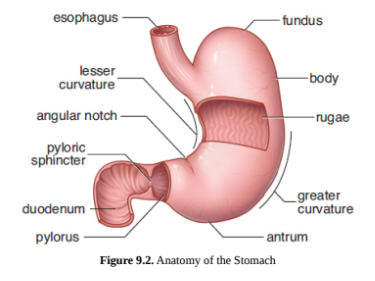
pyloric glands
contain G-cells that secrete gastrin, a peptide hormone
Gastrin
induces the parietal cells in the stomach to secrete more HCl and signals the stomach to contract, mixing its contents
chyme
acidic, semifluid mixture produced from digesting solid food in the stomach
gastric glands
respond to signals from the vagus nerve of the parasympathetic nervous system
vagus nerve
activated by the brain in response to the sight, taste, and smell of food
Gastric juice
combination of secretions from the other two cell types in the gastric glands: chief cells and parietal cells.
chief cells
secrete pepsinogen
pepsinogen
the inactive, zymogen form of pepsin, a proteolytic enzyme.
parietal cells
secrete HCl
H+ in the HCl cleave pepsinogen to pepsin
secrete intrinsic factor
intrinsic factor
a glycoprotein involved
in the proper absorption of vitamin B12.
Pepsin
digests proteins by cleaving peptide bonds near aromatic amino acids, resulting in short peptide fragments
activated by the acidic environment, so most active in at a low pH
Helicobacter pylori
stomach bacteria
infection is usually asymptomatic but can cause inflammation, ulcers, and even certain gastric cancers).
What six products does the stomach secrete?
HCl
Pepsinogen
Mucus
Bicarbonate
water
Intrinsic factor
Why does the stomach secrete HCl?
kills microbes, denatures proteins, and converts pepsinogen into pepsin
Why does the stomach secrete mucus and bicarbonate?
it protects the mucus membrane (mucosa)
Why does the stomach secrete water
dissolves and dilutes ingested material
What are the three sections of the small intestine?
the duodenum
the jejenum
the ileum
duodenum
responsible for the majority of chemical digestion and has some minor involvement in absorption
secretes enteropeptidase
secretes hormones like secretin and cholecystokinin (CCK) into the bloodstream
Enteropeptidase (formerly called enterokinase)
an enzyme critical for the activation of trypsinogen, a pancreatic protease, to trypsin, which then initiates an activation cascade
can also activate procarboxypeptidases A and B to their active forms
jejunum and ileum
Where does most of the absorption in the small intestine take place
pyloric sphincter
Food leaves the stomach through the ___________ and enters the duodenum.
Brush-border enzymes
present on the luminal surface of cells lining the duodenum and break down dimers and trimers of biomolecules into absorbable monomers.
Secretin
peptide hormone that causes pancreatic enzymes to be released into the duodenum
regulates the pH of the digestive tract by reducing HCl secretion from parietal cells and increasing bicarbonate secretion from the pancreas
enterogastrone, a hormone that slows motility through the digestive tract.
cholecystokinin (CCK)
secreted in response to the entry of chyme (specifically, amino acids and fat in the chyme) into the duodenum.
stimulates the
release of both bile and pancreatic juices and also acts in the brain, where it promotes satiety
Bile
complex fluid composed of bile salts, pigments (especially bilirubin from the breakdown of hemoglobin), and cholesterol
Bile salts
derived from cholesterol
emulsify fats and cholesterol into micelles.
without it, fats would spontaneously separate out of the aqueous mixture in the duodenum and would not be accessible to pancreatic lipase, which is water-soluble
gallbladder
stores and concentrates bile
just beneath the liver
common site of cholesterol or bilirubin stone formation
pancreas
release insulin, glucagon, and somatostatin— peptide hormones necessary for the maintenance of proper blood sugar levels
made of exocrine cells called acinar cells that produce pancreatic juices
Pancreatic amylase
breaks down large polysaccharides into small disaccharides and is therefore responsible for carbohydrate digestion
pancreatic peptidases
trypsinogen, chymotrypsinogen, and carboxypeptidases A and B
released in their zymogen form, but once activated are responsible for protein digestion
pancreatic lipase
secreted by the pancreas
capable of breaking down fats into free fatty acids and glycerol
bile ducts
connect the liver with both the gallbladder and small intestine
hepatic portal vein
in liver
receives all blood draining from the abdominal portion of the digestive tract
liver
takes up excess sugar to create glycogen, the storage form of glucose
stores fats as triacylglycerols
can also reverse these processes, producing glucose for the rest of the body through glycogenolysis and gluconeogenesis and mobilizing fats in lipoproteins
detoxifies both endogenous compounds (those made in the body) and exogenous compounds (those brought in from the environment).
villi
small, finger-like projections from the epithelial lining
each one has a capillary bed for absorbing water-soluble nutrients and a lacteal (lymphatic channel that takes up fats for transport into the lymphatic system)
mnemonic for the parts of the small intestine
Dow Jones Industrial
(Duodenum
Jejunum
Ileum)
chylomicrons
packaged triglycerides and esterified cholesterol molecules
fat-soluble vitamins
A, D, E, and K
dissolve directly into chylomicrons to enter the lymphatic circulation
water-soluble vitamins
B complex and C
are taken up, along with water, amino acids, and carbohydrates, across the endothelial cells of the small intestine, passing directly into the plasma.
large intestine
primarily involved in water absorption
three sections: the cecum, the colon, and the rectum
cecum
an outpocketing that accepts fluid exiting the small intestine through the ileocecal valve and is the site of attachment of the appendix.
colon
divided into the ascending, transverse, descending, and sigmoid colons
function is to absorb water and salts (such as sodium chloride) from the undigested material left over from the small intestine.
anus
the opening through which wastes are eliminated and consists of two sphincters: the internal and external anal sphincters.
internal anal sphincters
involuntary control (autonomic)
external anal sphincters
under voluntary control (somatic)