KNES 373 - Final Exam Review
 Call Kai
 Learn
Learn Practice Test
 Spaced Repetition
 Match
Match Flashcards
 Knowt Play
1/63

Earn XP
Description and Tags
lectures 13 and 14 (VO2max and exercise thresholds/domains), lecture 11 (anaerobic metabolism)
Name | Mastery | Learn | Test | Matching | Spaced | Call with Kai |
|---|
No analytics yet
Send a link to your students to track their progress
64 Terms
What is VO2max?
quantitative measure of an individual’s capacity for aerobic ATP resynthesis (max rate of oxygen uptake)
aka: maximal oxygen uptake, maximal aerobic power, aerobic capacity
What are the 3 different exercise tests used to measure VO2max?
ramp incremental (continuously increasing intensity)
step incremental (intensity increases in steps)
constant intensity (intensity stays the same)
When matched for training level, normalizing VO2max by lean body mass eliminates _______________ differences in VO2max.
sex-based differences
A high VO2max is necessary but not _____________ for success in events that are primarily aerobic.
sufficient
How much does VO2max decline per decade of age?
8% decline per decade in males and females
decline starts around age 30
decline can be slowed with training, but not eliminated
Ventilation shows a _____________ relationship during the VO2max test. What are the 2 important thresholds?
curvilinear, gas exchange threshold (GET) + respiratory compensation point (RCP)
Why are ramp incremental tests performed?
to determine exercise capacity (VO2max)
to identify cardiorespiratory response thresholds
What occurs in phase I of a ramp incremental test (RIT)?
linear increase in O2 consumption
linear increase in CO2 production
linear increase in VE
metabolic steady state (oxygen demand matches oxygen supply)
blood lactate/H+ are consistent (2 mmol/L)
The _____ or ______ is the upper boundary of the moderate-intensity domain, in which VO2 reaches a steady-state within ______ minutes and blood lactate remains around resting values.
GET (gas exchange ratio), LT1 (lactate threshold 1), 2-3
Why does blood lactate not increase below the GET?
the demand for ATP can be met by aerobic glycolysis and glycogenolysis
rate of pyruvate production is approximately equal to the uptake + oxidation of pyruvate, so that conversion of pyruvate to lactate is low
after a few minutes, fat oxidation will be the predominant energy system
What occurs in phase II of an RIT?
linear increase in O2 consumption
nonlinear increase in CO2 production
VE increases at a faster rate in relation to increased work load or VO2
steady state (oxygen demand matches oxygen supply)
BL/H+ are consistent but at a higher level
BL/H+ production and clearance is still at equilibrium
At the gas exchange threshold (GET), CO2 and H+ are _____________________________, causing an increase in CO2 production. The activation of the _____________________ increases the rate of H+ production.
buffered by bicarbonate, glycolytic pathway
Anaerobic glycolysis is activated in the __________ domain.
heavy
What is MLSS?
maximum lactate steady state, another name for RCP
critical intensity of exercise, the highest metabolic rate at which steady-state responses in VO2 and blood lactate are achievable
How long does it take to reach steady-state in the heavy intensity domain?
10-15 minutes
In the heavy intensity domain, there is an increase in the rate of ____________ production, which exceeds the rate of uptake and oxidation, and there is an increase in _____________ production, resulting in greater _____________ concentration.
pyruvate, lactate, blood lactate
In the heavy intensity domain, although the metabolic demand and blood lactate concentration are elevated, ______________ is still achieved because the physiological buffering systems (_____________, ______________, ______________, _____________) are able to minimize the metabolic disturbance.
steady-state, bicarbonate buffering system, hemoglobin, proteins, phosphates
What occurs in phase III of a RIT?
linear increase in O2 consumption
nonlinear increase in CO2 production
hyperventilation can not compensate the rise in H+
no metabolic stability (steady state)
BL/H+ production exceeds the clearance
What happens to ventilation beyond the RCP?
nonlinear increase in ventilation compared to CO2 production
to compensate for the decrease in pH, VE increases out of proportion to VCO2
hyperventilation can not compensate for the rise in H+
In the severe intensity domain, muscle metabolic responses to the high ATP demand result in a ________ rate of glycolysis which exceeds the ability of the _____________ to accept the increased production of pyruvate and the capacity of the system to buffer the increased ________ associated with the conversion of the lactate to pyruvate. What does this result in?
faster, mitochondria, H+, results in failure to achieve steady-state
What are the ranges of blood lactate concentration for each domain?
moderate: < 2 mmol/L
heavy: 2-4 mmol/L
severe: > 4 mmol/L
Why is exercise performed above the MLSS considered unsustainable?
a net anaerobic contribution to ATP resynthesis is required, signified by an unstable and increasing blood lactate
The power output associated with MLSS produces a VO2 equivalent to the ________.
RCP
The ramp-incremental test has become a gold-standard protocol to quantify _________ and _______________.
VO2 max, gas-exchange thresholds (GET, RCP)
What is mean response time?
in response to ramp exercise, O2 uptake at the mouth increases linearly with power output, however VO2 shows a delayed increase in relation to power output at the very beginning of the ramp
MRT stems from transit delay in physiological responses (neural and humoral adjustments) that need to occur at the beginning of the exercise to meet the demand of muscle VO2
When prescribing exercise in the moderate domain, the power output difference produced by the MRT should be ____________ from the ramp power output; otherwise what?
subtracted, otherwise the exercise intensity will be underestimated
In addition to the power output difference produced by the MRT, the _______________ should also be considered for exercise prescribed in the heavy and severe domains.
slow component
_______ alone should be applied in the moderate domain; both __________ and __________ should be applied for the heavy and severe intensities.
MRT, MRT, VO2 slow components
There is no dissociation (drift upwards/slow component) of O2 uptake for a given power output during constant exercise vs. a ramp incremental test in the ___________ intensity domain (below _____).
moderate, GET
What are the reasons for the slow component (dissociation of VO2) during constant load exercise vs. RIT?
type I muscle fibers fatigue, leading to recruitment of type II muscle fibers which are less efficient and consume more O2
What is the dissociation (slow component) of VO2 for each exercise intensity domain (including extreme)?
moderate
no dissociation
heavy
VO2 takes longer to stabilize + reaches values that are greater than predicted because of dissociation of VO2
severe
VO2 increases to VO2 max because of dissociation of VO2
extreme
exhaustion occurs before VO2 reaches VO2max
Why are exercise thresholds important?
can be used to accurately prescribe exercise
predicts exercise performance (determine the feasibility of a given exercise task)
How long can each exercise domain be tolerated?
moderate → > 2 hours
heavy → 45 min to < 2 hours
severe → seconds to 45 min
Thresholds are highly individual. What range of percentages of VO2max correspond to each threshold? This indicates that even at the same percentage of VO2max, individuals are not experiencing the same ______________.
GET/LT → 40-80% of VO2max
RCP (MLSS) → 65-95% of VO2max
metabolic stress
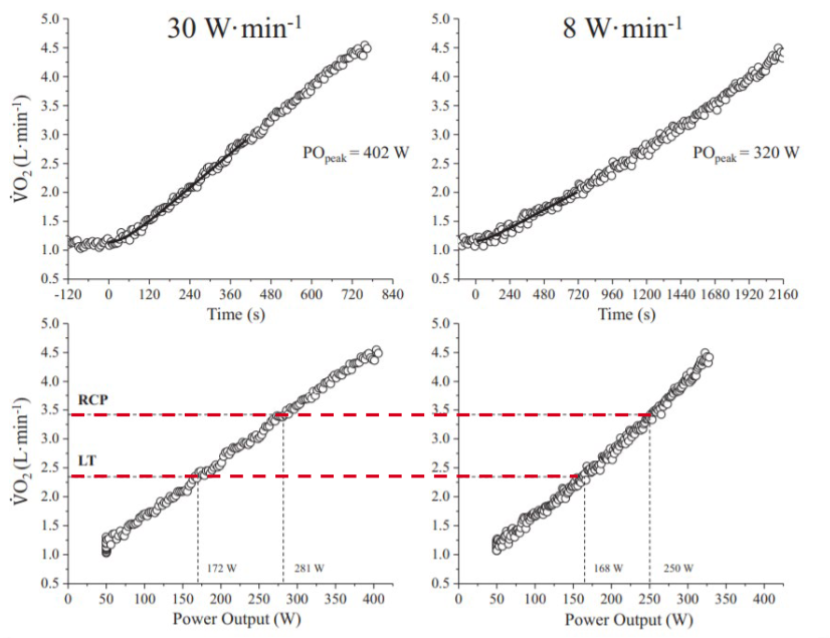
Regardless of fast (steep) or slow (shallow) ramps in an RIT, thresholds will occur at the same _________, but thresholds will not occur at the same _____________, and peak _____________ will be different between fast and slow ramps. The _________ ramp will reach a higher peak ___________ than the other ramp.
VO2, power output, power output, fast/steep
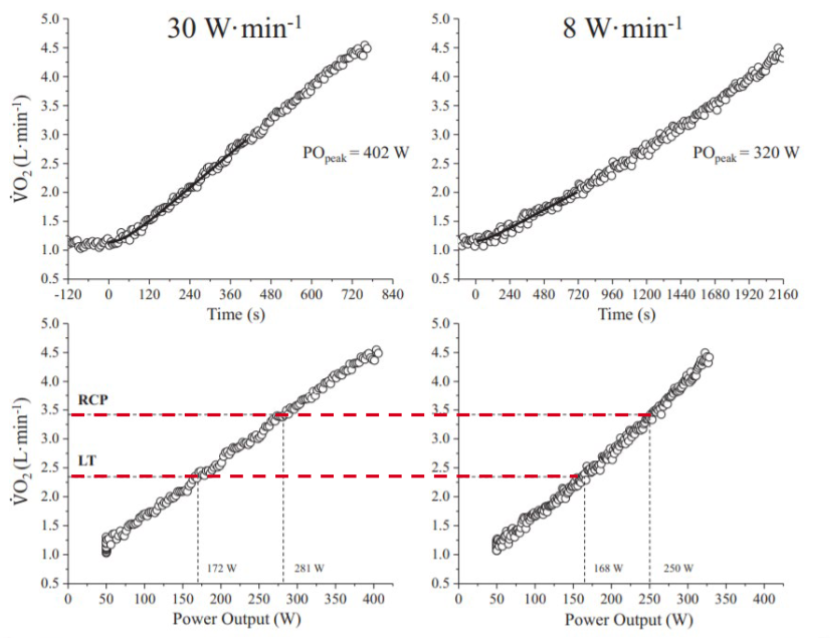
_______________ depends on the slope of the RIT. In a slow RIT, the power outputs at the GET and RCP thresholds will be ____________ than the power outputs at those thresholds in a fast RIT.
Power output, lower
What is critical power?
the maximum rate of work that an athlete can sustain for a long time without fatigue, considered to represent the greatest metabolic rate that results in wholly oxidative energy provision
derived from multiple time to task failure exercise visits
the asymptote of the power-duration relatioship
What is W’?
the amount of anaerobic work that can be performed above critical power (predicts time to exhaustion in the severe-intensity domain)
does not represent a finite amount of anaerobic energy available, it provides a measure of exercise tolerance for intensities that are dependent on anaerobic metabolism
Skeletal muscle mitochondrial protein content and slow twitch fiber proportion are strongly correlated with greater _____________.
critical power
What are the components of the glycolytic system (anaerobic metabolism)?
glycogenolysis
glycolysis
lactate production
Which macronutrient is the only one that can generate ATP both anaerobically and aerobically?
carbohydrates
From where are carbohydrates available during exercise?
blood
muscle
liver (to muscle via blood)
ingested (from digestion to muscle via blood)
How does glucose enter a muscle cell?
GLUT 4 (glucose transporter 4)
transport protein (NOT an enzyme)
specific to muscle cells
GLUT 4 uses _____________ in which the glucose molecules follow a concentration gradient, and are sensitive to which hormone?
facilitated diffusion, sensitive to insulin
How does the immediate system function?
as soon as muscle contraction starts:
stored ATP is broken down into ADP + Pi
increased Ca2+ and byproducts (ADP, Pi, H+) are formed and activate CK (creatine kinase)
CK accelerates breakdown of PCR to donate a P to ADP to create ATP
What are the 5 enzymes involved in anaerobic glycolysis?
hexokinase (HK)
phosphofructokinase (PFK)
lactate dehydrogenase (LDH)
glycogen phosphorylase (PHOS)
glycogen synthase
If you are at rest, glucose will be converted to ________________. If you are exercising at a low intensity, glucose will be converted to ______________ in the __________________ and then into ______________ in the ________________. If you are exercising at a high intensity, glucose will be converted to ___________ from _____________ (in the ___________).
glycogen, pyruvate, cytosol, acetyl CoA, mitochondria, lactate, pyruvate, cytosol
Explain the process of anaerobic glycolysis.
insulin binds to insulin receptor, signals GLUT 4 inside the cell
GLUT 4 moves to the cell membrane, glucose moves into the cell (from blood)
hexokinase converts glucose to glucose-6-phosphate (G6P) so that it can’t leave the cell (uses 1 ATP)
2 paths:
at rest: G6P converted to G1P by phosphoglucomutase), G1P converted to glycogen by glycogen synthase
exercise: G6P converted to fructose-1,6-phosphate (uses 1 ATP)
fructose-1,6-phosphate is converted to 2 pyruvates by PFK (makes 4 ATP (2 per pyruvate), 1 NADH)
low intensity exercise: pyruvate enters mitochondria to produce energy
high intensity exercise: pyruvate is converted to 2 lactate by LDH (lactate dehydrogenase), NADH is oxidized to NAD+
glycogen is broken down into G1P by PHOS (glycogen phosphorylase), G1P converted to G6P by phosphoglucomutase
What is the net ATP output from glucose and from glycogen?
glucose → uses 2 ATP, produces 4 ATP, net: 2 ATP
glycogen → uses 1 ATP, produces 4 ATP, net 3 ATP
What does hexokinase do?
converts glucose to glucose-6-phosphate (G6P, P from ATP attaches to glucose)
What are the 2 fates of G6P?
1) undergoes glycolysis
2) stored as glycogen
Phosphofructokinase is a ___________ enzyme that is activated and inhibited by what?
rate-limiting
activated by: ADP, AMP, Pi, G6P
inhibited by: ATP, H+
Anaerobic glycolysis yields ______ ATP (net). It also yields ______ NADH, which is __________by lactate dehydrogenase (LDH) to form NAD+.
2, 2, oxidized
What is glycogenolysis? What is happening and where? What enzyme catalyzes this reaction?
breakdown of glycogen into glucose-1-phosphate (G1P), end goal is glucose
occurs in the sarcoplasm (outside of mitochondria)
catalyzed by glycogen phosphorylase (PHOS)
Glycogen phosphorylase (PHOS) is a ______________ enzyme. What activates and inhibits its activity?
rate-limiting
activated by: Ca2+, AMP, Pi, epinephrine
inhibited by: ATP, H+, G6P
What is the ATP yield for glycogenolysis?
3 ATP (net)
requires 1 ATP
produces 4 ATP
What is McArdle disease?
mutation in gene that provides instructions for making the enzyme glycogen phosphorylase which leads to an inability to break down glycogen effectively
Differentiate between the 2 types of glycolysis in regards to need for oxygen, speed, ATP production and the product.

What does lactate dehydrogenase (LDH) do?
convert between pyruvate and lactate
Lactate is formed when ____________ and ______________ accumulate, because it signals that the mitochondria don’t have the capacity to accept pyruvate for the TCA cycle. Conversion of lactate to pyruvate increases ________ to continue the process of anaerobic glycolysis.
pyruvate, NADH + H+, NAD+
How is lactate a buffer for H+?
lactate consumes H+ during its production from pyruvate
How does exercise intensity affect lactate production?
higher intensity → more lactate production (exponential increase)
What is the fate of lactate?
converted back into glucose in the liver, converted back into pyruvate to be oxidized in the TCA cycle, fuel source for heart and brain
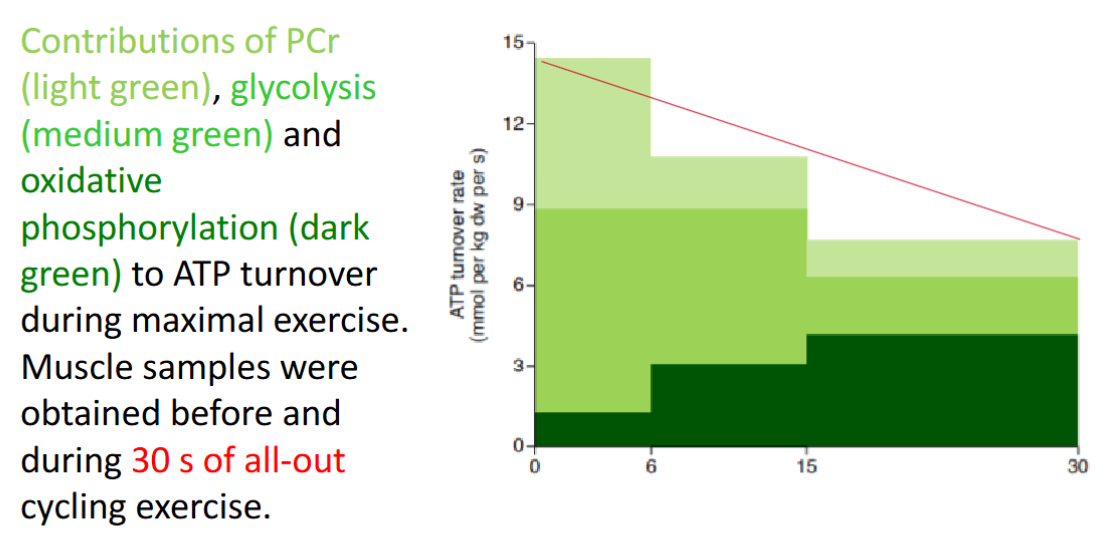
Which energy system increases its contribution during 30s all-out cycling exercise? Which energy systems decrease their contribution?
aerobic glycolysis (oxidative phosphorylation)
anaerobic glycolysis, PCR