PHYSICS
 Call Kai
 Learn
Learn Practice Test
 Spaced Repetition
 Match
Match Flashcards
 Knowt Play
1/49

There's no tags or description
Looks like no tags are added yet.
Name | Mastery | Learn | Test | Matching | Spaced | Call with Kai |
|---|
No analytics yet
Send a link to your students to track their progress
50 Terms
What is uniform acceleration?
Uniform acceleration is when an object's acceleration is constant over time. This means that the object's velocity changes by the same amount in each unit of time.
What is non-uniform acceleration?
Non-uniform acceleration is when an object's acceleration changes over time. This means that the object's velocity changes by different amounts in each unit of time.
What is free fall?
Free fall is a special case of uniform acceleration where an object is falling under the influence of gravity.
What are the BIG FIVE equations of motion?
The BIG FIVE equations of motion are a set of equations that describe the relationship between displacement, velocity, acceleration, and time for an object in uniformly accelerated motion. The equations are:
v_f = v_i + at
Δx = v_i t + (1/2)at^2
v_f^2 = v_i^2 + 2aΔx
Δx = (1/2)(v_f + v_i)t
Δx = vt - (1/2)at^2
What is uniform circular motion?
Uniform circular motion is the motion of an object moving in a circular path at a constant speed. The object's velocity is constantly changing due to the change in direction of its motion.
What is the difference between speed and velocity in uniform circular motion?
Although the speed may be constant, the velocity is not because the direction is always changing meaning that the velocity is always changing.
What is centripetal acceleration?
The centripetal acceleration is what turns the velocity vectors to keep the object traveling in a circle. The magnitude of the centripetal acceleration depends on the object’s speed, v, and the radius of the circular path, r. a꜀ = v^2/r
What are some examples of uniform circular motion?
Some examples of uniform circular motion include the motion of a car around a circular track, the motion of a satellite orbiting the Earth, and the motion of a ball on a string being swung in a circle.
What is the gravitational force?
The gravitational force is the force of attraction between two masses.
What is the formula for the gravitational force?
The formula for the gravitational force is F = G * (m1 * m2) / r^2, where G is the gravitational constant (6.674 * 10^-11 N * m^2 / kg^2).
What is the formula for gravitational acceleration?
The formula for gravitational acceleration is g = G * M / r^2, where G is the gravitational constant (6.674 * 10^-11 N * m^2 / kg^2), M is the mass of the object causing the gravitational force, and r is the distance between the object and the center of mass of the other object.
What is the unit of measurement for work?
Work is measured in joules (J).
What is momentum?
Momentum is the degree of an object's opposition to a modification in motion. It is a vector quantity, indicating it has both size and direction. The momentum formula is p = mv, where p is momentum, m is mass, and v is velocity.
Define impulse.
Impulse is the change in momentum of an object over a given time period. It is the product of the force applied to an object and the time over which the force is applied. The formula for impulse is: J = FΔt, where J is impulse, F is the force applied, and Δt is the time interval over which the force is applied.
What is the law of conservation of linear momentum?
According to the law of conservation of linear momentum, the total momentum of a system of objects remains constant if no external forces act on the system. This means that the sum of the momenta of all the objects in the system before a collision is equal to the sum of the momenta of all the objects after the collision.
What are the three types of collisions?
The three types of collisions are:
Elastic Collisions: In an elastic collision, the total kinetic energy of the system is conserved.
Inelastic Collisions: In an inelastic collision, the total kinetic energy of the system is not conserved.
Perfectly Inelastic Collision: In a perfectly inelastic collision, the objects stick together and travel in the same direction.
What is simple harmonic motion?
Simple Harmonic Motion (SHM) is a type of periodic motion where the restoring force is directly proportional to the displacement from the equilibrium position and is directed towards it. The motion is periodic and repetitive.
What is the relationship between acceleration and displacement in SHM?
The acceleration is directly proportional to the displacement and is always directed towards the equilibrium position.
What is the total mechanical energy of a system undergoing SHM?
The total mechanical energy of a system undergoing SHM is constant and is the sum of kinetic and potential energy. Total energy: E = 1/2 kA^2, Kinetic energy: K = 1/2 mv^2, Potential energy: U = 1/2 kx^2, where k is the spring constant, m is the mass, v is the velocity, and x is the displacement.
What is the force that causes simple harmonic motion?
Since the block is accelerating and decelerating, there must be some force that is making it do so. This cause, the spring exerts a force on the b
Uniform Circular Motion
The motion of an object moving in a circular path at a constant speed. The velocity is constantly changing due to the change in direction of its motion.
Gravitational force formula
Fg = G(m1m2)/r^2
Kinetic energy formula
KE = (1/2)mv^2
Potential energy formula
PE = mgh
Power formula
P = W/t
Momentum formula
p = mv
Moment of inertia formula
I = ∫r^2dm
Newton's Law of Universal Gravitation formula
F = G(m1m2)/r^2
Coulomb's Law formula
F = k(q1q2)/r^2
Ohm's Law formula
V = IR
Resistance formula
R = ρl/A
Kirchhoff's Laws
Σi = 0 and ΣV = 0
true or false: the force of gravity is different depending on the mass of the object gravity is pulling. but the acceleration due to gravity is always -9.8
true
t or f: to get any object's gravitational force, can i just multiply -9.8 by the object's mass
t
true or false: if i push something but stay still, that something is still exerting an equal and opposite force on me. however, we don't necessarily have equal and opposite accelerations, because we don't necessarily have the same mass.
true
if i say: “a bird flies towards the ground with an acceleration of 5 m/s²”
what do you know about my left-right acceleration?
there is none!
send two objects into the air at the same angle, but one object has double the initial speed of the other.
then object two will spend double object one’s time in the air
and object two will travel quadruple the vertical distance of object one (just trust me i’ve done the math)
is time of flight directly proportional to x or y velocity?
y!!
why do the spheres reach the ground at the same time even though they travel different distances
despite traveling different x-distances
the x-distance has nothing to do with air time
it is the y-distance that helps you figure out an object’s air time
sure, these two spheres have different x-velocities
A has none
B has some amount V0
but they have the same initial y-velocity of 0 (as neither is falling or rising at time t=0)
and, of course, are acted on by the same y-acceleration (-9.8 m/s²)
they travel the same y-distance, have the same initial y-velocity, and are acted on by the same y-acceleration (-9.8 m/s²)
according to what i did using this formula, having these three things in common means they also have time in common
d vs t
slope is v. if it’s curvy, you can find the slope of a certain part with a tangent line.
v vs t
slope is a, AUTC is DELTAd
a vs t
AUTC is DELTAv
A student claims that "if the planet had the same mass but was much denser (smaller radius), the escape speed from its surface would increase." In a clear, coherent, paragraph-length response, explain why this claim is either correct or incorrect.
Part C: Paragraph Argument (3 points)
1 point: For stating the claim is correct.
1 point: For referencing the inverse relationship between escape speed and distance ( r is in the denominator )
1 point: For explaining that a smaller radius means a greater escape velocity.
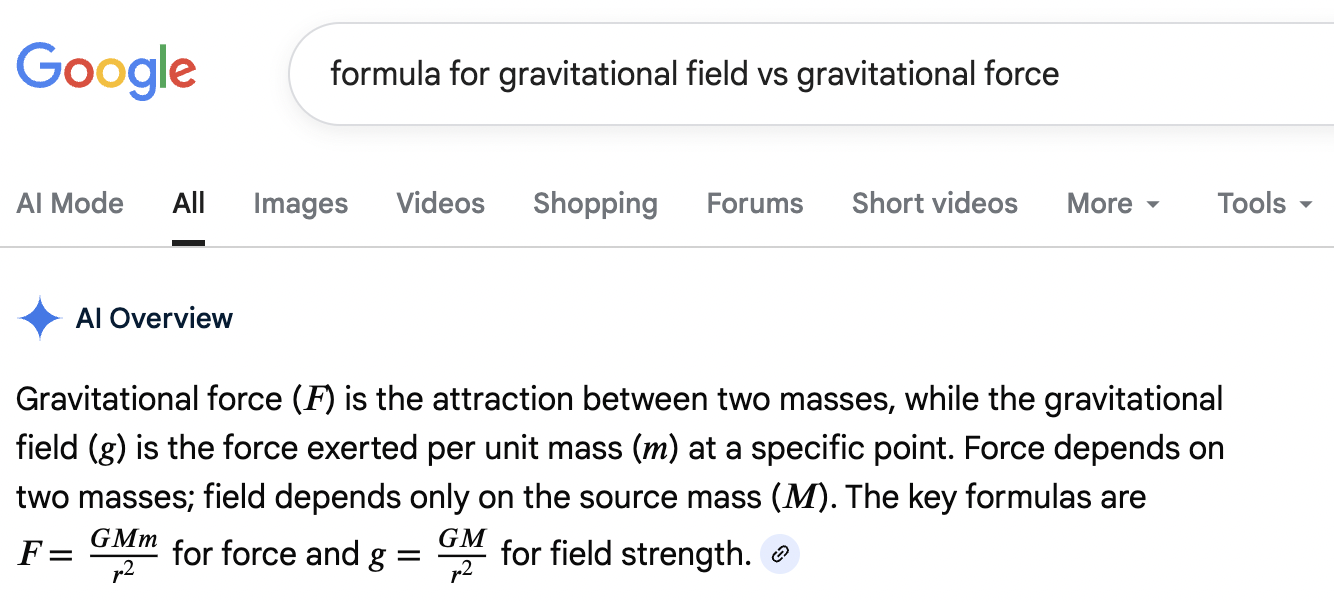
the units as N/kg and m/s2 are identical
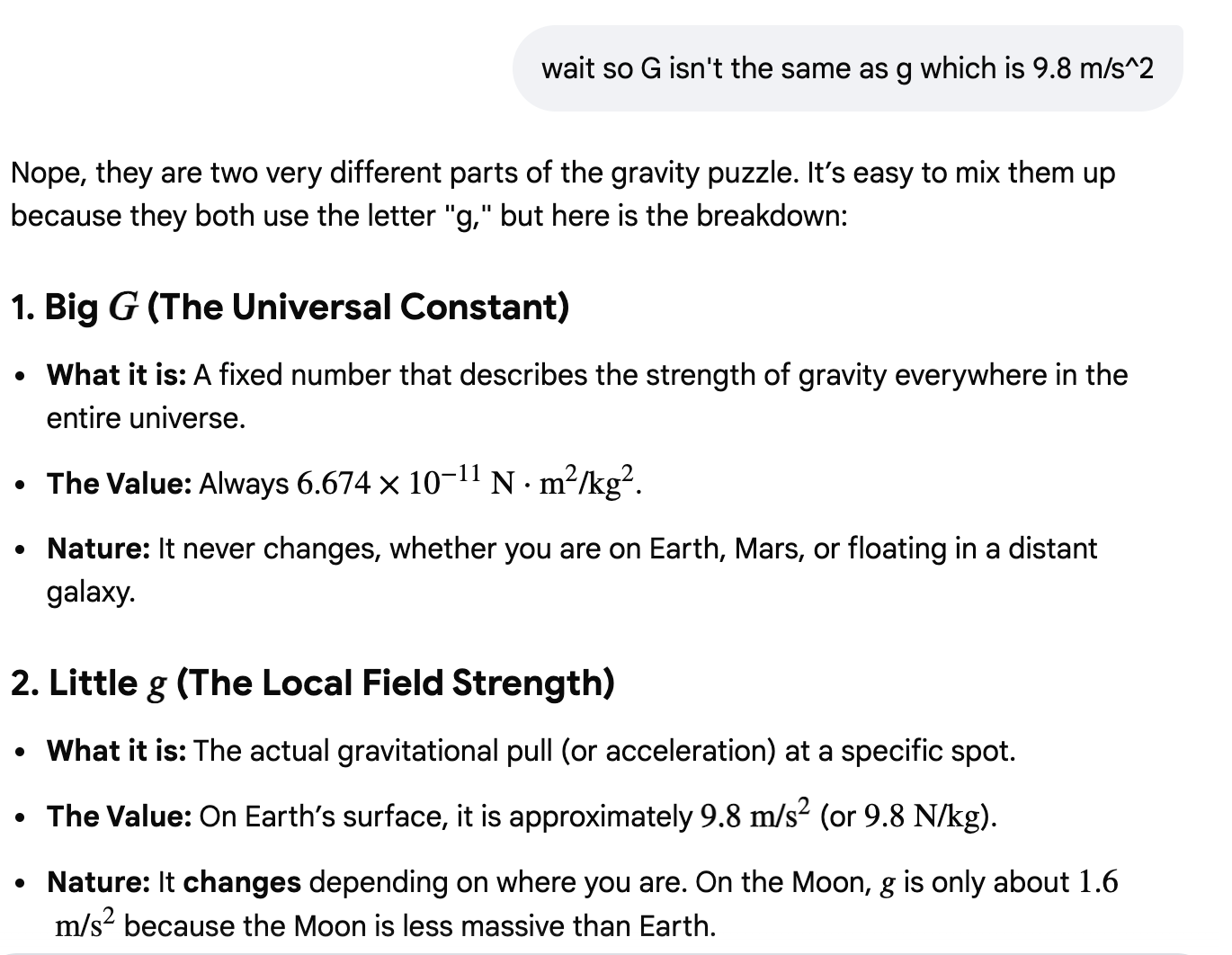
inertial mass and gravitational mass are the same number, just two different ways to measure mass. inertial would be like using a spring scale to move an object and measuring its acceleration to find mass. gravitational would be like Fg=mg, you could use Using Newton's Law of Universal Gravitation(al force) or just weigh and divide by 9.8
For a car to move at a constant speed, does the frictional force have to equal the force of the engine (assuming those are the only two forces at play?
Constant speed = no work?
yes
yes
examples of equivalence principle
work moving a box up a ramp vs. just lifting it is the same (1 has more distance but less force, 1 has more force but less distance)
impulse is a change in
momentum