VL VI - Transition laminar to turbulent
 Call Kai
 Learn
Learn Practice Test
 Spaced Repetition
 Match
Match Flashcards
 Knowt Play
1/24

There's no tags or description
Looks like no tags are added yet.
Name | Mastery | Learn | Test | Matching | Spaced | Call with Kai |
|---|
No analytics yet
Send a link to your students to track their progress
25 Terms
Important instabilities
Kelvin-Helmholtz instability (KHI)
Rayleigh-Taylor Instability (RTI)
Richtmyer-Meshkov Instability (RMI)
Preliminaries KHI
Inviscid (approximately)
Rotationless
Potential Flow
Recipe For Linear Stability Theory
Governing Equations
Reynolds Decomposition
Perturbation equation
Linearization of perturbation equation
Wave-mode
Eigenvalues
Interpretation of EVs
Stability diagram
How does KHI happen
Fluid Layers with different velocity layers
Steps laminar to turbulent flow
Stable, laminar flow
Primary instability: (unstable Tollmien Schlichting waves)
Secondary instability
Breakup vortices
Turbulent spots
Turbulent flow
Rayleigh Inflection point theorem for inviscid vs. viscid
inviscid:
can only be potentially unstable with an inflection point in the surface
otherwise stable for infinite reynolds number
viscid:
can get unstable with high reynolds numbers
When to use temporal ansatz
if we want to know when something occurs
driven by convection
When to use convective ansatz
if we want to know where sth occurs
driven by temporal perturbation
Name the four possible stability states of dynamical systems regarding small disturbances
stable
unstable
neutrally stable
nonlinearly stable
Name three physical parameters influencing the transition mechanism
surface roughness
wall geometry
disturbance spectrum of flow field
What is canonical flow
Representative flow configuration with isolated characteristic feature
Represents section of more complec realisitc flow
Describes isolated phenomenon
Benefits of numerical with Canonical flow
Calibration and validation of turbulence models
Phenomenological investigation
Whats x0 in a round jet
virtual origin of the stream
Properties of Round jet
Statistically stationary with axial symmetry
Whats q’
Indication of fluctuation
Whats UJ
Nozzle exit velocity
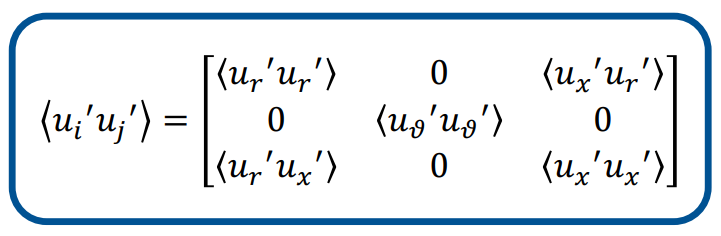
How does the RST change for a Round Jet canonical flow
Axisymmetric mean flow
Invariant under rotation
so every rotational part is 0 cross form
How has the round jet velocity plot be nondimensionalized
Using core velocity
half width velocity
whats r0,5
Half width velocity
Radius r where velocity is half
Are the velocity profiles of round jet self similar
yes
Whats independant of Reynolds number for turbulent flows
non dimensional spreading
half width velocity
Explain the advantage of using canonical flow configurations for the development of turbulence models compared to more complex configurations.
Canonical Flows are simple test cases, which can be thoroughly investigated both experimentally and via direct numerical simulations. Hence, they are well-suited for the development and calibration of turbulence models and their validation.
Explain the concept of self-similarity in the context of turbulence modeling.
Self-similarity means that by normalizing the flow configuration with suitably chosen reference parameters, the results are identical. The results can be represented with the help of a similarity function. They thus allow a generally valid representation of the flow field of the respective flow configuration and are thus particularly suitable for modeling approaches.