X-ray crystallography
 Call Kai
 Learn
Learn Practice Test
 Spaced Repetition
 Match
Match Flashcards
 Knowt Play
1/70

There's no tags or description
Looks like no tags are added yet.
71 Terms
Challenges for SCXRC (3)
needs x-ray suitable crystals
Only solid-state structure
time-averaged structure may change during scanning
TRUE OR FALSE: X-ray crystallography cannot be applied to solids which are very fine or large crystals
FALSE: Powder X-ray diffraction
What are the uses of powder crystallography? (3)
assess physical properties (e.g., phase transitions)
analysis of mixtures (eg. impurities, components)
grain size estimate
set up of SCXRC
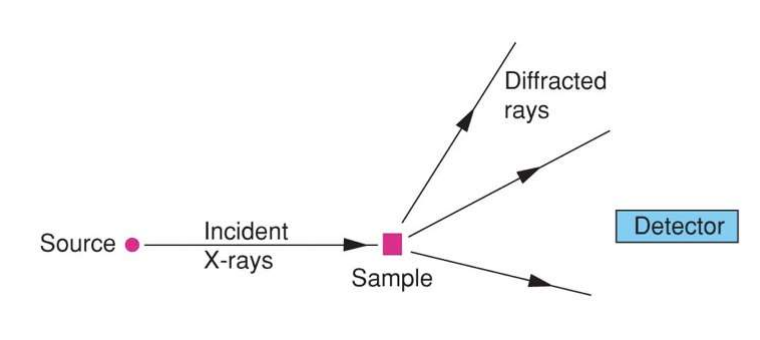
In Å, what is the length of a) X-ray and b) atomic bond?
a) 0.5-2
b) 1-3
Diffraction
deflection of rays passing through narrow slits or next to opaque edges
the (electrons/neutrons/protons) of atoms (absorb/diffract) incident X-rays with an intensity (proportional/unrelated) to the electron density
the (electrons/neutrons/protons) of atoms (absorb/diffract) incident X-rays with an intensity (proportional/unrelated) to the electron density
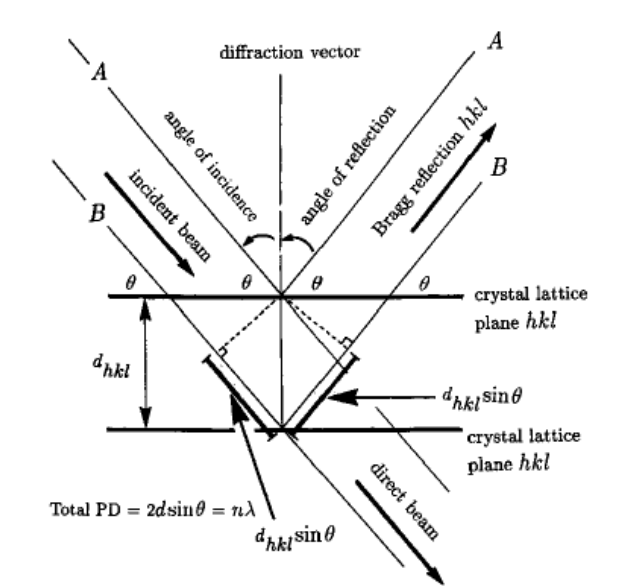
Bragg’s Law: a) what it measures and b) the equation
a) if the incident and reflected dhklsinθ is equal, there will be constructive interference and therefore diffraction
b) λ = 2dhkl sinθ
where:
λ= wavelength of incident radiation,
d= spacing between the lattice planes
θ= angle to the incident (and reflected) beam
Unit cell (definition)
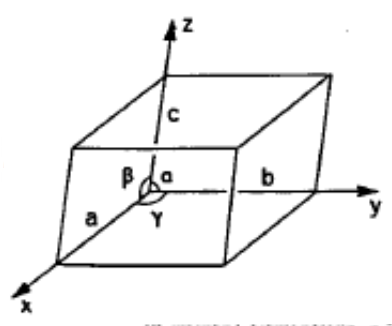
The repeating structural motif in a crystal is the unit cell that gives a diffraction pattern with sharp peaks
Dimensions of a unit cell
axes lengths: a, b, c
angles: α, β, γ
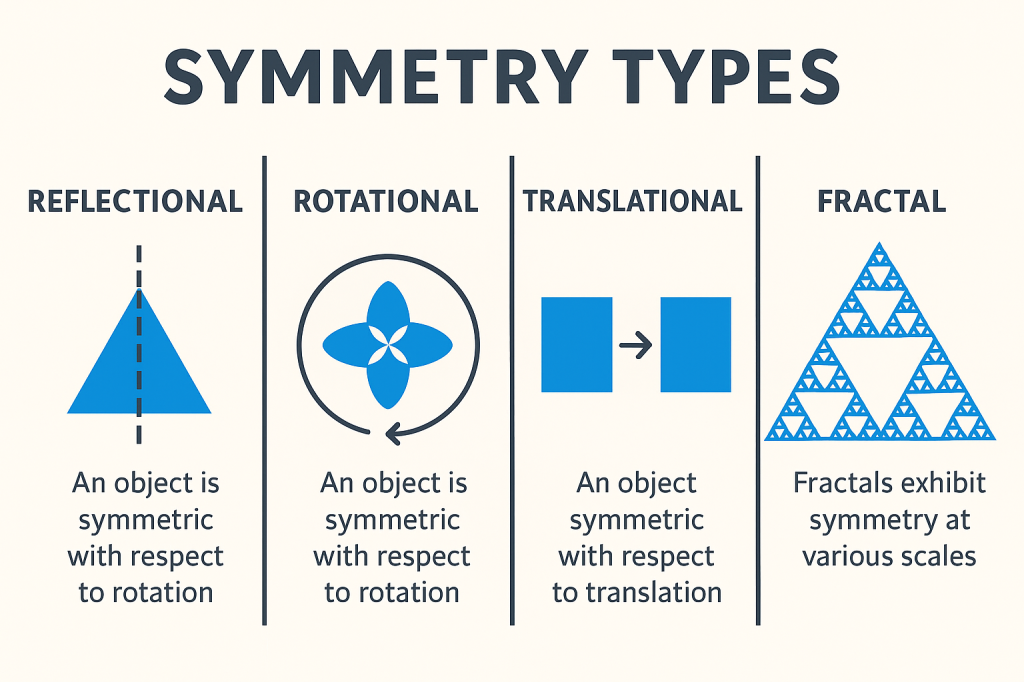
TRUE OR FALSE: The unit cell describes the entire contents of the crystal by translational and rotational symmetry
FALSE: by translational symmetry only!
Name the Seven Crystal Systems and describe them in terms of axes lengths, angles, and minimum symmetry
CHaRred TOMaTo
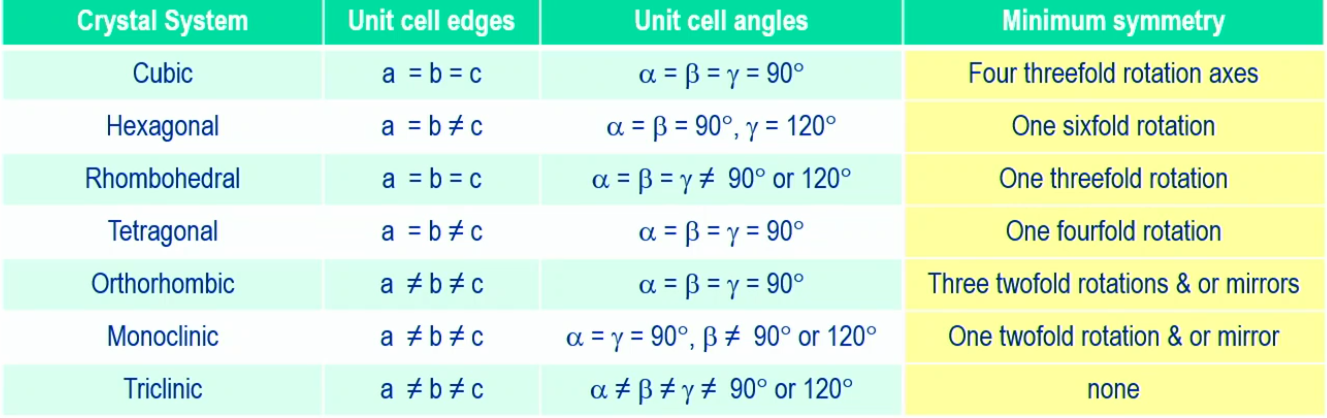
The unit cell from which the lattice symmetry is constructed is…
the smallest unit cell with the highest symmetry
2D Bravais Lattice
an infinite array of points that looks the same when viewed from any point
What are the possible unit cell structures for 2D Bravais lattice?
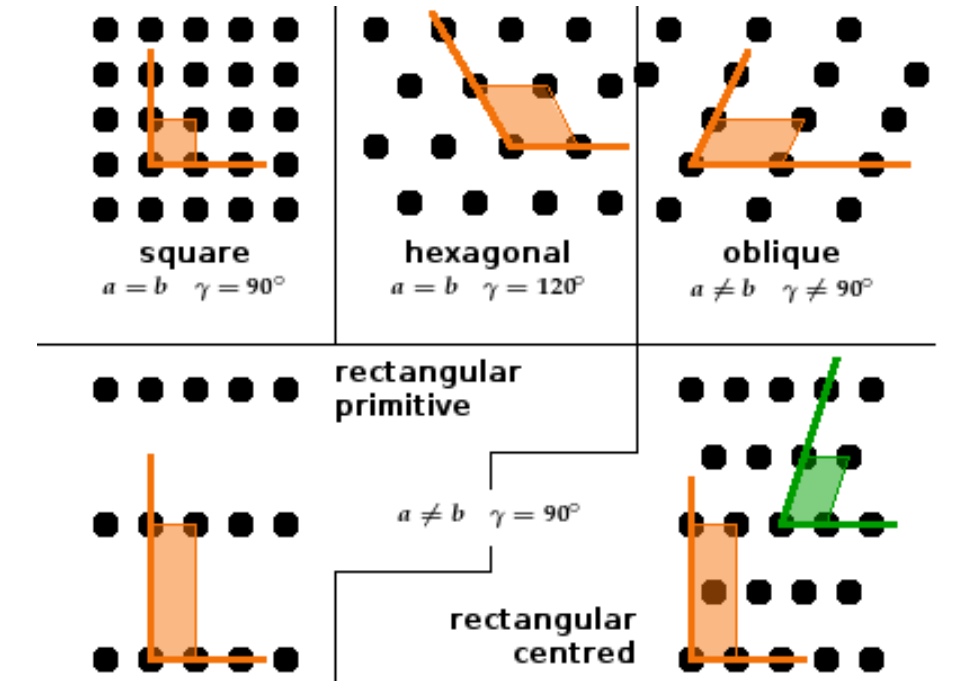
What is the justification for the existence of a rectangular centered lattice?
The molecule at the center provides greater symmetry than the oblique lattice would
What are the centering types for Bravais lattice?
Primitive (P), no centering
Base Centered (C)
Body Centered (I)
Face Centered (F)
“C” is like “F” but on two opposing faces
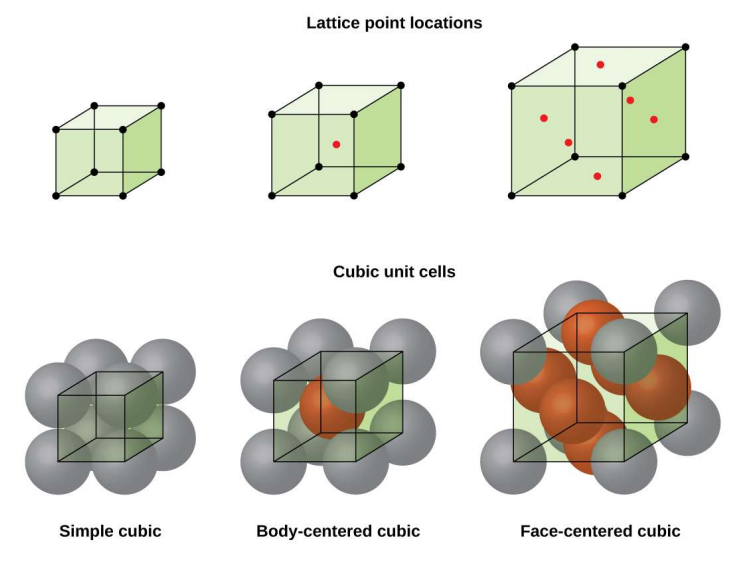
What centering(s) is available for all 7 Bravais lattices?
Primitive (P), no centering
Base Centered (C)
Body Centered (I)
Face Centered (F)
cubic: P, I, F
hexagonal: P
rhombohedral: P
tetragonal: P, I
orthorhombic: P, C, I, F
monoclinic: P, C
triclinic: P
Why is C centering not possible for a) cubic or b) tetragonal lattice?
a + b) a smaller tetragonal primitive lattice is created
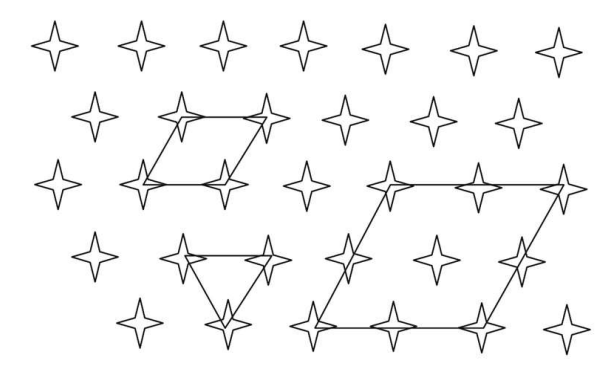
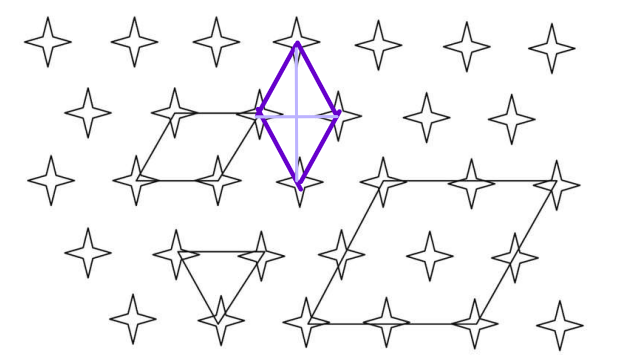
What is the best unit cell for the below crystal and why?
The purple rhombus because of the planes of symmetry
What are the two types of symmetry elements and how are they differentiated?
point and translational; in point symmetry elements one point is always unchanged
What symmetry element(s) cannot exist in crystals of enantiomerically pure substances?
mirror plane ∴ rotation-inversion, glide plane, inversion center
point symmetry elements (4)
rotation axes (n)
mirror plane (m)
inversion centre (1‾)
Rotation Inversion centres
Rotation Inversion centres
Rotation followed by inversion
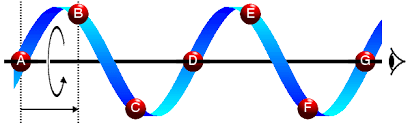
Screw axes
translates an object by a unit cell dimension multiplied by n/C along the direction of the axis, followed by a C-fold rotation
Symbol: Cn
imagine like a balloon deflating
Glide plane (+ types)
a reflection-translation operation:
Axial: a, b, c
Diagonal: n
diamond: d
What symmetry operation(s) result in systematic absence?
screw axis
glide plane
Symbol for a) rotation axes, b) mirror plane, c) inversion center, d) rotation inversion center.
Cn
m
1̅
n̅
Only C(__) axes allow space filling
Only C2/3/4/6 axes allow space filling
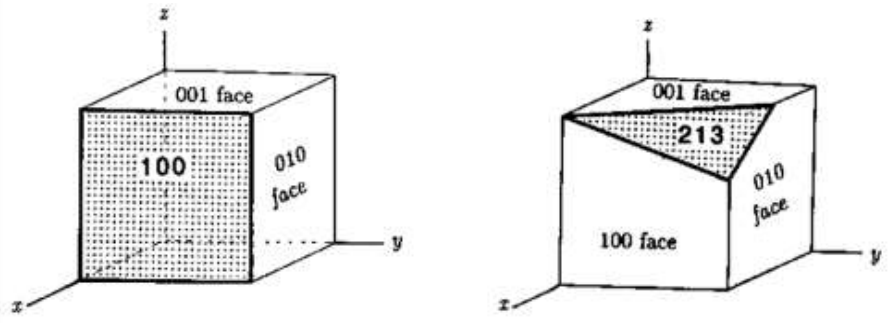
Assign Miller indices
identify the origin; the plane should not pass through the origin
if the plane intersects the axes defined from the origin it has a value of 1
If a plane is parallel to an axis, its intercept is at infinity and its Miller index is zero.
Take the reciprocals, clear fractions and reduce to lowest terms
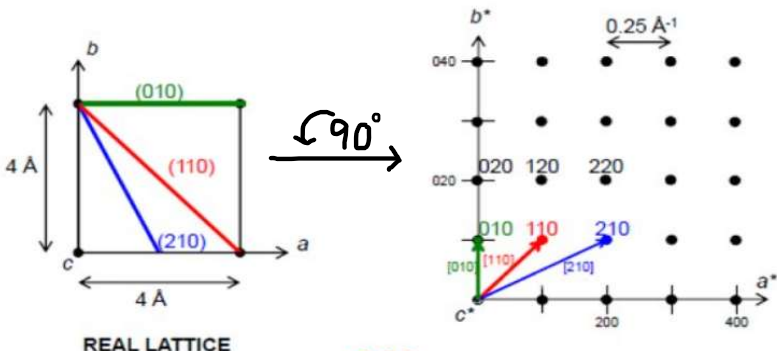
How is the real crystal lattice translated to the reciprocal lattice?
Fourier transform:
TRUE OR FALSE: The reciprocal lattice has the same symmetry as the crystal lattice.
TRUE
distance of reciprocal lattice points from the origin
d* = h·a* + k·b* + l·c*
The direction of a*, b* and c* of the reciprocal lattice coincide with a, b, and c of the crystal lattice if…
α = β = γ = 90o
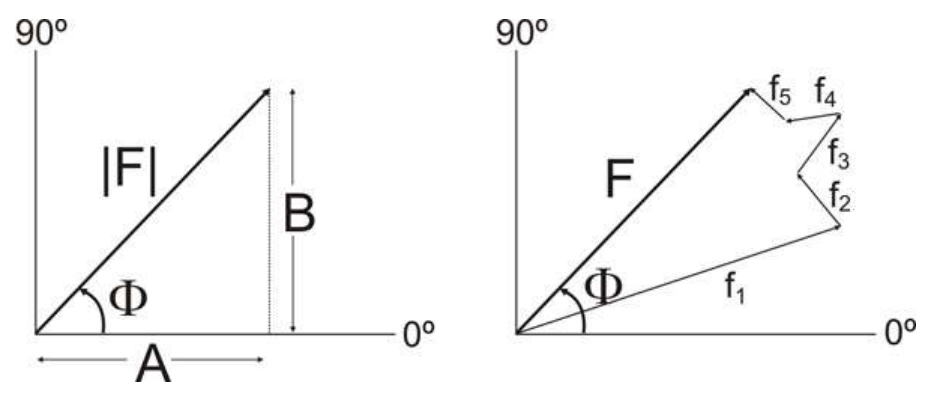
structure factor of X-ray reflection: F(hkl) = |F(hkl)|· exp[iΦ(hkl)]
where:
|F| is amplitude
Φ is the phase/angle
What magnitude of temperature is used for crystallography and why?
Low to avoid smearing of diffraction spots due to thermal vibration
What are the wavelength features of the x-rays in SCXRC?
single λ Κα line radiation
What elements are used for the X-ray tubes giving the radiation for a) small and b) large unit cells?
a) Mo (small λ)
b) Cu or Cr (larger λ)
Do the X-ray tubes giving the radiation for small or large unit cells give a more easily interpretable result and why?
small because shorter λ of Mo is higher energy therefore less radiation is able to be absorbed by the crystal, so less corrections are needed
What are the features of an ideal x-ray crystal? (3)
even dimensions
single crystal
50-200 microns (size of beam)
General process of data collection in SCXRC (5 steps)
select crystal
mount under cold atmosphere
collect pre-experiment to plan data collection
check for diffraction spots that are spherical, clear and distinct
collect complete dataset
TRUE OR FALSE: more symmetrical space groups need less frames to reconstruct from
TRUE
Phase problem
In X-ray diffraction experiments, we collect only the diffraction magnitudes, and not the phases. Unfortunately the phases contain the bulk of the structural information
What conditions must the electron density map display for accurate atoms? (3)
electron density should be positive everywhere
electron density should be concentrated spherically around atoms
atoms must be placed feasible distances apart
What are the four methods available for solving crystallography data? Give a short description of each.
direct method: manually assign atoms based on known information/ electron density
using models for existing isomorphous structures to refine data
Patterson synthesis: each diffracted atom gives an equal and opposite sign vector to the others, giving overall relative position of the atoms to each-other
Intrinsic phasing: Solves structure in lowest symmetry (P1) and then determines the space group
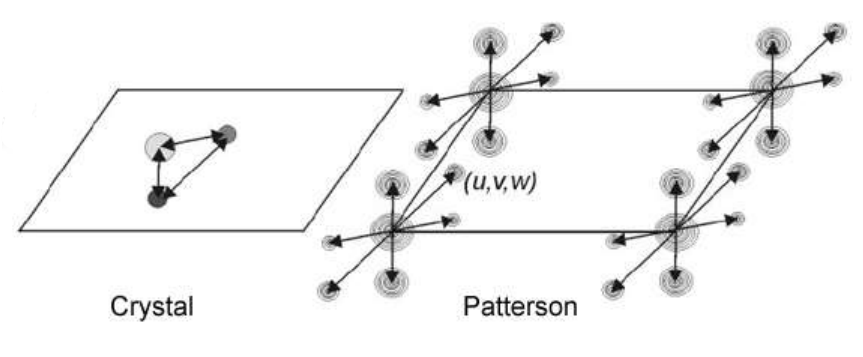
In Patterson maps, each peak has a size proportional to…
atomic mass
Problems with Patterson Syntheses (3)
Many possible solutions due to the periodic nature of a crystal, especially if there is more than one heavy metal
Problems when atoms are close to special positions of a unit cell.
Pseudo (false extra)-symmetry
a) From what values are Fourier difference maps created and b) what are they for?
a) |Fobs| - |Fcalc|
b) finding missing/ incorrect atoms
Electron Density Maps for a) Fobs and b) Fcalc are constructed from what?
a) experimental |F| together with phases calculated from some structural model
b) phases and amplitudes that are calculated from a structural model
What do a) Q peaks, b) troughs, c) large R values mean?
a) missing atoms
b) incorrectly assigned atoms
c) bad fit between data and model
What are the ideal values for a) R1, b) wR1, c) GooF?
a) <5%
b) <10%
c) 0.8 to 1.2
What is the difference between a) constraints and b) restraints?
a) exact mathematical relationship to ensure not all parameters are independently/freely refined
b) approximate targets (like additional experimental observations)
What are some shortcomings of XRC? (4)
time averaged structure as opposed to snapshot
structure may change in different conditions/ states
single crystals may not be representative of bulk sample
lightweight atoms cannot be seen
TRUE OR FALSE: racemic mixture unit cells contain both enantiomers within a single crystal
TRUE, BUT the enantiomers can crystallize into separate crystals too, although this is rarer
Space groups with only rotation and screw axes are (__) molecules
Space groups with only rotation and screw axes are chiral molecules
In PXRC, what parameters affect peak a) position (3), b) intensity (2), c) shape (4)?
a) unit cell dimensions, absorption, wavelength
b) atomic dimensions, preferred orientation of crystal
c) grain size, strain, stress, purity
What does the X-axis of a PXRD diagram show?
d-spacing in θ or 2θ
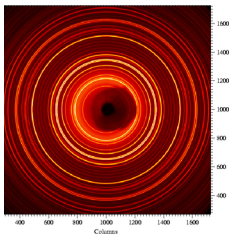
What problem was encountered in scanning this sample?
Nothing, its just powder diffraction method!
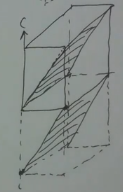
What are the Miller indices of this unit cell?
(101-)
orthorombic d spacing formula
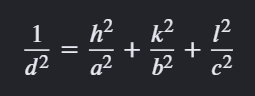
Indexing PXRD Patterns (5 steps)
find the 2θs from x-axis
calculate sin2θ. If you have 2θ, divide it.
calculate ratio = sin2θn /sin2θ1
IF NEEDED multiply ratios to get valid numbers
assign Miller indices that (squared individually) add up to ratio (h2 + k2 + l2)
When do ratios need to be modified in indexing?
if the values are not very close to integers
if the values cannot be given by three squared values (eg. 7, 15, 23)
Ascertaining lattice parameter formula
4a2 = λ2 (h2 + k2 + l2)n / sin2θn
divide by 4
square root
a = d in Angstrom
systematic absence
the intensity of the reflection from a set of Miller planes is zero
TRUE OR FALSE: systematic absences occur for all space groups except body centered
FALSE: observed for non-primitive lattices
For a systematic absence to be observed, (fewer/equal/greater) number of diffracted beams must be out of phase by (__)
For a systematic absence to be observed, equal numbers of diffracted beams must be out of phase by 𝜆/2
What indicates the presence of a) Face centered and b) Body centered cubics?
a) h, k & l are either all odd or even
b) h+k+l is a multiple of 2
What contributes to peak intensity in PXRC? (5)
higher mass atoms are more likely to appear (atom identity)
coordinates of atom in unit cell
symmetry of space group
if the crystal is in preferred orientation
how many diffraction planes contribute to a peak
How does a) symmetry of space group and b) if the crystal is in preferred orientation, c) number of diffraction planes affect peak intensity for powders?
a) higher symmetry makes fewer peaks
b) preferred orientation gives greater peaks
c) more planes means sharp, more defined peaks
Peak width can be affected by…? (4)
sample size
instrumental parameters
stacking faults
defects in the crystal structure.
Scherrer Equation to estimate crystal size from analysis of the peak width
βhkl = Kλ / Lhklcosθ
K: constant based on crystal shape
L: width of diffraction peak
βhkl: vertical thickness of crystal face