Module 3 week one
 Call Kai
 Learn
Learn Practice Test
 Spaced Repetition
 Match
Match Flashcards
 Knowt Play
1/24

There's no tags or description
Looks like no tags are added yet.
Name | Mastery | Learn | Test | Matching | Spaced | Call with Kai |
|---|
No analytics yet
Send a link to your students to track their progress
25 Terms
What is Leadership about
coping with change
future vision and planning
its a position you choose
How does leadership work
setting out to set direction (vision/strategies to achieve goals)
Deliver results by aligning people
make things happen by motivating, mentoring, inspiring
outcome is to produce change (new services/approaches)
What is management about
coping with complexity
dealing with day to day challenges
a position on an organizational chart ( you can get promoted to be here)
How does management work
set out to plan/budget
deliver results through organization and staffing (develop structure)
make things happen through control and problem solving (monitor/organize)
outcome is to produce predictability and order (consistently achieve budgets and targets)
Differences between leadership vs management
coaching vs performance
good will vs authority
enthusiasm vs fear
we vs I,you
give credit vs give direction
What is trait theories
theory of leadership
it is all about who you are - basic personal characteristics differentiate leaders from no leaders
assumption: leaders are born
goal: distinguish leaders form non leaders
problem with trait theories
mixed results when tested
some traits may actually be skills
fails to identify relative importance of traits
traits may not generalize across situations
What is behavioural theories
theory of leadership
there is an ideal leader behaviour : effective leaders behave consistently in different ways than ineffective leaders
one best way to lead
assumption: leaders can be trained
goal: develop leaders
behavioural theory leadership styles- university of Iowa
democratic/participative: encourage participation, delegate authority, more people oriented than autocratic——. found that this style leads to higher levels of satisfaction with your supervisor
Autocratic: accumulate power, dictate work methods, centralized decision making, limit participation
laissez-faire: absence of leadership, group has freedom
Problem with behavioural theory leadership styles
studies couldn’t find any significant relation between style and performance of subordinates
What are the two dimensions of leader behaviour - Ohio state university
Task: emphasis on the need for job to be done, organization if efficient and effective, job oriented leader behaviour
Relationship: concern for people, trust/respect, employee centred leader behavior
studies havn’t found relation between team management/ performance
Ohio state university grid
behavioural theory
two variables are task and relationship
variables are continuos meaning leaders can be at all levels from high to low, and orthogonal meaning they are linearly independent of one another
x axis is concern for production /task
y axis is concern for people
Country club environment pattern
HIgh concern for people
low concern for production/task
top left corner
Impoverished management pattern
leaders display low levels of concern for both task/people
bottom left corner
Task management pattern
low concern for people
high concern for task
bottom right corner
middle of the road management pattern
balanced approach, all things in moderation
middle of grid
Team management pattern
where the best leadership behaviours are hypothesized
concerned about both job and people
top right corner
What is contingency theories
theory of leadership
leaders are effective when their behaviours fit the situation
situational leadership theory
situational leadership theory
Style | Leader Behavior | Follower Readiness |
S1: Telling | High Task behaviours / Low Relationship | Unable & willing (Needs direction) |
S2: Selling | High Task / High Rel. | Unable and unwilling (Needs coaching) |
S3: participating | Low Task / high Rel. | Able but unwilling (Needs support) |
S4: delegating | Low Task / Low Rel. | Able & Willing (Needs autonomy) |
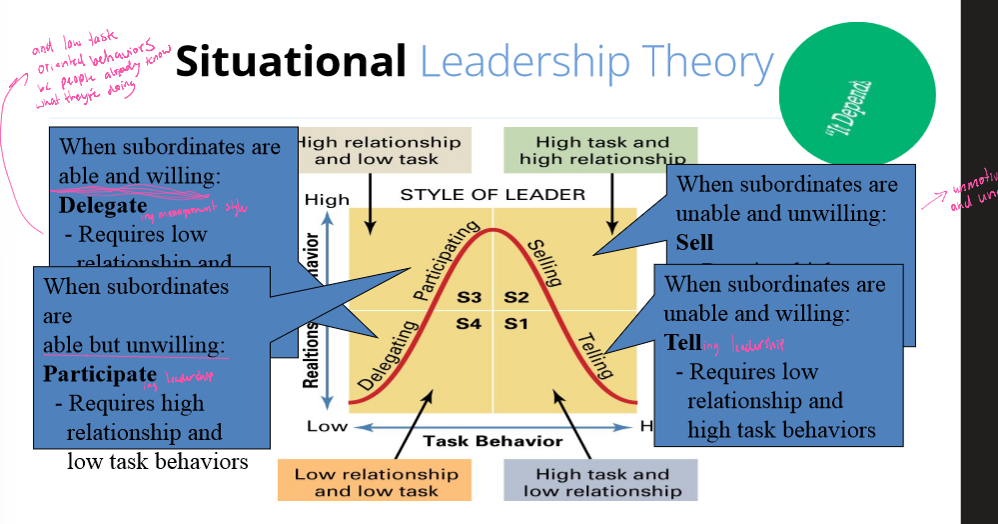
Best place to be on situational leadership theory graph
the best place is to be in the bottom left (willing and able)
worst place to be is top right
x axis goes task behaviour low to high
y axis goes relationship behaviour low to high
so this is opposite from ohio state grid on behavioural theory
self monitoring
the ability to modify how you are perceived by others
pro chameleon leadership
adaptable / flexible to environment / creativity
better career opportunities
con: not consistent, may loose credibility
Pro true to self leadership
stick to your own values, stay true to yourself
transparency, communication, efficiency
have set rules, credibility, dont care about image
con: limits growth, leaders may seem inflexible
What is authentic Leadership
Being true to yourself
maintaining strict coherence between what you feel and what you say or do
making value based choices
denial can be the greatest hurdle that leaders face when becoming self aware/ authentic
Positive self evaluation includes?
high self esteem
self efficancy
internal locus of control