unit 15 - inflation, unemployment and monetary policy
 Call Kai
 Learn
Learn Practice Test
 Spaced Repetition
 Match
Match Flashcards
 Knowt Play
1/15

There's no tags or description
Looks like no tags are added yet.
Name | Mastery | Learn | Test | Matching | Spaced | Call with Kai |
|---|
No analytics yet
Send a link to your students to track their progress
16 Terms
inflation
an increase in the general price level of an economy
deflation
a fall in the general price level of the economy
disinflation
a decrease in the rate of inflation
inflation in the credit market
borrowers benefit → value of debt decreases in real terms
lenders lose → the value of what is being repaid is decreasing in real terms
real interest rate or Fisher equation
= nominal interest rate - the inflation rate
measures the buying power of the repayement of a loan
menu costs
takes time for investors to adjust prices
impact of government imposing protectionist policies on inflation
Market becomes less competitive (lower imports) -> firms can charge a higher markup
Increase in price level
Lower real wages -> lower motivation of workers
Increase in wages -> increase in prices
Inflationary spiral
what leads to rising wages and prices
Firms being powerful enough to charge a higher markup
Workers have enough bargaining power at the given unemployment rate to demand the initial real wage
how bargaining power of workers could take place
Upward shift in wage-setting curve
Increase in the level of employment -> movement along wage setting curve
real wage equation
= nominal wage / price level
wage-price spiral
when wages go up due to low unemployment therefore prices go up
to keep the same markup
operates in reverse during a recession when unemployment is high
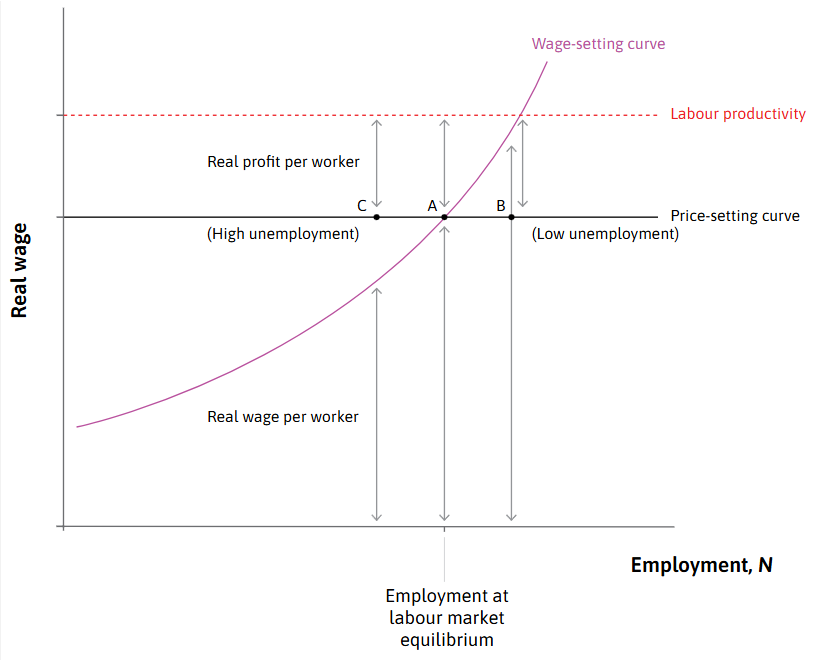
what does point A,B and C show
A → market is at equilibrium → Nash equilibrium → both employers and employees are are doing the best they can given the response of the other player
B → unemployment is lower → real wages for workers to work just as hard increases → workers have more bargaining power due to lower unemployment
C → unemployment is higher → workers are in a weaker bargaining position → claims of worker and owners sum to less than labour productivity
bargaining gap
when the real wage given by the wage-setting curve and that given by the price setting curve are not equal
vertical distance between the 2 curves
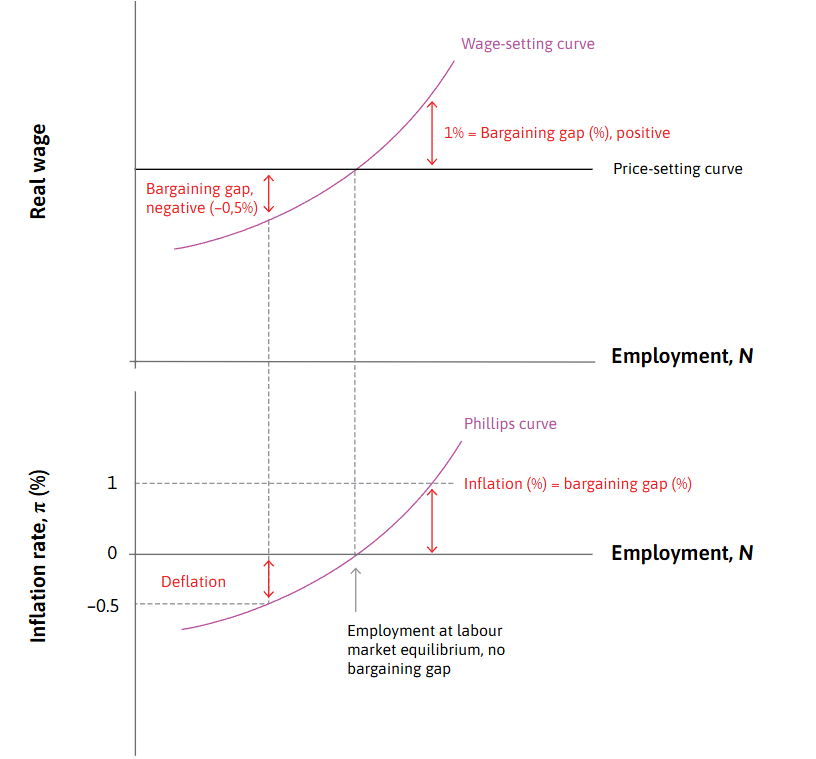
Phillips curve
shows the trade off between inflation and unemployment
acts as a feasible set from which policy makers can choose from
Friedman analysis of Phillips curve
argued there was a temporary trade-off between unemployment and inflation
no trade off in the long run
expected inflation
the way wage and price setters form their views of what will happen to inflation is through expected inflation