Unit 3: Lesson 2- Natural Theory
 Call Kai
 Learn
Learn Practice Test
 Spaced Repetition
 Match
Match Flashcards
 Knowt Play
1/24

There's no tags or description
Looks like no tags are added yet.
Name | Mastery | Learn | Test | Matching | Spaced | Call with Kai |
|---|
No analytics yet
Send a link to your students to track their progress
25 Terms
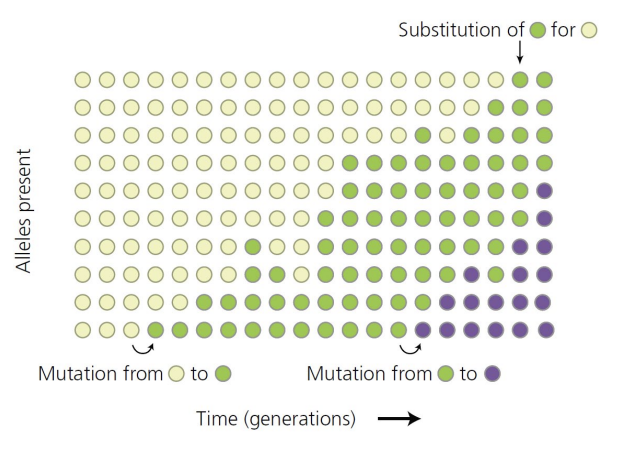
The “Rate of Evolution”
what does it mean
what is a mutation
what is substitution
“Rate of Evolution” = rate at which new alleles created by mutation are substituted for other alleles already present in the population
Mutation = creation of a new allele
Substitution = fixation of a new mutation (with or without additional mutations)
Setting the stage for Neutral Theory
how did the study of molecular evolution launch? What did scientist study?
what 2 things did the early analyses of molecular evolution find?
If natural selection doesn’t explain molecular evolution, then what process is responsible for rapid, clocklike change?
-The study of molecular evolution launched in the 1960s, when amino acid sequences of well-studied proteins were determined. This data provided researchers with a tool to study the rate of molecular change over time.
-Early analyses of molecular evolution found that rates of molecular change were:
Higher than expected under selection (shouldn’t most mutations be deleterious and then removed by selection?)
Constant (“clocklike”). Wouldn’t selection be more episodic and dependent on changes in the environment?
If natural selection doesn’t explain molecular evolution, then what process is responsible for rapid, clocklike change? Many researchers believed the answer: drift.
The Neutral Theory of Molecular Evolution
who formulated the neutral theory? and what did they explain?
what does this theory argue?
the rate of molecular evolution=
what were the 2 reasons on why this theory was astonshing?
-Kimura formulated the neutral theory to explain evolutionary change in nucleotide sequences
This theory argues that:
the majority of nucleotide changes that become fixed in a population are neutral and that drift dominates evolution at the DNA level. Even if mutations aren’t neutral, they would be deleterious and rapidly eliminated by selection.
Selection on beneficial mutations is largely inconsequential (lack importance) for changes at the molecular level
The rate of molecular evolution = neutral mutation rate
This theory was astonishing for two reasons:
1. Population size doesn’t matter (seems counter to what we learned about drift!)
2. Selection on beneficial mutations is excluded!
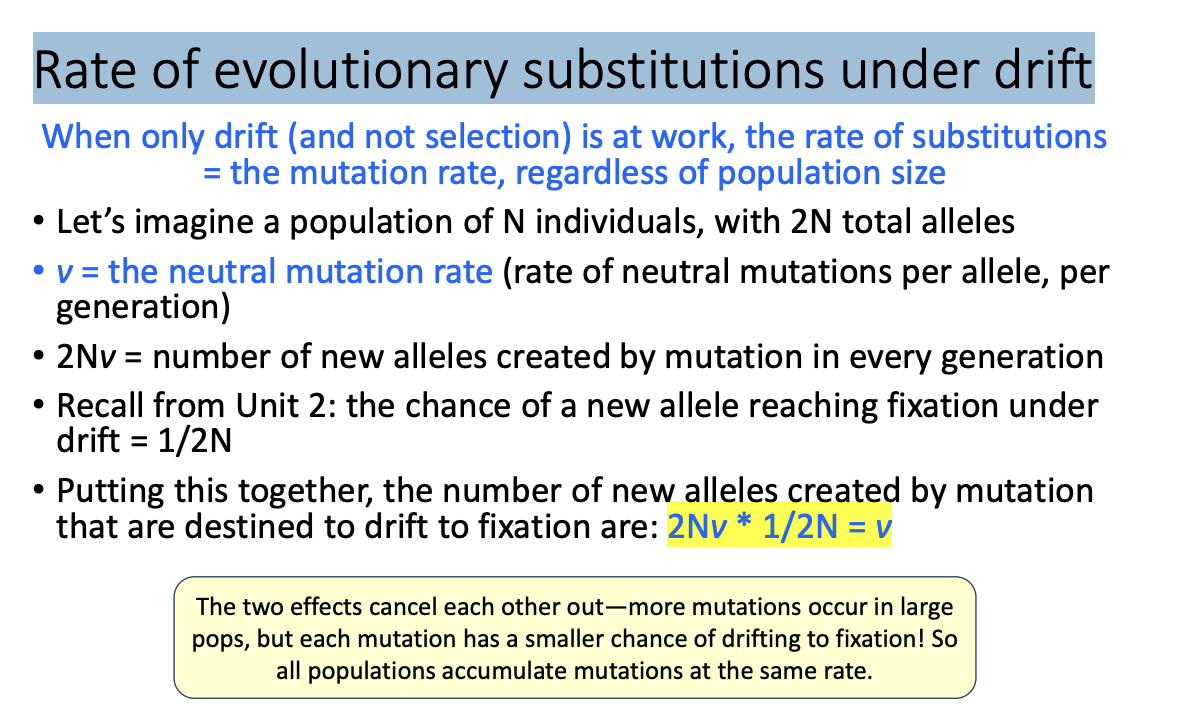
Rate of evolutionary substitutions under drift
v=
2Nv=
What about selection?
what 3 things happen when we factor selection into the natural theory model?
what two approaches did this lead scientist to?
When we factor selection into this model, three things could happen:
Deleterious alleles will appear, then be eliminated by selection
Neutral mutations will appear, then be fixed or lost due to chance (drift)
Beneficial alleles will appear, then will be swept to fixation by selection
Scientists debated about how important ideas #2 and #3 were for determining the rate of evolution. This led to two approaches: the neutral theory and the selectionist theory
Neutral vs. Selectionist Theory
Neutral theory (Kimura) = advantageous mutations are really rare. Almost all alleles are neutral, so the rate of evolution should equal the mutation rate.
Selectionist theory (Gillespie) = beneficial mutations are common enough that they can’t be ignored. The rate of evolution will reflect selection on beneficial mutations
Applying the Neutral Theory: Two Scenarios
explain first example- pseudogenes
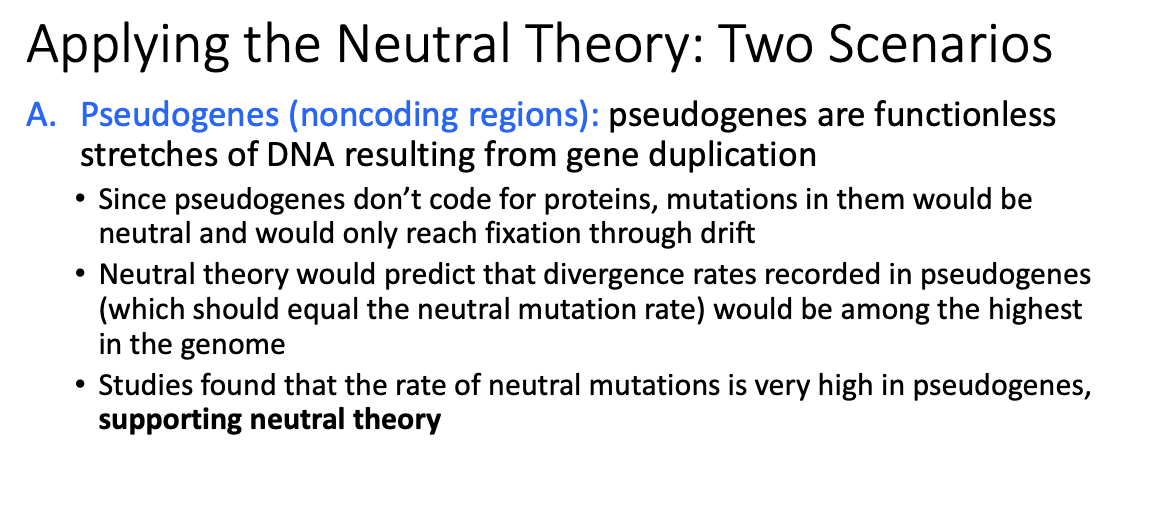
Applying the Neutral Theory: Two Scenarios
explain second example- coding regions
synonymous mutations (silent)
nonsynonymous mutations
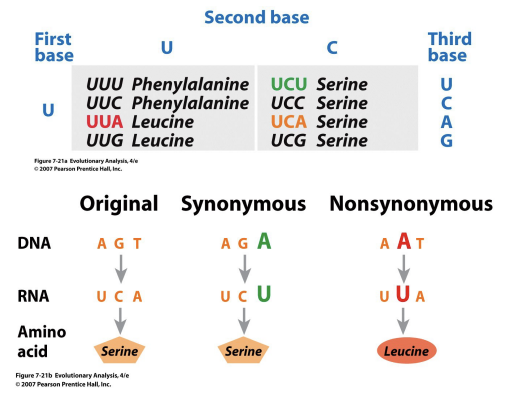
B. Coding regions: recall that the genetic code is redundant (several codons code for an amino acid)
Synonymous mutations (silent) = do not change the amino acid sequence
Nonsynonymous mutations = change the amino acid sequence
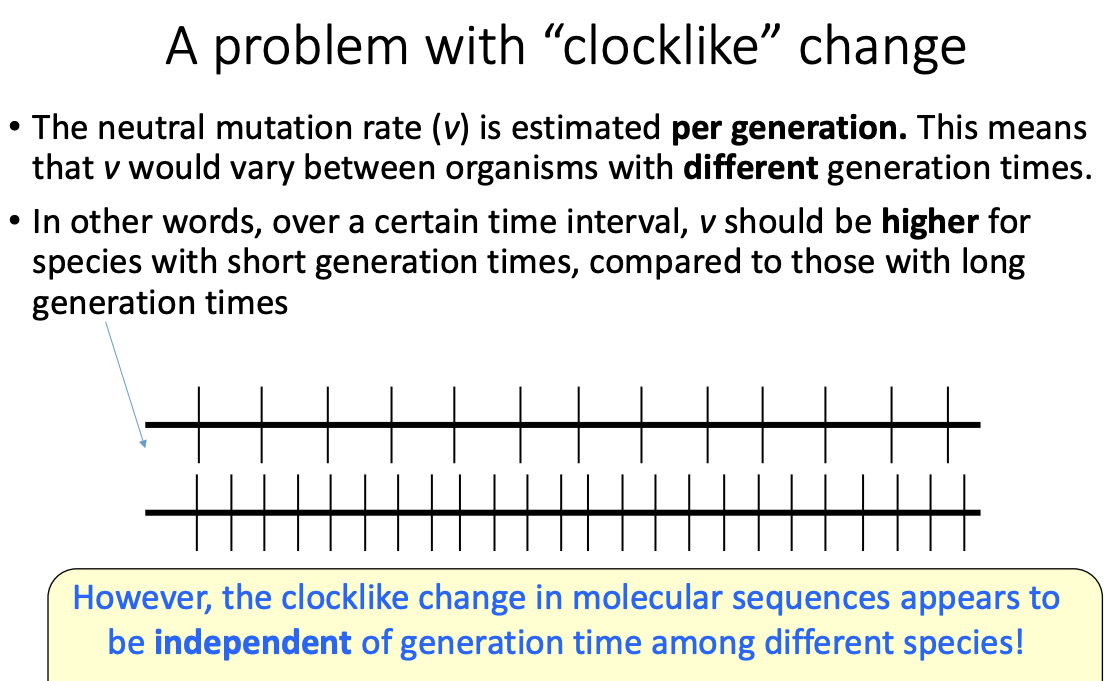
A problem with “clocklike” change
how is v (neutral mutation rate) estimated?
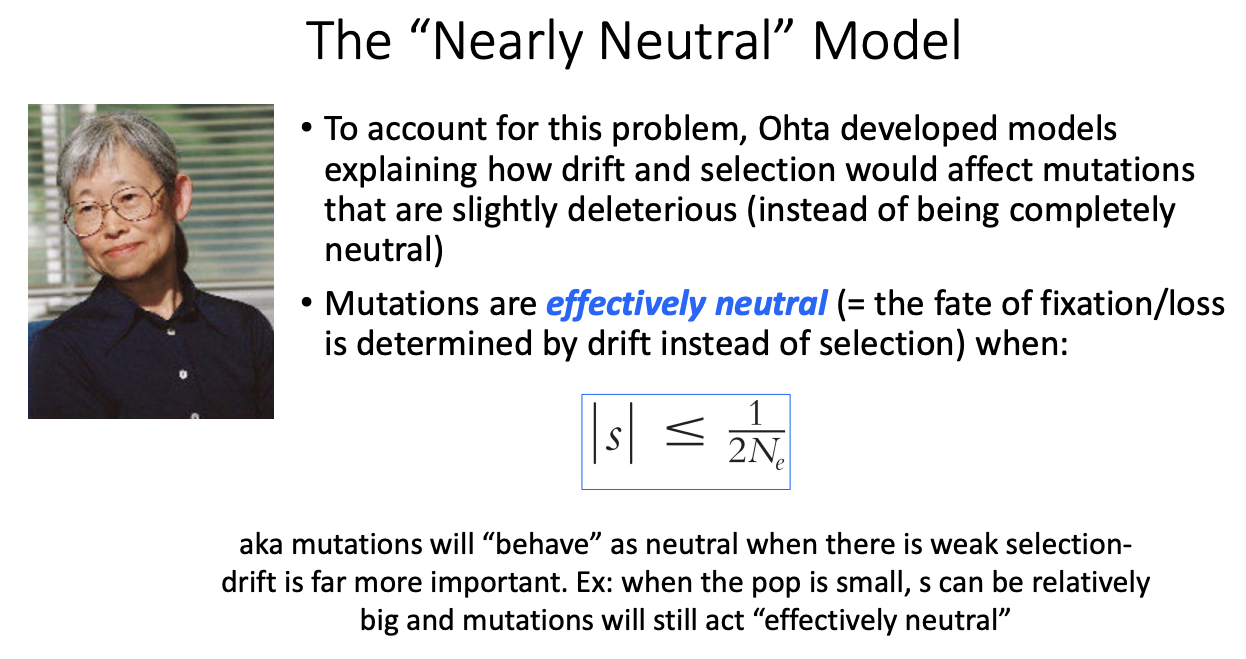
The “Nearly Neutral” Model
how did Ohta account for this problem?
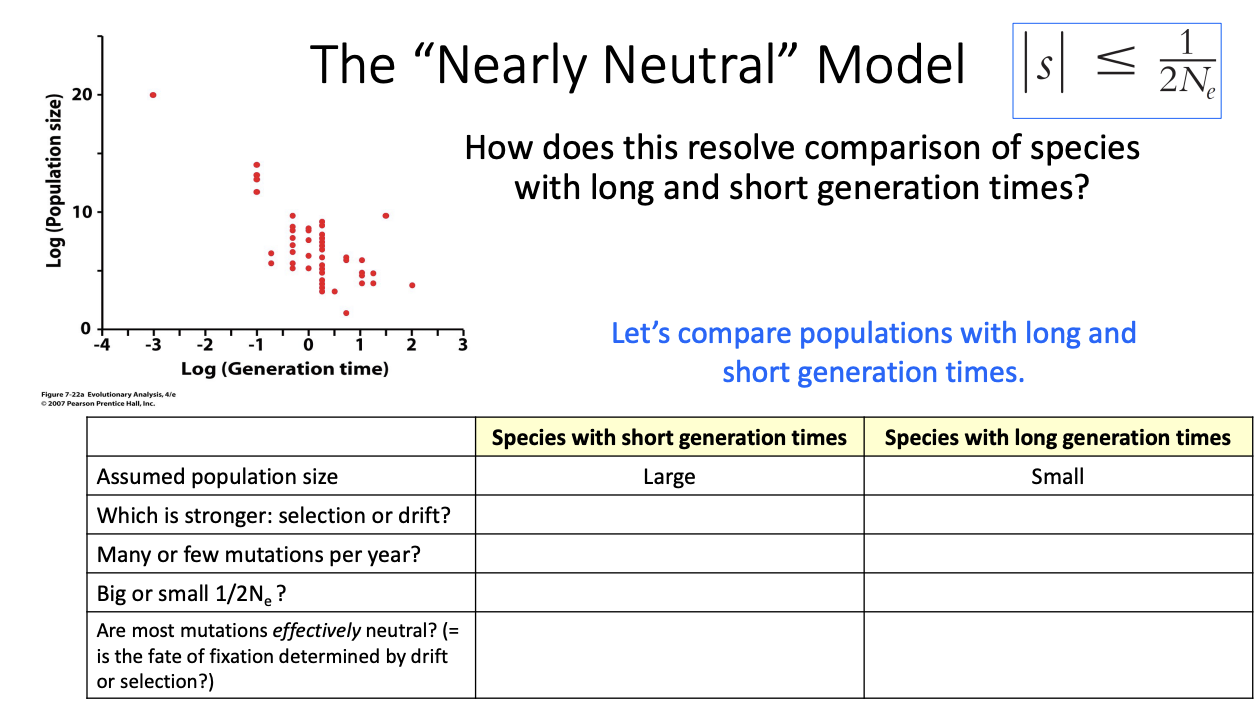
Species with short generation time
large
selection
many mutation
small 1/2Ne
not effectively neuatral
Species with long generation times
small
drift
few mutation
big 1/2Ne
yes effectively neutral
Neutral Theory as a null hypothesis
what part of neutral theory was controversial?
How can we determine the effects of selection at the molecular level?
Neutral theory has been controversial—especially the idea that the number of beneficial mutations fixed by selection is inconsequential!
How can we determine the effects of selection at the molecular level?
We can use neutral theory as a null hypothesis. If the rate of change we observe is very different from that predicted by neutral theory, then we could argue that selection is causing molecular evolution
Neutral Theory as a null hypothesis
how can we detect selection
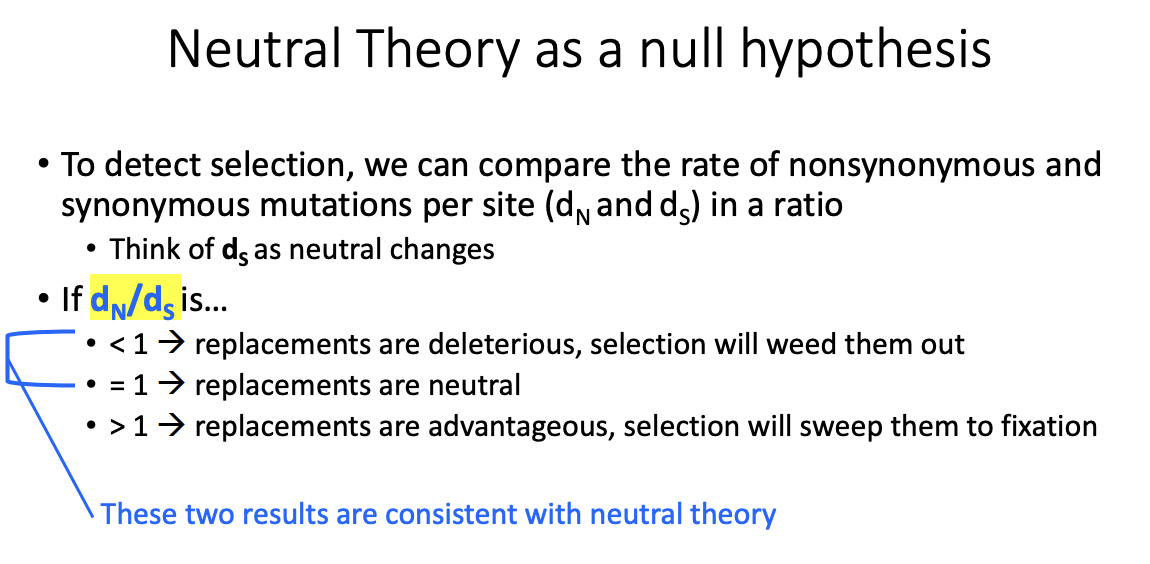
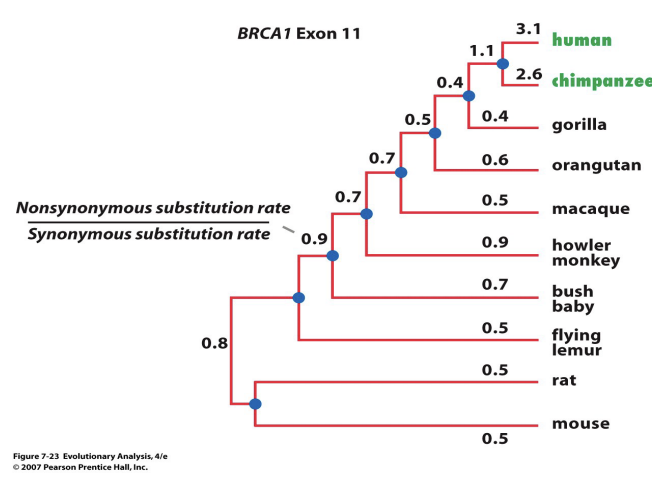
Neutral Theory as a null hypothesis
explain image
Most ratios here are less than 1, consistent with neutral evolution. However, on the branches leading to humans and chimps, the ratio is significantly greater than one, consistent with positive selection and adaptive evolution
Genomic Data
what is it?
what questions is asked about the genome architecture
What is genomic data?
DNA sequences
Arrangement in the genome (what chromosome is a gene on?)
Form, Function, and Phylogeny at Molecular Level (how does the structure of the genome vary across taxa?)
We can ask questions about genome architecture:
How does genome size vary among taxa? Do more complex organisms have more genes?
How is the information in a genome organized?
Where do noncoding sequences come from, and what do they do
Where do new genes come from?
When genes underlie adaptations?
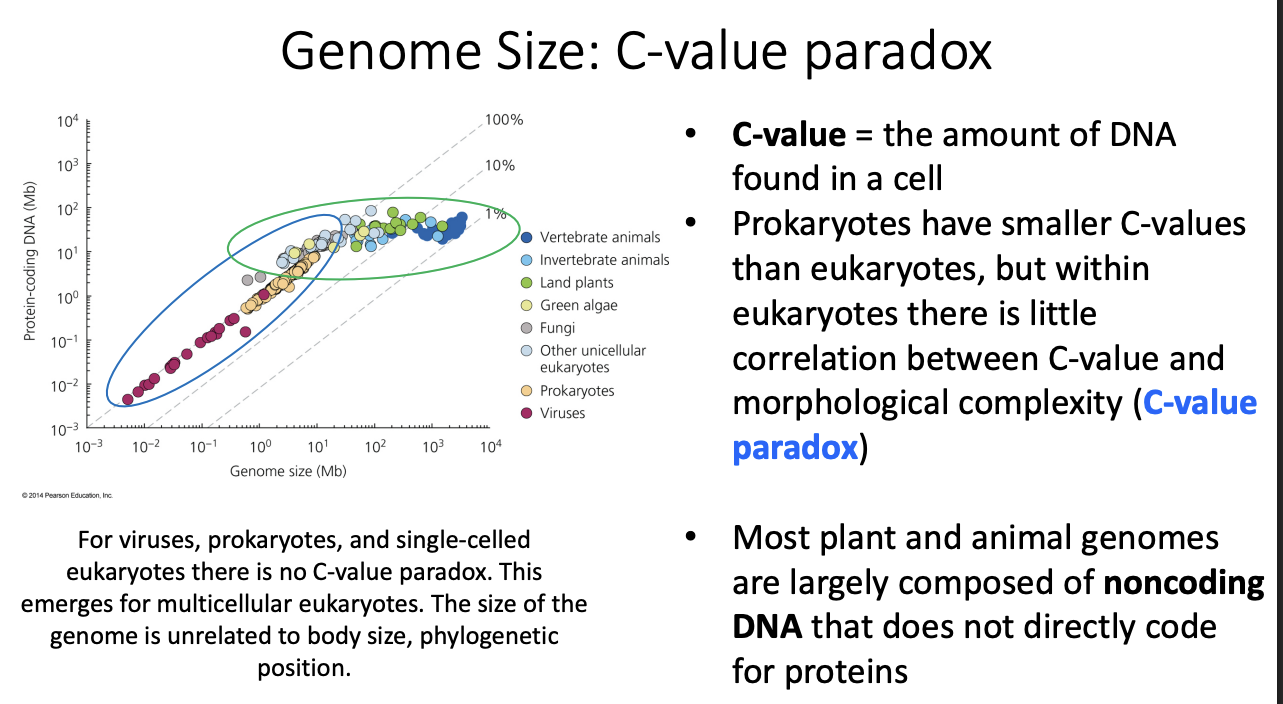
Genome Size: C-value paradox
C-value (eukaryotes and prokaryotes)
what are most plant and animal genomes largely composed on?
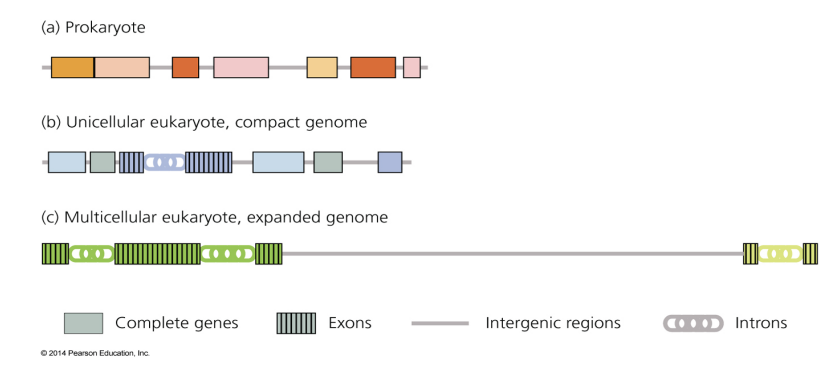
Intergenic regions?
Intergenic regions of eukaryotic genomes = space between protein-coding genes (made of mobile genetic elements, their remnants)
Not the same as introns, which occur within the coding region of genes and are transcribed into mRNA when genes are expressed.
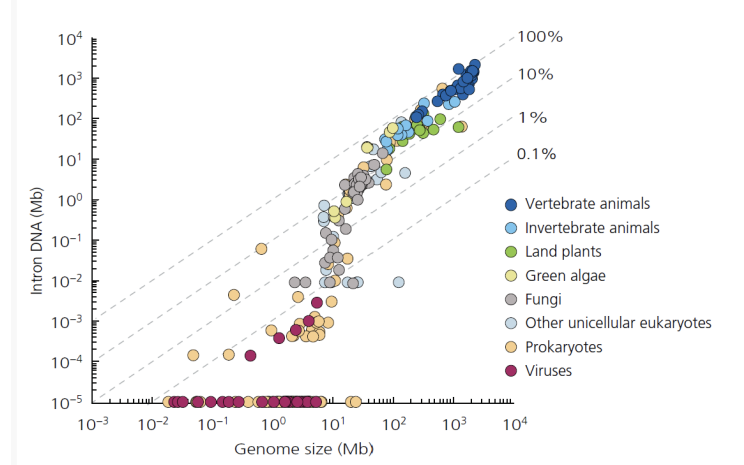
what do introns make up?
Introns make up a large portion of noncoding DNA in multicellular organisms
Thus, there are essentially two kinds of genomes:
(1) Small, compact, short intergenic regions with no introns
(2) Large, expanded, vast intergenic regions, several introns per gene
Molecular genetic elements
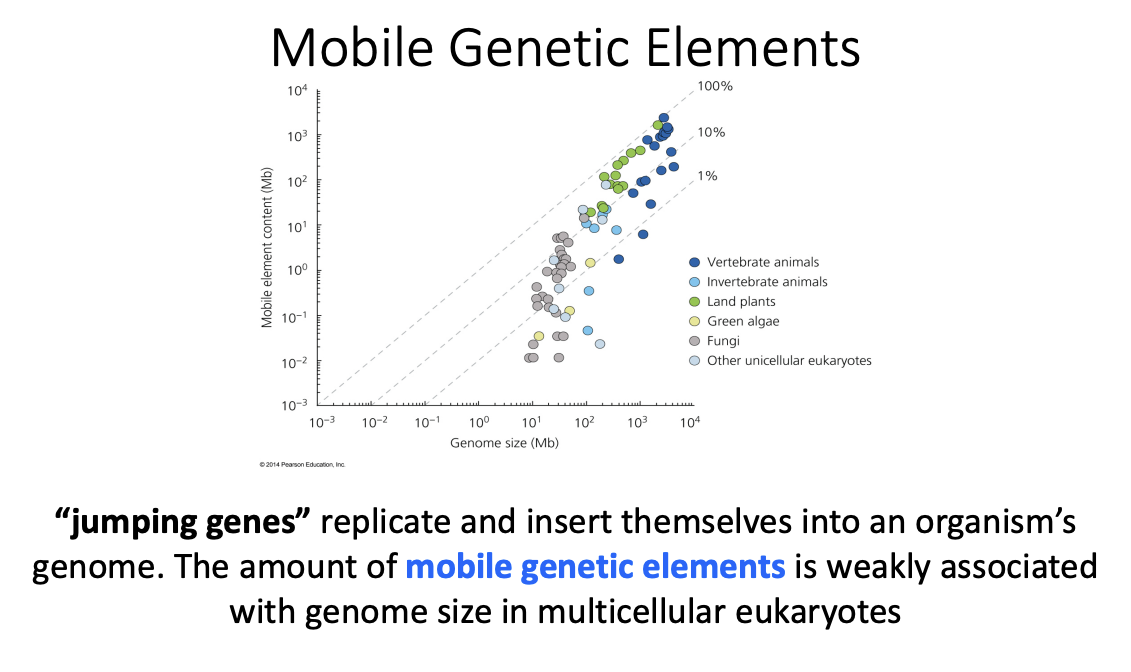
Mobile Genetic Elements: Genomic Parasites
transposones
selfish genes
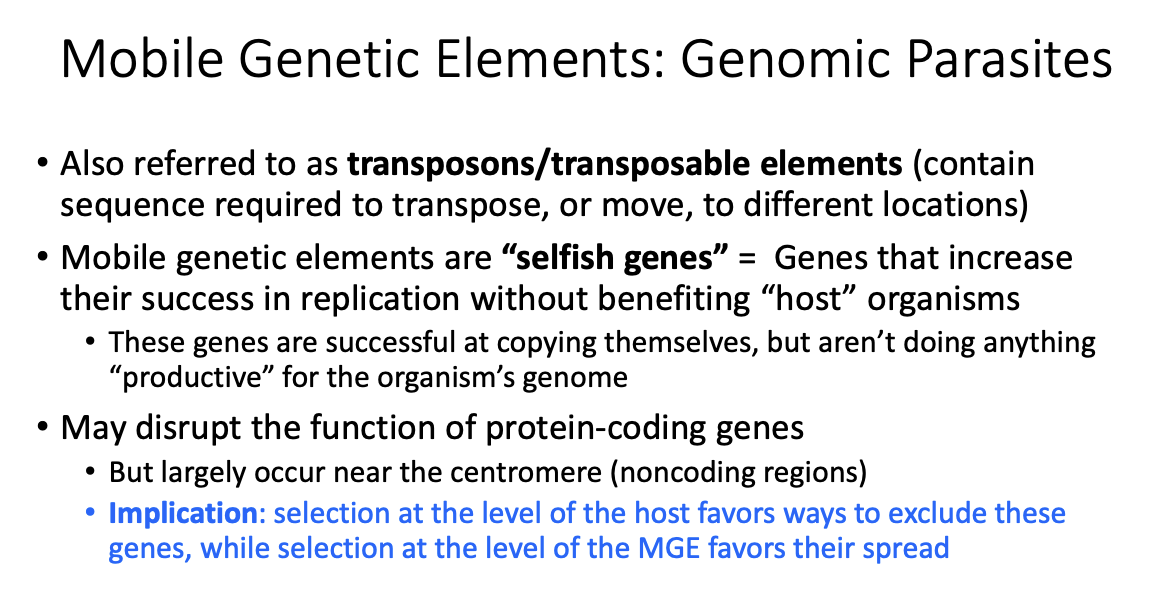
Mobile Genetic Elements: Genomic Parasites
Defending against the spread of MGEs
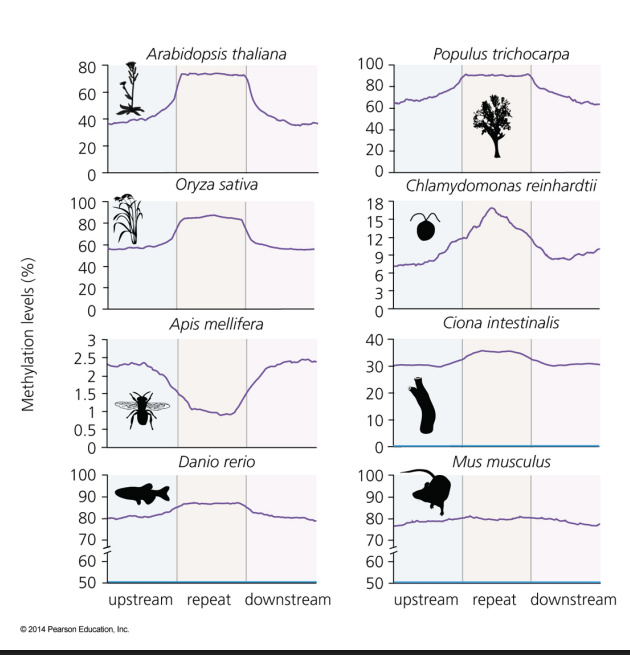
Methylation is used to prevent transcription. It is especially common in regions of the genome associated with mobile elements, preventing them from transposing
Post-transcriptional silencing: MGEs are transcribed into mRNA, and the mRNA is targeted and destroyed due to small RNA interference (RNAi)
Mobile Genetic Elements: Genomic Parasites
what happens when critical proteins associated with small RNA molecules were knocked out:
When critical proteins associated with small RNA molecules were knocked out:
1. the transcription of MGE’s increases drastically
2. Methylation of retrotransposon DNA also decreased dramatically
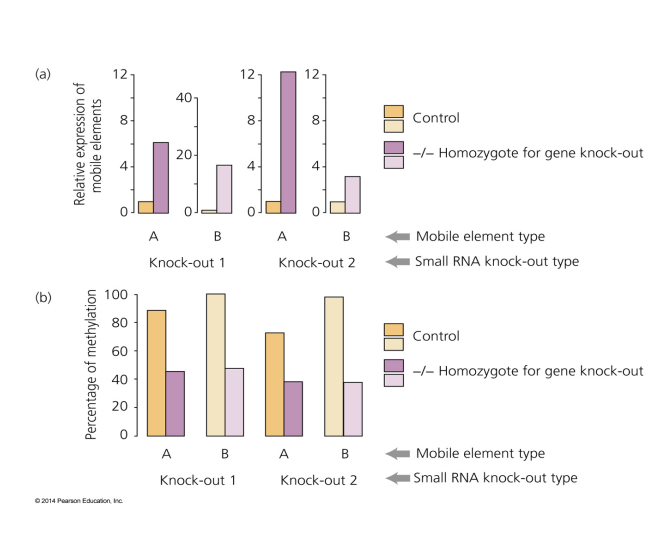
Mobile Genetic Elements: Genomic Parasites
These graphs show us methylation around MGE’s for different organisms. What can we conclude about the evolution of this strategy?
Methylation defense against MGE’s is evolutionarily conserved and existed in the common ancestor of plants and animals
Mobile Genetic Elements can impact phenotype
what did Xiao and colleagues find?
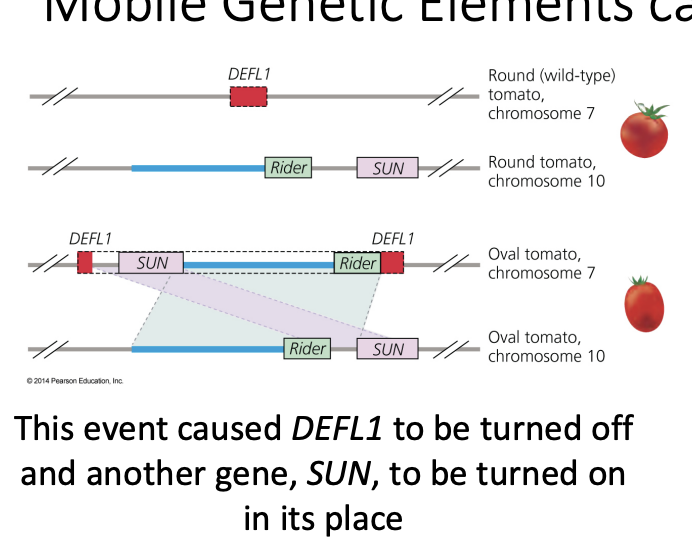
Xiao and colleagues found a difference in the genome of oval and round tomato lineages. The oval fruits had an extra piece of DNA in the DEFL1 gene of chromosome 7. This piece was associated with a retrotransposon on chromosome 10.
Mobile Genetic Elements can impact phenotype
Xiao and colleagues test?
Xiao and colleagues tested their ideas by inserted a piece of the transposed fragment from oval tomatoes containing SUN and a portion of DEFL1 into round tomatoes. They found that the more SUN was expressed, the more elongated the fruits were