Lectures 11 (taste and smell)
 Call Kai
 Learn
Learn Practice Test
 Spaced Repetition
 Match
Match Flashcards
 Knowt Play
1/26

There's no tags or description
Looks like no tags are added yet.
Name | Mastery | Learn | Test | Matching | Spaced | Call with Kai |
|---|
No analytics yet
Send a link to your students to track their progress
27 Terms
chemical senses
the function of taste and olfactory senses is to evaluate teh qualitiies of the substances we ingest into our bodies, namely, the food we eat (or drink) and the air we breathe
taste = a sense that arises from sensory receptors on the tongue (taste buds) that directly contact the food and drink we ingest into our mouths
taste buds = sensory receptors on the tongue
olfaction = a sense (smell) that arises from sensory receptros in the nasal cavity that detect aerosolized moles in the air that we breathe into our lungs
olfactory epithelium
the sensory organ for smell
cilia
hair like dendrites of bipolar olfactory sensory neurons
orthonasal olfaction
the sensing of odor molecules from the outside air
this occurs during inspiratory breathing
retronasal olfaction
the sensing of odor molecules from the mouth
this occurs during expiratory breathing
olfactory chemotransduction is mediated by g-proteins in the cilia of olfactory sensory neurons
all olfactory recpetors are g-protein receptors
their ligands are odorants from teh environ
they are special subtype of g-protein receptor called G(olf) which is ver similar to the Gs subtype bc it activates the adenylyl cyclase to stimulate production of cAMP, opens cation channels, etc
olfactory receptor Gene family
all olf receptros = GPCR
there are 1000 unique olfactory receptor genes, which is 3% of all of our genes
but only 400 genes are functional in humans, comparend to more than 1000 in dogs
each gene codes for a unqiue g protein recptor, and each recptor binds to a variety of different odor molecules (also most odor molecules bind to more than one recpetor)
olfacotry sensory neurons
the olfactory epithelium (the sensory organ for smell) = coated with olf sensory neurons
we have 40 million olf SNs
eahc olf SN expresses ONE type of olf g protein receptor
both taste and olf receptors can be regenearted
replacement cells are generated by stem cells in teh taste buds (for taste cells) and olf epithelim (for olf cells) that divide to create new sensory ns
where do olfactory Neurons send their axons?
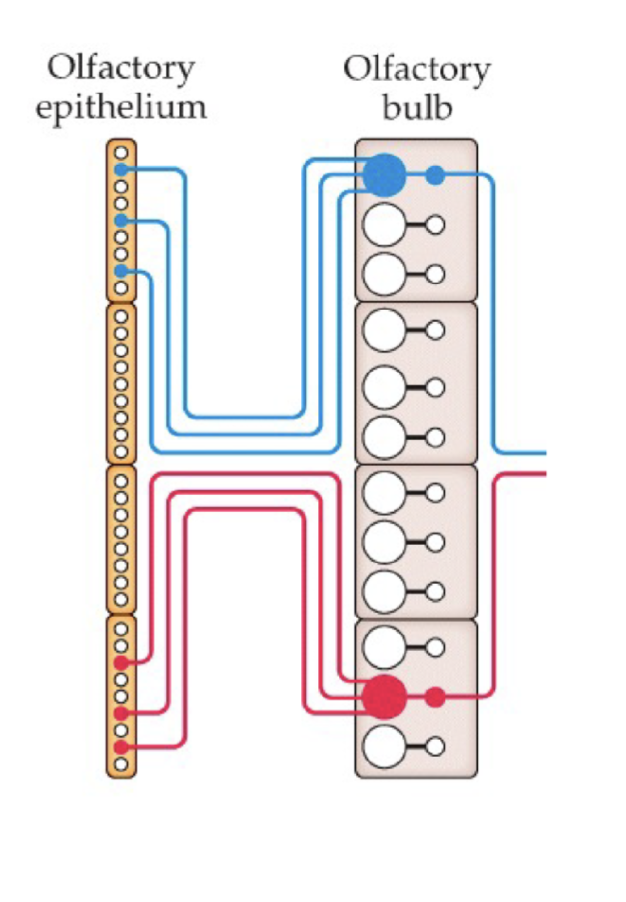
to the glomeruli of the olf bulb, hwere they synpase on mitral cells
glomerulus =
the incoming sensory nerves do not connect directly to the brain's output wires. Instead, they first bundle together in small, spherical networks of nerve tissue called glomeruli (singular: glomerulu
There are thousands of glomeruli in the olfactory bulb, and each one is highly specialized to detect a specific feature of a smell (e.g., "citrus" or "musty"
mitral cells = Mitral cells are the primary output neurons of the olfactory bulb. Their cell bodies sit in a distinct layer deep within the bulb, and they send out long, branch-like dendrites to connect with the glomerul
olfactory bulb = The olfactory bulb is a walnut-sized, oval-shaped structure located at the very front of the brain, right above the nasal cavity. Its primary job is to receive raw odor information from the sensory receptors in your nose and translate it into a "scent map" so the rest of the brain can understand what you are smelling
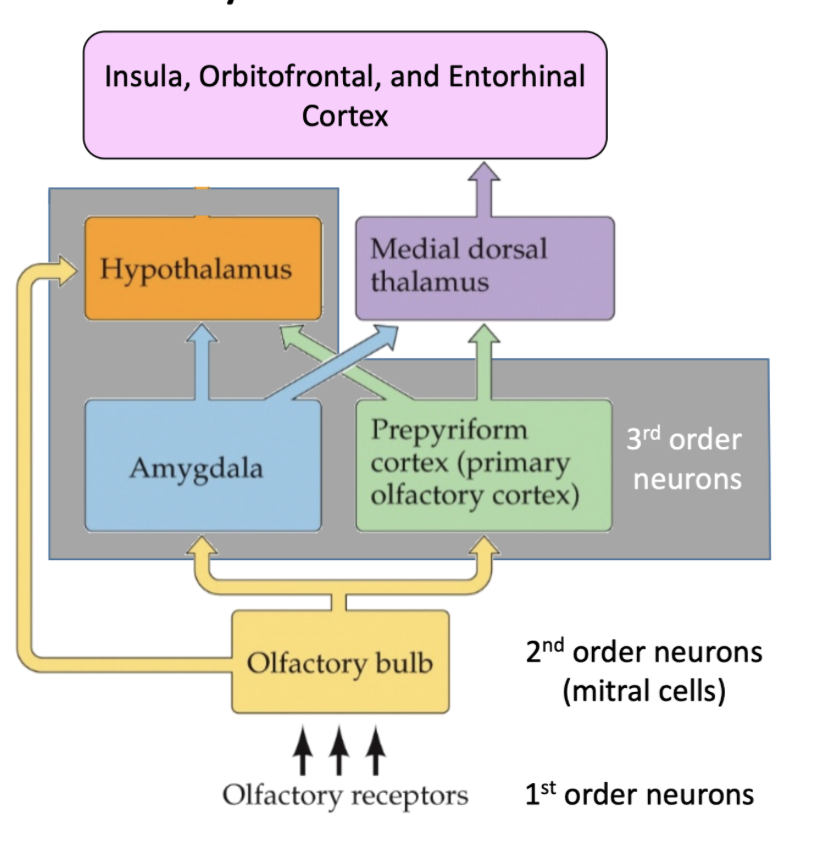
Olfactory Pathways (PROCESS)
first order olf sensory Ns (olf receptors) project to 2nd order mitral cells in teh olf bulb
2nd order mitral cells relay info from olf bulb to 3rd order targets in several brain areas:
prepyriform cortex (PC) is the primary olf cortex, which performs odor discrimination (notice that olf signals do not pass thru the thalamus to get to the PC)
amyg attahces the motivational valence to odors (pleasant, noxious)
HYPO thalamus regulates homeostasis and drives hormonal responses to certain odors (eg, pheromones)
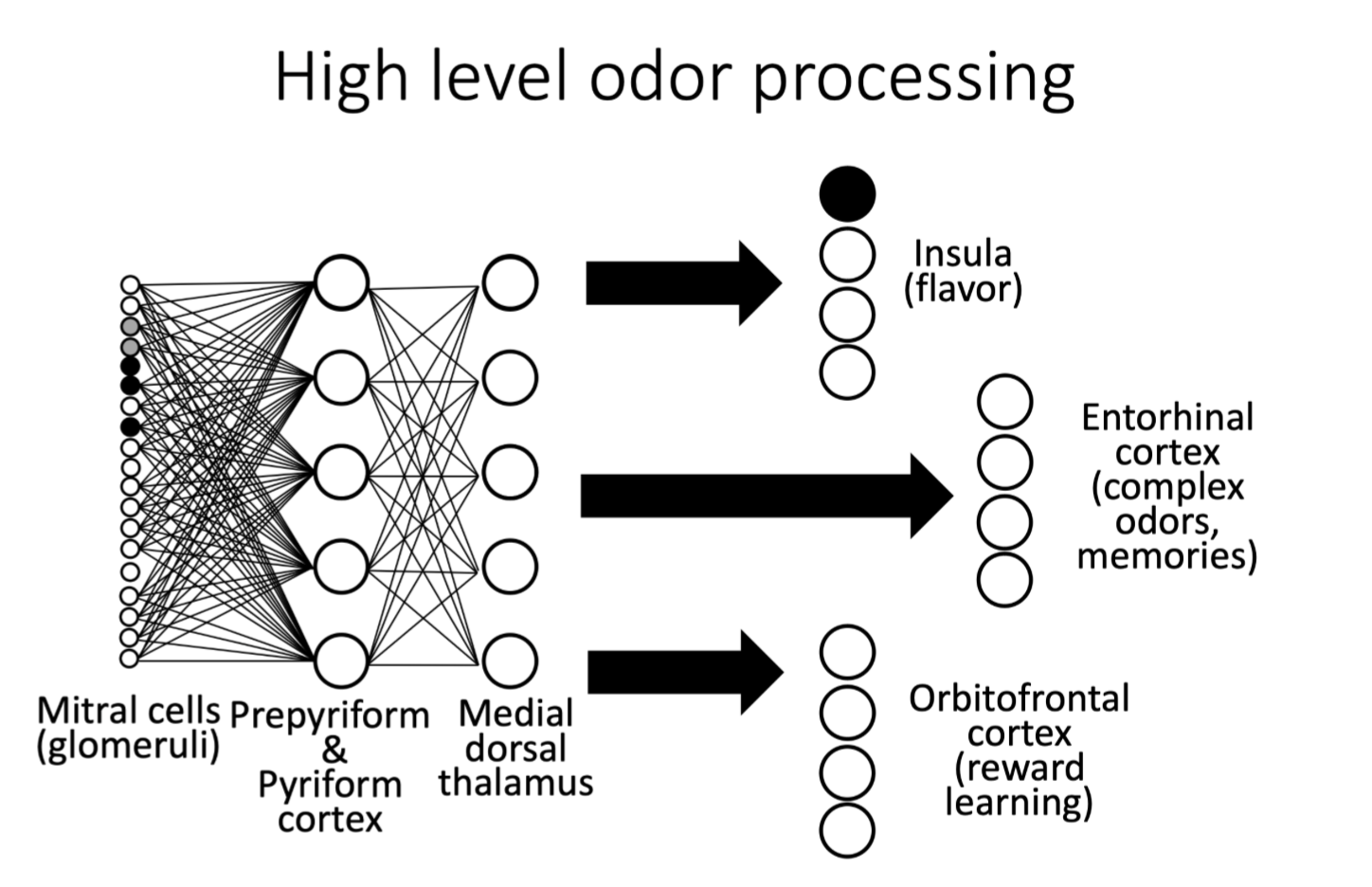
projectisions form 3rd order neurons relay olf signals to the medial dorsal thalamus which relays odor info to other areas of cortex, including
insular cortex, wich integrates olfaction, taste, and somatosensation to encode flavors
orbitofrontal cortex, which allows odors to influence decisons and beh
entorhinal cortex and hippocamps, which help to weave ordors into our episodic memroies of past exps
vermonasal organ
vertebrates have the V system to detect pheromoens (odor signals secreted by other animals)
receptor cells for this sys are found in VNO (vomeronasal organ) near the olf epithelium
humans odnt have this organ …
odor coding
every identifiable odor is comprised form unique combos of aotms and molecuels
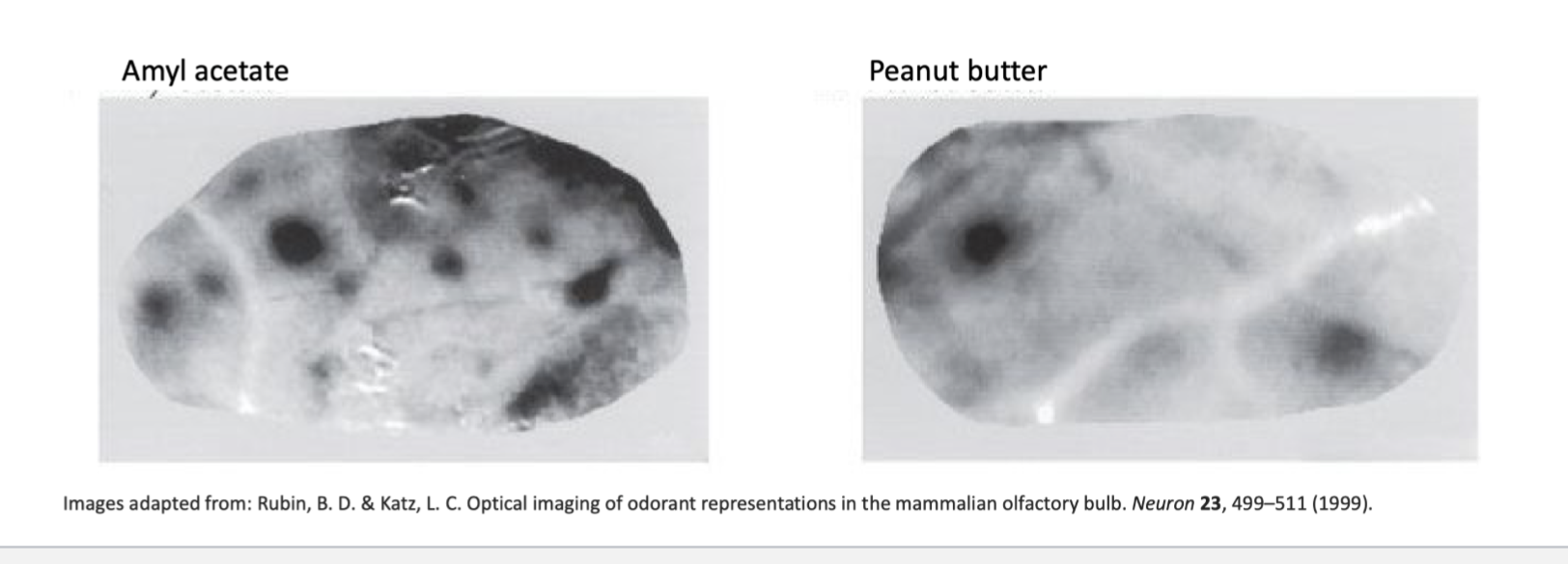
the unique chem composition activates a unique pattern of olf snesory neurosn, = unqiue patern of glomeruli
can distingusih over 1 trillion odors
popualation coding of odor identity
the images below show dark shading in regions of the mouse olf bulb acgivated by spscicfc odor
distributed code
sparse vs distributed coding
sparse - each item of info (eg, odor) is reped by activating or inactivating a small percentage of neurosn i the pop
pros = easy to readd and decode (one cell per feautre)
cons = low capacity
distributed code = each item of info is reped by activting or inactivating a larger percentage of neuonrs in he pop, for a max distributed representation, eahc item would activate about half of te neurons, but which neurons are activated woudl differ for every item
pros = high capacity (huge no of possible patterns, so many items encoded)
cons = difficlt to read and decod e
link the brain potion to the gunction
tastant and papillae
any subtance that can be tasted
pap = tiny bumps on tongue
taste pore
the hole that leads to the taste bud sac that dissolved tastants in saliva can flow to
the 5 basic tastees
salty - taste cells are dectectign Na,
sour = detct acids
sweet = dtect sugars
bitter = detect toxic substances
umami = savory flavor for protein rich fods
Salty and sout taste recpetors - chemical gradient ion channels
salty taste cells express a sodium channel called ENaC (3 subunits called alpha, beta, gamma), salt on the tongue causes the extracellular sodum concentratin to increase, resutl in inward chemcial force that pushes sodium into the taste cell to depolarize it
sour taste cells express a protein called PKD2L1 that is thought to function as a non-specic cation channel (ie, a channel that is permeable to multipe cations) which is gated by protons (H ions) whch are found in acidic compounds
umami , sweet, and bitter recptors = g proteins composed of (T1R and T2R subunits)
umamit taste cells express a taste recpetor composed from T1R1 and T1R3 subunits
GLU and MSG bnings to the T1R1
T1R3 subunit is regulatory
sweet taste = cells express a g-protein receptor composed from T1R2 and T1R3 subunits
bitter taste = express a g protein repceotr composed from 30 different members of the T2R family
sweet and bitter tastes and motivational valence
sweet tastes are inherently pleasant
bitter = unpleasant / dysphoric
Study on rats - genetically engineered taste cells
synthetic opiate peptide (RASSL) cannt be tasted by nromal mice bc there are no taste cells that resdpond to it
taste cells can be genetically engineered to respond to RASSL if they are transfecting with the RASSL receptor
make bitter and sweet taste cells responsive to RASSL
Dopamine and reward
dysphoria = dopamine down
pleasure = dopamine up
Taste Pathways
most taste cells do fire Aps
taste cells release NT (ATP and GLU) onto afferent cranial nerve fibers
nerve fibers of 2nd order taste neurons travle to teh brain via 3 cranial nerves
2nd order nueorns synapse onto 3rd order neurons in the cranial nuclei, including the nucleus of the solitary tract of the medulla
3rd order neurons project to the ventral posterior medial nucleus of the thalamus
VPM projects to gustatory cortex, which contains two major parts
anterior insula
frontal operculum
VPM (ventral posterior medial) nucleus
a crucial sensory relay structure located in the thalamus. It acts as a primary processing hub for facial sensations and taste, relaying these inputs to the brain's cerebral cortex (gustatory cortex)