5.3 Hormonal Coordination in Humans
 Call Kai
 Learn
Learn Practice Test
 Spaced Repetition
 Match
Match Flashcards
 Knowt Play
1/134

Earn XP
Description and Tags
These flashcards cover specification point 4.5.3 Hormonal Coordination in Humans. This includes 4.5.3.1 Human Endocrine System, 4.5.3.2 Control of Blood Glucose Concentration, 4.5.3.3 Maintaining Water & Nitrogen Balance in The Body (Biology Only), 4.5.3.4 Hormones in Human Reproduction, 4.5.3.5 Contraception, 4.5.3.6 The Use of Hormones to Treat Infertility, 4.5.3.7 Negative Feedback
Biology
GCSE Biology
AQA
Homeostasis & Response
Paper 2
Triple Higher
5.3.1 Human Endocrine System
5.3.2 Control of Blood Glucose Concentration
5.3.3 Maintaining Water & Nitrogen Balance in The Body
5.3.4 Hormones in Human Reproduction
5.3.5 Contraception
5.3.6 The Use of Hormones to Treat Infertility
5.3.7 Negative Feedback
Name | Mastery | Learn | Test | Matching | Spaced | Call with Kai | Chat |
|---|
No analytics yet
Send a link to your students to track their progress
135 Terms
The endocrine system is composed of ________ which secrete chemicals called ___________ directly into the ____________.
The blood carries the _________ to a _______ ________ where it produces an _______.
Compared to the nervous system the effects are _________ but act for _______.
glands
hormones
bloodstream
hormone
target organ
effect
slower
longer
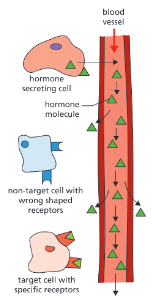
The pituitary gland in the brain is a ‘_____ _______’ which secretes several __________ into the blood in response to body conditions.
These hormones in turn act on other _________ to _________ other hormones to be released to bring about ________.
master gland
hormones
glands
stimulate
effects
What hormones does the pituitary gland secrete and what are these hormones’ functions?
ADH — affects the amount of urine produced by the kidney.
Growth Hormone — controls the rate of growth in children.
TSH — stimulates the thyroid gland to make thyroxine
a hormone that helps control the rate of metabolism
FSH — Follicle Stimulating Hormone:
Females — stimulates the ovaries to make oestrogen and to produce and release eggs.
Males — stimulates the testes to make sperm and the male sex hormone testosterone.
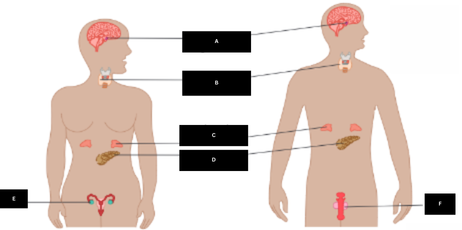
Label each part.
A — pituitary gland
B — thyroid gland
C — adrenal gland
D — pancreas
E — ovary
F — testes
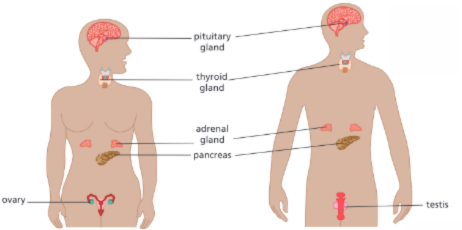
What hormone does the pancreas secrete and what is that hormone’s function?
Insulin
Controls the levels of glucose in the blood
What hormone does the thyroid secrete and what is that hormone’s function?
Thyroxine
Controls the metabolic rate of the body
What hormone does the adrenal gland secrete and what is that hormone’s function?
Adrenaline
Prepares the body for stressful situations
What hormone does the ovary secrete and what is that hormone’s function?
Oestrogen
Controls the development of the female secondary sexual characteristics and is involved in the menstrual cycle.
What hormone does the testes secrete and what is that hormone’s function?
Testosterone
Controls the development of the male secondary sexual characteristics and is involved in the production of sperm.
What is blood glucose concentration monitored and controlled by?
Pancreas
Eating foods that contain ______________ increases the glucose levels in the blood.
carbohydrates
What happens if blood glucose concentration is too high?
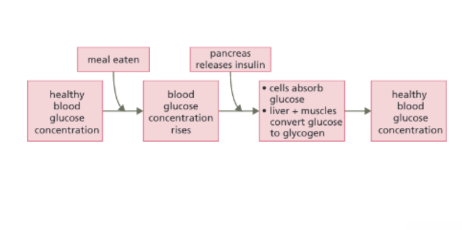
The pancreas produces insulin
Insulin binds in target organs (muscles and liver) causing:
Glucose to move from the blood into muscle cells for respiration
Excess glucose to be converted into glycogen which is stored in the liver
The blood glucose concentration is reduced
Rigorous activity, (e.g. _______), uses ________ for _________ and therefore there is less in the blood.
exercise
glucose
respiration
What happens if blood glucose concentration is too low?
The pancreas produces glucagon
Glucagon binds to the liver cells cause glycogen to be broken down into glucose
Glucose is released into the blood, increasing blood glucose concentration
What is insulin?
The hormone produced by the pancreas when blood glucose concentration is too high.
What is glycogen?
An insoluble carbohydrate made from glucose that is stored in the liver and muscles.
What is glucagon?
The hormone produced by the pancreas when blood glucose concentration is too low.
What causes type 1 diabetes?
The cells of the pancreas stop producing insulin.
What is the main risk factor for type 1 diabetes?
Some genetic tendency
What causes type 2 diabetes?
The pancreas makes insulin (could be less than the body needs).
The cells of the body stop responding to insulin.
What are the main risk factors for type 2 diabetes?
Age
Obesity
Lack of exercise
Some genetic tendency
What are the characteristics of type 1 and type 2 diabetes?
Raised blood glucose levels
Glucose in the urine
Thirst
Tiredness
Lack of energy
How is type 1 diabetes treated? (2)
Insulin injections/Insulin pumps
Low carbohydrate diet and regular meals
How do insulin injections help treat type 1 diabetes?
It allows glucose to be taken into the body cells and converted into glycogen in the liver.
This stops blood glucose concentration from getting too high.
As blood glucose levels fall, the glycogen is converted back into glucose.
Blood glucose levels are kept as stable as possible.
How does a low carbohydrate diet help treat type 1 diabetes?
It prevents large spikes in blood glucose levels
As carbohydrates are broken down into glucose
What are 3 ways to treat type 2 diabetes?
Eating a balanced diet — controlled amount of carbohydrates
Losing weight
Regular exercise
What types of drugs are there to treat type 2 diabetes? (3)
There are drugs that:
help insulin work better on the body cells
help the pancreas make more insulin
reduce the amount of glucose absorbed from the gut
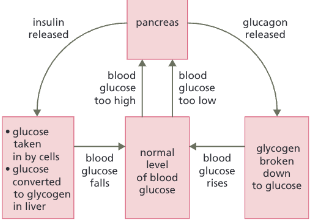
Control of blood glucose concentration is an example of __________ _________.
negative feedback
Water leaves the body via the ________ during _________.
_______, ______, and ______ are lost from the skin in sweat.
There is no control over ______, ____, or ______ loss by the _______ or skin.
lungs
exhalation
Water
ions
urea
water
ion
urea
lungs
Carbon dioxide __________ out of the cells into your blood down a ___________ ________.
It then ________ from the ________ into the air in the ________ of your lungs.
This air containing the excreted carbon dioxide is removed from your body when you ________.
As a side effect of exhalation, you lose ________ when the moist air from inside your lungs is forced out of your body.
diffuses
concentration gradient
diffuses
blood
aveoli
exhale
water
What is osmosis?
The movement of water molecules from an area of high water concentration to an area of low water concentration through a partially permeable membrane.
Excess water, ions and urea are removed via the _________ in the _______.
If body cells lose or gain too much water by _________ they do not function efficiently.
kidneys
urine
osmosis
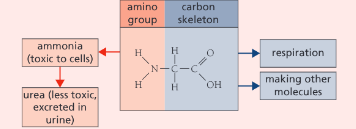
What does the digestion of proteins from the diet result in?
Excess amino acids that need to be excreted safely.
Where in the body are amino acids are deaminated to form ammonia?
Liver
Ammonia is ______ and so it is immediately converted to ______ for safe __________.
toxic
urea
excretion
The carbon dioxide made by the body cells during __________ must be removed, because dissolved carbon dioxide produces an ________ solution.
This change in pH would affect the working of all the __________ in the cells.
respiration
acidic
enzymes
How is urea produced?
The breakdown of excess amino acids in your liver.
How is urea removed from the body?
Filtered out of the blood by the kidneys.
Passed out of the body in the urine produced by the kidneys.
What do the kidneys do?
It makes urine by:
filtering out waste products
selectively reabsorbing useful substances (e.g. glucose, ions, and water)
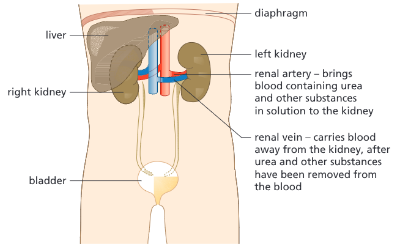
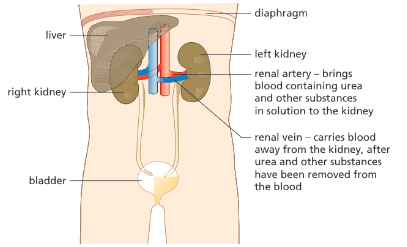
How do the kidneys work?
Glucose, mineral ions, urea, and water all move out of the blood into the kidney.
The blood cells and large proteins are too big to leave the blood in the filtering process — they do not go into the kidney tissues.
All of the glucose is reabsorbed back into the blood by diffusion and active transport.
The amount of water and dissolved mineral ions that are reabsorbed back into the blood varies based on what is needed by your body.
This is selective reabsorption.
Which gland is ADH (anti-diuretic hormone) secreted by?
Pituitary gland
_________ cells in the brain detect the concentration of ________ in the blood plasma.
Receptor
solutes
What happens if the water concentration in the blood is too high (solute concentration is too low/dilute)?
Pituitary gland releases less ADH into the blood
Less water moves out of the tubules and back into the bloodstream
Large volume of very dilute (solutes) urine
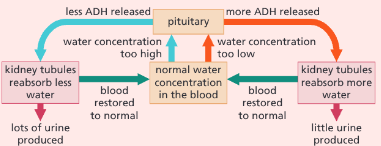
What happens if the water concentration in the blood is too low (solute concentration is too high/concentrated)?
Pituitary gland releases lots of ADH into the blood
ADH travels in the bloodstream to the kidney tubules
ADH increases the kidney tubules’ permeability to water
More water moves out of the tubules and back into the bloodstream
Smaller volume of very concentrated (solutes) urine
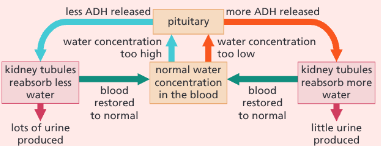
The control of water concentration in the blood is an example of ___________ __________.
negative feedback
What are 2 ways that kidneys can be damaged and/or destroyed?
Infections
Accidents
What are 2 ways of treating kidney failure?
Dialysis
Kidney transplants
What happens if kidney failure is left untreated?
Toxins (e.g. urea) build up
Mineral ion and water balance of body is not maintained
This affects all the cells
How does dialysis work?
Blood moves between partially permeable membranes surrounded by dialysis fluid.
Useful ions and glucose are not lost from the blood but urea, excess ions, and water diffuse across the membrane.
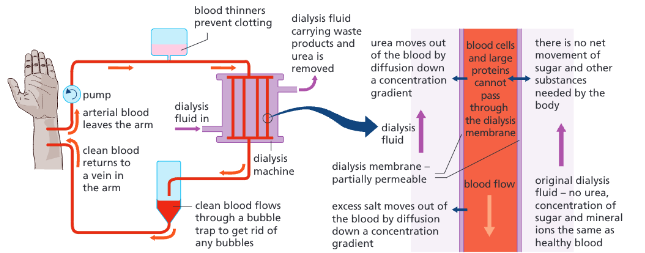
What is the concentration of glucose in dialysis fluid?
Same as healthy levels in blood plasma.
What is the concentration of mineral ions in dialysis fluid?
Same as healthy levels in blood plasma.
What is the concentration of urea in dialysis fluid?
None
Explain the movement of glucose during dialysis.
No net movement out of the blood.
Explain the movement of mineral ions during dialysis.
Excess mineral ions (e.g. sodium) diffuse from blood into dialysis fluid down their concentration gradient.
Explain the movement of urea during dialysis.
Diffuses from blood into dialysis fluid down the steep concentration gradient.
What is the final concentration of glucose in the blood after dialysis?
Healthy plasma levels
What is the final concentration of mineral ions in the blood after dialysis?
Healthy plasma levels
What is the final concentration of urea in the blood after dialysis?
Much reduced concentration of urea
Why must patients on dialysis control their protein intake?
To keep urea levels low.
Why must patients on dialysis control their salt intake?
Their kidneys cannot get rid of excess mineral ions.
What is the advantage of dialysis?
It acts as an artificial kidney and keeps people alive while they wait for a transplant.
What are the disadvantages of dialysis?
Patient must have a very controlled diet (low protein and salt).
Patient spends regular, long sessions connected to a dialysis machine.
There is only a short amount of time where the balance of substances in the blood are at the right levels.
So the patient may be tired and unwell as the next dialysis session approaches.
Expensive
Eventually causes serious damage to the body.
How do kidney transplants overcome the problem of kidney failure?
It functions like a healthy kidney and it cleans and balances the blood.
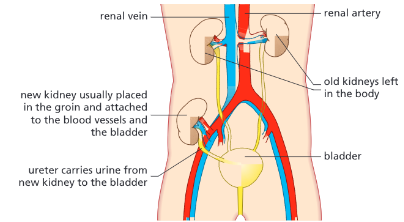
What is the main problem with a kidney transplant?
Rejection
Why may the patient’s body reject the donor kidney?
The antigens (proteins on the cell surface) of the donor organ will be different to those of the recipient.
There is a risk that the antibodies of the immune system of the recipient will the attack the antigens on the donor organ.
What are the ways to reduce the chance of rejection? (2)
Use a donor kidney with a tissue type very similar to the recipient.
Use immunosuppressant drugs.
What is the advantage of using immunosuppressant drugs?
It prevents rejection of the donor kidney by the recipient’s immune system.
What are the disadvantages of using immunosuppressant drugs?
They may prevent the patient from dealing effectively with infectious diseases.
The patient has to take them for the rest of their lives.
What are the advantages of a kidney transplant?
No restrictions that come with regular dialysis sessions.
They can eat and drink whatever they want.
Cheaper than dialysis
What are the disadvantages of kidney transplants?
Risk of rejection
Taking immunosuppressants every day for the rest of your life
Transplanted kidneys don’t last forever
What are the primary sexual characteristics in males?
Testes
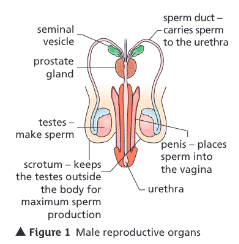
What are the primary sexual characteristics in females?
Ovaries
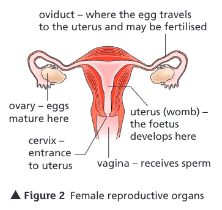
What is the main reproductive hormone in males?
Testosterone
Where is testosterone produced?
Testes
What does testosterone do?
Stimulates sperm production
What is the main reproductive hormone in females?
Oestrogen
Where is oestrogen produced?
Ovaries
How long is the menstrual cycle?
28 days
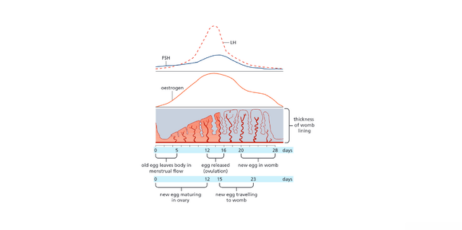
What day does ovulation occur?
Day 14
What hormones are involved in controlling the menstrual cycle? (4)
Oestrogen
Follicle stimulating hormone (FSH)
Luteinising hormone (LH)
Progesterone
What is ovulation?
The part of the menstrual cycle where a mature egg is released from the ovary.
Where is follicle stimulating hormone (FSH) produced?
Pituitary gland
Where is luteinising hormone (LH) produced?
Pituitary gland
Where is progesterone produced?
Ovaries
Secreted from the empty egg follicle in the ovary after ovulation.
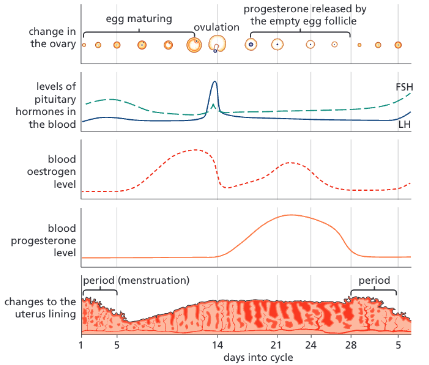
Menstrual Cycle:
Roles of Hormones:
FSH:
Secreted by _________ ________
Makes eggs ________ in their follicles in the _______
Stimulates ________ to produce __________
Oestrogen:
Made and secreted by _________
in response to ______
Stimulates the lining of the _______ to grow after menstruation
High levels of oestrogen:
inhibit the production of more _____
stimulate the release of ___
LH:
Secreted by _________ _______
Stimulates the release of a _______ egg from the ______
After _________, LH levels fall
Progesterone:
Secreted by ________ ____ _______ in the _____ after _________
Helps maintain pregnancy if the egg is __________
Maintains the lining of the _______ in the second half of the cycle
Inhibits _____ and ___
Cycle:
If the egg is not fertilised:
Levels of all hormones drop
Lining of the uterus pulls away and is lost from the body (period)
New cycle begins — levels of ______ and ________ increase
FSH
pituitary gland
mature
ovary
ovaries
oestrogen
Oestrogen
ovaries
FSH
uterus
FSH
LH
LH
pituitary gland
mature
ovary
ovulation
Progesterone
empty egg follicle
ovary
ovulation
fertilised
uterus
FSH
LH
Cycle
FSH
oestrogen
The interaction between FSH and oestrogen is an example of __________ __________.
negative feedback
What hormone does FSH stimulate the production of?
Oestrogen
What hormone does oestrogen stimulate the production of?
LH
What hormone does oestrogen inhibit the production of?
FSH
What hormones does progesterone inhibit the production of?
FSH
LH
What is contraception?
The use of artificial or natural methods to prevent pregnancy by stopping fertilisation or implantation.
Fertility can be controlled by a variety of ___________ and ____________ methods of contraception.
hormonal
non-hormonal
What are the hormonal methods of contraception? (3)
Contraceptive pills
Injections, implants, and patches
Intrauterine devices (plastic)
What are the non-hormonal methods of contraception? (4)
Barrier methods and spermicides
Intrauterine devices (copper)
Abstinence
Sterilisation
Combined Pill:
The combined pill is an ____ _____________.
It contains low doses of ___________ along with some ______________.
The hormones inhibit the production and release of ________ by the __________ _________.
As a result, no eggs _____ in the _________, preventing pregnancy.
The pill hormones also stop the ______ _______ developing, preventing ___________, and make the _______ in the cervix ______ to prevent sperm getting through.
oral contraceptive
oestrogen
progesterone
FSH
pituitary gland
mature
ovaries
uterus lining
implantation
mucus
thick
What are the advantages of the combined pill?
Quite effective
Easy to use
What are the disadvantages of the combined pill?
Side effects
high blood pressure
blood clots
breast cancer
Has to be taken regularly
No protection against STIs
Progesterone-only Pill:
It is an ____ ____________ that only contains progesterone
prevents the _______ from releasing the egg
thickens the _______ in _______ so sperm cannot swim
stops ________ eggs from ___________ in the uterus
_______ side effects than the combined pill
It is especially important to take the progesterone-only pill very regularly otherwise:
the artificial __________ levels drop
the body's own hormones take over very ________
may lead to the unexpected release of an ______ when a person thinks they are protected from ___________
oral contraceptive
ovaries
mucus
cervix
fertilised
implanting
Fewer
hormone
quickly
egg
pregnancy
What are the advantages of the progesterone-only pill?
Less side effects than combined pill
Quite effective (if taken very regularly)
What are disadvantages of the progesterone-only pill?
Must be taken very regularly
No protection against STIs