Intro to Psych Exam 1
 Call Kai
 Learn
Learn Practice Test
 Spaced Repetition
 Match
Match Flashcards
 Knowt Play
1/147

There's no tags or description
Looks like no tags are added yet.
Name | Mastery | Learn | Test | Matching | Spaced | Call with Kai |
|---|
No analytics yet
Send a link to your students to track their progress
148 Terms
Psychology
study of BEHAVIOR and MENTAL PROCESSES
Biological approach
brain and nervous system functioning (physiological systems)
ex: heart racing, sweaty palms
Behavioral approach
observable behavioral responses and environmental determinants —- WHY do people do what they do??
ex: no thoughts/feels/goals, exclusively the observable, external rewards
Psychodynamic approach
subconscious
ex: how childhood affects our adult behaviors
Humanistic approach
growth mentality, freedom to change and not stay stagnant
ex: choice to live by higher human values, free will
Cognitive approach
memory, attention, perception, thinking, problem solving
ex: memory and thinking affect behavior
Evolutionary approach
adaptation, reproduction, and natural selection explain human behaviors
Sociocultural approach
influences of social and cultural environments on behavior
Henry L. Roedinger and Kathleen McDermott
experimented with lists and “false memories” bc of word association
Jean Piaget
swiss psychologist studied childhood development
Post-event information
facts, events, and suggestions that come long along after the event has happened
unknowingly integrate this information into your memory, modifying what you believe you saw
Elizabeth Loftus
memory researcher
able to make false memories seem real
memories = “story-truth” or “happening-truth”
Stephen Ceci
memory researcher working with preschool children
kids remembering mouse traps
Daniel L. Schacter
source memory — the ability to recall precisely when and where an event occurred
memories are jigsaw puzzles
Memory not an objective camera recording it’s….
constructed bits and pieces from senses, feelings, stories from others, and implications from personality
Henry Molaison
lost his hippocampus while undergoing neurosurgery for seizures
most studied case in medical history
loss of new memory creation and loss of 11 years of previous memories
could still get faster at new motor skills
Retrograde memory loss
a loss of memories prior to the brain damage (not just after)
Word association
enough indirect activation prompts the brain to falsely remember a word that wasn’t actually included
memory
the retention of information or experience over time as the result of three key processes: encoding, storage, and retrieval
encoding
the first step in memory; the process by which information gets into memory storage
selective attention
focusing on a specific aspect of experience while ignoring others
divided attention
concentrating on more than one activity at the same time — decreases encoding
sustained attention
the ability to maintain attention to a selected stimulus for a prolonged period of time
executive attention
the ability to plan action, allocate attention to goals, detect errors and compensate for them, monitor progress on tasks, and deal with novel or difficult circumstances
levels of processing
a continuum of memory processing from shallow to intermediate to deep, with deeper processing producing better memory
shallow processing
physical and perceptual features are analyzed
intermediate processing
stimulus is recognized and labeled
deep processing
sematic, meaningful, symbolic characteristics are used
elaboration
the formation of a number of different connections around a stimulus at a given level of memory encoding — uses more parts of the brain
self-reference
relating material to your own experience
a good study hack
imagery
one of the most powerful ways to make memories distinctive
dual-code theory
memory for pictures is better than memory because the pictures are stored as both image codes and verbal codes
storage
encompasses how information is retained over time and how it is represented in memory
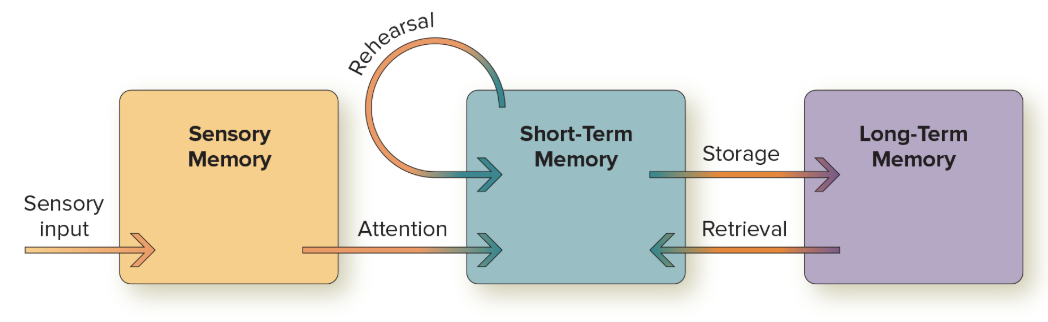
Atkinson-Shiffrin theory
theory stating that memory storage involves three separate systems: sensory memory, short-term memory, and long-term memory
sensory memory
memory system that involves holding information from the world in its original sensory form for only an instant, not much longer that the brief time it is exposed to the visual, auditory, and other senses
rich and detailed, but lots of information is lost bc we can’t transfer everything into short/long-term memory
echoic memory
refers to auditory sensory memory, which is retained for up to several seconds
iconic memory
refers to the visual sensory memory, which is retained for only about a quarter of a second
short-term memory
limited-capacity memory system in which information is usually retained for only as long as 30 second unless strategies are used to retain it longer
memory span
the number of digits an individual can report back in order after a single presentation of them
chunking
grouping or “packing” information that exceeds the 7±2 memory span into higher order units that can be remember as single units
rehearsal
the conscious repetition of information
working memory
a combination of components, including short-term memory and attention, that allow individuals to hold information temporarily as they perform cognitive tasks; a kind of mental workbench on which the brain manipulates and assembles information to guide understanding, decision making, and problem solving
time outside greatly impacts and benefits working memory
aspect of working memory — central executive
integrates information from the phonological loop and the visuo-spatial sketchpad, but also from long-term memory
important roles in attention, planning, and organization
aspect of working memory — phonological loop
specialized to briefly store speech-based information about the sounds of language
acoustic code — sounds we hear
rehearsal — allows us to repeat the words in the phonological store
aspect of working memory — visuo-spatial sketchpad
stores visual and spatial information
functions separate from phonological loop, so we can rehearse numbers while making spacial arrangements of letters
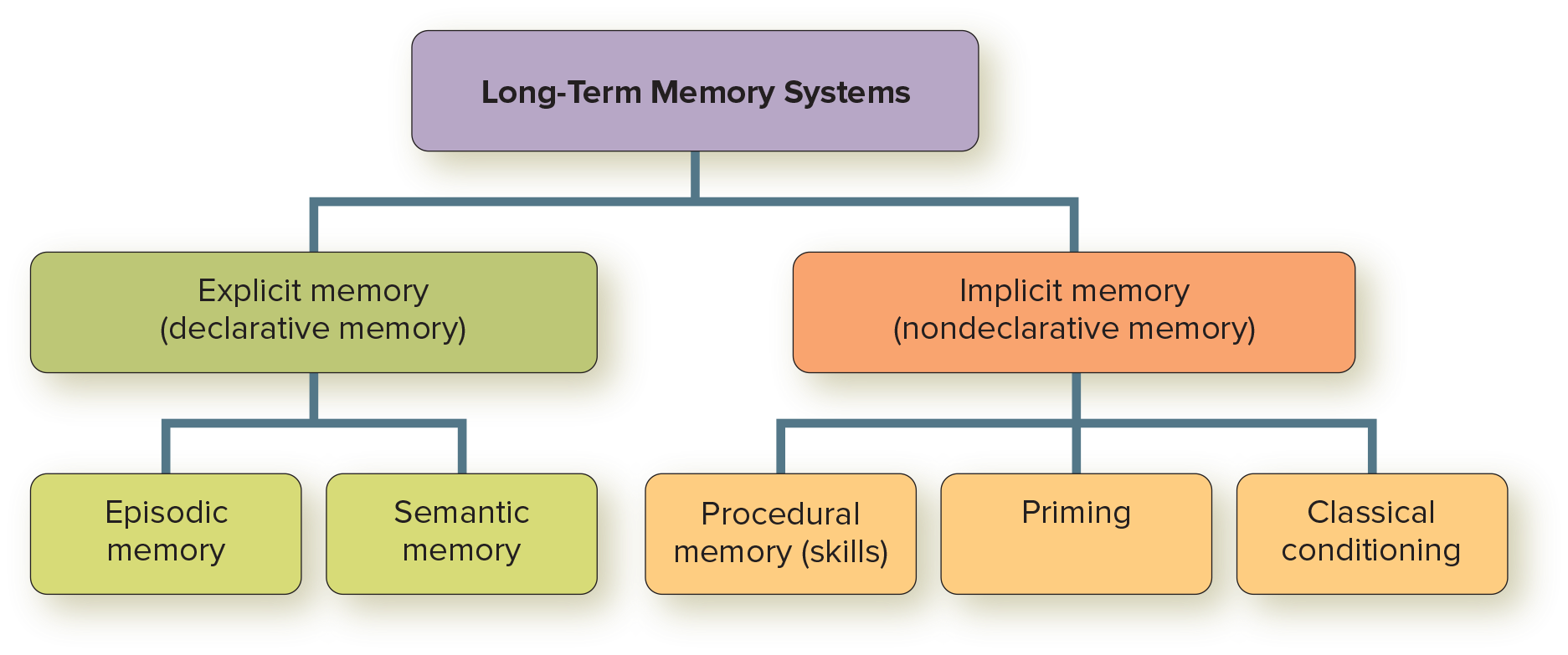
long-term memory
a relatively permanent type of memory that stores huge amounts of information for a long time
explicit memory
the conscious recollection of information, such as specific facts or events and, at least in humans, information that can be verbally communicated
episodic memory
sematic memory
subgroup of explicit memory — episodic memory
the retention of information about the where, when, and what of life’s happening—that is, how individuals remember life’s episodes
autobiographical — your experience
subgroup of explicit memory — sematic memory
a person knowledge about the world
expertise, general knowledge, everyday knowledge, famous individuals, important places, and common things
independent of an individual’s identity with the past
implicit memory (non-declarative memory)
memory in which behavior is affected by prior experience without a conscious recollection of that experience
subgroup of implicit memory — procedural memory
memory for skills
subgroup of implicit memory — priming
the activation of information that people already have in storage to help them reme,ber new information better and faster
subgroup of implicit memory — classical conditioning
a form of learning in which the automatic learning of associations between stimuli cause one stimuli to evoke the same response in the other
how memory is organized
schemas
connectionist networks
method of memory storage — schemas
a preexisting mental concept or framework that helps people to organize and interpret information. Schemas from prior encounters with the environment influence the way individuals encode, make inferences about, and retrieve information
script
schema for an event, often containing information about physical features, people and typical experiences
method of memory storage (connectionist networks) — connectionism or parallel distributed processing (PDP)
the theory that memory is stored throughout the brain in connections among neurons, several of which may work together to process a single memory
consolidation — any piece of knowledge (a name) is embedded in the strengths of hundreds or thousands of connections among neurons
how memories are stored
neurons (memory)
brain structure (memory functions)
neurons and memory
memories are composed of specific sets or circuits of neurons
neurotransmitters are the ink with which memories are written (activation of neurons requires neurotransmitters)
long-term potentiation — if two neurons are activated at the same time, the connection between them, and thus the memory, may be strengthened
similar neurons are activated during encoding and retrieval of a memory
brain structures and memory functions
explicit memory — hippocampus, temporal lobes in cerebral cortex, areas of the limbic system
retrospective — remembering things from the past
prospective — remembering things we need to do in the future
implicit memory — cerebellum (priming uses areas of the cerebral cortex - temporal lobes and hippocampus)
memory retrieval
the memory process that occurs when information that was retained in memory comes out of storage
serial position effect
the tendency to recall the items at the beginning and end of a list more readily than those in the middle
primacy and recency effect/bias
recall
memory task in which the person must retrieve previously previously learned information
recognition
a memory task in which the person only has to identify (recognize) learned items
encoding specificity principle
information present at the time of encoding or learning tends to be effective as a retrieval cue
context-dependent memory
people remember better when they attempt to recall information in the same context in which they learned it
autobiographical memory
a special form of episodic memory, consisting of a person’s recollections of their life experiences
reminiscence bump
finding that adults remember more events from their second and third decades of life than from other decades
3 levels of autobiographical memory
lifetime periods — long segments of time from years to decades
general events — extended composite episodes measued in days, weeks, or months
event-specific knowledge — individual episodes measured in seconds, minutes, or hours
flashbulb memory
the memory of emotionally significant events that people often recall with more accuracy and vivid imagery than everyday events
motivated forgetting
forgetting that occurs when something is so painful or anxiety-laden that remembering it is intolerable
Hermann Ebbinghaus
first researcher into “forgetting”
encoding failure
when the information was never entered into long-term memory
inference theory
people forget not because memories are lost from shortage but because other information gets in the way of what they want to remember
proactive inference
situation in which material that was learned earlier disrupts the recall of material that was learned later
retroactive inference
material that was learned later disrupts the retrieval of information that was learned earlierde
decay theory
when an individual learns something new, a neurochemical memory trace forms, but over time this trace disintegrates; suggests that the passage of time always increases forgetting
tip-of-the-tongue phenomenon
a type of effortful retrieval associated with a person’s feeling that they know something but cannot quite pull it out of memory
familiarity network
areas around the hippocampus that appear to impact deja vu
retrospective memory
remembering information from the past
proactive memory
remembering information about doing something in the future; includes memory for intentions
amnesia
the loss of memory
anterograde amnesia
a memory disorder that affect the retention of NEW information and events
retrograde amnesia
memory loss for a segment of the PAST but not for new events
cognition
the way in which information is processed and manipulated in remembering, thinking, and knowing
behaviorism
the human mind is a “black box” and should be left to philosophers to understand
John van Neumann
developed the first modern computer and prompted research into the mind’s computer like qualities
artificial intelligence
a scientific field that focuses on creating machine capable of performing activities that require intelligence when they are done by people
thinking
the process of manipulating information mentally by forming concepts, solving problems, making decisions, and reflecting critically or creatively
concept
a mental category that is used to group objects, events, and characteristics
four reasons for concepts
allow generalization
allow association of experiences and objects
aid memory (more efficient)
provide clues about how to react
prototype model
a model of concepts emphasizing that when people evaluate whether a given item reflects a certain concept, they compare the item with the most typical items in that category and look for a “family resemblance” with that item’s properties
problem solving
mental process of finding an appropriate way to attain a goal when the goal is not readily available
steps in problem solving
Find and frame problems
Develop good strategies
evaluate solutions
Rethink and reframe problems and solutions over time
subgoals
intermediate goals or problems to solve that put one in a better position for reaching a final goal or solution
algorithms
strategies—including formulas, instructions, and the testing of all possible solutions—that guarantee a solution to a problem
heuristics
shortcut strategies or guidelines that suggest a solution to a problem but do not guarantee an answer
fixation
using a prior strategy and failing to look at a problem from a fresh new perspective
functional fixedness
failing to solve a problem as a result of fixation on a things unusual functions
reasoning
mental activity of transforming information to reach conclusions