oceanography chapter one study guide
 Call Kai
 Learn
Learn Practice Test
 Spaced Repetition
 Match
Match Flashcards
 Knowt Play
1/104

There's no tags or description
Looks like no tags are added yet.
Name | Mastery | Learn | Test | Matching | Spaced | Call with Kai |
|---|
No analytics yet
Send a link to your students to track their progress
105 Terms
what are the 5 subfields of oceanography
geological oceanography
physical oceanography
chemical oceanography
biological oceanography
marine engineering
geological oceanography
studies the earth’s composition, plate tectonics, seafloor sediments and bathymetry, coastlines and beaches, earthquakes, volcanoes and hydrothermal vents
also resources like nodules, oil and gas
physical oceanography
studies waves, tides, currents, and ocean- atmosphere interactions
chemical oceanography
studies the distribution of particles, gases and dissolved chemicals, and the impacts and interactions with geology and biology
biological oceanography
studies marine organisms, micro to macro
ecosystems and the impact of pollutants and disruptions
fisheries
marine engineering
design and construct platforms, vessels and harbors
define science
systematic process of answering questions about the observable world by gathering information (data) and constructing an explanation compatible with all available data
define hypothesis
a tentative explanation for the observations that can be tested and disproven with all available data
define experiment
test that simplifies observations in nature by controlling the conditions under which observation is made
define theory
when a hypothesis is repeatedly supported over a period of time in a variety of contexts and by a variety of studies and researchers, it becomes a theory, which explains that observation
define law
explain patterns in nature that have been observed uniformly, summarizing observations usually in a mathematical or verbal expression
name every ocean
arctic, southern, indian, pacific, atlantic
are there natural divisions between the oceans
nope
average depth of the ocean
about 4000 meters
average temp of the ocean
about 4 degrees celsius
what is the average salinity of the ocean
34 grams per kilogram (about 40)
what is the max depth of the ocean
11,000 meters
is avg elevation of the continents or avg depth of ocean higher?
avg depth of the ocean is greater (4000m vs 840m)
what percentage of water on earth is freshwater
2%
what are the two largest reservoirs of freshwater on earth
glaciers(the biggest reservoir) and groundwater
4 reasons why desalination is bad
expensive
uses a lot of land
taking in water damages the ecosystem
the water it expels also damages the ecosystem
condensation theory
our solar system condensed from a cloud of dust and gas enriched by the remnants of exploded stars
what occurs during accretion
particles stick together and then grow
what occurs during density stratification
the densest materials fall to the center, while the less dense materials take place outward
how did earth form
1- particle accretion
2- meteor and asteroid bombardment heated the surface and added mass
3- gravitational compression
4- high temps turned interior into semisolid volume
equation for calculating volume
density= mass / volume
what are the two original sources of water on ancient earth
comets and asteroids
volcanic outgassing of water vapor
describe the steps that led to the formation of the ocean
1- dense clouds formed from outgassing
2- rain droplets fell, evaporated, and fell again, until the surface was cool enough to hold liquid water
3- puddles with dissolved minerals accumulated into the first salty ocean
how long after earth’s formation were the oceans fully formed
the oceans were fully formed 4 billion years ago
when did the first evidence of life appear in the fossil record
3.5-4 billion years ago
what was the process that transformed the ingredients of life into the first life form
biosynthesis
define biosynthesis
creation of RNA from sugars, amino acids, and nucleotides
what was the first piece of life to evolve (believed)
RNA
LUCA
last universal common ancestor
what modern subsurface system is thought to be similar to the system in which life originated
hydrothermal vents
why were hydrothermal vents the cradle of life
energy rich chemicals are abundant here, and temperature is high
how was oxygen introduced to earth’s atmosphere, and what were the effects of this oxygenation
cyanobacteria evolved, and this was the first organism to carry out photosynthesis, and this created an oxygenated atmosphere, everything that couldn’t consume oxygen died from this
list all 4 pieces of evidence that the continents used to be together in a super continent and have since moved across earth’s surface
1- the continental shelf pieces fit together like a puzzle
2- fossils match across modern oceans
3- geological features connect across modern oceans
4- magnetic signature stored in continental rocks suggests that the continents move relative to eachother
which crust is denser, oceanic or continental
oceanic crust is denser
what material makes up oceanic crust
basalt
what kind of rock makes up continental crust
granite
where is the lithosphere
cool, rigid, outer layer, makes up the continental and oceanic crust, and some of the upper mantle
where is the asthenosphere
hot, partially melted layer, that makes up the mantle
have we ever collected samples of the earth’s mantle?
yes, we dug into the mid-atlantic ridge
isostacy
holds up continents like the way buoyancy hold up boats
isostatic adjustment
when mass if added or removed causing plates to move up or down
examples of isostatic readjustment
melting of ice sheets makes crustal rock go up
what three forces cause tectonic plates to move laterally
mantle convection
ridge push
slab pull
what 3 pieces of evidence support seafloor spreading
1- sonar bathymetry of the seafloor reveals ridges
2- radiometric dating using isotopes to reveal ocean crust is much younger than earth
3- paleomagnetism studies in rocks reflecting earth’s magnetic field at the time of the rock’s formation
what is the half- life of a radioisotope, and how it can be used for radiometric dating
it is the amount of time it takes for ½ of that substances to decay, and it can be used for dating by counting the ratio of daughter to parent molecules
is oceanic crust created or destroyed at mid-ocean ridges
new seafloor is created at mid-ocean ridges
is the youngest oceanic crust close to or far from the continents
the youngest would be far from the continents, because the old rock is constantly being pushed away from its source of creation
why is there no oceanic crust older than 200 million years old, even though earth is much older
because it subducts beneath the lighter continental crust
name the three types of plate boundaries
divergent, convergent, transform
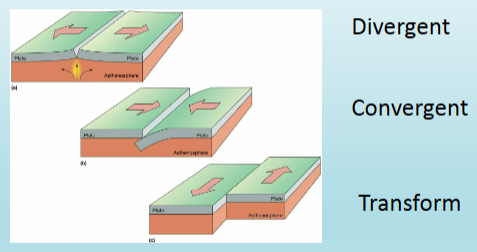
what are the 4 characteristic features of divergent plate boundaries
1- mid ocean ridge
2- volcanos
3- rift valley
4- shallow earthquakes
where does the fluid in hydrothermal vents originate, and how are the chimney structures build
they are formed when seawater percolated through porous exposed basalt, gains heat and chemicals from the surrounding rock deep in the crust, and is injected back into the ocean
the chemicals dissolved in the hot water react immediately with the seawater, precipitating mineral chimneys
the hot water does not boil because of the great pressure at depth
what are the five characteristics of convergent plate boundaries
mountains, volcanos, subduction zone, trench, deep earthquakes
what type of convergence created the deepest point in the ocean, and the mariana trench
ocean- ocean convergence created the mariana trench
how were the hawaiian islands created
a mantle plume or hotspot, as the plate moved away from the plume , it left the islands formed and created the chain of islands
how does multibean swath bathymetry work, and what kind of data does it produce
with an array of acoustic beams, a ship can create a full picture of the seafloor
how does chirp sonar work and what kind of data does it produce
a sound beam that modulates the frequency creates a range of sound waves that will bounce off layers of different density, or discontinuities
this allows us to see “through” the seafloor
why is important to know about the presence of methane in sediment
safety while coring or drilling
extraction of natural gas
research in biology or chemistry
how to we detect methane in the sediment
deeper, lower wavelength sounds penetrate deeper but in less detail
chirp shows you shallower layers
pingers reflect just the seafloor
how can satellites detect undersea features like ridges and seamounts
they can detect small changes in sea surface height
the area of the ocean is dominated by which two oceanic provinces
ridges and basin floors
describe active margin and what plate boundary it is found at
active margin is moving plates, and at a convergent boundary
describe a passive margin and what plate it is found at
no plate activity, not divergent or convergent, just a transition from continental to oceanic crust
know where the continental shelf, shelf break, continental slope, continental rise, and abyssal plain is located
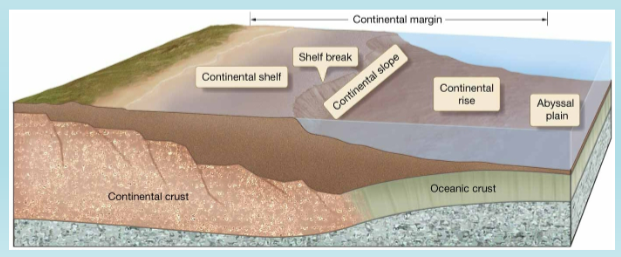
where are submarine canyons observed and what are they caused by
they are found on continental slopes
they are started by ancient rivers, when the sea level was lower, and they are carved deeper by turbidity currents and gravity flows
what is a turbidity current
underwater avalanches
abyssal plain, and why is it so flat?
abyssal plane extends from the base of continental rise, and it is flat because the large amount of sediment filled in any crevices or hills
where would sediment cover be the thickest
furthest away from the mid- ocean ridge
how does fast spreading affect the topography
features are spread over a larger area
how does slow spreading effect the topography
more vertical topography and more pronounced central rift
where is the pacific ring of fire and what type of boundary does it represent
it represents active margins, it is marked by convergent boundaries, it is where the worlds most active volcanoes, and deepest earthquakes occur
what are the four benthic zones in order from most shallow to most deep
continental shelf
bathyal zone
abyssal zone
hadal zone
what are the two pelagic zones of the ocean and where are they located
neritic= over continental shelf
oceanic= beyond continental shelf
what defines the vertical zones of the ocean and why
light, because photosynthesis
what are the four vertical oceanic pelagic zones from closest to the surface to furthest from the surface
epipelagic
mesopelagic
bathypelagic
abyssopelagic
how does proximity to continents affect the accumulation rate of sediments
closer to continents= high accumulation rate
what count create a white colored sediment and where would it most likely be found
a white colored sediment is formed from biogenous calcareous ooze
these are found in warm shallow tropical water (high productivity) or below the calcium comphensation depth
how could boulders, pebbles, and cobbles end up in ocean sediment
through high energy transport mechanisms, like melting ice, coastal erosion, landslides, or turbidity currents
what determines the sediment grain size in a region
the energy in the environment
where would you find large grain size
high energy environment
where would you find small grain size
low energy environment
how do well sorted sediments differ from poorly sorted sediments
well sorted= mostly the same size
poorly sorted= varying particle size
what can grain shape tell you
indicated the distance from the source
where would a very large sediment be found
very close to the source
where do terrigenous sediments come from and how are they transported to the ocean
originate at continents, and they are transported by the blowing of dust, erosion of land, volcanic eruptions
describe the sedimentary rock cycle
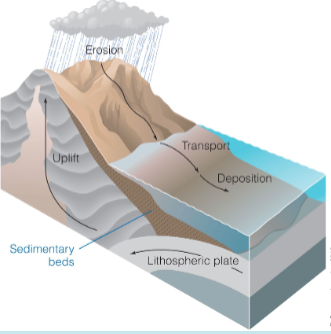
how did shallow water limestone rock make it onto the peak of mount everest
uplift occured when the indian plate collided with the eurasion plate which then formed the mountain
why do we find fish fossils in the middle of the continental US
due to the colorado plateau, which was once a massive seaway
define ooze
deep sea sediments containing at least 30 % biogenic sediments
describe the main minerals that make up calcareous ooze
carbonate skeletons precipitated by various creatures
what organisms produce carbonate skeletons
foraminifera, pteropods, coccolithophores
what makes up a siliceous ooze
living things that precipitate silica
what organisms produce silica
diatoms and radiolarians
why dont we find carbonate below 5000m in the modern ocean
because it begins to dissolve at cold depths, and it is no longer in its solid form
this is the standard depth of the CCD
define lysocline
depth at which a significant amount of CaCO3 begins to dissolve rapidly
what are two reasons why you might find calcite deeper than 5000 m
because it got burried and wasnt exposed to the water
because the rate of addition is very high and steady