Human Development FINAL
 Call Kai
 Learn
Learn Practice Test
 Spaced Repetition
 Match
Match Flashcards
 Knowt Play
1/98

There's no tags or description
Looks like no tags are added yet.
Name | Mastery | Learn | Test | Matching | Spaced | Call with Kai |
|---|
No analytics yet
Send a link to your students to track their progress
99 Terms
childhood-onset fluency disorder(stuttering)
substantial disruption in the rhythm and fleuncy of speech; the most common speech impairment
concrete operational stage
the period of cognitive development between 7 and 12 years of age, which is characterized by the active, and appropriate, use of logic
decentering
the ability to take multiple aspects of a situation into a account
meta memory
an understanding about the processes that underlie memory, which emerges and improves during middle childhood
metalingustic awareness
an understanding of one’s own use of language
Wachsler intelligence scale for childern, 5th edition
a test for children that provides separate measures of verbal and performance(no nonverbal) skills, as well as a total score
Kaufman Assessment Battery for childern, 2nd edition
an intelligence test that measures childern’s ability to integrate different stimuli simultaneously and to use sequential thinking
triarchic theory of intelligence
Sterbverg’s theory that intelligence is made up of 3 major components: componential, experiential, and contextual
least restrictive environment
the setting that is most similar to that of children without special needs
mainstreaming
an educational approach in which exceptional children are integrated to the extent possible into the traditional educational system and are provided with a broad range of educational alternatives
formal operational stage
the period at which people develop the ability to think abstractly
information processing approach
the model that seeks to identify the way that indiviuals take in, use, and store info
metacognition
the knowledge that people have about their own thinking processes and thier ability to monitor their cognition
identity-versus-identity-confusion stage
the period during whiich teenagers seek to determine what is uniqe about themselves
Erikson’s stages
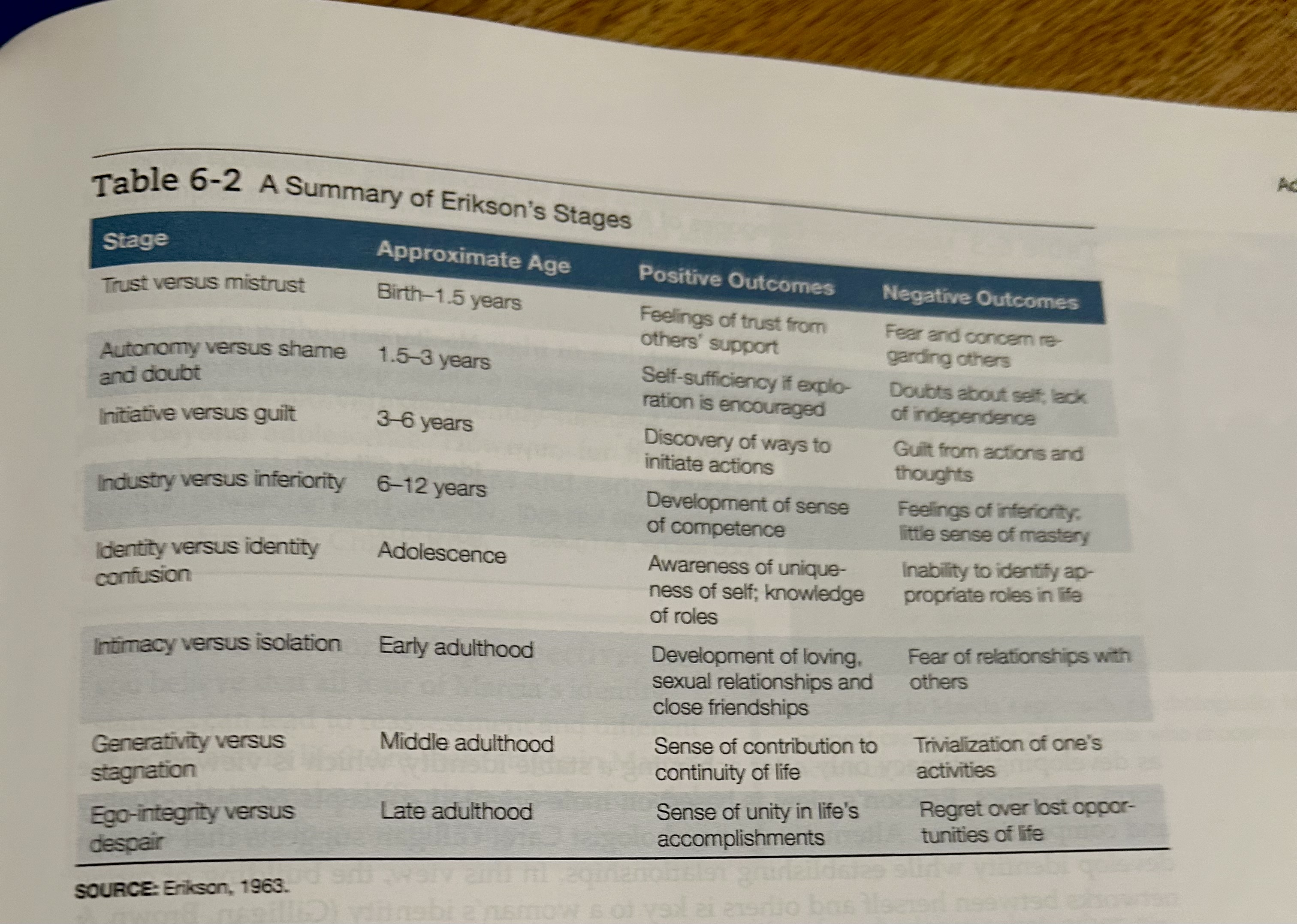
identity achievement
the status of adolescents who commit to a particular identity following a period of crisis during which they consider various alternatives
identity foreclosure
The status of adolescents who prematurely commit to an identity without exploring all options
moretorium
the status of adolescents who may have explored some identities to some degree, but not committed yet
identity diffusion
the status of adolescents who consider various idenity alternatives, but never come to one or never even consider idenity options
coregulation
A period in which parents and children jointly control children’s behavoir
Blended family
Remarried couples who have at least one stepchild living with them
industry-versus-inferiority stage
according to Erik Erikson, the period from age 6 to 12 characterized by a focus on efforts to attain competence in meeting the challenges presented by parents, peers, school, and the other complexities of the modern world
Dominance Hieracrchy
rankings that represent the relative social power of those in a group
status
The evaluation of a role or person by other relevant members of a group
Social competence
the collection of soical skills that permit indidvuals to do well in social settings
menarche
the onset of menstruation
primary sex characteristics
characteristics associated with the development of the organs and structures of the body that directly relate to reproduction
secondary sex characteristics
the visible signs of sexual maturity that do not directly involve the sex organs
senescene
the natural physical decline brought about by aging
psychoneuroimmunolgy
the study of the relationship among the brain, the immune system, and psychological factors
primary appraisal
The assessment of an event to determine whether its implications are positive, negative, or neutral
secondary appraisal
The assessment of whether one’s coping abilities and resources are adequate to overcome the harm, threat, or challenge posed by the potential stressor
postformal thought
thinking that acknowledges that adult predicament must sometimes be solved in relativistic terms
acquisitive stage
According to Schaie, the first stage of cognitive development, encompassing all of childhood and adolescence
Achieving stage
The point reached by young adults at which intelligence is applied to specific situations
responsible stage
the stage where the major concerns of middle-aged adults relate to their personal situations, including protecting family
executive stage
the period in middle adulthood when people take a broader perspective than previously, including concerns about the world
reintegrative stage
The period of late adulthood during which the focus is on tasks that have personal meaning
triarchic theory of intelligence
Sternberg’s theory that ntelligence is made up of three major components: componential, experienmental, and contextual
how to calc IQ
Mental age/chronological age*100=IQ
what should avg IQ be?
100, they change the test so it is 100
What counts as an intellectual disability?
IQ lower than 70, PLUS difficulty with conceptual, social, and practical skills
what is intelligence
includes procesing speed, myelination speeds this up
gardner’s theory on intelligence
Interpersonal-other people’s emotions
Intrapersonal-your own emotions
fluid vs crystailized intelligence
Crystallized(things you know, facts) vs fluid intelligence(processing of info)
Young adults are usually between in fluid intelligence than older adults and vice versa
what predicts IQ
genes and envirnment, breat feeding and early education increase IQ, midset also improve IQ
what are the 5 componets of emotional intelligence?
Self awareness
Self-regulation/Management(the biggest indicator of human success)
Attitude/motivation/Passion
Emotion
Social Skills
what are the 3 Cs in discipline
Collect(calm yourself)
Connect(listen, validate)
Correct(request guide, tell)
High control/structure and high warmth =
Authoritative(Reasonable demands, consistently enforced with sensitivity to and acceptance of child
High control/structure and low warmth =
Authoritarian(many rules and demands, few explanations, and little sensitivity to child’s needs
Low control/structure and low warmth =
Uninvolved(few rules and remands, parents are uninvolved and insensitive to child’s needs
Low control/structure and high warmth =
Permissive(few rules and demands, children are allowed fun freedom by indulgent parents
child outcomes for the 4 parenting types
Authoritative- best outcomes: mature and independent
Authoritarian-lower self-esteem, rebellious, dependent, angry
Permissive-impulsive , lacking persistence, bad in school
Neglectful-worst outcomes: depressed, anxious, antisocial
siblings can be..
equal status playmates
benefits of being an only child?
slightly higher IQ(parent attention)
Niche picking
A theory that people cause their environment(which then interacts with their genes)
Brother and sister, one is a jock and one is a nerd, but they both have the same IQ
peer status definitions: popular, average, neglected, rejected, controversial
Popular: frequently nominated as best friend; rarely disliked
Average: Average number of positive and negative nominations
Neglected: Infrequently nominated as best first but not disliked by peers
Rejected: Infrequently nominated as a friend; actively disliked by peers (the kid who is gonna struggle the most)
Controversial: Frequently nominated as someone’s best friend and as being disliked
The mmyth of storm and stress
Stanley Hall argues that adolescence is a period of heightened “storm and stress”. Is this true?
The relationship with parents does change:
Spend less time together; but time together in protective
Parents tend to mildly argue with teens overclothing, etc, they are simply seeking autonomy
But most teens have a positive relationship w/ their parents
Only 25% have more serious problems
adolescent egocentrism, personal fable
Adolescent egocentrism: a teen’s focus on her own feelings and experiences
Often characterized by the imaginary audience: the belief that their peers are always watching
Personal Fable: belief that their own experiences and feelings are unique and no one has ever felt like this before
how many teens have tried tobacco, and what percentage use marjiana, and alcohol in 2023
1/3 or 20% and 40%, 22%
effects of using marijuana
Impact on learning and attention
Weekly use under the age of 18 is linked to: lower IQ, lower income, higher likelihood of dropping out, being on welfare, being depressed, and attempting suicide
Marijuana damages the developing brain
alcohol and drug use-factors
Parents: drinking goes up if:
Parents are uninvolved or set unrealistic expectations
Alcohol is an important part of their parent’s social lives
Stress
Alcohol is a depressant(self-medicating anxiety)
Peers
Having peers who drink is a risk factor
internalizing behavior
Turning stress inward
depression, anxiety
About 20%
2X likely in girls than boys
Externalizing behavior
Turing stress outward-acting out
Aggression, antisocial(rule-breaking)
Somewhat more common in boys
functional death
the absence of a heartbeat and breathing
thanalogostis
people that study death and dying
what are the five basic steps of approaching death proposed by Kübler-Ross
terminal illness diagnosis
denial(shock)
anger
bargaining(then relaization)
depression
acceptance
intimacy-versus-isolation stage
according to Erikson, the period of postadolescence inot the early 30s that focuses on developing close, initimate relationships with others
passionate(or romantic) love
a state of powerful absorption in someone
companionate love
the strong affection for those with whom our lives are deeply involved
labeling theory of assionate love
the theory that individuals experience romantic love when 2 events occur together: intense physioligcal arousal and situational cues suggesting that the arousal is a result of love
intimacy component
according to Sternberg, the component to love that encompasses feelings of closeness, affection, and connectedness
passion component
according to Sternberg, the componet of love that comprises the motivational drives relating to sez, physical closenss, and romance
decision/commitment component
according to Sternberg, the 3rd aspect of love that embodies both the initial cognition that one loves another person and the long-term determination to maintain that love
cohabitation
couples living together without being married
normative-crisis theories
The approach to personality development that is based on fairly universal stages tied to a sequence of age-related changes or crises
generativity-vs-stagnation
according to Erikson, the stage during middle adulthood in which people consider their contributions to family and society
gerontologists
specialists who study aging
primary aging
agin that involves universal and irreversible chnages that because of gentic programming, occur as people get old
secondary aging
changes in phsyocal and cognitie fucntioning that are as a result of illness, health habits, and other individual differences, but are not the result of increased age itself and are not inevitable
osteoporosis
a condition in which the bones become brittle, fragile, and thin, often brought about by a lack of calcium in the diet
genetic programming theories of aging
theories that suggest that our body’s DNA genetic code contains a built-in time limit for the reproduction of human cells
wear-and-tear theories of aging
the theory that the mechanical fucntions of the body simply wear out with age
ego-integrity vs despair stage
Erikson’s final stage of life, characterized by a process of looking back over one’s life, evaluating it, and coming to terms with it
redefiniton of self vs preoccupation with work role
the theoory that those in old age must refine themselves in ways that do not relate to their work roles or occupations
body transcence vs body preoccupation
a period in which people must learn to cope with and move beyong changes in physical capabilities as a reuslt of aging
ego transcendence vs ego preoccupation
the period in which elderly people must come to grips with their impending death
age stratification theories
the view that an unqeual ditrubtion of economic resources, power, and privilage exists amoung people at different stages of life