Week 9 Tough
 Call Kai
 Learn
Learn Practice Test
 Spaced Repetition
 Match
Match Flashcards
 Knowt Play
1/30

There's no tags or description
Looks like no tags are added yet.
Name | Mastery | Learn | Test | Matching | Spaced | Call with Kai |
|---|
No analytics yet
Send a link to your students to track their progress
31 Terms
Demand for Domestic goods in an open economy
Z ≡𝐶+𝐼+G - (IM/𝜀) + X
The first three terms C I G constitute the domestic demand for goods (DD)
No we subtract imports in terms of domestic goods and add exports
Net exports formula
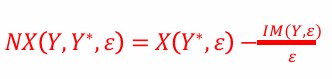
NX = X(Y*, ε) − IM(Y, ε)/ε
X = Exports
Y* = Foreign income
ε = real exchange rate = (e x P*)/ P = (nominal exchange rate x foreign price level)/ domestic price level
IM = Imports
The determinants of imports
Higher real exchange rate leads to higher imports therefore IM = IM(Y,ε)
An increase in domestic income Y leads to an increase in IM, an increase in the real exchange rate leads to an increase in imports IM.
The determinants of exports
X = X(Y*,ε)
An increase in foreign income leads to an increase in X.
An increase in the real exchange rate ε leads to a decrease in X
DD Domestic demand for goods
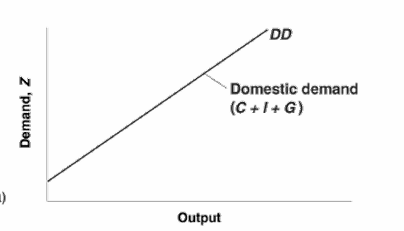
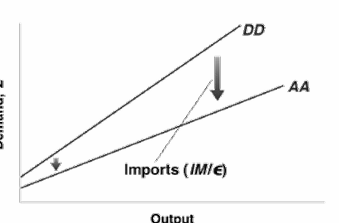
AA Demand for domestic goods
First obtained by subtracting the value of imports from domestic demand
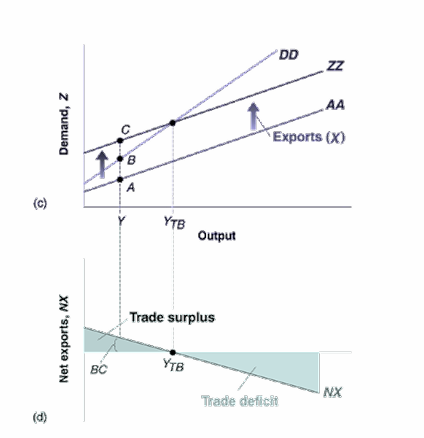
DD,AA and ZZ lines and there effect on the trade surplus
DD - Domestic Demand C + I + G
AA - Domestic Demand for Domestic goods. Demand - Imports C + I +G-IM
ZZ = C+I+G-IM+X
Goods market in equilibrium
Y = Z In equilibrium when domestic output equals the demand - both domestic and foreign for domestic goods
Equilibrium formula in an open economy


these two are the same because of the NX formula

NX formula ( net exports) = Exports - Imports
As we are studying in the short run we assume prices are sticky and therefore we can assume prices to be constant
In this case we can assume the P/P* = 1 so that ε=E
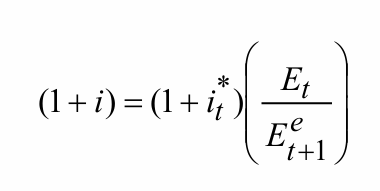
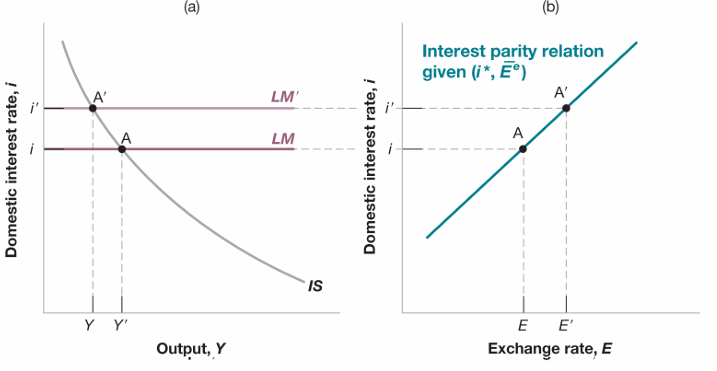
The interest parity condition (UIP)
Where Et = exchange rate
Eet+1 = exchange rate expected in the next period
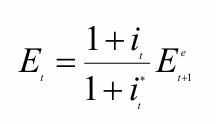
Rearranged UIP to get current exchange rate
This relations tells us that the current exchange rate depends on the domestic interest rate, on the foreign interest rate, and on the expected future exchnage rate
The more the pound appreciates the more investors expect it to depreciate in the future
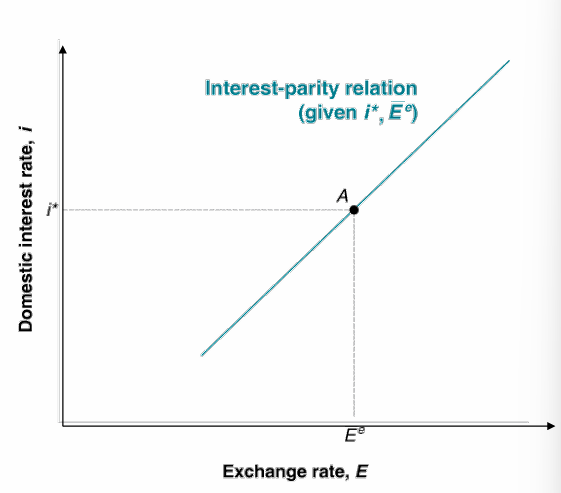
What does the UIP imply
It implies a positive relation between the domestic interest rate and the exchange rate
UIP
i increase = E Increase
i* increase = E decrease
Ee increase = E increase
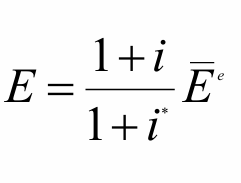
2 effects of an increase in the interest rate
Reduction in investment which was already present in the closed economy
Appreciation in the exchange rate which is only present in the open economy
IS-LM model in an open economy
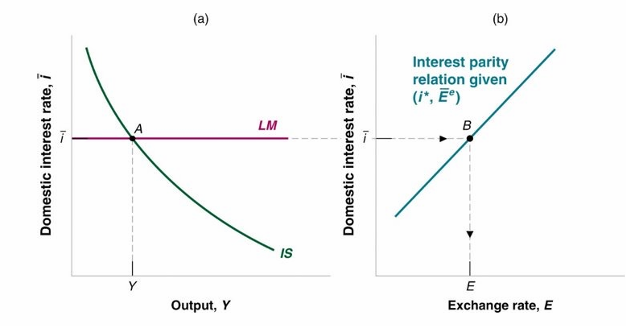
Effects of increases in domestic demand in closed and open economies
Now an effect on the trade balance in open economy
Effect of government spending on output is smaller than it would be in a closed economy. Meaning the multiplier is smaller in the open economy
Why is there low macro-coordination amongst G7 countries
Some countries may be required to do more than others
Countries have strong incentive to promise to coordinate and then not deliver on that promise
Fiscal Multiplier in an open economy for home country
Formula shows us how much output changes for every unit of increase in government spending
m = marginal propensity to import - how much imports rise when income rises
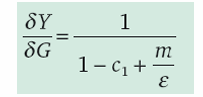
Fiscal Multiplier
Measure of how output changes to a change in fiscal policy.
Fiscal multiplier in an open economy for the foreign economy
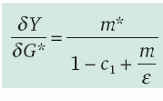
The Marshall-Lerner condition
Condition in which a real depreciation leads to an increase in net exports.
A depreciation leads to a shift in demand, both foreign and domestic, to domestic goods as they now appear cheaper.
Real exchange rate formula
Real exchange rate = Nominal exchange rate x Foreign price level/ Domestic price level
What two things must the government do if it wants to reduce the trade deficit without changing output
It must achieve a depreciation sufficient to eliminate the trade deficit at the initial level of output.
The government must reduce government spending
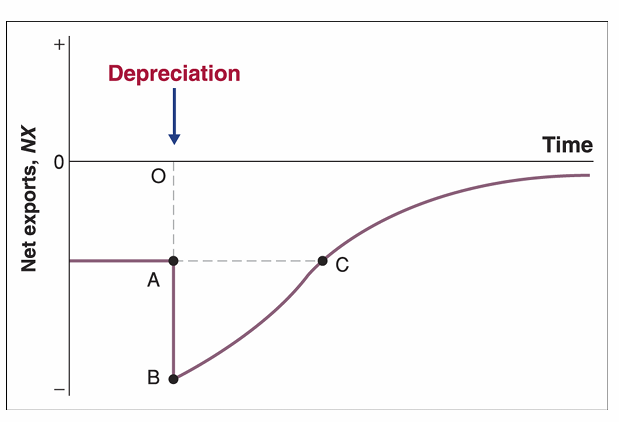
The J curve
A real depreciation leads initially to a deterioration of the trade balance because initially exporters and importers don’t respond immediately. This means that goods abroad appear more expensive and our domestic goods appear cheaper. But the quantity of each has not changed, meaning we are paying more for the same amount of imports and receiving less for the same amount of exports. Eventually, markets respond and the trade balance improves.
Investment (Saving) formula in a closed economy
I = S + (T-G)
S = private sector saving
(T-G) = government savings
Investment (Saving) formula in an open economy
CA = S + (T - G) - I
IS-LM UIP curve
Fixed exchange rate
(1+i) = (1+i*)
Under a fixed exchange rate and perfect capital, the domestic interest rate must be equal to the foreign interest rate.